A Proper Family Christmas

I’m going to be honest with you, today’s blog post is copied wholesale from an entry in December 2007. Back then I was sent a copy of A Proper Family Christmas by Jane Gordon-Cumming, and it was perfect Christmas reading. Dollops of Wodehouse and Just William, and even Jam and Jerusalem. I’ve just spotted that there’s even an audio book version available now. Anyway, I don’t often just repeat posts, but lots of people won’t have spotted the review two years ago, and Jane’s book is just so delightful that I want more of you to know about it. A bit late to order it for Christmas presents, perhaps, but might be good for the post-Christmas rush… Anyway – here goes:

I also have an AA Milne quotation for every occasion. Well, I can’t remember exactly how this goes, but something along the lines of: “Every critic instantly assumes that, should a writer be able to make his audience laugh, he secretly wishes he were making them cry”. Milne didn’t always love his critics, but the point is that we shouldn’t underestimate the comic writer – I think it’s much more difficult to make readers laugh than it is to make them cry, and a comic novel done well is a wonderful thing.

Step forward Jane Gordon-Cumming, and A Proper Family Christmas. I was worried people didn’t write books like this any more. Don’t get me wrong, I love pensive, slightly depressing, high-literary fiction more than anyone – Virginia Woolf is one of my favourite authors, after all (though she is incredibly funny, I must add) – but where did novels go which gently laugh at human nature and the tangles they get themselves in? Thankfully Jane G-C has written one such novel, and I know you’ll love it.

William lives by himself in a rambling old house, such as are only found in fiction – well, I say alone, he actually lives with a rather wonderful cat called Scratch. You can’t go wrong with cats in fiction – they’re such amusing and characterful creatures. Anyway, William is an obstreperous old man, but one you can’t help loving. Despite his best efforts, every member of his family descend on his house for Christmas – his forthright siser Margery; widow Hilary and her attractive teenage son; neurotic Lesley and Stephen with their spoilt child Tobias and put-upon nanny Frances; scatty Julia and innuendo-flinging Tony with worldy-wise daughter Posy and flirty nanny Shelley; arty Leo who seems to be perpetually ignored by all; charmer and antiquities expert Oliver. Phew, think that’s everyone. What a cast! Despite a lot of characters and a lot of names, like one’s own family one never gets confused. They all have their place and, like them or loathe them, you can’t help being quietly fond of each and every one.

This novel is definitely a character piece – throw together a lot of disparate and amusing people, and a few Wodehousian plots, and see what happens. And what happens is a witty and touching romp through the intricacies and politics of a family Christmas. If you don’t recognise it all, you’re lucky, but you’ll love it nonetheless. A perfect Christmas present for someone who loves something to read on Boxing Day, just so long as they can’t recognise themselves in its pages… and best not give it to anyone called William, Leo, Margery, Lesley, Stephen, Tony, Shelley, Tobias, Posy, Julia… at a pinch Frances, Oliver, Hilary and Daniel will take it as a compliment…

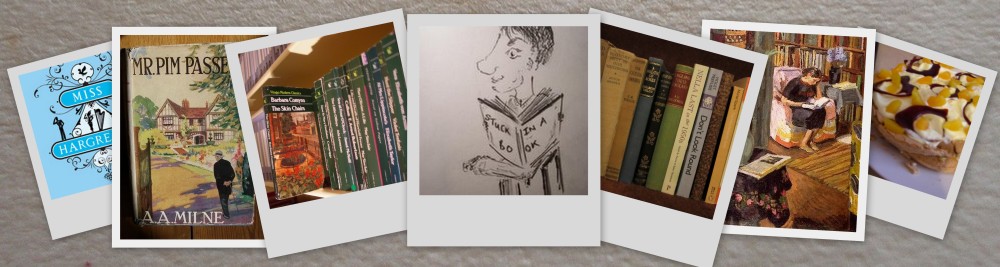
Stuck-in-a-Book Cartoon

Sometimes (and very little of late, for which I apologise) I put little sketches up on Stuck-in-a-Book – which are very much amateur, and just to make things a little different around here. I’m a little embarrassed that they will, from now on, appear on the same site as this fantastic caricature/cartoon by Sarah Bailey, a lovely lady local to us in Somerset (go and visit her website). Admittedly most of my blog readers don’t know what I look like, but the sketch does have a little photo of me in the bottom left corner, to give you a clue…

Quiz Answers


Well, you’ve done me proud, readers – especially on Round Two, I was mightily impressed. I shan’t single out anybody in particular because there are no prizes… but compare what you got to these answers, and give yourself a Christmassy pat on the back.

Round One: Book Covers
(quiz here)
1. To The Lighthouse – Virginia Woolf
2. Brave New World – Aldous Huxley
3. Fingersmith – Sarah Waters
4. Chocolat – Joanne Harris
5. Notes on a Scandal – Zoe Heller
6. Her Fearful Symmetry – Audrey Niffenegger
7. Spies – Michael Frayn
8. The Blind Assassin – Margaret Atwood
9. Memoirs of a Geisha – Arthur Golden
10. Midnight’s Children – Salman Rushdie
11. Filth – Irvine Welsh
12. The Prime of Miss Jean Brodie – Muriel Spark
13. A Clockwork Orange – Anthony Burgess
14. Enduring Love – Ian McEwan
15. Lady Chatterley’s Lover – D. H. Lawrence

Round Two (Characters’ Names)
(quiz here)
1. Oliver Mellors = Lady Chatterley’s Lover (DH Lawrence)
2. Quasimodo = The Hunchback of Notre Dame (Victor Hugo)
3. Bilbo Baggins = The Hobbit (JRR Tolkein)
4. Clare Abshire = The Time Traveller’s Wife (Audrey Niffenegger)
5. Rachel Ashley = My Cousin Rachel (Daphne du Maurier)
6. Sir Robert Chiltern = An Ideal Husband (Oscar Wilde)
7. Michael Henchard = The Mayor of Casterbridge (Thomas Hardy)
8. Anne Catherick = The Woman in White (Wilkie Collins)
9. Liesel Meminger = The Book Thief (Markus Zusak)
10. Cedric Errol = Little Lord Fauntleroy (Frances Hodgson Burnett)

Round Three: Views and Reviews
(quiz here)
1. AS Byatt
2. The Old Curiosity Shop – Charles Dickens
3. Ulysses – James Joyce
4. Martine McCutcheon
5. Dan Brown
6. Saturday – Ian McEwan
7. Jane Austen
8. John Keats
9. Enid Blyton
10. Jordan/Katie Price

Quiz: Round Three

Right, final round from me, hope you’ve been enjoying it so far.

Views and Reviews

2) Which book was Oscar Wilde talking about when he said: “One must have a heart of stone to read the death of little Nell without laughing.”

3) Which significant, and very long, 1922 novel did Virginia Woolf dismiss as the work of a “queasy undergraduate scratching his pimples.”

4) Which ex-soap actress published her debut novel The Mistress this year, described in The Guardian as ‘arguably one of the most baffling publishing decisions since Headline paid more than minus 37p for Ashley Cole’s emetic memoir My Defence’?

5) Which American author’s writing, from his novel’s first word ‘Renowned’ onwards, did linguist Geoffrey Pullum describe as “not just bad; it is staggeringly, clumsily, thoughtlessly, almost ingeniously bad”?

6) What is the title of the novel, all of which takes place on February 15th 2003, which John Banville described as “a dismayingly bad book. The numerous set pieces are hinged together with the subtlety of a child’s Erector Set.”

7) Who was Mark Twain talking about when he said that, every time he read her most famous book, ‘I want to dig her up and beat her over the skull with her own shin-bone’?

8) Which poet’s Endymion was dismissed by a contemporary reviewer as “imperturbable drivelling idiocy”?

9) It was recently revealed that the BBC had a ban on dramatising a certain children’s author’s books, from the 1930s to the 1950s, describing the author as a ‘tenacious second-rater’ who wrote ‘stilted and longwinded’ books. Who is the author in question?

10) Which celebrity ‘novelist,’ whose 2007 book outside the Booker shortlist, did Lynda La Plante call ‘a terrible thing for young girls who just want pink welly boots.’


Bloomsbury wins!

We interrupt normal broadcasting (there is a second round of the quiz to have a go at) to say… there’s a Bloomsbury Group competition! If you’re in a book club or reading group, or however you want to term it, you have a chance to win eight copies of one of Bloomsbury’s titles (go for Miss Hargreaves, go on) as well as limited edition greetings cards and bookmarks. For all info, click here. The competition isn’t open for long – I think it closes tomorrow – so hurry, hurry, hurry!

Quiz: Round Two

Though I’m writing all these posts on Tuesday afternoon, I’m going to assume that you all did really well on the picture round yesterday – so give yourselves a hearty pat on the back.

Tonight is a round which is harder to describe, but much easier for me to copy and paste into blogger. These are all characters who are better known by the titles of the books in which they appear. I think I’d better give an example – if the character were ‘Mary Boleyn’ then the answer would be ‘The Other Boleyn Girl’. Here goes… (same idea as yesterday – have a go in the comments, but make sure you don’t read the comments first if you want to have a go!) (Oh, and Thomas family – don’t cheat!)

1.) Oliver Mellors
2.) Quasimodo
3.) Bilbo Baggins
4.) Clare Abshire
5.) Rachel Ashley
6.) Sir Robert Chiltern
7.) Michael Henchard
8.) Anne Catherick
9.) Liesel Meminger
10.) Cedric Errol

Quiz: Round One

By the time you read this, my Book Group Quiz will have finished. Inspired by Gaskella’s literary quiz in Abingdon, we decided to make our own – five of us have contributed rounds, with me doing three of them. Over the next few days I’ll pop up my questions for your delectation. Do have a go in the comments, but make sure you don’t read the answers if you want to have a go yourself!

First off, the picture round. These all fit nicely onto an A4 sheet, but I don’t know how to transfer that to my blog – so I’ve had to put them all up individually. They are all sections from book covers – I’m only looking for the title of the book, but feel free to throw in the author too, if you’re up for a challenge.

1.
2.
3.

4.
5.
6. 7.

8.

9.

10.

11.

12.

13.

14.

15.

Thank you Miranda!

No, not Miranda the adorably daft BBC sitcom which has just come to an end, but Miranda from Skirmish of Wit – for it is she who drew my name from Stacy’s (aka Book Psmith) Persephone Secret Santa. December 15th is the day of the Big Reveal, I believe, and by the time anyone reads this it’ll be December 15th in England at least. It must be already the 15th in about half the world (though don’t ask me which half, because I can never remember which side the sun rises and which it sets… I remember this ruining a poem I wrote when I was about ten.) Talking about poems, to bulk out this post out, I’ve included the poem I contributed to the Thomas Family Newsletter. Yes, I’m afraid we’re one of those families which send out Newsletters… I can never think of anything to write (although last year I’d just passed my driving test, so I think it was all about that) so this year I went for style rather than substance.

Back to Persephone – Stacy asked us to send a list of the Persephone Books we already have, but I thought it would be quicker to send a list of the four or five novels which I’m lacking (except now the new books have come out, I need all those too – especially keen to get hold of To Bed With Grand Music by Marghanita Laski because the title is so good). Miranda chose to send *drum roll* House-Bound by Winifred Peck, which looks wonderful, so thank you Miranda!

Not only that, oh no, she also sent a rather lovely desk calendar featuring woodcuts by Gwen Raverat – isn’t that nice? Sorry the photo’s a bit blurry.

I’m looking forward to seeing which other Persephone Books cropped up around the blogosphere… And, to leave you, here’s that poem – with apologies to AA Milne’s ‘Disobedience’ (in case you don’t know it, it’s here)

Simon Simon
David David
Thomas (to be brief, me)
Took great
Trouble at learning
Though he was twenty three.
Simon David said to his Parents
“Parents,” he said, said he.
“I mustn’t go down
Til I’ve got the best gown.
I’ll stay on for the PhD.”

Simon David
Thomas’s Parents
Wore a distinctive frown.
Simon David
Thomas’s Parents
Thought he was playing the clown.
Simon David
Thomas’s Parents
Said to their son, said they:
“If you must hang round
In that Oxford town,
Just don’t expect us to pay.”

Magdalen College
Put up a notice:
“POOR or ORPHANED or SHUNNED?
Step in, penniless students,
Apply for our hardship fund.”
Simon David,
Wondering vaguely
If the offer is all it appears,
Applied and agreed
And found out that he’d
Signed up for three more years!

Simon Simon
David David
Thomas (the name is mine)
Has done
A few other things
In the year 2009.
Simon David says to his readers,
“Readers,” he says, says he:
“I’d tell you it all,
From the big to the small,
But – this is the final line.”

Try Anything Twice

[N.B. this post migrated from my old site and, like all of them, it messed up the quotations a bit – this one has turned into one huge paragraph and I no longer know where the gaps should be!]

Good things come to those who wait, we are told, and that’s generally how I treat books which come to my shelves. A few leap immediately to hand, read within minutes of arriving, but most are left – like fine wines – to mature. And so it is that Try Anything Twice by Jan Struther, which arrived in October 2007 from lovely Ruth (aka Crafty Person), has finally been read. And it’s like a hot cup of tea on a wintery afternoon.

Jan Struther is best known for Mrs. Miniver – which I wrote a bit about back here – the voice of quintessential middle-class Englishness leading up to World War Two. Though she altered dramatically for the film, there was still that kernel of being England’s everywoman (within the remit of those with servants and children at boarding school and jolly outings.) Though Try Anything Twice doesn’t feature Mrs. M, the voice is instantly recognisable. Published in 1938, the volume collects articles and essays that Jan Struther wrote for Spectator, New Statesman, Punch, and other journals. They’re all from that middle-class world, but what an observant world it can be – whether noting the vagaries of updating an address book (‘Zazoulian, the little Armenian painter. His pictures are not very good, nor his conversation amusing, and it is eighteen months since you saw him: but a “Z” is a “Z”‘) or going to a Registry Office to find a nanny (one who is neither a dragon nor a duchess) or the poetic potential of a builder’s plans.

As always with short stories or essays or poems – anything where there is no uniform whole – it is near impossible to write a convincing review of Try Anything Twice, especially since I read it over the course of some weeks. Verity’s review is worth seeing, by the way, but for now I think the best way to talk about the book is to give you a sample. It’s not necessarily the best in the book, but it’s fairly representative of the style of Try Anything Twice. All of the book is actually available online, but of course (!) it’s better to get hold of the book itself. If you like the following, as they say, you’ll like the book. Ladies and Gentlemen; ‘With Love From Aunt Hildegarde’

THERE are three ways of choosing presents for other people. The first is to choose something you think they would like; the second, something you would like yourself; the third, something you think they ought to have. Of these methods the first is the wisest but the least common; the second is less wise but more usually followed; while the third is wholly unforgivable and accounts for much of the post-Christmas bitterness from which we are apt to suffer. My great-aunt Hildegarde is an almost fanatical devotee of the third method. Many people would call her an ideal aunt; that is to say, she gives us presents not only at Christmas but for each of our birthdays and often in between times as well. But her gifts have, so to speak, a sting in the tail; they represent her unspoken criticisms on our habits, customs and whole mode of living. Whenever we see her firm capable handwriting on a parcel, or a box arrives from a shop with one of her cards enclosed, we pause before unpacking it any further, sit back on our haunches and wonder what we’ve done wrong now. “I know,” says T. “Last time she dined here the spout of the coffee-pot was chipped and it dribbled all down her frock.” “No,” I reply, “I know what it is. The menu-card was propped up against the candlestick, and she said how awkward it was the way it kept slipping down.” And when we open it, sure enough, if it isn’t a new china coffee-pot it is a pair of menu-holders–contrivances which we particularly dislike, even when they are not made from tooled gun-metal in the form of two hedge-sparrows rampant, regardant and proper. Once she came to tea with me on a pouring wet day and found nowhere to park her umbrella. The next day a large tubular object arrived. It had vaguely military associations, but it had been so converted and distorted that it was difficult to tell whether it had originally been a large German shell or part of a small field-gun used in the Russo-Japanese War. A third possibility is that it was once a moth-proof travelling container for a Balkan field-marshal’s top-boots. At any rate, it takes up a great deal of room in the hall. And another time, I remember, she wanted to write a note at my desk and was scandalised because there was no proper pen and ink–although, as I explained, I had three fountain-pens, any of which I was willing to lend her. Four days elapsed and I began to breathe more freely. But on the fifth there came a small square parcel containing a silver-mounted ink-pot with my initials irrevocably engraved upon it (which accounted, no doubt, for the delay). Like the umbrella stand, it was a convert; but in this case there was no difficulty in guessing its original function. To make matters quite clear, Aunt Hildegarde had attached a note saying: “I feel sure you will like to have this little memento of poor dear Blackie, on whose back you took your first ride. This is the very hoof which she used to lift so prettily to shake hands. May it bring you lots of inspiration for your little poems!!” I groaned, filled it with fountain-pen ink and set it fair and square in the middle of my writing-table, where it remains to this day, a constant reminder of the agonies and humiliations of childhood; for it was the self-same hoof with which Blackie once stood for a full five minutes on my toe, I having neither the strength nor the courage to remove her. I do not wish to look a gift-hoof in the mouth or to seem in any way ungrateful, but the thing is getting on our nerves. Not only are we developing an inferiority complex about our own home but we are becoming self-conscious about entertaining Aunt Hildegarde. We dare not give her grapes, lest she should think that we are hinting at grape-scissors; nor lobster, for fear of invoking a set of silver-plated picks. But however careful we are we cannot think of everything. We did not, for instance, foresee that she would give us an electric clock for Christmas. It is true that when she came to stay with us a month ago our drawing-room clock was not behaving quite as a good clock should. One day it was a few minutes slow and she missed the weather forecast on the wireless. And another day it ran down altogether and made her late for church. “Your Uncle Julian,” she said gently, “used to wind all the clocks in the house every Sunday morning.” But this mild fragment of reminiscence did not at all prepare us, though perhaps it should have, for the grey maple rhomboid which now adorns our mantelpiece. At least, it looks like maple, but it is actually (so the accompanying leaflet informs us) made of steel, which can neither shrink nor warp, neither rust nor tarnish. It runs off the electric mains; it needs no winding; it is guaranteed to keep absolutely perfect time; and ever since it came into the house we have felt acutely ill at ease. Our old happy-go-lucky days are over. No more can we think comfortingly as we start out rather late for a dinner-party: “Oh, well, perhaps our clock is fast,” nor, when we arrive there to find hostess champing and fellow-guests ravenous, can we murmur, “We are dreadfully sorry, but our clock was slow,” for our friends have already got to know about our new, our abominable possession. Gone too are sundry minor pleasures, such as listening for the radio Time Signal and leaping up to make a half-minute adjustment; and, better still, squandering pennies in a lordly way by dialling T.I.M. And gone–worst of all–is the small friendly sound which used to accompany our thoughts, the balanced alternation of tick and tock, like the footsteps of a little dog walking very quickly beside you on the pavement. Time now proceeds for us in a series of hard metallic clicks, one every minute, each identical with the last: it is a large, slow, hopping bird of prey which follows relentlessly behind us. For fifty-nine seconds it stands still; we escape it; we are immortal; and then with a sudden deft leap it catches us up again. Better never to escape; better to have our little trotting dog. But there is nothing to be done about it. If we did not use the clock, or if we banished it to the dining-room, Aunt Hildegarde would not only think us both mad and decadent–for what sane responsible citizen would not jump at the opportunity of being always certain of the time?–but she would also be terribly hurt. It was touching to see her when she came to tea yesterday, gazing up with reverent eyes at the angular, impersonal, implacable monster on the mantelpiece. “Your Uncle Julian,” she said, “would have found it such a boon.” The vulture took another hop forward.

Festive Reading

I’ve spotted a few different bloggers, and people in my reading groups, talking about the books they intend to read over Christmas – and quite often they’re picking specifically seasonal titles. My friend Lyn reads A Christmas Carol every year, for example, and Claire at Paperback Reader has just put up some she intends to read (including Barbara Comyns’ A Touch of Mistletoe, which may not have a very Christmassy theme, but certainly has a Christmassy title.) I’m feeling a little odd-one-out, now, since I never do seasonal reading. I read Tove Jansson’s The Winter Book on a beach in summer (though admittedly it was windy and perishingly cold); I’m just as likely to read something set in sunny Spain by a fireside in December as I am in June. And I do feel I’m missing out, a bit… but somehow I don’t plan my reading that well.

The one exception which springs to mind is Jostein Gaarder’s The Christmas Mystery, a lovely book which has a chapter for each day of Advent – I read it in that style a few years ago.

How about you? Do you just read what comes your way, or do you plan books for seasons? Is it every season, or is Christmas special? The books I’ve set aside to read over the festive weeks (aside from ones for my research) are The Bell by Iris Murdoch, In the Springtime of the Year by Susan Hill (completely unseasonal, you see), Pastors and Masters by Ivy Compton-Burnett, and The Unspoken Truth by Angelica Garnett. Whether I’ll actually get around to reading any of them is another question – others might force their way in, I like to keep my reading spontaneous when I can, since so much (for research and book groups) can’t be.

I’d be interested to hear from you – especially if you have an unusual choice for this time of year…