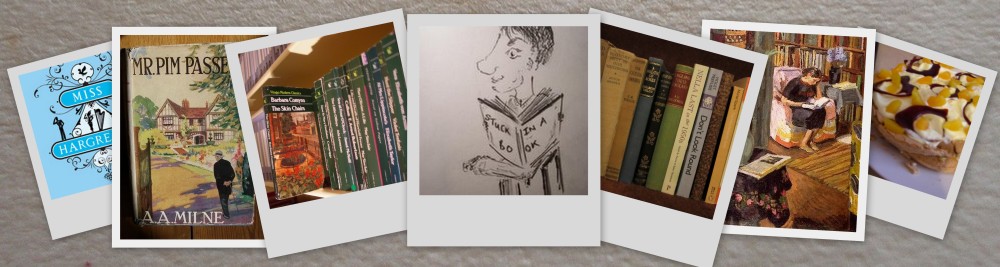

I wanted to add a second novel to my #SpinsterSeptember contribution, so went through my shelf of ‘would these make good British Library Women Writers suggestions?’, flicking through them until I saw any indication that they featured spinsters. Since most of the shelf are hardbacks without dustjackets by little-known authors, with minimal info about the titles online, it was mostly a case of keeping an eye out for ‘Miss’.
Well, Hush, Gabriel! (1940) by Veronica Parker Johns is narrated by a self-described ‘respectable spinster’, aged 52, and I was drawn in immediately by the opening paragraph:
I may as well state at the beginning that I am used to being surprised by Clotilda. I was surprised when she was born; somewhat more so than my mother, who had kept the secret from me until the last possible instant. I first became aware of it when Mother, coyly but with determination, refused to come to my graduation exercises at college. When, a few months later, I ceased to be an only child, I found Clotilda surprisingly beautiful, and so she remained, gracefully avoiding the awkward age as I trudged into my late thirties. I was amazed when she married Malcolm Allen, confounded when she moved with him to a quiet, unassuming Virgin Island. Therefore, I scarcely turned a hair when one of her house guests was found, surprisingly to everyone else, murdered.
This is how I learned that I was reading a murder mystery! Agatha (the spinster in question) is visiting her sister ahead of Clotilda’s impending baby. There are a handful of other guests, assembled in a clear ‘one of these is going to be a murderer’ sort of way, with little other reason for them all to come together. It took me a while to disentangle them, as they tend to dart onto the scene and disappear – we have Dolly Woods, a silly, brash woman whom Agatha meets on the journey there, and her older, wealthy husband. There’s likeable Mary and her flirtation with Carl; there’s Clotilda and her fairly absent husband; there’s a local judge, whom Agatha grows swiftly fond of. And there is Agatha’s dog Nell, who has somehow made the journey.
I really enjoyed Parker Johns’ writing from the off. She gives Agatha an ironic turn of phrase and tone of voice that I definitely appreciated – I loved the deft way this paragraph finishes:
I liked Carl, too. He was the only one of the guests I had known before, if you except my shipboard abhorrence of Dolly Woods. He had introduced Clotilda to Malcolm, but I had forgiven him for it long since. Numerous theatre invitations during my winters in town had down down my resistance. When a boy of thirty pays that much attention to a woman scenting fifty, she’s just bound to weaken. Eventually I invited him up to my place in Connecticut for summer weekends, and he not only came but seemed to enjoy himself. It was he who had thrust Nell, my cocker spaniel, upon me, and he had been a loving godfather to her. I was grateful to him for always remembering her birthday and forgetting mine.
The aforementioned murder happens pretty quickly – a doctor is found, shot through the head. The mystery part seems to be pretty short-lived: Clotilda instantly confesses to the murder. This is curiously disregarded by everyone, with the feeling that pregnant women will confess to murder at the drop of the hat because of hormones, or something. But the plot thickens when Agatha establishes that the doctor didn’t die by shooting – he was shot after he was dead.
To be honest, the novel’s very promising opening isn’t lived up to. Parker Johns seems to have put all her stylistic effort into the first chapter or so, and the prose becomes much more plebian as we go on. Agatha remains an interesting character, but without the captivating charm that initially thrusts her on the scene. And, yes, it is novel (especially for 1940) for a 50-something spinster to be given a romantic storyline, and it is satisfying that her romance is also intellectual, rather than abandoning her wisdom on the opportunity for a man. But it doesn’t really make up for the novel’s less able elements.
The main one is structure – it sort of meanders on, but further deaths and crises but it’s hard to be very invested. Alongside that is a lot of padding from characters who seem rather one-note, except for Dolly Woods who makes an extremely unlikely transformation into a very likeable character. The title doesn’t seem to make any sense. We learn that Clotilda says “Hush, Gabriel” at the scene of the murder, and Agatha knows she always said it growing up, but since we already knew from the first chapter that Clotilda was at the scene of the murder, it doesn’t add much.
And then there’s the racism… that’s the key reason that I won’t be rereading (or keeping) this novel. I suppose a 1940 novel set in the Virgin Islands is unlikely to be culturally sensitive, and I wasn’t surprised by the slightly-off depiction of the Black inhabitants – though, on the other hand, pleasantly surprised by one of the characters being a Black doctor, well-respected in his profession. The n-word is used a couple of times, but by a character we are clearly meant to consider awful. BUT – I won’t explain exactly how, in case you ever read this – the solution to the mystery partly involves some horrendous racism. Sigh.
So, I think there is a kernel of something wonderful for Spinster September here – if Agatha had lived up to her initial introduction, she would have been a total delight. And if Veronica Parker Johns has written any novel more consistently and coherently, then I’d be interested to read it – at its best, her writing is wonderful. But, overall, this one ended up being a disappointment.


 I was VERY excited when I saw that the Furrowed Middlebrow series from Dean Street Press will be reprinting many Margery Sharp and Stella Gibbons titles in January. Do I have many books by both these authors still unread? Yes, of course. But it’s still great to be able to get easily available copies of books that have eluded many fans for years – most notably Rhododendron Pie by Sharp, something of a golden fleece for book bloggers.