Barmy in Wonderland by P.G. Wodehouse – #1952Club

It is a truth universally acknowledged that every club year will have appearances by Georges Simenon and Georgette Heyer – but there’s another prolific mid-century writer who usually turns up too. While P.G. Wodehouse didn’t write a novel every year, he did for 1952 – and I picked up Barmy in Wonderland back in 2018 in Hay-on-Wye.

Barmy – real name Cyril Fotheringay-Phipps – is exactly the sort of person you’d expect from (a) that name and (b) his featuring in a Wodehouse novel. He’s a member of the Drones Club and a very posh, very inept, very well-meaning gentleman. Despite his poshness, he is not wealthy – heaven knows how he’s paying for the Drones Club – and is in the unusual position for a Wodehouse hero of having a pretty lowly job. He works as a desk clerk for J.G. Anderson, the owner of a couple of hotels in America, who loathes him.

I can do no better, to introduce you to the characters, than to share from the Wikipedia summary: “He [Anderson] is angered after a hotel guest, the famous but obnoxious actor Mervyn Potter, and Anderson’s desk clerk, amiable and impressionable Cyril ‘Barmy’ Fotheringay-Phipps, wake him at 3 a.m. to give him a frog.”

Mervyn Potter is a matinee idol type, and also a near-constant drunk. It allows Wodehouse to write this sort of wonderfully Wodehousian understatement:

A female Mervyn Potter fan, seeing her idol face to face like this, would probably have blown bubbles at the mouth and collapsed in a swoon. At the least, she would have gazed at him with ecstasy. From Mr. Anderson’s gaze ecstasy was conspicuously absent.

Barmy has recently come into some money from an inheritance, and Anderson has hopes that he will buy one of the hotels – but it isn’t enough money for that. Instead, he is persuaded to invest as a producer in the new play that Potter is starring in. He is unsure until he realises that the production’s secretary is Dinty Moore – a woman whom (bear with me) he fell in love with after setting her hat on fire. As he says later…

“I fell in love with you at first sight, don’t you know, and all that sort of rot, but I had rather intended to hush it up till a more suitable moment.”

Any fan of Wodehouse will know what Dinty is like: she’s one of his capable, funny, unsentimental-until-she’s-won-over types. ‘Capable’ is perhaps top of the list, and she has to be, with Barmy’s lovable uselessness.

I found all the stuff with Anderson and a complex attempt for Potter to woo someone with Barmy’s help – during which Barmy unwillingly scales a tree – fun enough but didn’t really lead anywhere. Barmy in Wonderland really picks up when it becomes about the play. It’s obvious to the reader that Sacrifice is a dud, and Wodehouse has fun mocking the American world of theatrical productions, not least the fact that nobody remembers or cares about the name of the author. I only learned from the Wikipedia page just now that Barmy in Wonderland is adapted from a play – The Butter and Egg Man by George S. Kaufman – which seems to have largely focused on this stage of the plot. The characters’ names are different and, of course, the title is, so it seems to have been a slightly coy adaptation.

This part of the novel is a lot of fun, much pacier than the earlier section, and particularly enjoyable when the first night of the play is a disaster. In the aftermath, with people trying to solve the problems, I particularly loved a character called Fanny – famed for her juggling act, though in this case hanging around as the wife of a producer – who ridicules them all and throws in useless suggestions to amuse herself. Here, for instance, one of the actresses is trying to make her character more likeable:

“No sympathy. That’s the answer. Something ought to be put in to show that I’m really all right at heart and not just a frivolous Society butterfly.”

“How about giving out pamphlets?” said Fanny.

Towards the end of the book, it really picks up and works very well. But overall, I think this is mid-level Wodehouse. At his best, his way with words is wonderful, and the examples I’ve quoted so far definitely amused me. But there was a far higher quota than usual of lines that didn’t quite land, or felt a little underworked. For example:

If the Lithuanian chambermaid who at half-past nine that night came to turn Barmy’s bed down had been at all psychic — which, of course, very few Lithuanian chambermaids are — she would have sensed, as she went about her work, a strange, almost eerie atmosphere in Room 726, as of a room in a haunted house that is waiting for its spectre to clock in and start haunting.

It doesn’t quite land, in my opinion. I particularly thought of that ‘of course’ in the section in dashes. Wouldn’t it have been better as ‘distressingly’ or ‘regrettably’ or something along those lines? Perhaps it’s unfair to pick a section at random and do close reading on it, and humour is naturally subjective, but there felt like lots of slightly wasted opportunities to me – like Wodehouse was getting it out in a rush.

Look, it’s a P.G. Wodehouse novel, so of course it was a fun time. I have a weakness for novels about the theatre, so I loved that. It’s just that, at his peak, Wodehouse has a genius for combining plot, character, and his own brand of witty exaggeration and understatement. There’s enough of that in Barmy in Wonderland to make it a good time – but I don’t think it’s the best place to start with him.

The Equations of Love by Ethel Wilson – #1952Club

I bought The Equations of Love by Ethel Wilson in Canada back in 2017, based on her being a Persephone author. Since then, I’ve read another couple of novels by her – but I think this overlooked gem might be her masterpiece. Or perhaps I was just in exactly the right mood to read the sort of brilliance that Wilson is? Either way, it’s my new favourite by her. (NB: when I call it ‘overlooked’, that is true in the UK – for all I know, every Canadian schoolboy and schoolgirl is reading The Equations of Love.)

The Equations of Love is actually two novellas which, as far as I can tell, have no point of connection: Tuesday and Wednesday and Lilly’s Story. They don’t seem to have appeared separately, but rather have always been together under this title. I thought they were both excellent but preferred the first, shorter, of the two – let’s all concentrate on that one.

The novella is about Mortimer and Myrtle Johnson, living in a small, shabby apartment in Vancouver. Mort makes a fragile living at whatever handyman work he can get – though he quickly considers himself too good to be looked down on, and either quits or is fired within a few days or even hours. Myrtle is a cleaner and she holds the power in the marriage – she holds, indeed, the power in almost any relationship with any other human. Wilson lovingly describe her tyranny:

When she slowly raises her heavy eyelids as she soon will, but not until she feels inclined to, you will see their power. Myrtle’s eyelids, and her small amused smile, which is not a turning-up but a turning-down of her lips, induce a sudden loss of self-confidence in the individual towards whom the look or non-look, the smile or non-smile, is directed. She can make you, or Mort, feel insecure and negligible, just by the extra quarter-inch of her dropped eyelids and by that amused small turned-down smile. It is not fair. If you should in your beauty, your new hat, and your recent tennis championship appear before Myrtle, she can by her special look and without saying a word, intimate to you and your friends that, for some reason obscure to them and to you but well known to her and to the rest of the world, that she thinks very poorly of you.

Tuesday and Wednesday is only 129 pages long in my edition, but there are worlds of richness in it. You might expect so short a novella to keep to the canvas of this marriage and this apartment (and – hurrah – the feisty cat, who fools them she is a tomcat). But Wilson widens the scope. Mort goes to work as a gardener, and we see the power jostles with his distracted, kind, unsure employer – with enough feminity to raise Mort’s oafness flirtation, and enough money to make him feel angrily inferior. There is a memorable scene where Mort meets an old friend who takes him to visit his workplace, which is an undertakers. We follow Myrtle to her work, where there is no power imbalance because Myrtle holds all the cards. Other friends and relatives appear – we even see the world from an anxious niece of the couple, who feels she must visit the only people she knows in Vancouver, but desperately doesn’t want to be there.

In each scene, what makes Tuesday and Wednesday so good is Wilson’s control of tone. She is so insightful in the way people behave, particularly around the numerous power dynamics that are constantly in play. She’s brilliant at what people no longer notice because it is part of the furniture of their life – from an unclean home to an unhappy marriage. And she balances all of this with a witty, ironic tone that she judges perfectly. We remain invested in the characters’ lives, but always aware that they are being observed. The detachment means we don’t get too overwhelmed by pathos – these are people under a microscope, intensely real but not necessarily to be loved.

I suppose the only way for you to discover how brilliant Tuesday and Wednesday is would be to read it – but I’ll finish this section with a quote about the cat, because I can’t resist anybody who writes well about cats:

The kitten, who was not a tom, felt her way about in the dark which was, to her, transparent, and learned the room. Feral, wise, with her inscrutable little hunter’s nose and whiskers she felt and explored and recorded each chair leg, each table leg, each corner. She prowled and prowled on silent paws, and sometimes she stopped to wash. When she was satisfied, she accepted and adopted the room. Then she slept fitfully. She slept anywhere, lightly yet deeply, waking and moving often. Chiefly she slept on Mort and Myrtle who lay deep in sleep, warm and approved by her. But sometimes she awoke, remembering something pleasant. Then she jumped lightly down and ran to her box. She scrambled up the side of her box and sat down, quivering, still, looking into the transparent dark with bliss.

The second of the novellas is Lilly’s Story, and yet it starts with a pair of sisters – ‘old Mrs Hastings who was a widow, a saint and a mystic’ and ‘her younger, elderly sister Miss Edgeworth’ – who live together with sundry other relatives. We learn a lot about the Chinese cook, Yow, which regrettably includes some attempts to transcribe his accent – even down to ‘oily [early]’. If you need to include square brackets in your dialogue to make clear what you’re writing, maybe don’t bother.

It all feels like we’re setting up a family dynamic with these sisters, hangers-on, and the rather unlikeable Yow – focused around a bicycle which Miss Edgeworth whimsically owns without riding, to be seen walking it around, and which Yow less whimsically borrows. But it turns out this is all a detailed prelude to kicking off Lilly’s story – as perhaps we might have guessed from the title.

Lilly had a sort of flirtation with Yow, more on his side than hers, and lives in a world filled with potential dangers. She is haunted by the possibility of the police – who once came to her home, when she was 11 years old, and have remained a threat in her mind ever since. Years later, and as the timeline of the novella truly begins, it’s partly this fear that sends her out into the world alone, to earn her living.

The rest of the novella follows her employment in various places, marked more by kindness than you might expect, and the raising of a daughter, Eleanor, for whom she fantasises a legitimate background – styling herself as a widow. The mother/daughter relationship continues for many years in the short novella, though with Eleanor herself less vivid – seen really in relations to Lilly. Except when she is very young, and more present on the page, where she seemed more individual:

By the time Eleanor was six years old she had three gods and her mother. Her mother was not a god, she simply an extension of herself. She had a slave, and she had a companion who refused to be owned and could not be coerced – the cat. Eleanor’s gods were Major and Mrs Butler and Leo, the big dog. As Leo sat upon his haunched looking majestically around him, Eleanor, standing, could look into his face, caressing his ears. Her slace was a nondescript faithful little black and tan dog who could be dressed in doll’s capes and hats, and would sit, miserably, in the doll’s pram that Mrs Butler had given to Eleanor.

Wilson has the same tone as before, and I also really liked and admired Lilly’s Story, but I think there’s a reason I preferred Tuesday and Wednesday. In Lilly’s Story, there are many characters but Lilly is undoubtedly the central point. And I found that Wilson’s detached, observational style worked better for a couple and their world than it did for an individual and her world. When a writer puts one person front and centre, maybe we need to be more deeply buried into their mind and heart. I knew a lot about Lilly by the end of the book, and I was fascinated by her, but I don’t think I ever really cared for her. Wilson’s characters, in The Equations of Love, are infinitely detailed, thoroughly real, and very memorable – but I think the style works best when we see them constantly in relation to each other, and not to be loved as individuals.

If I had only read Lilly’s Story, I’m sure I’d have raved about it – and it is excellent. But there was something so exceptionally well-realised in Tuesday and Wednesday that it had to suffer by comparison. As I said at the beginning, it may just be that I was in exactly the right reading mood for Wilson’s particular acuteness – but, to me, Tuesday and Wednesday is a miraculous little gem.

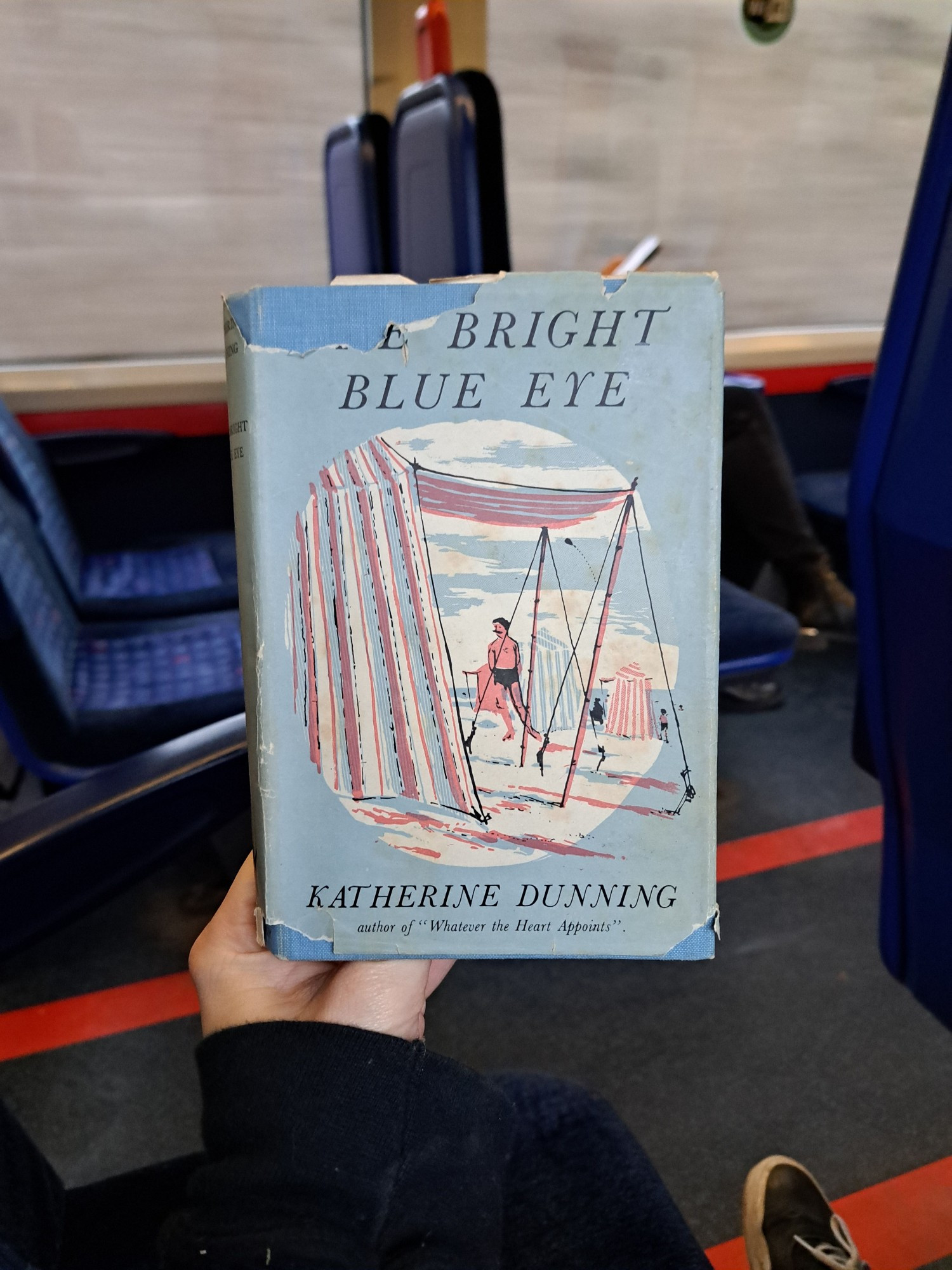
The Bright Blue Eye by Katherine Dunning – #1952Club

The Spring Begins by Katherine Dunning was my favourite read of last year, and has been reprinted in the British Library Women Writers series (hurrah!) so naturally that set me off to see what else Dunning had written. At the time, the only one I could find online was The Bright Blue Eye – though now Dunning’s great-niece has sent me her other three books, which is extraordinarily kind of her.

The Bright Blue Eye by Katherine Dunning

Dunning wrote a handful of books in the 1930s and then a couple in the 1950s – this is the last of her output, and very different in tone from The Spring Begins. Where that one is lyrical, with deep insight into people’s emotional cores and their hopes, The Bright Blue Eye is much lighter and much wittier. At the heart of it is an eccentric family – with the most ‘normal’ member being the narrator, Kate, about whom we learn relatively little. She is really a focal point for a bizarre group.

The most eccentric, and the most memorable, is Father – a wonderful creation, whose kind-heartedness is matched only by his thoughtless enthusiasm for inventing. Worried about getting everyone into the home? He makes collapsible three-tier bunk beds that can be wheeled around the house at will – though, sadly, are not collapsible enough to get through the door. His brother is innocently tending to the garden, and Father leaps at the opportunity to create an automated digger – which will clearly destroy everything in his wake. The ‘bright blue eye’ of the title is his eye, brightening at the idea of invention. His other passion is architecture, specifically cathedrals, and he delights in telling everyone the many flaws of the most celebrated cathedrals. Here he is, talking to his son Crispin’s fiancée:

Poor Beryl’s face looked tired, but she was still determined to see the best side of us. We must be nice, we really must be nice people, since we were Crispin’s family. Let her hold fast to that thought. She forced a look of animation back into her eyes, and waited for Father’s next words. Up till now she had not realised that this country, and certainly not Europe, boasted so many cathedrals, and all of them wrong. If she had thought of our national monuments and buildings at all, she had thought of them with respect and pride. But not any longer! Those happy inconsequent days were gone for ever. She knew better now, but acquiring this knowledge had been tiring, a top-heavy culmination to a difficult day.

I found Mother a less dominant character, despite the blurb on my edition claiming ‘it is their mother, whose beauty and calm ride tranquilly over tempers and discomforts, who is the centre of the picture’. It would certainly be a more chaotic dynamic without her, though I’m not sure how effective she is – particularly when she is a little blind to the foibles of her younger children.

There’s the youngest – bold, confident Hugh, who speaks in a seemingly affected childish patois, all missing verbs and articles. But he is overshadowed by Miranda. She seems, frankly, like a sociopath. Brilliantly clever, she wins all manner of prizes at school – but is the terror of teachers and classmates alike. She takes great pleasure in exaggerated prophecies of doom. For instance, when someone bangs their head, she declares “Skull broke, I think. Terrible hard bang. House still trembling.” Though a terrifying character in the abstract, she is not terrifying here. It is her own brand of precocious non-conformity, and nobody takes her particularly seriously.

There are a bunch of other characters I’ve not talked about, from angelic Fenella to longsuffering Cousin Clare, and each gets their moment in the sun in the novel. If I had to compare to another writer, The Bright Blue Eye reminded me most of Betty Macdonald. It is less hyperbolic, but still a witty eye cast at a bizarre family, loving in their own way. It is also similarly episodic. While things do progress, there isn’t really a through-line to the plot, and I did find that the novel didn’t have much forward momentum. I think one of the hardest things to identify is why a book does or doesn’t have this momentum. The Spring Begins did; The Bright Blue Eye didn’t – and yet neither have a stereotypically ‘plotty’ plot.

The Spring Begins is definitely the better book, but I still enjoyed The Bright Blue Eye whenever I picked up. The writing is so enjoyable, often so funny, and there are great set pieces – like a terrible shift in a cafe, or befriending lorry drivers when two lorries break down on their rickety driveway, or the chaos on a French beach that lends the novel its cover. Reading this novel has also got me curious about Dunning as an author: she clearly has a great deal of range, and I wonder what her ‘voice’ is like, distilled down. Luckily I now have her other books, so will be able to put together a picture!

Catherine Carter by Pamela Hansford Johnson #1952Club

One of the things I love about our clubs are when it leads me to read books that have languished on my shelves for years – and they end up exceeding my expectations. In some cases, by a long way. I’d be surprised if Catherine Carter doesn’t end up on my favourite reads for the year, and I’m grateful to the 1952 Club for getting it off my shelves. (You may have already heard Rachel and me talk about it on Tea or Books?)

I’m also indebted to Jane. Back in 2017, we participated in a Secret Santa at a group devoted to Virago Modern Classics on LibraryThing – and Jane sent me an incredible tower of books. Each of them had a postcard included about why she’d chosen them: ‘This one because I remembered that you liked theatrical settings, because I enjoyed it, and because I remembered that you read PHJ’s book about Ivy Compton-Burnett.’ (And it’s signed!)


View this post on Instagram


A post shared by Simon Thomas (@simondavidthomas)

Indeed, that’s one of a handful of books I’d previously read by Pamela Hansford Johnson. I enjoyed The Honours Board, I didn’t like An Error of Judgement and I didn’t remember a lot about The Unspeakable Skipton. Well, none of that prepared me for how wonderful Catherine Carter is – and how very different from her other novels.

The books I’ve read by her are always populated by interesting people, but they are treated with authorial detachment. She presents them, she unveils their weaknesses and (less often) their strengths, but she doesn’t seem to have much fondness for them. That’s fine; it’s a type of writing I often enjoy. But Catherine Carter is the opposite – it is suffused by the author’s affection for the main characters, even when they are being weak and flawed. In that way, it reminded me of Elizabeth Goudge. It’s by a long distance my favourite of hers so far.

Right, I haven’t told you anything about what Catherine Carter is about – though the cover might give you a clue. Hansford Johnson takes us to the world of 1880s theatre. Specifically the company presided over by Henry Peverel – an actor/manager (but not owner) who is loosely based on Sir Henry Irving in physical appearance and mannerisms, though not story. He is renowned and proud of it. He takes advice from few and has close friendships with even fewer – but he has an abiding love for the theatre, and respect for talent and good judgement, that means he is often unexpectedly amiable. There is nothing malicious about him, but he does consider himself a greater authority than anybody else on what makes a play or a part work. And he is right to think so.

‘In the middle of luncheon,’ goes the opening line, ‘Henry Peverel remembered that he had promised to hear Mostyn’s niece recite.’ And that’s where Catherine Carter comes in. Mostyn is one of Peverel’s almost-friends and a playwright who is respected for his verse plays – but not loved. Peverel doesn’t want to put on one of Mostyn’s plays because he knows it will be a financial disaster – and so, out of a sort of guilt, he hears Catherine Carter recite. She is young, agitated, jumpy. But Peverel sees talent there. He agrees to take her into the company – initially without any parts – but he will coach her once a week.

Catherine Carter is a long book – 467 pages in this edition, though I’ve seen it listed at 576 pages in another. And that means it has plenty of breathing space to take its time. The plot is the gradually evolving relationship between Catherine and Peverel, but Hansford Johnson isn’t rushing anything. We might guess from the outset that they will fall in love, but I was thankful it didn’t happen too suddenly. There is the age gap between them – about 18 years, I think – but it’s really the imbalance of power that would have made any sudden romance hard to stomach. Catherine is an ingenue, albeit one who quickly starts standing up for her own views, challenging those of others around her. Peverel has final say in which roles are given to whom, and even whether or not Catherine is part of the company. It is right that we spend the first hundred or so pages slowly introducing Catherine to this world.

And Hansford Johnson writes so well about the theatre. I don’t know how accurate it is about the specifics of 1880s theatre, but she is wonderful on the process more broadly – the ways in which people explore the psychology of a character, both understanding the motivations as written by the playwright, and finding their own unique interpretations of the role. Hansford Johnson references some (then) modern plays that I think might be made up, though also possible I just don’t know them – but her main focus is on Shakespeare. Along the way, in Catherine Carter, are enveloping explorations of Much Ado About Nothing, Romeo and Juliet, Othello, HamletAnthony and Cleopatra and more. The novel is soaked in a love and respect for theatrical acting, and an unspoken defence of its vitality. How many modern novels would allow an author the time to luxuriate in these discussions? But how brilliantly they build up a sense of this closed world, where theatre and performance are everything.

Here is the moment, after many weeks of their coaching, where Catherine realises she has been elevated from student to equal:

So, as he replied, as they spoke together in a common dream, Catherine became almost wholly Juliet, forgetting herself almost wholly: yet beneath the love and the poetry, and the spell of that perfect metamorphosis which is the rarest but most profound joy which actors know, she realised that she was changed.

Some people become aware at an early stage that the progress of their life and spirit will take place not by a slow imperceptible development but by sudden leaps, so unpredictable that they cannot be watched for. It is the patient people who know this; they are patient because they cannot force what must come to them apparently from without, and through the oddest agencies. They may know, in a second, the determining of twenty years or a lifetime.

When Catherine understood that for the first time Peverel was playing to her as an equal, not reserving part of his mind for the inspection of a pupil, but giving the whole of it to his own interpretation, trusting her to give it to him, unwatched, uninstructed, as freely as he gave to her, she knew that the certainties of her childhood, the affirmations of the looking-glass, had not deceived her. She understood with a calm and radiant clarity, that whether or not she ever became a great actress, it was within her spirit to be so.

Catherine slowly, slowly rises through the ranks of the cast. There is an excellently done section where she is offered her first speaking part in a performance. Flattered by her achievements in these sessions with Peverel, she is holding out for one of the main roles. If not the female lead, then at least a good speaking part. And she is given… the role of the maid. It comes with a handful of words, but that is all. She cannot hide her disappointment – but it is only when overhearing other members of the company being good-naturedly envious that she realises she is wrong. It is a privilege to have any part. But it is too late: Peverel has seen her first reaction. Hansford Johnson is excellent at developing the ways that Catherine and Peverel behave towards each other, and think of each other, throughout the hundreds of pages of Catherine Carter. It is always shifting, evolving. At heart is a mutual respect, but at any moment there might be pity, anger, love, disappointment, care, regret layered over the top. As a portrait of two confident, determined people who are pulled forever into some sort of synergy, it feels positively Shakespearean.

Hansford Johnson’s writing is as rich as her creation of characters. Here is a moment, relatively early in the novel, where Catherine fears she will be cast out:

She could hear the beat of her own heart, echoing from the stony walls. It had not occurred to her before this moment that he might dismiss her, and the idea made her feel sick. All that morning she had thought about him in various differing fashions; humbly, angrily, even contemptuously. Now, her gaze upon his long, lean back, his angular skull, upon the left shoulder borne a little higher than the right, her heart froze in contemplation of a world without him. Echo and emptiness, the fleeting smiles of strangers and the horror of every-day: and his voice taken from her. He must remember that she was young and foolish, and still, still teachable.

Unlocking the door, he held it as she passed before him. He took her not into the office but into his sitting-room, where the fire was lit. The wine with its load of dust blew darkness across the sky. The windowpanes rattled and were rayed with rain. It was a day for farewells.

I thought the pacing of those paragraphs was excellent, particularly the end. And there was something about the repeated ‘still, still teachable’ that I found very effective. Throughout, her writing is beautiful without being unduly showy. I found it a page-turner, despite the slow ease of the plot.

The novel is often also funny – largely due to Catherine’s mother, always called Mrs Carter by the narrative. She is a ‘stage mom’ before the term existed – though one you can’t help loving. Convinced of Catherine’s talent, she sees anything other than a starring role as a bitter insult – while also able to turn any review into a dazzling compliment in her mind. Catherine is constantly embarrassed by her, unsuccessfully trying to repress her, and secure in her love. It’s a well-judged relationship that adds enough humour to the novel to keep it light, without falling into caricature.

Hansford Johnson is also good on the ways in which theatricality can seep into one’s bones. She clearly has a deep respect for it herself, as evidenced by her fascinating delving into the whole process of putting on a play, but she’s not above some gentle teasing of theatrical types. Here are Henry and Catherine, mid-argument:

Henry got up and went to the window. It is a convention of the theatre that persons engaged in any tense or distressful scene are given to walking about; up to the window, down to the desk. And that quarrelling persons are given to conducting their quarrels back to back. It always seemed to Catherine that this was utterly unlike the habits of real life: strong human emotion, in her experience, usually immobilised its subject. For her own part, she had never conducted any business of maximum important to herself whilst moving about a room. Henry, however, a man of the theatre, was playing the scene according to its rules. The stage, Catherine felt, was set; Henry, upstage to window, left; Mrs Carter (seated) centre; herself (seated) downstage, right. She was unhappy and embarrassed.

I realise I’ve hardly told you anything that happens in the novel – but it was really secondary to the feeling of being in it. As Jane noted in her card, I will race towards any novel with a theatrical setting. I’ve never come across one as deeply immersed in theatre as this one, or as successfully. Perhaps it isn’t an authentically 1880s novel, and certainly the dialogue never feels 1880s – nor does it feel 1950s – but that doesn’t matter. Like all the most enjoyable novels, it invites you into a fully realised world, confident in the significance of its characters to keep you entertained and engaged for all of its 476 pages. I’m so glad I accepted the invitation.

Treasure Hunt by Molly Keane – #1952Club

The first post-it that came out of my 1952 Club bowl was Treasure Hunt by M.J. Farrell – the pseudonym of Molly Keane, and my Virago Modern Classic uses both names on the cover, though the newer edition pictured above doesn’t any more. (The introduction to my edition, unexpectedly, is by Dirk Bogarde.) I’ve read quite a lot of her novels in the past and usually enjoyed them, but somehow hadn’t moved her into the highest echelons of my beloved writers. Well, thank you 1952 Club, I think Treasure Hunt might well be my favourite so far.

Treasure Hunt was Keane’s final published novel before a break of almost 30 years, and was based on a 1949 play of the same name – though I have no idea how closely it resembles the play. Certainly, the setting is very static: as in so many of Keane’s novels, we are in an enormous house lived in by Anglo-Irish gentry. As the novel opens, the patriarch Rodney has died – and the lawyer Mr Walsh takes great pleasure in telling Rodney’s thoughtlessly extravagant brother and sister that there is no money left. Hercules and Consuelo (the names in this book!) struggle to take it in, after years of having every luxury at their fingertips:

“Actually, Mrs Howard,” Mr Walsh said with entire satisfaction; this was the moment he had been righteously awaiting. For this he had got out of his bed of ‘flu. “Actually, do you follow me? – the Bank owns Ballyndayne.”

“The Bank?” Consuelo repeated the word as vaguely and prettily as though it meant the bank whereon the wild thyme blows, oxslips and the nodding violet grows, or the one the moonlight sleeps along, none of the hard anxiety usually so emphatic in the word – “The Bank? Oh, just a little mortgage, I expect.” She was practical now, quite the business head. “That’s nothing. That’s rather the thing to have, I understand. Just take no notice – that’s what Roddy always said.”

“I’m afraid,” Mr Walsh proceeded, still with satisfaction, “the time has unfortunately come when the Bank is taking every notice.”

You can see what a lovely wit Keane has in her phrasing. While I’ve enjoyed her other novels, I don’t remember this sort of verbal sparring and ironic lilt to the sentences that reminds me a lot of E.M. Delafield. It’s fun seeing the cluelessness of Hercules and Consuelo, not least because the stakes aren’t really that high. They can no longer drink vintage champagne all day, but they’re not going to be homeless. Their attempts at economising are ludicrous – but there is a fundamental decency to them and a dignity that seems unshakeable.

“But you know we can’t even afford a car.”

This was laughable: “Dear boy, there’s a Rolls in the garage.”

“Yes,” Phillip agreed, “there is. But only one of its gears works.”

“Quite enough, too,” Consuelo commented with a sort of Edward VII grandeur. “Most modern cars have far too many.”

Thankfully the whole household isn’t clueless. Philip (Rodney’s son) and Veronica (Consuelo’s daughter) have plans to help the family keep their home: they want to open it up to paying guests. And you KNOW how I love a novel about paying guests.

Philip and Veronica are not eccentrics, and so perhaps leap off the page less vividly than the older generation – but I love what Keane does with them. She manages to people the novel with ‘normal’ characters and those who are borderline grotesques without it feeling uneven. Philip and Veronica are sensible, thoughtful, driven people who react much as you might expect to much-loved parents/uncle/aunt who behave foolishly – there is a warmth to the novel that means you never feel the generations are antagonists, even when they have very different wishes.

The family that move into the house as the first paying guests are a young woman, her mother and her uncle. They are expecting something rather grander than the house – particularly when Hercules, Consuelo and the complicit servants do their best to drive them away with damp beds and inedible food. Keane sends up this new trio, clueless in their own way, and is very funny at details like the decision-making that led to their journey across the Irish Sea:

In her mind were recreated all the difficulties and horrors of that decision and departure: reading advertisements, answering advertisements, refusals, acceptances, half measures, arguments, letters, agony of decision, agony of indecision, discussion, sleeplessness, arguments: the burden that precedes change, the lack of necessity for change, the absolute necessity for change, the friends who advised for it – creating doubt – against it, creating resolution, advice only sought to strength her in resolution.

It’s a brilliant set up for a novel, and I loved it. Oh, and a key player I haven’t yet mentioned is Aunt Anna Rose. If Consuelo and Hercules are eccentrics, she is plain loopy. She sits in a sedan chair in the living room, firmly believing she is in a train carriage travelling on her honeymoon – all the family accept her delusions, and try to get the paying guests to do so too. Most mysteriously, Aunt Anna Rose refers often to valuable rubies that are in the house somewhere, if only she could remember where she left them. The ‘treasure hunt’ of the title is the decades-long search for these rubies if, indeed, they really exist. Of course, the reader knows a Chekhov’s gun when he/she sees one…

This was a delightful start to the 1952 Club and has made me re-evaluate Molly Keane as a truly brilliant writer. Imagine the wit of E.M. Delafield, the unhinged characters of Barbara Comyns, and the setting and dynamics of Elizabeth Bowen – all put together with something quintessentially Keane. If you’ve never tried her, it’s a great place to start – and if you’ve sampled other novels by Keane, make sure you don’t leave this one unread.

The Man on the Pier by Julia Strachey

Strange at Ecbatan: Old Non-Bestseller Review: Cheerful Weather for the  Wedding/An Integrated Man, by Julia StracheyIf you know the name ‘Julia Strachey’, it’s probably for Cheerful Weather for the Wedding – reprinted by Persephone Books, and later made into a very enjoyable film. Or perhaps you know her connection to Bloomsbury Group regular Lytton Strachey, who was her uncle (though, until I googled it, I thought she was his sister). Well, either way, let me introduce you to another of her books: The Man on the Pier (1951), later republished as An Integrated Man.

“Everything in my life is well ordered and serene. I wake up in the mornings rested and refreshed! And above all with a feeling of virtue. My days are spent unharassed by pressures that torture and distort. At the age of forty-one, I’m bound to admit that I have become that fabulous beast an ‘integrated man’!”

So opens the novel, and you can see why they chose the later title. I’m not sure it’s the most promising opening, and it does sound rather artificial to me – thankfully the tone naturalises relatively quickly. Speaking is Ned Moon, staying with a friend Reamur Cedar (!) in an estate. The opening scene is quite a funny one of him trying to avoid a chaotic maid, and that’s about the most plot the first half of the novel has. The rest of this section is conversation and description, and Strachey does both very well.

Outside, a vast summer confusion was going on. Beetles, spiders, caterpillars, ladybirds, insects innumerable were crawling in and out of flower-pots, and leaping off the tops of grasses. Hedgehogs were stealing cautiously through the long clover in the fields. Amongst the corn, field-mice, rabbits and young partridges were scuttling, where already binding-machines joggled along, clogging the air with petrol vapour. In the little orchard, beyond the yew tree, thistles were seeding and the thistle seeds and the white butterflies came floating about over everything, whilst cows coughed grassily, cats sneezed fishily, and all of this and more besides was being recorded on the air in sound and smell.

Pages are devoted to beautiful descriptions, which do not contribute to any sense of momentum but which make the novel very enjoyable to sink into. Sometimes it is the surroundings – sometimes it is merely the day-t0-day lives and habits of those present:

After dinner, reading. And at last bed, with much discussion as to who would, and who would not, have a bath. Finally, Agatha Christie, owls, and the sounds, through the dark corridors, of gushing bath-taps behind locked doors, together with innumerable clickings and latchings of bedroom doors both near and far and… sleep.

So, why is Ned staying here? To discuss with another guest, Aron, the prospect of them opening up a private school together. Neither seem to have any particular aptitude for it – unless self-confidence is an aptitude – but I enjoyed all the discussions. Particularly good is the sibling relationship between Aron and his sister Gwen (Reamur’s wife), who, in that sibling way, is unafraid to poor cold water on his pronouncements. Every time they clash is believable. They bicker without restraint, knowing that no lasting damage will be done to their close brother/sister bond, and able say things that could end flimsier relationships.

Gwen is particularly unsure that Aron’s new wife Marina will be suited to the role of headmaster’s wife. Ned hasn’t met his friend’s wife, as he was out of the country when the wedding took place. It’s clear, from Gwen’s description, that she is of a class and disposition that will struggle to mingle with the wives of teachers – it will be considered beneath her, perhaps, and be awkward for everyone.

We hear a lot about Marina before she appears, and are predisposed to be intimidated by her. Preemptively, we imagine she will be a cat among pigeons. But when does come, with her daughter Violet, something more unexpected happens. Ned instantly falls in love with her. Not only that, he decides with very little hesitation that he must have an affair with her. Even more surprisingly, she feels the same.

It’s hard to see what this mutual infatuation is based on, and it felt like a stone flung in the calm waters of the novel – and not in a good way, at least in my opinion. There is nothing subtle about a stone being flung. The Man on the Pier was such a rich, detailed, calm novel – and the introduction of a would-be affair felt quite ordinary and boring in comparison. It did lead to some of the most beautiful scenes, describing the site of a planned tryst between them – an abandoned and decrepit mansion. Strachey wrote about that location with almost mythical beauty, like describing a fantasy land. But I don’t find the possibilities of an affair anywhere near as interesting as the dynamics of siblings, friends and potential entrepeneur colleagues.

That’s personal taste, of course. For others, the arrival of Marina and the romantic storyline might be when the novel began to pick up. I would so much rather Strachey had kept confidence in her ability to write a strikingly beautiful, often amusing novel about very little indeed. If the first half of The Man on the Pier had kept going in a similar vein, I think it could have been something very special. Either way, Strachey was an excellent prose stylist and observer of behaviour, and it’s a shame that her output was so limited.

Moominsummer Madness by Tove Jansson

Moominsummer Madness

I started seeing Moomins popping up in reviews all over the place, and discovered that that it is #Moominweek! Literary Potpourri and Calmgrove have set this up, and even though I was late to the party, I rushed off to read Moominsummer Madness (1954) translated by Thomas Warburton – handily also ticking the Women in Translation Month box.

Tove Jansson is one of my favourite writers – you can click her name in the tags/categories section and find all of the other reviews I’ve done – but I’ve only read one Moomin book before. She is so brilliant in her adult novels and short stories at piercing relationships between people who aren’t quite able to communicate, whether that be the beautifully unsentimental meeting of grandmother and granddaughter in The Summer Book or the who-is-fooling-whom darkness of The True Deceiver. How does that translate to a world not about humans, but instead about moomins and their ilk?

In Moominsummer Madness, a nearby volcano causes tremendous flooding in Moominvalley.

In the fair night they could see something enormous rise high over the tree-tops of the forest, like a great wall that grew and grew with a white and foaming crest.

“I suppose we’d better go into the drawing-room now,” said Moominmamma.

They had no more than got their tails inside the door when the flood wave came crashing through the Moomin Valley and drenched everything in darkness. The house rocked slightly but didn’t lose its foothold. It was soundly built and a very good house. But after a while the drawing-room furniture began to float around. The family then moved upstairs and sat down to wait for the storm to blow over.

The whole house is soon under water. Somehow they rescue food from the kitchen (why is bread edible after it’s been floating around in floodwater? Maybe we shouldn’t ask such questions) and they don’t seem very perturbed by the turn of events. Calmness is key. And, calmly, they adopt another house that floats by.

At first they are worried that they are evicting someone else, or that the residents have perished in the flood. What the reader works out pretty quickly is that this is a floating theatre. The world of stage, props and backdrops is foreign to Moominmamma, Moominpappa et al, and it’s fun to see them discovering what’s going on – helped, sort of, but a grumpy rat (Emma) that lives in the theatre and speaks often of her late husband (who passed when the iron curtain fell on him).

Along the way, some of the gang get arrested for complex reasons, and there are various sidelines about combatting an overly authoritative park keeper and adopting a group of ‘woodies’. There’s a lot going on in quite a short book, and that’s partly because it is a constant chain of events – the characters seem to take most things in their stride, so there isn’t all that much describing their reactions. But there is some lovely humour along the way. I enjoyed Jansson’s riff on the theatre:

‘I want a lion in the play, at all costs,’ Moominpappa replied sourly.

‘But you must write it again, in blank verse! Blank verse! Rhymes won’t do!’ said Emma.

‘What do you mean, blank verse,’ asked Moominpappa.

‘It should go like this: Ti-dum, ti-umty-um – ti-dumty-um-tum,’ explained Emma. ‘And you mustn’t express yourself so naturally.’

Moominpappa brightened. ‘Do you mean: “I tremble not before the Desert King, be he a savage beast or not so savage”?’ he asked.

‘That’s more like it,’ said Emma. ‘Now go and write it all in blank verse. And remember that in all the good old tragedies most of the people are each other’s relatives.’

‘But how can they be angry at each other if they’re of the same family?’ Moominmamma asked cautiously. ‘And is there no princess in the play? Can’t you put in a happy end? It’s so sad when people die.’

‘This is a tragedy, dearest,’ said Moominpappa. ‘And because of that somebody has to die in the end. Preferably all except one of them, and perhaps that one too. Emma’s said so.’

Not being super family with the family and add-ons, I couldn’t remember much about people’s characters. They are sketchily reintroduced, so I know that Moominmamma is reassuring and calm, Moominpappa is kind and imaginative, Little My is angry and looking for affection etc. But I have to admit that I can’t quite get past them all being non-human, made-up creatures. I realise that it is an imaginative failing in me, but though I enjoyed reading Moominsummer Madness, I’d have enjoyed it more if they were all humans and the story was surreal rather than fantastic.

I’ll probably keep reading Moomin books now and then, because I want as much Jansson as I can get. And, yes, this was fun. But I’m so glad that there are plenty of non-Moomin books out there to show how brilliant Jansson was at her best. (Sorry not to write a wholly enthusiastic post for #Moominweek, but I’m glad to participate nonetheless!)

The Visitors by Mary McMinnies

On 13 May 2018, Barb at the wonderful Leaves and Pages blog wrote about The Visitors (1958) by Mary McMinnies. According to the note I’ve made inside my copy, it arrived at my flat on 18 May 2018. If you go and read her original review, you’ll know why I had to snap it up instantly. ’10-carat diamond quality, people, 24-carat gold. This is very good stuff indeed,’ she wrote.

So, why did it take me six years to actually read the book? Upon opening it, I saw that it was 574 pages of miniscule font. I calculate that it’s about 275,000 words. And I was too nervous to dive into it.

But, after doing a novella a day in May, I was ready for something mammoth. It took me about six weeks to finish it (while reading lots of other things simultaneously, of course) – but what an experience it was. I so seldom enter this fully, exhaustively into a world.

What is that world? The city and country names are made up, but it is a thinly disguised Krakow, Poland. Larry Purdoe works for the British Foreign Office and has been stationed there – bringing with him the main character of the novel, his wife Milly. Also with them are two squabbling young children and their harassed, anxious, spiteful nanny, Miss Raven. They enter a world filled with rules that aren’t quite explained to them, wielding power from representing a powerful nation, but ultimately rather at sea.

There was one other hotel in the town, with many more rooms, although not so luxurious, but if a foreigner chance to go there first instead of to the Grand, he would invairably be told that all the rooms were occupied and be directed to the Grand, because the Grand was the foreigners’ hotel. Thus matters were simplified for everyone concerned.

Milly put on her nicest tweeds, her thinnest stockings and a new hat and penetrated the labyrinth of rooms. Eventually she stumbled upon Miss Raven buttoning Dermot into gaiters.

“How’s everything going, Miss Raven? All right?”

Miss Raven, who eschewed optimism on principle, and in particular the brand indulged in by employers, did not feel bound to make any such fatuous admission. All she said was: “I’m taking them out.”

Milly is the kind of character so richly complex that it is almost impossible to describe her. On the one hand, she is superficial and greedy. She gets over her head in the black market, so she can buy astoundingly expensive porcelain while people around her are starving. She is charmed and dizzied by the circles she’s in, particularly the Americans. But she is also headstrong – ruling the household, including her husband, and much more socially purposeful than he is. She befriends the impoverished Countess Sophie and snubs a taxi driver; she despises people a couple of rungs below her on the class ladder, but is drawn to a fraught friendship with her kind, impulsive maid, Gisela.

One of my fears, in opening such a long book, is that there would be thousands of characters. In fact, I’ve mentioned almost all the principle people already. I loved that McMinnies poured out all the detail and description over a small cast. We got to know them with such depth. Hardly anything of significance happens – there is an ominous mushroom-picking trip, a run-in with some dangerous types which could turn nasty, and a very funny dinner party. But mostly it is just the day-to-day life of a foreign official’s wife, not really fitting in with either the ex-pat community or the people from ‘Slavonia’ aka Poland. It is layered, layer upon layer, filling those hundreds of pages.

I’m not sure I agree with either of the assessments from the two reviews online – Barb says ‘I dove into it every chance I had, five minutes here, ten minutes there, not wanting to miss a sentence. It was positively addictive.’ Brad’s verdict, at Neglected Books, on the other hand: “It manages to be, at the same time, both highly realistic–indeed, drearily, tediously, relentlessly realistic at times, the kind of realism that’s so convincing that it can feel like the writer is holding your head under water and you want to struggle to break free–and utterly artificial.” I don’t think The Visitors is at all a page-turner – it was a novel to langour in, slowly over many days. And I can see why Brad says it is ‘drearily, tediously, relentlessly realistic’, but I found it simply deserved a different kind of reading. It couldn’t be rushed. You couldn’t expect something of note to happen on every page, or even in every chapter. It needs to be leapt into, wallowed in, enjoyed on its own utterly un-abbreviated terms.

Tonally, the novel is varied and rich. There is a slightly ironic detachment to much of the description, recognising that Milly is a little absurd – but not absurd enough to truly mock. Some of the novel is rather amusing – I noted down this exchange between Milly and her young daughter, Clarissa:

“There’s something I want to ask.”

Milly softened. “Go ahead.”

“Well, what I was wondering… you’re past your first youth, aren’t you? So–“

“Just say that again?”

“What? Oh… it’s all here… wait, I’ll read it… ‘She was a woman past her first youth, say twenty-six or -seven years old but still comely…’ So what I was wondering was–“

“What book is that?” said Milly weakly. “You know, you read so much.”

“It’s one Abe lent me… and he says I can’t read too much. I haven’t got into it yet. In fact I’ve only got to the first page.”

“Quite far enough, I should say.”

Occasionally, McMinnies will get more serious and even philosophical. There is a section where the narrator berates Milly for failing to identify happiness when she finds it – constantly searching and yearning for it, but not acknowledging it or expecting it in the right places.

And then there were some sections that felt quite experimental – taking advantage of the lazy slowness of the writing to explore details that would be summarised in a handful of words in other novels. Larry hates to see women cry. Those six simple words are transformed into this curiously beautiful passage, mostly one long sentence. It is redundant, in story terms, but it is somehow glorious for that.

He hated tears; all tears, no matter who shed them, he hated them in every way, shape, or form. He hated them in prospect, the quivering lip, the sighs, the twisted handkerchief, the slow welling up; je hated the aftermath, the blotches and hiccups and shininess; he hated them near at hand, snuffled into one’s own clean handkerchief or damping one’s shoulder, he hated them at a distance on the cinema screen. He hated the threat of them, the secret weapon concealed about each female person to be employed at the least hint of an attack; he hated them for the efficacy with which in seconds they could reduce him or any man to the rank of bastard, and whilst hating himself for the bastard he indubitably was, he hated the tears that washed it home to him far more. He hated them as the outward and visible signs of self-pity, as the preface to chapters of remorse which must be ploughed through, which they would freely punctuate before an evening night might be considered well and truly spent. Most particularly he hated those tears whose purpose was to provide ‘relief’; through a vale of tears one would be frog-marched beside her, the weeper, still humbly wishing to do her a service, acknowledging oneself to blame – whilst ‘something in the oven’ burnt to a cinder or one’s own passion grew cold – and when one was permitted to clamber up the other side, panting, when the river of woe had run dry, she, the Niobe, the source of it all, would park up and say brightly: “Now I could do with a sandwich” – or – “You know I’m always this way about this time…” Tears of rage, of fatigue, frustration, petulance, jealousy, boredom; tears for the act of love (shed, at least, after it), tears to accompany weltschmerz, at the sight of the moon, say, or as an agreeably salty appetiser to a re-hash of old letters; tears with a thousnad uses, as a threat, an excuse, an outlet, useful in prevarication, provocation, useful all around the clock – God, even in dreams! – buckets and buckets of crocodile tears. How he hated them. But he had never in his life seen any quite like these.

I’ve not had many experiences like reading The Visitors. Perhaps the closest reading experience was L.P. Hartley’s The Boat. I think it’ll stay with me a long time, as there can’t be many characters I have spent such time with – time both laborious and leisurely, and ultimately completely satisfying. What an unsual, ambitious and ultimately excellent, book.

Elizabeth Goudge and Maggie O’Farrell

As with previous A Book A Day in May challenges, sometimes I’m doubling up on days – and in the past two days I have finished a 407pp book (The Heart of the Family by Elizabeth Goudge) and a 484pp book (This Must Be The Place by Maggie O’Farrell). Before you think I am some sort of reading superhero, I should tell you that I had read most of both of them already. One of the bonuses of having lots of books on the go at once is that it lines up quite a few candidates for this May challenge. Anyway, some quick thoughts about the two books in turn…

The Heart of the Family: Book Three of The Eliot Chronicles

The Heart of the Family (1953) by Elizabeth Goudge

The Heart of the Family is the third in the trilogy about the Eliot family. The first, The Bird in the Tree, was one of my favourite reads last year – I loved the family dynamics, the warmth and clarity with which Goudge wrote about them, and the no-longer-fashionable theme of self-sacrifice. I went onto read the second in the trilogy (though didn’t get around to blogging about it), and really enjoyed that one too – people often single out The Herb of Grace (also published as Pilgrim’s Inn) as their favourite in the series. I can see why, as I loved the theme of setting up a new home, but I missed Lucilla – the matriarch who rather fades into the background.

In the third of the trilogy, Lucilla is somehow still with us – well into her 90s, a little less dominant over her family’s decisions, and in a period of reflecting back on her life and all its triumphs and sorrows. David, the young man with youthful naivety and fervour in The Bird in the Tree, is now an older family man, less impetuous and emotional but still making strained decisions. He has also been successful in his career as an actor, and it has brought him a secretary – Sebastian Weber is the most significant new character in this book. Sebastian intensely dislikes David – and his arrival at the family home challenges both of their views of each other.

But this is truly an ensemble piece. We have grown to know and love (or at least understand) such a wide cast of characters, and it is a poignant pleasure to see more of them. I found myself more drawn, this time, to Margaret and Hillary – two of Lucilla’s children whom she has not loved with extravagant affection of other children and grandchildren, but who are such solid people that I couldn’t help empathising with them intensely.

As before, there is Goudge’s mix of serious Christian spirituality and wry humour. It’s such a pleasure to read a novelist who takes faith seriously, and she is also often great fun. I loved this bit…

For Meg’s religious ideas at this time had been formed more by Mrs. Wilkes than by her mother, and Mrs. Wilkes leaned more to the Old Testament than the New. Sally told Meg shyly and beautifully about the Baby in the manger and the lambs carried in the arms of the Good Shepherd, and Meg listened courteously but was not as yet very deeply impressed, but Mrs. Wilkes’s dramatic accounts of the adventures of the Old Testament heroes sent her trembling to her bed and were quite unforgettable.

“And up to ‘eaven ‘e went,” Mrs. Wilkes would say of Elijah, “with such a clanging and a banging of that fiery chariot that you could’ave ‘eard it from ‘ere to Radford. And all the angels shouted, ducks, and all the archangels blew their trumpets till the sky split right across to let ‘im in. Like a thunderstorm it was, ducks. Somethink awful.”

So, yes, I enjoyed The Heart of the Family – but I did find it very much the worst of the trilogy. The characters were delightful to re-encounter because of my fondness for the family, but the pace and momentum was a bit lacking. It’s a long novel to more or less meander, and there is some hard-to-pin-down quality missing in this book that was there in the other two. It was good, but for some reason it felt a bit like a faint shadow of the other two.

This Must Be The Place (2016) by Maggie O’Farrell

And talking of faint shadows… I won’t bury the lede this time. I really enjoyed this long novel but, again, it’s not as good as the others I’ve read by O’Farrell. I think this is my sixth book by O’Farrell and it’s my least favourite – excellent writing and fascinating characters, but something is missing in the momentum here too. (Sidenote: this beautiful cover was hiding behind the dustjacket.)

It’s too complex a novel for me to cover everything going on – but the gist is that Claudette went missing. She is a world-famous French actor and director who disappeared one day. By the time it became clear that she’d faked her own death, she was away – people knew she was alive, and presumed she was a recluse. In actual fact, she had ended up married to Daniel, an American academic who studies speech development.

Daniel has previously been married to another woman. He has also broken off a previous relationship with a woman who was later found dead. There are children from different stages of his life, some of which he is estranged from.

In typical O’Farrell fashion, we dart all over the place – many, many different relationships and different time periods, from the 1940s to the 2010s. Sometimes we are in America and sometimes in Ireland. A lot of the story has to be pieced together, bit by bit, as more and more is revealed. I’ve described some of it in linear fashion, but that absolutely isn’t how the novel is presented.

I can cope with a bit of jumping around if there is something to keep us hooked. I thought she did it brilliantly in Instructions for a Heatwave, for example. And I did enjoy This Must Be The Place – her writing and characterisation are superb. But I wasn’t really sure what the reason for reading was. In other books of hers, there has been one or more central questions that we want answered. In This Must Be The Place, I wasn’t really sure what that was. It’s in many ways an excellent novel, but I got to the end unsure quite why she’d written it.

As I say, the writing is beautiful, so I want to end with a section that I noted – this is 1940s, with Daniel as a very young man:

Daniel looked at the man. The man looked at him. In later years, he will recollect only dimly the trip he and his mother took on the ferry. He will recall it as a series of sensations: a sock that kept slipping and wrinkling under his heel, the startling white undersides of gulls as they wheeled above him, a girl throwing pizza crust up into the air for them, the amber beads of rust on the rails. And this: the unaccountable sight of his mother sitting with a man who was not his father, her skirt with the sailboat print arranged around her, the man turning toward her and whispering words that Daniel knew were unsettling words, persuasive words, frightening words, her head bowed, as if in prayer.

So perhaps I was a little disappointed by both these books, while also thinking them rather good. It’s a case of expectations being very high, and quite hard to express justly in a quick review! I’m glad to have read them.

Valentino by Natalia Ginzburg #ABookADayInMay Day 2

Happily, day two of A Book A Day in May was much more successful – and, somehow, even shorter. Only 62 pages! And yet Ginzburg gets a whole world into Valentino (1957), translated by Avril Bardoni. It contains a great deal, both in terms of character and plot, and yet doesn’t feel like it should have been any longer. It’s a miracle of concision.

The narrator is Caterina, writing with love and yet some detachment about her brother, Valentino. He is a young, selfish man who has been brought up to believe that he will become an exceptional man. He has been given an expensive education and most whims have been answered by his parents – even while Caterina and Clara, his sisters, have been expected to get by on scraps. Caterina sets off to a distant market early every morning, to get marginally cheaper vegetables, while Valentino takes exams in a half-hearted way and obsesses with his appearance. As the novel opens, Valentino is doing something he apparently does often: bringing a fiancée to meet the family:

Many times he had become engaged and then broken it off and my mother had had to clean the dining room specially and dress for the occasion. It had happened so often already that when he announced he was getting married within the month nobody believed him, and my mother cleaned the dining room wearily and put on the grey silk dress reserved for her pupils’ examinations at the Conservatory and for meeting Valentino’s prospective brides.

But Maddelena is different from the line of pretty young students that Valentino brings home. She is at least a decade older than Valentino, very wealthy, and not at all attractive. On meeting her, Valentino’s mother bursts into tears.

As the novella continues, this curious mix of characters go through months of their lives in not many lines. Ginzburg shows us Clara’s thawing resentment, Maddelena’s generosity and her subdued pride, Valentino’s much less subdued pride, the mother’s stubbornness, and the enchanting new character – a cousin of Maddelena who starts to charm Caterina. She is perhaps the only character we aren’t able to observe properly – because she is primarily the observer. The other characters are drawn with their competing emotions, while Caterina’s motives and feelings are a little less clear. She is a substitute for the reader and, being a daughter or sister to most of the characters, makes us feel fully immersed in the family dynamics.

Ginzburg is so good at families, at least in the two novellas I’ve read by her (the other being Sagittarius). And she is very funny too, with a wry humour that is exentuated by the sparseness of the prose. For example…

My father said he would go to have a talk with Valentino’s fiancée, but my mother was opposed to this, partly because my father had a weak heart and was supposed to avoid any excitement, partly because she thought his arguments would be completely ineffectual. My father never said anything sensible; perhaps what he meant to say was sensible enough, but he never managed to express what he meant, getting bogged down in empty words, digressions and childhood memories, stumbling and gesticulating. So at home he was never allowed to finish what he was saying because we were all too impatient, and he would hark back wistfully to his teaching days when he could talk as much as he wanted and nobody humiliated him.

The humour gradually ebbs from Valentino as the tone becomes more serious – and there is a development in the plot that is hardly given any space to grow, but works its way backwards through the story so that it transforms everything we’ve read.

Valentino is a brilliant little book, showing what a master of economy Ginzburg was. I’m keen to keep reading her, and glad to have at least one more book (Family Lexicon) on the shelves to try.