Trance by Appointment by Gertrude Trevelyan

Recovered Books by Boiler House Press continue their admirable work of bringing out G.E. Trevelyan’s novels and sent me Trance By Appointment back in March. I read it in July and I’m finally writing about it – and, gosh, Trevelyan was such a varied writer. That sort of variety might explain why she hasn’t had perhaps the legacy she deserves, since it is hard to describe what sort of writer she is, or what to expect when you open one of her novels.

Trance By Appointment (1939) was Trevelyan’s final novel, and is in many ways the most traditional of the ones I’ve read by her. Two Thousand Million Man-Power is formally interesting, doing rather brilliant things with fluid prose and a sense of diving from the general to specific; William’s Wife has an extraordinary single-mindedness in its focus on one woman’s self-inflicted downfall. And Appius and Virginia is a little experimental in style as well as unusual in topic.

Against that backdrop, Trance By Appointment feels more ordinary in style and topic – though ‘ordinary’ is not a criticism in this case. Jean is certainly living an ordinary life: she is a working-class girl living in London, and that does mean that we have to put up with a little of Trevelyan’s attempts to paint a portrait of everyday, working-class Lond0n life (she even uses “You won’t ‘arf catch it if Mum sees you!”) She is good at this sort of milieu in William’s Wife but a little unconvincing in the outset of this novel.

But try not to let that hold you back – because we see Jean in a fascinating world. Simply to earn a little money, she becomes a sort of apprentice to ‘Madame Eva’ – a kind, canny woman who charges her clients to read palms, tarot cards, or a crystal ball. Her instructions are an interesting mix of showmanship and insight: she takes for granted that their service is inherently charlatan – but she also gives hints of how you can genuinely interpret people’s demeanour and their words to give accurate understandings of their future.

Jean is timid and uncertain, and stumbles her way through the initial readings – never quite understanding that any element of it might be fraud, despite Madame Eva’s best efforts. And then one day…

Jean set out the cards and started off reading them to her, and then, while she was talking, all at once it was as if the cards went big and misty and faded out, and she was looking all along a road that had sunshine at the end of it. She didn’t know any more until she came back the way she did when she was by herself and heard her own voice as if it had been talking. There were the cards still laid out in front of her, but she was sitting back in the chair and she hadn’t moved them from the first layout, hadn’t even turned up the wish.

She was going to do it when the girl got up and took her hand. “Oh, thank you,” she said, with tears in her eyes. “You have helped me such a lot.”

She put down her money and went out, and Jean went and told Madam Eva. She felt all in a daze.

Jean discovers that she has The Gift. She goes into a trance, without any recollection of what took place during it – except it clearly helps people. She then learns that her spirit guide, leading her into this realm, is a young girl called Daisy – the late little sister of Mr Mitch. In introducing us to Mr Mitch, Trevelyan doesn’t show her greatest moment of restrained subtlety: ‘Mr. Mitch was a bit fat, with a white face, and his hair was curly except that he oiled it down, and was starting to go bald on top, he brushed it across.’

Things progress, and Mr Mitch becomes increasingly controlling of Jean – including marrying her, and swiftly showing her little affection. His total disdain towards his offspring is a little exaggerated, perhaps. I’m sure such men exist, but I think he would have been a more interesting character had he been a little less full-throated in his hatred of Jean spending any time with their children, and his total lack of care for Jean’s wellbeing. Sometimes showing us the worst of humanity is, while possible, not paricularly likely.

The reader can see where the novel is going to go, more or less, and we see Jean’s descent into misery – not done as well or as gradually as the descent in William’s Wife, but engaging nonetheless. And there is a revelation in the latter part of the novel that truly shakes Jean’s outlook on her unasked-for talent, as well as asking wider questions about everything we’ve done so far. It was a decision on Trevelyan’s part that certainly made Jean a more compelling character.

Trance By Appointment is a short novel and I think that’s for the best – because, on its own terms and at a reasonable length, it works very well. Lacking the subtlety of character and plot in some of Trevelyan’s other novels, and the ambitious stylistic choices she makes elsewhere, it would have dragged had it been any longer. As it is, I can safely recommend Trance By Appointment as a good read – and, if not a final flourish in a fascinating career, at least a respectable culmination of a writing life that had rather better highlights.

Woman Alive by Susan Ertz

I have only read one Susan Ertz novel before Woman Alive (1935) and it was a good, fairly traditional novel about generations of a family tangled up in domestic disputes and hopes. Nothing very unexpected, though a good version of that kind of thing. Ertz was pretty prolific, and nothing in that novel would have led me to imagine what I’d find in Woman Alive – which is a sci-fi dystopia.

It starts off in the present day, with a man sent by time machine into the distant future (erm, 1985). I’d say Ertz lingers a little too long on the mechanics of the thing – or, rather, it’s done pretty quickly but with more details than we need, because the time travel is pretty irrelevant and just a way to get us into 1985. (Two things to note: isn’t it interesting that it’s only one year off Orwell’s more-famous Nineteen Eighty-Four? and also, more personally, to the year I was born.)

What is happening in 1985, in the United States of Europe(!)? Well, our narrator can explain:

A new gas has been secretly manufactured by the attackers against which the people attacked had no defence. It was called, from its greenish-grey colour – it was not, like most gases, invisible – celadon gas, and it poisoned as well as burned. The destriction of property had ceased to be one of the objects of war; only the destruction of life was aimed at.

[…]

The bodies of those it killed generated a disease – a sort of by-product of the gas itself – which proved to be highly contagious and invariably fatal, but – and was the fact with which the entire world was now faced – fatal only to women. Within twelve hours of the launching of that brief war, which lasted only eight, women began to drop dead in the streets, in their houses, in the fields, in aeroplanes, everywhere. Some of them succumbed at once; others lingered on for days.

There is no escape from this sudden plague. ‘Women were isolated, sent up in captive balloons, taken to the tops of high mountains, injected with every known serum, but death came to them all.’ Across the whole of the earth, all women and girls perish.

And, of course, this means that the human race will be over – not immediately, not for the life-span of the youngest boys alive at the time of the crisis, but eventually. Much of the world grinds to a halt, and Ertz is interesting on the professions that continue and those that give up:

Only the painters and the scientists, it appeared, were going on with their work as before. The happiest, most absorbing, and pleasantest of all the arts furnished its own rewards. The world might end, but painters went on painting because it was so much pleasanter to paint than not to paint. Scientists, too, were able to forget mankind’s doom in their researches, their almost divine interest and passion for truth providing momentum enough to carry them through even such a monstrous tragedy as this. 

It felt quite telling, in current discussions of AI, that the very creative professions that AI is trying to replace are the ones that Ertz sees as essential no matter waht.

BUT – the title of the novel might have clued you in that all is not as it seems. There is one woman alive after all.

Again, Ertz is keen to give us some back story about how this woman has survived – something to do with an all-purpose innoculation given previously by a doctor, who then sadly died before he could pass it on to anyone else – but, again, it scarcely matters. The important thing is, the narrator and a couple of other men discover the existence of the woman: Stella. She is the sole woman in the world. And what a predicament to be in.

Soon, the world’s nations are feuding for the chance to have a man from their country be the father of the new generations of humankind. Things quickly turned militaristic. Stella finds herself celebrated as a queen – and yet expected to do the whims of powerful men. Her wishes are scarcely considered – until she takes a stand.

I enjoyed the ways in which Ertz thought through the likely responses to something of this nature, not least the proliferation of nay-sayers and conspiracy theorists. Leaflets are distributed denying that Stella truly is a woman, and can’t you imagine this sort of faction existing? We’ve already discovered they exist in almost any crisis. The leaflet reads…

“Men! You are easily fooled. This is not a woman at all, but a boy dressed up. It is a shameful trick on the part of the British Prime Ministre [sic] for the glory of Britain. There are no women. Go back to your homes. It is nothing but a hoax, perfidious and indecent.”

I haven’t even mentioned the boy in Stella’s care, and the other men who feature – there are villains and heroes – because this is really Stella’s book. She is forthright and determined, while also ill-equipped (as who would not be?) to deal with this mantle. Ertz has created a memorable heroine you’ll certainly be cheering on.

Woman Alive is an enjoyable, well-written, often rather clever novel that whirls past. Written during a period where the next world war seemed likely if not impossible, it does also respond well to the rising emnities between countries. My only wish is that Woman Alive had been a little more substantial. It’s a novella and is over almost as soon as it has properly begun – not least because we spend precious time, as discussed, on the mechanics of the sci-fi. It is very rare that I ask for a novel to be longer, but I think Ertz’s ingenious idea deserved more space for exploring it, and more development for the people involved.

But what an unusual find for 1935! And how (almost) totally forgotten it seems to be. I think Woman Alive makes interesting reading alongside dystopian sci-fi classics of the period – and is certainly more atuned to the specific plight of women in these sorts of futures than most books are. It does not have the substance of Nineteen Eighty-Four and other novels that are better-remembered, but it is still very much worth remembering as a moment in the history of early/mid-century dystopian fiction.

Oh, and one final point – throughout are wonderful illustrations by Bip Pares that I think do a brilliant job of combining futurism with a distinctively 1930s Art Deco style, with hints of Fascism in there too. I think Woman Alive is worth hunting out for the illustrations alone – here are a couple of them.

The Spiral Staircase by Ethel Lina White – #ReadingWales25

I have Karen to thank for highlighting the fact that Ethel Lina White was Welsh – Karen contributed a review of Fear Stalks The Village to Reading Wales Month, which is run by a different blogging Karen! Well, that was all the incentive I needed to sneak into final days of Reading Wales with a read of Some Must Watch (1933) – though I’ve called this review The Spiral Staircase, because the novel has just been reprinted under that title by Pushkin Press, presumably because of the famous film adaptation under that name. Indeed, I almost snapped up a copy of the reprint before I realised I already had it under its original title. I’ll refer to it as Some Must Watch from now on, but if you want to get your own copy then hunt for the staircase.

(Sidenote: my copy of Some Must Watch is falling apart, and that’s probably the reason it was priced at £1 by Addyman Annexe in Hay-on-Wye, when any 1930s copy is otherwise prohibitively expensive.)

The only Ethel Lina White novel I’ve read before is The Wheel Spins, which is most notable for having been adapted into Hitchcock’s The Lady Vanishes. In Some Must Watch, White truncates the time period and the space – it is almost all in a country manor over the course of one long evening – and, in doing so, ups the tension.

Helen Capel is recently arrived at the Warren household as a ‘lady help’ – born into a class that entitles her to have meals with the family, and penniless enough to need the work. Bedridden Lady Warren is the formidable matriarch of the family – below her is her widowed son, known as the Professor, an austere and absent-minded man. His sister, Mrs Warren, is the one really running the household, and Helen’s boss. The Professor’s son is ‘a clever, ugly youth […] violently and aggressively in love with his wife, Simone’. She, meanwhile, is more interested in flirting with the resident student, Stephen Rice, a wolfish man whose chief positive trait is affection for his rescue dog.

The household at the Summit (the curious name for the house) is completed by Mr and Mrs Oates, who do almost every conceivable servant task except open the door for visitors, and the newly arrived Nurse Barker – who is an unfriendly, masculine woman given to grudges. The house is near the Welsh/English border, much like Hay-on-Wye.

I’ve rattled through the cast quite quickly, and I did have to flick to the beginning every now and then to remind me how they related to one another – but they are well-drawn, and a particular handful become important in the second half of the novel.

As the novel opens, Helen has been at the Summit for a while and is walking back home after dark – it’s her afternoon off, but she is outside after dark and this isn’t wise. A serial killer has been haunting the region, and his target is young women. His first killings were in town (somebody blithely says that nobody much minds it, if it stays in town) but he’s been getting closer and closer to them. And the Summit is in the middle of nowhere, with just a handful of nearby cottages. Helen’s walk through the woods is an excellent, chilling start to Some Must Watch – we know that nothing is likely to happen to her this early in the book, but the atmosphere still grabs us. And then she sees a man stepping out from behind a tree. She runs home in terror – but was she right to be terrified?

Helen is equally scared of threats within the house, particularly old Lady Warren, whom she suspects is not as helpless as she portrays herself…

“But you’re to sleep with me. You see, my dear, you’re not safe.”

As she smiled, Helen was suddenly reminded of the grin of a crocodile.

“I couldn’t pass a night alone with her,” she thought, even while she was conscious that her fear was only of her own creation. It was obviously absurd to be afraid of a poor bedridden old woman, with a diseased heart.

“I’m afraid I can do nothing without Miss Warren’s instructions,” she said.

“My step-daughter’s a fool. She doesn’t know what’s going on in this house. Trees always trying to get in…”

The next day, though, the fear ratchets up a notch. Another young woman is murdered, very close to home, and the household are sure the serial killer will strike again. It seems to be agreed that Helen is the most likely target. Some characters take a malicious joy in this warning, while others make it more companionably. Nurse Barker is in the former camp:

“Haven’t you noticed that the murderer always chooses girls who earn their own living? It looks as if he had a special grudge against them for taking work from men. Very likely he’s a shell-shock case, who came back from the War, to find a woman in his place. The country’s crawling with women, like maggots, eating up all the jobs. And the men are starved out.” 

The bulk of the novel takes place over the next evening and night, waiting to find out if the murderer will strike again. There is a wild storm outside. Initially, all members of the house agree they will close and bar the shutters and sit tight through the night – but gradually, one by one, they leave for a series of reasonable and unreasonable motives. Helen’s hope gets more and more fraught as the night goes on, the potential defenders disappear (or get deep drunk), and her imagination gets more and more out of hand. Her only other hope is Dr Parry, the local doctor who took an instant (and mutual) shine to her. But will he be able to get in, when the Professor has made everybody promise that not a soul will be let over the threshold during the night?

Ethel Lina White is on brilliant form. It is such a tense novel, with creeping dread created entirely from shadows and distant knocks and the sorts of things that do prey upon a fearful heart on a dark and stormy night. Indeed, it’s a genre most often found (in the 1930s, at least) in penny magazines and cheap paperbacks. Ethel Lina White takes the maiden-in-peril thriller and elevates it through her excellent writing. There are sections that are amusingly ironic, and her creation of character is more nuanced than you might expect. But it’s really, at its heart, a very well written tale of fear. White’s talents and her restraint (almost always – there is one ‘Oh, actually I was strangling myself‘ moment that made me roll my eyes) mean that Some Must Watch remains an effective, chilling tale when so many other examples of the genre feel like melodramatic period pieces.

I’m keen to watch The Spiral Staircase film, which inexplicably made Helen unable to speak. I don’t know where else it wanders from the plot, but it’s all been uploaded to YouTube so I will no doubt find out before too long!

Dew on the Grass by Eiluned Lewis – #ReadingWales25

I don’t think I’ve managed to join in Reading Wales before – an annual project led by Karen at Booker Talk. To be honest, that’s largely because I have no idea which authors on my shelves are Welsh. I imagine there are quite a few hiding among the vintage books, and perhaps I should do some digging into the more Welsh-sounding surnames (though, as someone with the surname Thomas and no Welsh blood, I know it’s not always a given).

But I knew about one Welsh book: Dew on the Grass by Eiluned Lewis. It’s a classic of Welsh literature, hovering somewhere in the hinterland between novel, memoir, and children’s book. I suppose it falls down most certainly on ‘novel’, but it feels very like a memoir of childhood – four siblings living in Pengarth, called Delia, Lucy, Maurice and Miriam – as well as the vicarage children nearby. The oldest is 11 years old and the youngest ‘Miriam – who ran to width rather than height – barely managed to reach the key-hole at three and a half years’. (We are introduced to them by that most familial of things – heights etched into a doorpost.)

As far as I can tell, Pengarth isn’t a real village, but it represents any similar community in the Welsh borders. The novel was published in 1934 but is set in a hazy past. As Charles Morgan hints in his brief prefatory letter, Dew on the Grass is aimed at those who have ‘said “My childhood is gone!” and mourned for his giants’. Childhood is bathed in a glow of nostalgic innocence. The children here may have minor feuds and grievances, but you know that they will not outlast the sunlight. They experience nothing that will scar them psychologically – significant, as Morgan writes, in an era with ‘legends, now intellectually in vogue, which represent children as Freudian Yahoos incontinently abandoned on the doorstep of the London School of Economics’.

I’ve been calling this a novel, but it’s really a series of vignettes. Here’s a taste from the beginning of one of them…

The Rectory children had come to tea and now all of them had run out into the garden and were deciding what game they should play next. Released at length from the spell of Louisa’s eye and the cool, leaf shaped nursery, they danced out on the lawn, shouting, hopping with excitement, ready for something adventurous, scarcely able to contain their glee.

“Rounders!” someone shouted. But were there enough of them for rounders? Yes, if they got Dick the stableboy to join in; then Delia remembered that Dick was cleaning out the hen-house under Jarman’s eye, so it was no use counting on him.

“Hide and seek!” called out David. “I vote for hide and seek.”

“No, no, not hide and seek,” Lucy thought to herself. “Oh God,” she prayed rapidly – half shutting her eyes because you should always pray with your eyes closed, but only half because the others might notice and laugh at her – “let it not be hide and seek. Please, dear God, let it not be hide and seek.”

But it was. Perhaps God didn’t mind what game they played, although it mattered so much to Lucy; or perhaps He was punishing her for being rude to Louise that morning.

That’s about as high as the stakes get in Dew on the Grass. So, what did I think? Well, it’s undeniably charming. It crosses the line into twee, really. And sometimes I am happy for a dose of twee.

In an episode of Tea or Books?, Rachel and I talked about books that do or do not have ‘bite’, and I’ve found it a useful categoriser in my head ever since. This book has the least bite of any novel I’ve ever read – which isn’t a bad thing, it’s just a choice and something that can delight in certain moods and irritate in others. The children act like children, so it’s not a case of unlikely Victorian moralising from their mouths – but they also live a fundamentally happy, peaceful, contented life in a narrative totally absent of irony.

I can see why Morgan found it delightful, and I can particularly see why it was precious to buyers of my 1944 reprint. In the midst of war, this was exactly the sort of world that people believed they were fighting for. It’s a very selective vision of any era – but, why not. It wouldn’t suit every mood, but sometimes it’s lovely to read something in which happiness is so evident on every page.

The Spring House by Cynthia Asquith

We all know that the quality of a book is no guarantee that it will stay in print. The ones that survive almost always have merit, but the ones that disappear could be equally brilliant. And I was reminded of that yet again with The Spring House (1936) by Lady Cynthia Asquith. I’m going to warn you up front: this book is incredibly difficult to get hold of, but if you do have the chance then leap at it.

One of my favourite Instagram accounts is Virginia at Old Book Dreamer. She mostly reads mid-century women writers and has the most astonishing book collection – astonishing for the beautiful editions, but also because she manages to get hold of books that seem to have almost disappeared. It was she who recommended Asquith’s novels to me – not this particular one, but The Spring House was the first I managed to get hold of. And, indeed, I think Asquith only wrote two novels. I’m so grateful that Virginia directed me to her.

Though published on the cusp of World War Two, The Spring House is set during World War One. The heroine, Miranda, is living at her palatial family home that has been turned into a convalesence hospital for soldiers. In her mid-20s, she has a soldier husband who was in Canada at the outbreak of war and has had to remain there, and a young son called Pat. Among the cast of characters are her kind, slightly anxious mother, a witty friend called Gloria, a naively virtuous nurse called Vera, and her officious Aunt Madge. And then there are the men…

Miranda is considered a good person by everyone who knows her, the reader included. And it’s perhaps curious that nobody seems at all censorious about her various relationships with men. While she hasn’t committed adultery, there are several flirtatious friendships – with Richard, with Horace, with a pacifist poet and a demanding portrait artist – that are accepted fact in her social circle and seem to matter more to her than her absent husband. We learn so very little about him for most of the novel. Nobody seems to lament his absence or even particularly to notice it. It’s a curious slant on the traditional anxious-wife-on-the-home-front image that we are accustomed to.

Here she is with Richard who, as the novel opens, is perhaps the man getting closest to her heart (and, like the others, doesn’t give her husband a second thought):

Richard complained that she did not really care for him, but only for his admiration.

“To you I am only one of many. You ration me. I want long draughts of your company: not just tantalising sips. I wish you hadn’t got such a hospitable heart, that is, if you have any at all.”

Miranda winched.

[…]

“You only want admiration,” he went on. “You can’t stand any heart-searching. All you want is a superficial, stationary relationship.”

As always when pressed, Miranda felt herself losing all sense of her own identity. Everything seemed slipping from her. She felt like an actress in a badly-rehearsed play – as though she had forgotten her part. But something must be said.

“Oh, please, Richard,” she quavered, “must you be so interrogative? We used to be so happy.”

She spoke with a paralysing sense of unreality. The scene seemed something she had read about, and her mind, as we often the case, split into mutually critical parts. If only she could be spontaneous, instead of always her own censor! How much easier it would be to speak out on this sort of occasion if one had read less, she thought, not for the first time. If only I hadn’t read so many novels! They tie one’s tongue by making everything seem a cliché.

That ended up being quite a long excerpt, but I think it gives you a good sense of who Miranda is as a character – and who Asquith is an author. Because Richard isn’t wrong (without being entirely right). And Miranda just wants to be let alone to live as makes herself and others most content – including, later, getting involved in nursing. But what makes the scene and character so unusual for me is how conscious Miranda is of her perception and her reactions – not just in comparison to the other women she knows, but in comparison to the long line of fictional characters she’s encountered in books. And nothing can warm a reader to a character more than them being a reader.

But she is not alarmingly self-aware. She treads the line constantly between self-awareness and self-delusion, as the narrative often highlights. When her usually irritating Aunt does something requiring some sympathy, the narrative notes, ‘Never able to distinguish between pity and affection, she at once began to feel fond of her.’

Quite a lot of the novel has happened when the main plot comes along. He is a soldier, a friend of Miranda’s brother, home on leave. And with a speed that would be irritating if the novelist weren’t keenly aware of it, they fall in love. The main stage of the novel is then occupied by the rush and shock of feelings Miranda hasn’t experienced before, and the attempt to fit him into her life. The husband is remembered, but really only as a sad obstacle.

This is the perhaps the main thrust of The Spring House, but I am writing about it briefly because I didn’t find it as interesting as other relationships in her life – particularly her two brothers, Robin and Stephen. The way Asquith writes about mourning a sibling is subtle and beautiful. It is surely no coincidence that Asquith’s own brother died during World War One. There is a ring of authenticity to so much of The Spring House, and it’s worth remembering that Cynthia Asquith was in her late 20s during the war. Despite being written a couple of decades later, there are many elements that conjure up the war vividly and often with an unusual perspective. For example…

It was some weeks since Miranda had been in London. She was struck by its air of resigned adaptation, the prevalance of khaki, the number of slightly wounded to be seen in the streets, and the look of subdued sorror on so many faces. The sight and sound of marching soldiers still moved her like a fine line of poetry, but the Join-our-jolly-Picnic recruiting posters angered her, and she sickened at the grim sight of the sacks hung up for bayonet practice in Chelsea Barracks. As she approached Waterloo Station, she passed the ongoing draft of guardsmen, about three hundred moving as one, and many women running along by the side of them.

Asquith is clearly a very excellent writer. Her talents seem to have mostly been turned to memoirs and ghost stories, but she turns her hand to novels with a beautiful elegance. Here’s an example of her writing that also helps explain the title:

Slipping a coat over her nightgown, she stole downstairs and out of the back door. It was very mild, but the beauty of the still night made her shiver. The lawns were silver with dew, as silver as the giant soaring stems of the beeches. She hurried to the little wooden hut with a thatched roof that was perched half way up the hill from which one looked down on the House. It had been built for her as a surprised birthday present when she was six. The ‘Spring House’ she had called it as a child, because she preferred spring to summer, and the name had clung. A favourite refuge of her childhood, it always drew her back. Wherever she might be, she felt it was here that she would wish to bring any great perplexity, joy or sorrow. Within its shelter she seemed able to shrink back from the glare of life into the golden haze of her girlhood; or, if she chose to invite them, memories of early childhood came flying back to her heart.

Harder to convey is her excellence at creating place and character. Miranda is such a vivid, rounded character that it feels almost scandalous that so few contemporary readers have had the chance to meet her. You know how some characters are so alive that they should be recognised and celebrated in readerly circles? Elizabeth Bennet, Cassandra Mortmain, Anne Shirley, Mrs Danvers, John Ames and so on. It’s absurd to me that someone as alive as Miranda should only be met by a handful of living readers.

Does the book have flaws? Yes, there is a tendency to self-analysis and philosophising that could wear a bit then. I could see somebody losing patience with the way people openly and unrealistically discuss themselves and others. Love at first sight is also a red flag for some readers, and I did find the romantic relationship one of the least interesting (though still quite interesting). But The Spring House has that special something which overcomes any drawbacks. It’s one of the most immersive, beautiful novels I’ve read in many years and has reminded me what I love so much about interwar writing. Since it’s not set at the time it’s written, I don’t think it could fit into the British Library Women Writers series – but it would be a brilliant find for Persephone or a similar publishing house. We can but hope.

A couple of #ABookADayInMay disappointments

Inevitably, not every book in A Book A Day in May is going to be a success. The past couple of days have both been novellas that are gonna go straight to a charity shop (unless someone from the UK would like me to post to you – in which case, let me know). (You might not want to when you’ve read the reviews.)

The Cheval Glass (1973) by Ursula Bloom

When I read Tea Is So Intoxicating by Mary Essex – one of Bloom’s pseudonyms, and now in the British Library Women Writers series – I was amazed that a book so enjoyable and well-crafted could be written by an author of 500+ novels. How could one maintain that level of quantity AND quality? Well, I’ve long suspected that she saved her best work for the ‘Mary Essex’ name – and The Cheval Glass suggests that might be the case. It’s the first fiction I’ve read under her own name, and it’s pretty bad.

Pearl is a young girl living in a family’s ancestral home. Her mother Mary was taken very ill during childbirth and becomes an invalid, having to stay in bed most of the time – so Pearl entertains herself by rambling around the large house and its attics, inventing friends to play with. More on that later.

While Mary is ill, her husband (James) falls in love with Hilary, an artist who has rented a house in the village. This happens entirely off the page. We no sooner encounter her than this love is taken as read. Curiously (in one of several signs of terrible editing), we hear about the meeting twice. We also hear, twice, about Mary getting terminal cancer. Quite how that relates to difficult childbirth, I’m not sure. Anyway, it’s the sort of novel where people decide to Honourably Do The Right Thing and then tell each other about it thoroughly unnatural dialogue. Here’s James, speaking to Hilary…

In a low voice he said, “I could never part with you, Hilary. This love has come to pass and is for ever. When the hour comes and she goes,” he choked a trigle uneasily, for it hurt him, “when the hour is here, we will marry after a reasonable waiting period, and the neighbourhood will think that we became so accustomed to each other during her illness that this automatically ensued. They will accept it as being that.”

Alongside all of this is the significance of the cheval glass. It has been in the family for generations – and, in it, Pearl starts to see one of her ancestors from generations ago. Here she is, telling Hilary about it:

“There is a lady here,” she whispered, complacemently and calmly. “Another lady,” she said, as though this was merely a piece of information which she accepted as being true. No more.

“Another lady?”

“Yes.”

“Where?”

“In the glass,” said the child, and stared up at her with a curious look in her eyes. She went on more slowly. “It is so very difficult to tell anybody who is grown-up, but she lives here. She does not always come when I want her. But most times. She is here.”

It’s a promising premise, but Bloom does very little about it. Everybody more or less immediately accepts that the mirror is a portal to the past, and ‘the lady’ (always in inverted commas) doesn’t seem to have anything more pressing to pass on than vague relationship advice to Hilary. Poor Pearl seems to disappear from the novel after the first half, having been seemingly its heroine, and The Cheval Glass becomes about Hilary’s rather tedious love triangle/square.

It’s a very weak novel, and shows clear signs of having been written at speed without any editing. Every sentence is clunky, and I found it rather a chore to get through. From now on, I think I’ll stick to Bloom when she appears as Mary Essex. Such a shame, since the cover is so striking.

The Grasshoppers Come (1931) by David Garnett

This one isn’t bad so much as it is not my taste. From the title, I thought it would be about nature – and that is how things start, with a three-page description of the heat and the ‘stridulations’ of grasshoppers:

As each day of the early summer passed, the sun grew hotter, the fine windless weather more settled, and the stridulation noisier, more incessant, and the little whirlpools, which seemed to catch up the flying insects over the reeds, larger and more powerful, holding them up longer in flight.

But then it becomes clear that it’s other flying things that are going to take centre stage – for this is also an aerodrome. Garnett cleverly describes the planes in similar manner:

Round and round they flew, some higher up wandering off a little way over the surrounding country, others lower down, and these lower machines were continually shutting off their engines and gliding almost silently in to land, dropping their tails as they settled down and bounced upon the earth, when, after a short run, they stopped until suddenly the engine was opened up again, and they would roar across the grass into the eye of the wind and fly away.

From here, it becomes a novella about life at an air base and descriptions of flying, with a variety of pilots I struggled to tell apart except one of them is a woman (in an era where all female pilots seemed to be celebrities). I suppose, in 1931, reading about flying was quite thrilling. I found it all a little tepid.

The Grasshoppers Come then gets into adventure mode, I think, with all manner of challenges and obstacles to the flying. Towards the end someone is stranded after a crash and has to survive of the self-same grasshoppers of the title, and I found this section the most compelling – perhaps because it didn’t rely on flying as inherently interesting.

So, there we go. Two more novellas off the shelf and off to a charity shop!

A very short novella by Vita Sackville-West #ABookADayInMay no.21

I read Vita Sackville-West’s The Death of Noble Godavary back in 2019, as part of another book-a-day project, but it’s taken me another five years to read the second novella in the slim volume. It’s not mentioned on the cover, but there is a 60-page novella in there too, called Gottfried Künstler. I’m pretty sure it’s a novella rather than a long short story, but who’s counting. (Well, me, I suppose.)

The story is slightly inexplicably set in Germany in 1523, though the dialogue and most of the details feel a lot more 20th-century than 16th. It is the depths of winter and opening scene is the whole town gathered to skate on the frozen river. Everybody is there, from every class and community. Among them is our hero, Gottfried. As with everything in this beautifully written novella, Sackville-West describes his skating in a lovely way:

Besides – for he was fastidious and proud – he liked the idea of cutting his patterns as it were in space; if he left a mark at all, it would soon be obliterated; he liked doing something very difficult, which no eye would observe or be able to follow, and which he himself would not be able exactly to repeat. Indeed, one of the reasons why he loved the ice was because it so soon dissolved and was lost without trace into the commonwealth of waters; so fine, so enchanted, so steely, so perfect in itself, when it was there, it was yet so brief; in such a way, he thought, he would wish the best of himself to crystallise once into existence and then be lost and forgotten.

The novella was published in 1932 but there is a note saying it was written in 1929 – I wondered if Vita Sackville-West and Virginia Woolf compared notes on their skating scenes, since there is such memorable skating in 1929’s Orlando.

Off he glides, but everything changes when he falls and hits his head. The local doctor assists, but doesn’t take him home – since he worries his wife would object, and he is scared of her disapproval (an enjoyable dose of character comedy in these side figures). Physically, he is not too bad – but he has lost his memory completely. He has absolutely no idea who he is.

The only person who will help him in Anna. She lives alone, always seen hooded, and rumours abound that she is a witch. The townspeople seem content to gossip about and ostracise her, rather than anything more concrete, and nobody puts up much of a fuss when she invites Gottfried to stay with her. At which point, Sackville-West breaks the fourth wall in a way I appreciated.

The sophisticated reader of novels will long before now have completed this story according to lending library experience, by assuming either that (a) Gottfried Künstler fell in love with Anna Rothe, (b) that Anna Rothe fell in love with Gottfried Künstler, (c) that – most promising of all – Gottfried Künstler and Anna Rothe fell in love with one another. A great disappointment is in store for the sophisticated reader of novels: none of these three things happened.

As she adds, again rather beautifully, ‘Love is not the only thing in the world, though novelists appear to believe so; and fortunately there are other ways of resolving the confusion of life into some sort of synthesis.’ For much of the novella, Sackville-West depicts and celebrates the chaste, sweet, naive friendship that springs up between the two. We don’t know all that much about Gottfried before his accident, but he has clearly transformed – into a man with a simple, fervent love of the natural world and the small adventures of life. They make a snowman together, for goodness’ sake.

There is almost no dialogue for most of Gottfried Künstler, which I think helps us remain at a bit of a distance – watching the two get to know each other and find great joy in that. Usually I love dialogue in a story, but in this novella its absence helped prevent it becoming cloying or fey. It felt in many ways like a fable.

And, like a fable, there is a darker twist in the tale – which I shan’t spoil. It felt fitting, and was done very well, but it was appropriately sad too.

More or less every time I write about Sackville-West, I mention that we do her a disservice when we only think of her in relation to Woolf. She is an exceptionally good writer, and this little-known example of her work is another instance of that writing. It might, in fact, be the purest distillation of it that I’ve read.

No Peace for the Wicked by Ursula Torday – #1937Club

In the final afternoon of the 1937 Club, I’m writing about the most obscure of my choices this week – Ursula Torday’s No Peace for the Wicked. It’s one of three novels that Torday wrote under her own name in the 1930s – and she started writing again the 1950s, turning then to gothic romances and mysteries under the pseudonyms Paula Allardyce, Charity Blackstock, Lee Blackstock and Charlotte Keppel. Having gleaned that from Wikipedia, I wondered what her early novels would be like – particularly with a title like No Peace for the Wicked.

As it turns out, the title doesn’t seem to have any particular significance for the characters. The heroine is Lynn. As the novel opens, she is 16 years old and living with her Aunt Beatrice and cousin Stephen, who is not her contemporary (he’s 29) but behaves rather like a slightly resentful older brother. Lynn has been there for many years, because her parents were killed in an accident. Beatrice has provided for her material needs, and offered some affection – but strictly on her own terms, which are laden with expectations that Lynn will be ladylike, respectful, and grateful.

Stephen and Beatrice often squabble, but they are united in ridiculing Beatrice. She has pretensions to art patronage, forever inviting promising young musicians to the house whose promise never seems to come to much. Beatrice gathers the local great and good to concert parties, which nobody besides herself seem particularly to enjoy. Torday is often a very funny writer, and I enjoyed the close observation she uses in highlighting the absurdities of Beatrice and her circle.

Aunt Beatrice sat still and upright, her hands folded on her lap. There was a faint smile on her mouth; once perhaps it had really been a smile of pleasure, now it was merely an expressionless elongation of the lips. Miss Martin also clasped her hands, but her head was thrown back, displaying her corded throat and flat breasts to the utmost disadvantage. She always tossed her head back when listening to music; Stephen once remarked that she seemed as if she were gargling with melody. Colonel Ingelby had shut his eyes. This looked like concentration, but was actually acute boredom. On one memorable occasion he had fallen asleep, and a Chopin nocturne had been cut short by a huge snore. Lynn had laughed so immoderately at this that she had been sent up to her room in disgrace. The Colonel’s wife, a plump little woman whose main interest lay in bridge parties, cared as little for music as he did, but to show that she knew how to appreciate it beat an audible tattoo on the arm of her chair, in the wrong tempo.

Lynn is at an age where she is starting to push against the bounds that Aunt Beatrice has put on her life. In this, she is sometimes aided and sometimes thwarted by Stephen. One of the main things I wish Torday had done differently in No Peace for the Wicked is Stephen’s age. He is 13 years older than Lynn, and it’s important for the dynamic that he is older and has more independence – but he could have done that at 21. It’s not clear how he has spent his 20s, living with his mother and not developing very much – and he acts so much like Lynn is a contemporary that the disparity in their ages feels a very odd decision.

The first half of the novel is a lot about the dynamics between this three characters – usually with a comic tone, and occasionally a bit more melodramatic. The melodrama overtakes the comedy around the halfway mark: it is the eve of Lynn’s interview to study at Oxford (where Torday studied herself), and… Stephen has run away with a vampish young woman.

One thing leads to another, and Lynn (now 21) and Aunt Beatrice move unhappily to a boarding house. Beatrice is hurt and angry, but continues so determinedly to idolise Stephen that she turns her ire on Lynn. Everything she does is wrong and wicked. And Lynn continues to push against these restrictions – particularly when she meets an egotistical young pianist, Richard, and falls suddenly in love with him. Much of the second half of the novel is about the on-again-off-again of their relationship, which is tempestuous and slightly ridiculous, in the way of many romances for 21-year-olds.

Melodrama again takes over, and the dialogue and responses sometimes feel a bit borrowed from the more hysterical reaches of 1930s cinema. It makes sense because they are so young, and I don’t think the reader is expected to think either Lynn or Richard is behaving very well. I read the whole novel on the train to and from London, so I think it would have felt less repetitive if I’d read it over a longer period.

I think the plot and character development could have done with a bit of finessing, but I still really enjoyed reading No Peace for the Wicked because of Torday’s style. It reminded me a bit of Stella Gibbons non-Cold-Comfort-Farm novels. It’s often very amusing and wry. Here, for example, is a funny bit about an incidental character who only appears for a couple of pages:

Mr Crane had fed his imagination for many years on the kind of novel where the hero beats the heroine with a sjambok, and after he has so dealt with her, covers her face with passionate kisses. He was a vehement preacher of the creed that all women like to be ill-treated. (At the age of forty-six he was still unmarried.)

Alongside the humour and melodrama is also a certain darkness. Lynn is often occupied with the limits of her own morality, and what wicked acts she might consider doing (and perhaps that is where the title comes in). Whether or not that comes to anything, I shan’t spoil – but it introduced a note of tension that it’s unusual in a 1930s domestic novel.

My 1937 Club reading has been a bit sub-par overall – but I’ve ended on a high note. I think Ursula Torday is an interesting and enjoyable novelist, and it’s a shame that her novels under her own name have disappeared so much. If you spot one in a bookshop, grab it and give it a chance.

Two #1937Club murder mysteries

I am so behind with gathering up and reading 1937 Club posts – what else is new for a club week? – but I’m loving seeing them flood in, and will catch up. For today, I am writing about two golden age detective novels – how golden are they?

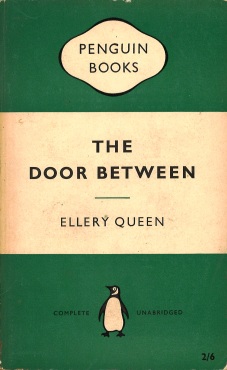
502: The Door Between (1937) by Ellery Queen | The Invisible Event

The Door Between by Ellery Queen

It’s only in typing out the title and author that I realise they rhyme. Anyway, this novel by ‘Ellery Queen’ (a pseudonym of Frederic Dannay and Manfred Bennington Lee, as well as the name of the detective) is my second by him – and I was intrigued by the title, because I love anything that centres domestic detail.

At the heart of the book is Eva – a young woman who is courageous and stubborn, but also given to the occasional damsel-in-distress flare up. Her father, a famous cancer researcher Dr John MacClure, is engaged to be married to Karen Leith. Leith is an American living in Manhattan, but obsessed with Japan – she has lived there for a long time, and writes novels that are heavily influenced by all things Japanese. Her study has Japanese furniture and art all around it, and her servant is an older Japanese woman. I don’t know how much research the authors did into Japanese culture, but I suspect they relied more on vibes than accuracy. (Incidentally, Wikipedia tells me that Ellery Queen remained the most popular mystery writer in Japan until the 1970s.)

Eva is herself in a deepening romantic relationship with a doctor – I quite enjoyed the spirited way they go from despising each other to love over the course of the first few chapters. It felt very knockabout-comedy, and I could see that section of the book being turned into a fun Golden Age of Hollywood movie.

Eva goes to see Karen, to build some bridges with her future mother-in-law. The servant comes out of Karen’s study with a piece of paper, and says that Eva can go in later. Eva is sat outside the only exit to the room. And… yes, you guessed it. Karen is found dead – and nobody could have gone in or out. Her throat is cut, but there is no sign of a knife – just a small hole in the window where a stone has come through, and an empty birdcage.

Enter the detective, Ellery Queen, a fairly louche and whimsical character. Something I enjoy about the Ellery Queen books is the dynamic between Queen and his father, who is an Inspector. They have a sweet, squabbling repartee – enough respect on each side to plough on together, and enough cynicism towards the other’s role to make it fun.

As for the plot… it’s my second Ellery Queen novel, and I am beginning to think he’ll make up any old nonsense. There are so many coincidences and unlikely scenarios strung together, with nobody asking the right questions until Ellery swans in and pieces everything together with seemingly very little time between cluelessness and absolute certainty. It’s overly complex and very unconvincing. Obviously the author was and is extremely popular, but these novels make me think that Ellery Queen would have been rather better at enjoyably silly romances than murder mysteries.

I quite enjoyed both Ellery Queens I’ve read, but ultimately I don’t think the pay-off is worth it, and I probably won’t be reading any more.

brahms caryl simon s j - a bullet in the ballet - AbeBooks

A Bullet in the Ballet by Caryl Brahms and S.J. Simon

Another detective whose name begins with Q! This time it is Adam Quill, who gets involved when a ballet dancer is shot in the middle of a performance of Petroushka – in a death scene, no less. The aftermath of the death is one of the msot 1937 moments I’ve come across in the 1937 Club:

It was perhaps as well that Palook could not remain alive to read his own obituaries, for he would not have been at all pleased with the manner in which these were framed. By an unfortunate coincidence Hitler had selected the day of his death to threaten the world with peace, collaring the greater part of the front pages and every first leader in the country. This left a mere double column for Palook’s sensational end, and much of this had been used up by the sob-sisters with graphic descriptions of everybody’s reactions to the event, except, of course, Palook’s.

A Bullet in the Ballet was the first of the collaborations between Caryl Brahms and S.J. Simon. Brahms was a critic and journalist as well as novelist, and she specialised in the ballet – so brings a lot of knowledge to the novel, often rather at the expense of the reader if (like me) they know nothing about ballet. I’d never heard of Petroushka and had to play catch up to understand any significance in it.

The novel is very arch, and Vladimir Stroganoff (!), who runs the ballet company, is openly more concerned with the ongoing performances than he is about poor Palook’s murder. Murder isn’t taken particularly seriously by anybody in the novel, and there is a heightened unreality to it that didn’t quite work for me. Many moments were enjoyable, but tonally it felt a bit of an unsuccessful reach.

It’s a very self-aware piece of detective fiction. Quill is very Tired Of These Hysterical Foreigners (and at one point reads a murder mystery and is annoyed at its French detective) – and Brahms and Simon include quite a few fourth-wall-breaking references to how detectives should behave. And there are things like this…

“Now,” said Stanely comfortably as the waitress departed with the order, “I realise, of course, that everyboyd connected with the crime is under suspicion. As I’m anxious to help you, it is necessary that I should be elimiated at once from your list. I will therefore give you my alibi.”

The astute reader at this point will immediately jump to the conclusion that Stanley must be criminal and that this ingeniousness is merely low cunning designed to mislead. Even Quill had read enough detective stories to feel vaguely suspicious.

I did find all the rivalries, jealousies and other motives a bit hard to keep track of, though thankfully Brahms and Simon have a couple of times they recap everything that went before in a handy list, with motives and opportunities for each person.

And the solution? It comes so late in the day, in a chaotic rush, and it sort of makes sense, but there’s no earthly reason that any reader would have picked it any more than any other explanation picked out of the sky. But I don’t think Brahms and Simon are in this for the plot. They’ve definitely prioritised atmosphere and humour. It didn’t quite work for me, but it could for you.

So there you go – two detective novels by two-author-writing-teams, and neither of them especially successful for me! I’ll admit that the 1937 Club hasn’t had my biggest success rate – but I have one book left to finish, so fingers crossed.

The 1937 Club – This Reading Life

I Would Be Private by Rose Macaulay – #1937Club

For a long time, I tended to see Rose Macaulay only mentioned in relation to her final novel, The Towers of Trebizond. That shifted a bit when Vintage brought back some of her novels, and other publishers (including the British Library Women Writers) have reprinted some of the more obscure ones. But, my gosh, Macaulay was prolific. I’ve read a couple of biographies of her and 12 of her books, and I still keep coming across titles I’d forgotten existed. I don’t remember anyone ever talking about I Would Be Private, but apparently I bought it ten years – and the 1937 Club has got it down from my shelves.

You could guess for hours and not come up with the premise of the novel. It’s… an ordinary couple having quintuplets, and being so beset by the press and the public that they move to a Caribbean island. Sure, Rose, why not?

Ronald is an honest, kind policeman and his wife, Win, is about to have a baby. In these days before ultrasounds and the like, they don’t know how many – but suspect it may be twins. As it happens… she has five. Ronald, standing safely outside the bedroom where this is happening, in the manner of a 1930s husband, is perturbed. His emotional mother-in-law is on hand to reassure…

Mrs Grig was wiping her streaming eyes.

“Don’t you get fussed, son. That’s the lot now. Doctor says so.”

Ronald, who thought he should have said so at least three babies back, felt suspicious.

The central conceit of the novel is perhaps rather flawed. Yes, people sometimes have five babies at once. It would probably make the local news and then be quietly forgotten. In Macaulay’s world – and in the words of the doctor – ‘My dear fellow, you can’t keep quintuplets private. It’s a public event.’

It does require some suspension of disbelief that they would be beset by paparazzi outside their house, quoted at length (in fabricated quotes) by the press, and used as the testimonies for advertising anything from baby food to furniture polish. I don’t mind suspending some disbelief, but so much of the motivation in I Would Be Private rests on this rather unlikely scenario, and it rather weakens the narrative.

The new father doesn’t feel very attached to his offspring. He and his wife debate sending at least three of them off for adoption, and it doesn’t seem to be a decision with any emotional ramifications. Macaulay often writes on the edge of satire, but I Would Be Private dances a little uneasily between emotionless satire and real human behaviour. But she is at her best (for me, at least) when she is using the narrative voice to undermine her characters. I love the word ‘observed’ here, for instance, as the babies are addressed:

“Cheepy cheep,” Mrs Grig observed. “Five ickle dicky-birds all in a row. Was they, then, was they, yum yum yum.”

“Wee wee wee,” the nurse added.

The main pair are rather lovely creations. Despite his unfatherliness (at least at first), Ronald is a simple and upstanding young man, and his wife is kind and slightly overwhelmed by her mother and sister. She’s also, mostly, exhausted. Her mother, Mrs Grig, is obsessed with the quintuplets but doesn’t let her cherishing of them stand in the way of potentials to make money. Win’s sister, meanwhile, is even more after cash – and has the rather brilliant profession of getting payments by finding companies who are breaking Sunday working laws. Only Macaulay would put in a character like that.

Anyway, after seeing no future in which they can be private, Ronald and Win set off with their offspring to a Caribbean island… and part two of the novel begins, with a whole heap of new characters.

We don’t see all that much of the island’s inhabitants, but there is a British immigrant community there – a minister and his two adult daughters, and various fairly interchangeable highbrow artists and writers. Macaulay has a lot of fun at their expense – e.g. John the painter:

John was not sure how good his technique was, but his subjects – or rather his objects – he thought superb, and his particular school of art put the choice of objects and their arrangement definitely above the mere technique of brushwork.

There’s a very funny scene where John is trying to make a seaside scene as abstract as possible, and one of the vicar’s daughters insists on trying to translate it literally. Later there’s another very-Macaulay conversation between Francis, a writer, and Ronald, who tolerates this community without feeling any affinity with it:

“Good writers and bad may sell well; bad writers and good may sell badly. People will sometimes tell you that a bad literary style and a lack of any quality but sentimental ardour will make a best-seller. That’s just second-hand middlebrow cant. Don’t believe them.”

“No one,” said Ronald, “has ever told me that.”

“It’s no truer than that literary merit will either sell a book, or make it unpopular. Or that publishers’ advertising, or reviewers’ puffing, will necessarily sell it. It’s all a fluke, a fortune, a gift of the capricious gods, and no one knows on what it depends.”

Ronald and Win are still prominent, and discovering that even a Caribbean island isn’t really a place for privacy – but there are probably too many characters and plotlines introduced in this half. It’s all a bit dizzying, and it’s not clear where the heart of the novel is, or even if it’s meant to have one.

There is a lot to enjoy, nonetheless, for people (like me) who love Macaulay’s very distinctive style. Who but Macaulay could write the sentence ‘Dorothea took the path up the hill to the lunatic asylum, to see if Lindy was there, annoying, as usual, the young men’? And who but Macaulay would use the words technorrea, pleontecny, and tertologise – none of which seem to exist, at least according to a Google search.

And then there’s the title! It’s taken from this epigraph, allegedly from Roger Rampole’s Cheaping, though I can find no evidence of what that is, or if it even exists. Macaulay made up the quote that ‘The World My Wilderness’ comes from, so she may well have made this up too:

Press me not, throng me not, by your leave I would be private. Jupiter Ammon is a man not then free? What a pox, may he not choose his road, is he to be bethronged, beset, commanded, as he were a beast in a drover’s herd, or a zany in a fairman’s show? Stand back, you knaves, you buzzing flapdragons, give me leave to be private, by Cock’s death I’ll walk free or I’ll walk not at all.

The only place I can find this online is from a mention in the Houses of Parliament, when The Lord Bishop of Hereford quoted it in 1973, saying that Macaulay had, in turn, quoted it. With amusing delicacy, he admitted ‘by Cock’s death’.

Would I recommend I Would Be Private? Honestly, I think it should be a long way down the list of Macaulay novels you seek out. Something I haven’t mentioned yet, but should, is that it is rigorously racist throughout – which obviously makes it harder to read or enjoy. It’s also a premise that doesn’t really work – or, to work, needed to be played with a bit more surrealism, perhaps. There are too many characters introduced too late in the book, and too little momentum. It’s a shame, because a lot of the writing (particularly at the beginning) is really ironically funny, and the main two characters are delightful. It was a quick read, but not a book that I’d say anybody needs to go to major lengths to find.

EDIT: see the comments for a real set of quintuplets in the 1930s, whose experience may make this novel less far-fetched than I’d imagined! And maybe was the model for Macaulay’s novel.