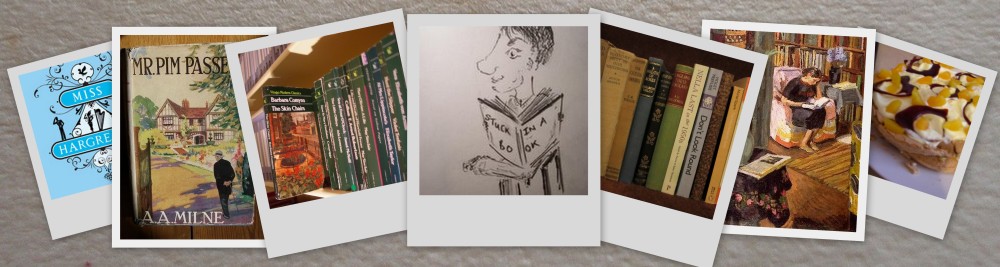
BBAW – Barbara’s Meanderings

As part of Book Bloggers Appreciation Week, we were paired up with another blogger to do an interview swap. I’ve just got my questions, so haven’t answered them yet, but here is the half to post on my blog. Step forward Barbara, from Barbara’s Meanderings. Not my usual sort of blog, since our reading tastes are very different, but a portal onto a different world… I really enjoyed having a look at it, go and have a see yourself.

-Maybe start off by telling us a bit about yourself and the content of your blog?

I have been a serious writer for over ten years. I have been married for 44 years to the same person and we have two grown daughters. My background is teaching and I have a Masters in Reading and Writing K-12. The last year I taught I was a Literacy Specialist. Most of my work is either YA [Young Adult] or MG [erm..? Could someone tell me what this is!], but I do have a few adult pieces as well. My children’s story was published online in Story Station and my adult story was published in Moondance.org. In addition various memoirs and poems are published online as well. I also have a YA novel ready for publication and I am almost finished with my second YA novel. I am a member of several writing groups on Yahoo including a KidsMuse, a critique group and several other message board groups.

My blog is called “Barbara’s Meanderings” because my thoughts wander and though it is mainly about writers and writing and I interview guest authors and review their books, it is also about my life. At times my life becomes very interesting because of the places and things I wind up doing. So I write about that too, as well as some current events and my own political views. I also write about my day-to-day life and how world events affect it.

1.) How did you enter the world of blogging? What/Who made you decide to start?

The idea of writing a blog started on MySpace, but when I moved over to Facebook I decided to make it a more regular blog and joined Facebook Networked Blogs. I am also a member of Blog Catalog. The idea of writing a blog started when I realised that I had a lot to say and nowhere to say it.

2.) How would you describe your taste in books? Maybe give us a few examples of great reads from 2009 so far.

Of course I love to read YA books, so I have read quite a few this year. I like to vary my reading and alternate between adult books and YA. Usually I like to read novels, and I love romances. But I also enjoy well-written non-fiction biographies.

It’s hard to remember all the books I’ve read this year, but the YA book that stands out for me is Purge by Sarah Littman. I have read all the books in The Harry Dresden series by Jim Butcher and wait eagerly for the next one. In addition, I have read the latest Richard Russo book, That Old Cape Magic, and at the moment I am in the middle of Best Friends Forever by Jennifer Wiener. I also review books, so I have read the books of all the authors I have interviewed on my blog this year, starting with Simon Rose, Tim Hooker, Pierre Dominique Rostan, Cynthia Polansky, Penny Ehrenkranz, Jennifer Banash, and my latest interview with RD Larson. Furthermore, I love to read books by authors I love, so I will read any book by John Irving, Nicholas Sparks, Richard Russo, Dennise Lehane, and Barbara Kingsolver.


3.) Do you see yours as a reader’s blog or a writer’s blog, or do they meld?

I think that reading and writing do meld, but on my blog it depends on the day. When I can, I like to add to things like Quotable Thursday, that one of my friends does, where you need to post a quotation of your choosing. I almost always use quotations abouts writing. When I am reviewing a book, I’m concentrating on reading.

4.) A frequent feature on your blog is weekly author interviews – talk about those for a bit!

What I like about these interviews is how different they are. Many times my questions are the same for each author, but it’s fascinating to learn how diverse these interviews are. Authors are given the questions ahead of time and they send me the answers which I post on my blog. Then they are usually available to answer any questions or comments. Very often I have a drawing for a free book from the author from the names of the people who have left a comment. The next post is usually a review of the author’s latest book.

5.) Right, pretend I’ve not read your blog before – could you send me in the direction of three blog posts you’d most like me to read?

Sure!
Walter Cronkite Dies at 92
Postcard Friendship Friday! With a Polar Bear…
Why I Love Lions


6.) Whilst we’re talking links, could you recommend three bookish blogs to me?

This was difficult, but here are three that I think are the best:
Bertram’s Blog
Cynsations
Jill Corcoran Books

7.) Finally, the silly question. Since we’re celebrating Book Bloggers this week, I’d like you to answer this question using only words which begin with ‘B’… how many adjectives beginning with ‘B’ can you think of to describe accurately your blog?

You could say that my blog is bookish, beautiful, believable, breathtaking, bold, bright, brash, brilliant, Barbara-like, big, and broad!

BBAW – UK

Hello if you’ve come in from the BBAW website! You’ve come at the right time, because I’ve got a competition going to win a copy of my favourite novel, Miss Hargreaves… feel free to enter…

I am incorrigible, aren’t I?

Let me explain. Amy, who’s helping organise Book Blogger Appreciation Week this week, noticed my quick post on the absence of UK bloggers in the shortlists, and asked if I’d redress the balance by writing a piece for her about UK bloggers… Click here to read it on her page, but I’ve also copied it below. I’m not sure the blog links will work, but they’re all in the sidebar anyway… (and, by the way, my tongue is firmly in cheek all the way through)

UK Book Bloggers
George Bernard Shaw (or someone like him) once said that Britain and America are two nations divided by a common language. Since he was Irish, that brings a whole other factor into the equation, and perhaps it’s best to pretend Dorothy Parker said it, and move on… because this is my roundabout way to say that Amy has very kindly asked me to write a bit for BBAW about the UK blogging scene. (Doesn’t the word ‘scene’ make that sound edgy? In half an hour or so, I’m going to join the cup-of-tea-and-biscuit scene. Wow, it works for anything.) Yes, that’s right, the country which brought you Shakespeare and Austen and Dickens and, erm, J.K. Rowling has also been busy a-blogging. Of course we aren’t wholly divided blogging worlds – some of my favourite blogs are written Stateside, such as Danielle’s A Work in Progress – but most of the blogs I read are UK-based, and, as L.P. Hartley didn’t quite say in The Go-Between, the UK is another country; they do things differently there. For a start, we read different books, because different books are published here. The American blogs I read tend to be of an Anglophile persuasion, so perhaps the disparity isn’t so evident, but UK book blogs often go weak at the knees when Virago Modern Classics are mentioned, or Persephone Books, or proper orange-striped Penguins. UK’s independent publishers are celebrated, not least because they often prove most willing to send out review copies to blogs. We get excited when the Booker Longlist is announced – to American bloggers, Booker might just sound like a Creole equivalent of ‘reader’. We tend not to host reading challenges so much (don’t know why), our style is perhaps a little more dry, and, of course, over here 1800 isn’t very old and 1900 feels like yesterday. Jane Austen was dead before Herman Melville was in short trousers, etc. etc. But we need some names, don’t we? Being a wee little place, our blogging community sometimes feels quite compact. There are doubtless thousands of literary blogs here in sunny Albion, but the ones I want to write about all more or less know each other – pop around for a cup of sugar, things like that. A whistle-stop tour of my favourite UK blogs always has to start with Cornflower. With a complementary ‘domestic arts blog’, Cornflower’s friendliness and charm comes with great book recommendations and beautiful things to look at as well. Elaine at Random Jottings is another favourite, since we share more or less the same taste in books – also does a sideline in opera-chat. And Simon S of Savidge Reads should get a mention, not just because his blog is always lively and witty and good, but because we follow each other all over the blogosphere – Simon S, Simon T, Simon S, Simon T. Try saying that five times whilst drinking a glass of water. Actually, don’t. Alongside these old faithfuls, I must just mention one or two newer UK blogs to keep an eye on. I love Claire aka Paperback Reader and am rather excited by a very new blogger, Hayley at Desperate Reader. Of course there are many others – Brit Lit Blogs lists quite a few, though with slightly bizarre weightings given to some, and obscurity to others. Still worth a look, if you can navigate it. One of the benefits of living on a small island (aside from never being more than 72 miles from the coast: fact) is that none of the UK bloggers are that far apart from each other. I can pop up to Edinburgh in much the same time it would take a Canadian to get a pint of milk. In fact, I will be doing that soon, hopefully, and seeing Karen from Cornflower whilst I’m there. Meeting bloggers in person is one of the fun, unexpected bonuses of writing a UK blog. Seeing the face behind the font is always exciting, and rather easier here than Across The Pond – I’ve met the good people behind Geranium Cat’s Bookshelf, Random Jottings, Dovegreyreader, Cornflower, Other Stories, Oxford Reader, The B Files, and Pursewarden – and there is talk of a UK blogger meet-up before the end of the year, watch this space. If you can get on a ‘plane and join us, you’d be very welcome – but for now I hope I’ve done my bit for the blogs of Great Britain. Do stop by and say hello, forgive us when we –ise things instead of –izing them, and maybe we’ll make Anglophiles of you yet.

Do You Want to be a Librarian?

Don’t forget to put your name in the draw to win a copy of Miss Hargreaves – I’ll do the draw on Friday – but for now there is something rather wonderful to watch… (see above)
Isn’t this fantastic? Don’t you all want to be librarians now? As a Bodleian employee (now and then) I only wish that Oxford’s premier library would get film something similar. I especially love how the people on telephones don’t answer the questions asked, or show any sign that they’ve heard the questions at all.

Life and Death of Harriett Frean

Today we’re headed to more Stuck-in-a-Book familiar territory – good old Virago Modern Classics.

I’ve heard quite a bit about May Sinclair (she first used the phrase ‘stream of consciousness’, doncha know) but not read anything by her – in Thame I came across Life and Death of Harriett Frean, and, being so short, it leapt immediately to the top of my tbr pile. And I read it in a morning – it’s got 184 pages but there’s so little text on each one that it’s more like 90 pages of an average book. And somehow, in this tiny amount of space, May Sinclair manages to include an entire, long life.

There aren’t many incidents in Harriett Frean’s life, at least not significant ones. She lives her life as a spinster, in the benevolent shadow of her parents – to the end of her days, she proudly and frequently announces ‘I’m Hilton Frean’s daughter’. The one event of note is a tangled love triangle (doesn’t that sound very like Hollyoaks? Obviously it’s nothing of the sort.) Her close friend Priscilla always protests that she will never be married, and forces Harriett to pledge the same vow… when Robin comes along, both their resolves are tested. The novel becomes a ‘what might have been’ – questioning whether moral choices are black and white, and what happens to those who choose the path not labelled ‘happy ever after.’

The thread I found most interesting (and one familiar from other Virago Modern Classics such as The Love Child by Edith Olivier, and The Third Miss Symons by F. M. Mayor, as well as Persephone Books’ Alas, Poor Lady by Rachel Ferguson which I must write about soon) is the life of a spinster with her mother. Or, more importantly, the life of a spinster once her mother has died. These paragraphs are subtly rather clever:

Next spring, a year after her mother’s death, she felt the vague stirring of her individual soul. She was free to choose her own vicar; she left her mother’s Dr. Braithwaite who was broad and twice married, and went to Canon Wrench, who was unmarried and high. There was something stimulating in the short, happy service, the rich music, the incense, and the processions. She made new covers for the drawing-room, in cretonne, a gay pattern of pomegranate and blue-green leaves. And as she had always had the cutlets broiled plain because her mother liked them that way, now she had them breaded.

And Mrs. Hancock wanted to know why Harriett has forsaken her dear mother’s church; and when Connie Pennefeather saw the covers she told Harriett she was lucky to be able to afford new cretonne. It was more than she could; she seemed to think Harriett had no business to afford it. As for the breaded cutlets, Hannah opened her eyes and said, ‘That was how the mistress always had them, ma’am, when you was away.’
Lives of mutual self-sacrifice have, in the end, benefited neither of them. Sometimes May Sinclair seems to be dragging her novel into polemic territory – not necessarily a bad thing, but I’d question some of Sinclair’s advertised morals on occasion – but that aside, Life and Death of Harriett Frean is a slight, sharp view of so many women’s situations in the early twentieth century. Not particularly cheerful, it must be said, but very powerful – the blurb compares it to Woolf, and others which I forget, but they’re right – if this novel doesn’t quite deserve to be considered a classic of Modernism, it’s not very far off. What’s more, it’s in print from Virago – though if I know you, and I think I do, you’ll be hunting for the proper green VMC edition…

Miss Hargreaves Prize Draw

Just to point out, in case you haven’t managed to get all the way through the previous post – two copies of Miss Hargreaves by Frank Baker are up for grabs – just comment on the post below. A runner-up will get a set of Bloomsbury Group bookmarks, matching Miss Hargreaves and four of the others in the series – if you already have the novel, just say, and I’ll only put you in for the bookmarks.

“I abominate fuss…” Miss Hargreaves and Me

I’ve already written about Miss Hargreaves before on Stuck-in-a-Book, but I felt that a new edition warranted a new review. I’ve just finished reading the novel for the fifth time since 2003… and I love it all over again.

Just to say at the beginning – this review doubles as a prize draw. I have two copies of Miss Hargreaves to give away, and a set of Bloomsbury bookmarks for a runner up. Of course, if you already have a copy of Miss H and would prefer the bookmarks, just say that in the comments.

I usually try to put a positive spin on the books I read, so there is a real danger that I’m going to go wildly overboard with superlatives on Miss H, because – along with Diary of a Provincial Lady and Pride and Prejudice – it is the novel I could happily read over and over again, starting as soon as I’d finished.

Norman Huntley and his friend Henry are on holiday in Ireland, when they wander into a hideous church, led by a sexton with a squint.

I turned to the chancel, hoping to find something – however slight – that I could praise. But it was worse up there. Seaweed green altar frontal; dead flowers; lichenous-looking brass candlesticks; pitch-pine organ with a pyramid of dumb pipes soaring over a candle-greased console; ‘Sanctus, Sanctus, Sanctus,’ splashed in chrome Gothic lettering over the choir walls; mural cherubim reminding you of cotton-wool chicks from Easter eggs; very stained glass; tattered hymn books, tattered hassocks – it was a horrible church. But there were, mercifully, two redeeming features; those were the dust sheets spread over lectern and pulpit. Somehow you felt a little safer with those dust sheets.
Meanwhile, Squint was rhapsodizing.
“I beg you to observe the beautiful lettering and decoration on the chancel wall. ‘I saw the Lord sitting upon a Throne.’ You like it?”

He had a habit of hissing like a goose, particularly when he was eager about something.

“Very pretty indeed,” I said.
“Original,” said Henry.
“Unusual, in a sense.”
“Full of feeling.”
“Filthy,” I said.

The awkwardness of the subsequent conversation forces Norman, on the Spur of the Moment, to make up a mutual acquaintance with a previous clergyman – that acquaintance is Miss Hargreaves.

‘And this lady, this Miss Hargreaves, she is still alive?’

‘Ten minutes old, precisely,’ said Henry.

I trod on his toe brutally.

‘The soul of youth,’ I said. ‘She is a poet,’ I added dreamily.

‘She would be an old lady,’ said Squint. ‘Over eighty.’

‘Nearer ninety,’ said Henry.

‘A touch of rheumatoid arthritis,’ I said, ‘but no more than a touch.’

Having left the church, Norman and Henry continue to embellish Miss Hargreaves’ character. A keen musician, she is the niece of the Duke of Grovesnor, has a cockatoo called Dr. Pepusch and a dog called Sarah. Perhaps most wonderful of all, she travels with her own hip bath. Proud of their creation, they continue the joke by sending her a letter, inviting her to visit Cornford…

… and she does.

A telegram arrives, telling them to expect her. Disbelievingly, they wait at the train station:

Limping slowly along the platform and chatting amiably to the porter, came – well, Miss Hargreaves. Quite obviously it couldn’t be anyone else.

‘At Oakham station,’ we heard her saying, ‘we have exquisitely pretty flowers. The station-master is quite an expert horticulturist. Oh, yes, indeed!’

‘Shall I have all your luggage put on a taxi, Mum?’

‘Just wait! Kindly stay! A moment. Accept this shilling, I beg of you. I am a trifle short-sighted, porter – oh, did I give you a halfpenny? Here you are, then. Can you see a young gentleman anywhere about? If so, no doubt but it would be my friend Mr. Norman Huntley.’

I flopped weakly on to a chair.

‘Can’t see no one, Mum,’ I could hear the porter saying.

‘Then let us wait! Do not go. What a handsome train – what a most handsome train! I wrote a sonnet to a railway train once. In my lighter moments, porter; in my more exuberant moments. My Uncle Grovesnor was good enough to say it recalled Wordsworth to him. Do you read at all, porter? Tell me. Tell me frankly.’

Isn’t she simply wonderful? Frank Baker has given her a voice so unmistakably hers, she is a unique creation and every word she says is a pleasure to read. To have seen Margaret Rutherford play her on stage and screen! I have hopes of the 1960 film turning up one day. Or Maggie Smith to play her now – she would be perfect. And, oh, Miss Hargreaves’ poetry! It is as strange and unique as she is, yet has undeniable panache.

Oh why must I go with my green tender grace
To lay all my eggs in one basket?
If I were a mayor I could carry a mace;
My card and address in a casket.

[…]

All this goeth on and my mind is a blank,
A capriciously prodigal hostage.
What care I when comforters tell me the Bank
Will pay death-duties, homage and postage?

But Miss Hargreaves is not all frothy excitement and delight – she “abominates fuss”, wants things to be just-so, and is unlikely to let decorum of convention prevent her from carrying out her good intentions. ‘She had the gift of being able to do unconventional things in the most casual manner, never losing her dignity thereby.’ As the novel progresses, while she may retain her dignity, Miss H manages to cause all sorts of trouble for Norman, with his family, his girlfriend, and his colleagues and acquaintances at the Cathedral where he plays the organ. (Music is a hugely important element of the novel – anybody who loves the organ, harp, or violin will find plenty to enjoy here.) She becomes something of a Frankenstein’s monster – as Norman’s mother says, ‘I think one would get quite fond of her, and yet never want to set eyes on her again.’

Miss Hargreaves may be the most extraordinary inhabitant of Cornford, but the others are by no means normal. Frank Baker is not satisfied with the creation of one exceptional character – he has made another, in the form of Norman’s father. Constantly talking at cross-purposes to everyone around him, and utterly absent-minded, he throws the most deliciously irrelevant things into conversation: ‘”Parrots are intelligent birds,” said father. “Knew one once that could recite a Shakespeare sonnet. All except for the last line.”‘ He gets irrationally worked-up about a new teapot, uses Browning as firewood in the bookshop he erratically runs, but is also the only person in Cornford who really believe Norman’s tales, and, in his own bizarre way, comforts him. ‘”Get it off your chest, boy. I may not listen, but I shall gather the trend of it.”‘

I have probably written far too much, and quoted at length, but I just love this novel so, so much. My quotation on the back of the Bloomsbury edition says ‘Witty, joyful, and moving but above all an extraordinary work of the imagination’ – and indeed it is. Endlessly surprising and captivating, Baker keeps the novel pacy all the way through. The idea could have grown stale, but there are enough twists and turns to keep you hooked. Sometimes sinister, sometimes sad, sometimes hilariously funny – Miss Hargreaves covers more or less all the bases, always written in the sort of delicious writing which is hardly found anymore. Miss H is one of the best characters of the twentieth century, in my opinion, and I really cannot encourage you enough to find this extraordinary book.

Don’t forget, for a copy of this wonderful novel – pop your name in the comments. Two winners will be announced later in the week, and a runner-up will get the bookmarks. If you’d prefer the bookmarks to the novel, just say.

Links to other reviews of Miss Hargreaves:
Cornflower
Random Jottings (warning: a lovely review, but gives away quite a lot)
Oxford Reader
Harriet Devine
Fancy Day

Stuck-in-a-Book’s Weekend Miscellany

Happy weekend, all. Next week I will, honest, promise, definitely be putting up my review of Miss Hargreaves, and a giveaway to go along with it – so watch this space. I’m trying to re-read it first… not much time at the moment.

1) The link – is a rather fun, bookish competition from The Big Green Bookshop. I saw about this at Chasing Bawa‘s blog – basically tell this bookshop (in email, post, ‘phone or person) your five favourite books (in no order). You have until November 22nd to do so – after that somebody clever with a spreadsheet will compile a Top 50. And one lucky person, randomly selected, will win 20 books of their choice from that 50. What’s not to like? Click here for all their info, or here for their blog, or just email enquiries@biggreenbookshop.com.
My top five? Well the first three are always there, in some order or other, but after that I improvise based on my feelings for that day.

1. Miss Hargreaves – Frank Baker
2. Pride and Prejudice – Jane Austen
3. Diary of a Provincial Lady – EM Delafield
4. Winnie the Pooh – AA Milne
5. Family Roundabout – Richmal Crompton

And whilst I’m at it, I found this name-the-book-from-the-photo competition in their archives… it’s hilarious, and groan-inducing. Go and have a try, you’ll love it. I got none of ’em.

2) The book is in fact books. At the Kisses on a Postcard launch the other day, Alexandra Pringle was saying how jealous she felt of those who hadn’t read Barbara Trapido before, because of all the bookish pleasures ahead of them… at which point I raised my hand and confessed my sins of omission. And so the lovely people of Bloomsbury have sent me their new editions of her novels… any Barbara Trapido fans out there, and if so, where should I start? So far I’m hearing ‘start at the beginning’ with Brother of the More Famous Jack, a fantastic title.

3) And for the blog post this week, I really enjoyed Rachel’s (aka Book Snob) tales of recent buying. The first line will make you realise what an affinity Rachel is: I went out on my lunch break today to Brompton Road, ostensibly to buy a dress for a wedding I am going to on Saturday, but somehow I returned back to my office with no dress and a bag full of books.Now it’s true that I’ve never set out to buy a dress, but most of my errands turn into impromptu book buying trips. You can read more about it here, and find out what she bought. (Rachel, if you’d like me to post you the sketch as a souvenir of sorts, just email me your address!)

Katherine Mansfield – Selected Stories

Thanks so much for your response yesterday, everyone, that was really interesting – and lovely to have comments from new people. I have to check these things sometimes – doing an English degree tends to make one a bit blinkered, in terms of which authors are well-known and which aren’t. I usually ask Colin – he knows rather more about literature than most, but isn’t as obsessed, and he assured me that nobody at his office would have heard of Katherine Mansfield. I knew the literary-blog-reading-and-writing world would be rather more keyed up, but wasn’t sure where our Kath featured on the scale of things. So, whilst more or less all of you have heard of Katherine Mansfield, she remains an untapped mine for many – and so I shall put her into my ongoing list of 50 Books You Must Read etc. etc….


27. Katherine Mansfield – Selected Stories

Katherine Mansfield only wrote for a few years, in the 1910s and ’20s. She was on the outskirts of the Bloomsbury Group, in an ambivalent friendship with Virginia Woolf. Born in New Zealand, her stories are set in both NZ and England, but also often an indeterminate mixture of the two. I wrote about Claire Tomalin’s biography of KM a couple of years ago, if you’re interested… but onto her writing.

Though you can read anything by KM – I recommend buying her collections as they were published, especially The Garden Party and Bliss, as well as various others – the Selected Stories is an excellent place to start. Plus Oxford University Press just sent me their latest World’s Classics edition of it, and it’s rather beautiful – as well as including nearly all of my favourite stories. But – and this might be make or break in terms of appreciating KM – don’t start at the beginning. This Selected Stories, perhaps unsurprisingly, lists her stories chronologically. KM’s writing got better and better, most of her best work appearing in the two years before she died, age 34, of TB. Who knows what she’d have gone onto achieve had she lived – or perhaps it was facing her death which drew such genius out of her?

If you do get this collection, which I’d encourage – or indeed any collection – then start with something from The Garden Party. ‘The Garden Party’, for example. Other favourites from around this period include ‘Miss Brill’; ‘Bliss’; ‘The Daughters of the Colonel’; ‘Her First Ball’; ‘A Cup of Tea’. All of these are included in the OUP selection. Others prefer her longer stories, ‘Prelude’ and ‘At the Bay’, but I think her craft and talent are shown best in the short, short stories.

What is it that makes KM so very, very good? It is this ability to demonstrate so much in such short works – to capture entire lives in mere sentences. Even if you don’t usually like short stories, I can’t imagine anybody not appreciating these. They manage to show everyday events, which at the same time completely turn people’s lives upside down. They are about people dealing with grief, or change, or power shifts, or the strange. ‘The Garden Party’ is all about class, on one level, but also a girl’s first encounter with death. And her writing – it is absolutely sublime. Virginia Woolf said ‘I was jealous of her writing. The only writing I was ever jealous of.’ It transports you to another world when you’re reading it – everything delicate and observant without being cloying or obtrusive. A quiet modernist, her stories owe as much to Chekhov as to any later writers.

I don’t want to give away the plots of these stories, because quite often only one significant event happens, and it is the stunning crux of the story. Like ‘Bliss’ – incredible story – to give away the ending would be treason! But when the pivots take place, they are not sensational – they are life, and KM’s talent is in sensitively showing how people respond to events which are externally almost insignificant, but of huge personal enormity. And, because it’s impossible to judge a writing style without evidence, here’s a link to ‘The Garden Party’, and here is one to ‘Bliss’ (note the significance of the first word, in conjunction with the title). Do go and read them, slowly, and see if you wouldn’t like to read more. I do hope you’ll give KM a try, if you haven’t before – and if you’ve not read her for years, why not get a copy and read one story a night for a few weeks? Just remember, contrary to everything we learnt in The Sound of Music, don’t start at the beginning, it’s not a very good place to start.

Katherine Mansfield

I’m going to be writing about Katherine Mansfield later in the week, inspired by Danielle recently getting her selected works, and I just wanted to do a straw poll today… so if you’re popping by for the first or the hundredth time, just let me know:

a) whether or not you’ve heard of Katherine Mansfield?

if yes…

b) whether or not you’ve read anything by KM?

if yes…

c) what your favourite story by KM is?