Stuck-in-a-Book’s Weekend Miscellany


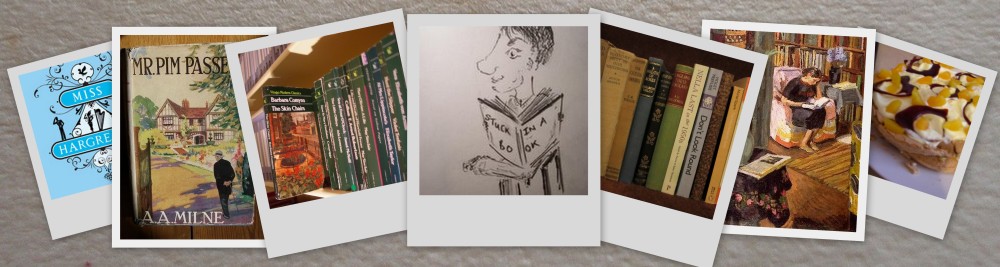
Will you look at that, somehow it’s the weekend again. Hope you all had a lovely week – mine has not been quite as busy as perhaps it should have been, but was very nicely interrupted today as Our Vicar and Our Vicar’s Wife paid a fleeting visit on their way through to a wedding in London. Oh, and the photo above isn’t particularly relevant – I took it last summer in Cornwall – but I don’t think I’ve shared it here before, and it is rather brilliant.

Right – as per usual, the link, the book, the blog post. It’s like the good, the bad, and the ugly – except it’s the good, the good, and the good.

1.) The link – is this rather fun and interesting article about joining a book group. I may or may not have stolen this link from someone else, I made a note of it last Saturday, and can’t remember – so apologies if I’m not crediting you! I look forward to my various book groups as highlights of my month, and love reading about other people’s experiences in them…

2.) The book – came through the post yesterday, and has the rather irresistible title Love, Revenge & Buttered Scones and is by Bobbie Darbyshire. I’m hoping to read this before too long, but thought I’d alert you to it now, in case it takes a back seat while I wade through the enormous fantasy book I’ve promised my brother I’ll read… Anyway, the novel is about (I quote the blurb) ‘an innocent meeting of a reading group which sparks a series of bizarre events. Three troubled people, driven by loneliness, vanity and revenge, hurl themselves on Inverness public library to find that nothing is as they expect.’ Sounds fun, doesn’t it?

3.) The blog post – is a little unusual for a book blog, but I was struck by Spitalfields Life’s post on Postman’s Park – which commemorates those who died in ‘Heroic Self-Sacrifice’. To give an example: ‘Soloman Galaman, Aged 11, Died of Injuries, Sept. 6 1901, After Saving His Little Brother From Being Run Over in Commercial Street.’ For lots of photos of the unique commemorative tiles there (they are Victorian and the turn of the century), and a bit of the history behind it, click here. I’ve never been in person, but will try and seek it out next time I’m in London. Have you ever been there?

Congratulations…


Sorry not to give much warning that I was bringing the signed Solar competition to an end, but it’s been a few days and I think everyone’s entered who is going to be entered – and I am pleased to say (using a random number generator, since Patch is asleep) that a signed copy of Ian McEwan’s latest novel will be on its way to…

Claire from Paperback Reader!

Well done Claire – could you email me your address, and I’ll forward it to the company?

And the runners-up who win Solar T-shirts are…

AmbireBooks and A Bookish Space!

I will have to check that it’s ok to send T-shirts internationally, so fingers crossed I haven’t got your hopes up… please email me your address, and let me know whether you want size ‘small’ or ‘large’ (not Aristoleans obviously, no happy mean!)

In McEwan news, I got an email today telling me about this event, for those oop North:

Ian McEwan in conversation with Sam Leith

Monday 22nd March at 6.30pm

Royal Northern College of Music , 124 Oxford Road , Manchester M13 9RD

Tickets £7 available from the Box Office 0161 907 5555

box.office@rncm.ac.uk

supported by Waterstone’s, 91 Deansgate

Travels With My Aunt

As far as I’m aware, until this month I had never read a book with the word ‘Aunt’ in the title – and now I find myself reading two of them. Travels With My Aunt by Graham Greene, and Aunts Aren’t Gentlemen by PG Wodehouse – both very funny. Perhaps Aunts are a source of untapped hilarity (also languishing on my shelf is Cordial Relations: The Maiden Aunt in Fact and Fiction by Katharine Moore, so more to discover there, too…)

My lovely book group has themed months, where the shortlist for voting must be suggested within a theme or idea. Next month, for example, is books set in Oxford (I’m holding out for Jill by Philip Larkin). Last month was books about geographical journeys – and I suggested Travels With My Aunt by Graham Greene, which was eventually victorious. I hadn’t read it – indeed, I knew almost nothing about it – but has been told by one or two people that I should read some Greene. And I’m very glad that I did.

Henry has never met his Aunt Augusta before she turns up at his mother’s funeral: “It’s odd how we seem to meet only at religious ceremonies. The last time I saw you was at your baptism.” His quiet life working in a bank, tending his dahlias, and generally not doing very much – it’s all about to be wildly disrupted. His is not a spirit of adventure – ‘The bank had taught me to be wary of whims. Whims so often end in bankruptcy.” But Augusta is no-nonsense, fairly eccentric, and determined to change him. But I’ll let Henry do the describing:

I wish I could reproduce more clearly the tones of her voice. She enjoyed talking, she enjoyed telling a story. She formed her sentences carefully like a slow writer who foresees ahead of him the next sentence and guides his pen towards it. Not for her the broken phrase, the lapse of continuity. There was something classically precise, or perhaps it would be more accurate to say, old-world in her diction. The bizarre phrase, and occasionally, it must be agreed, a shocking one, gleamed all the more brightly from the odd setting. As I grew to know her better, I began to regard her as bronze rather than brazen, a bronze which has been smoothed and polished by touch, like the horse’s knee in the lounge of the Hotel de Paris in Monte Carlo, which she once described to me, caressed by generations of gamblers.

For Aunt A is well-travelled. When she suggests a trip, Henry thinks Brighton would be a good destination, and it does offer an interesting excursion – little does he know that their travels will later include Paris, Istanbul, Paraguay… Truth be told, the destinations aren’t hugely important in themselves (which rather relieved me, as I’m not usually a fan of travel literature, and was glad that the novel didn’t turn into it) but rather act as settings for the illicit and extraordinary activities with which Augusta is involved. I don’t want to spoil them for you, but safe to say the police get involved along the way.

Having written that, you might be surprised to learn that the character I was reminded of most, from the earliest chapters onwards, was Miss Hargreaves. In the unlikely event that you’ve missed me talking about Miss Hargreaves, probably by favourite novel, you can read my eulogies here. Miss H was written in 1939; Travels With My Aunt came out in 1969 – and Aunt Augusta is more or less what I’d expect Miss Hargreaves to be if she’d lived thirty years later, and been rather less respectable. I can’t imagine Miss Hargreaves saying, for instance, “A brothel is after all a kind of school.” But the characters have the same indomitable spirit, eccentric manner, and amusingly unpredictable speech. The success of Greene’s novel, for me, is through character – through Augusta and Henry’s conversations, where two wholly different characters meet and travel together. The first half of the novel focuses upon character (broadly speaking) and the second half more on plot – which I found perhaps less interesting, though apparently it is more akin to Greene’s literary thrillers.

I haven’t read anything else by Greene, and I’ve been told that Travels With My Aunt is the unGreenelike Greene novel, but I was so charmed and amused by this spirited novel that I’ll definitely be trying some others. Anybody got anything to suggest? I’m also keen to see Maggie Smith in the film, but (of course) it hasn’t been released on DVD… (Oh, and for the thoughts of another member of the book group – I’ve just spotted Harriet’s review!)

Project 24: The Agony and… no, just the agony, really…

Project 24 is starting to get difficult… I’m already halfway through April on my allowance (if you count the book which is winging its way to me at the moment, to be revealed when it arrives) and, though there aren’t many specific titles I’ve had to avoid, I just miss book shopping…

But today was the first time that I stood in front of a book, something of a battle of wits, forcing myself not to buy it. The book in question is The Spy in the Bookshop: Letters Between Heywood Hill and John Saumarez Smith 1966-1974. It was in the £2 bookshop in Oxford which I walk past everyday. I really enjoyed the letters of Heywood Hill and Nancy Mitford, The Bookshop at 10, Curzon Street, and would love to have the follow-up… but I’m not excited enough about it to make it one of 24. But it’s only £2. But… but… but… this is so difficult!

I need to start planning what I’m going to do in January 2011… I’m thinking trip to Hay-on-Wye, trip to the Bookbarn, rather large splurge on my Amazon basket…

Tell me – if you’re joining in, which books have made Project 24 (or whatever number you’ve chosen) especially difficult?

Can Any Mother Help Me?

I don’t remember where I first heard of Jenna Bailey’s book Can Any Mother Help Me? but it has been across the blogosphere like wildfire over the past year or so. Ironically, a few people bought it because of a mention or two here at Stuck-in-a-Book in the past – because I got my copy in mid 2008. It was one of those titles I just *needed* to own immediately, had to read immediately… and then, of course, it somehow languished on my bookshelves for the best part of two years. But no longer!

Can Any Mother Help Me? tells the story of the Cooperative Correspondence Club – known to its members as CCC – which began in 1935 when a young woman wrote to Nursery World:

Can any mother help me? I live a very lonely life as I have no near neighbours. I cannot afford to buy a wireless. I adore reading, but with no library am very limited with books. I dislike needlework, though I have a lot to do! I get so down and depressed after the children are in bed and I’m alone in the house. I sew, read and write stories galore, but in spite of good resolutions, and the engaging company of cat and dog, I do brood, and “dig the dead.” I have had a rotten time, and been cruelly hurt, both physically and mentally, but I know it is bad to brood and breed hard thoughts and resentment. Can any reader suggest an occupation that will intrigue me and exclude “thinking” and cost nothing!

The solution was to set up a collective magazine (of which there were apparently over two hundred that are known about) to which women would contribute, under pseudonyms ranging from ‘Sirod’ (Doris backwards) to ‘Cotton Goods’ (for the proudly working-class) to ‘Elektra’ and ‘A Priori’. The members came and went, but over half a century these women sent around their contributions on all manner of topics, but mostly simply about their own lives. Ad Astra organised it all, and sent them out in the beautiful homemade covers shown in a picture below.

The book is essentially a selection of articles from different magazines, with editorial material provided by Bailey. She has grouped the articles thematically: issues of raising children (members had to be mothers – the issue was raised of allowing non-mothers to join, but it was decided against); the war; everyday life; marriage; working; hard times; growing old. There are quite a few ‘voices’ in the book, and only a few become really familiar, but it’s certainly an interesting sample and cross-section of a fascinating project.

I loved the idea of the CCC, and did enjoy reading the book, but somehow it didn’t *quite* match up to what I was expecting. Or rather, what I was hoping – because I didn’t know how I expected Bailey to arrange the material. She could only really pick and choose certain pieces, it would be impossible to give the feeling of belonging to the group – instead, I felt a little like an eavesdropper. Also, once all the articles were typed up, with marginalia noted in neat little font, the feel of the magazine was lost. I’d have loved a facsimile edition of one or two copies of the magazine – so that all the original handwriting and margin notes and crossings-out would have been reproduced. But perhaps that wouldn’t be possible, or too expensive, or even illegible.
When Claire reviewed the book, she pondered over blogging as a modern equivalent of the CCC. In a way it is, but much closer (in my experience) is the Yahoo Group I’m in. Are other people in these sorts of email groups, where people send out emails to a whole group, and correspond that way? They’re not as popular as they once were, but the one I’ve been in since January 2004 (a quarter of my life!) is incredibly dear to me. The experiences of the CCC sounded very familiar – the cautious and slightly nervous initial face-to-face meetings, which become regular and joyous occasions; the feeling that you can share close, personal events with people you’ve never had the opportunity to meet; the joy of kindred spirits. Who knows whether we’ll still be going in fifty years’ time (with some record-breaking-aged people, if we do) but I know that it has been, and will continue to be, a very special part of my life.

If Bailey’s book couldn’t quite convey this sense of intimacy and special-ness, that’s only to be expected, because the reader must remain an intrigued outsider to the group. At the same time, it is the only way that we can now remember such wonderful groups and I applaud Bailey (and the Mass Observation project which held the material, and also gave rise to significant books like Nella Last’s War) for immortalising the CCC and making their venture accessible to many.

Oh, and for anybody reading this in Oxford… the £2 bookshop has a number of copies…

Signed Solar!

It’s an embarrassment of riches around the blogosphere at the moment, with at least one other blog I’ve spotted running this competition – for a signed copy of Ian McEwan’s latest offering, Solar. Thank you, Random House, for offering this!

Also, there are Solar T-shirts to be won – so mention in the comments if you’d fancy one of these, otherwise I’ll assume you’re just in the draw for the book.

And, because just saying ‘me please!’ isn’t all that entertaining for you, I’d like to know which Ian McEwan novel is your favourite, or (if you’ve not read any or many) which you fancy reading. Other than Solar, that is…

For me – it’s a toss up between Atonement and Black Dogs. I’m going to go with Black Dogs. And the one I want to read next? The Child in Time, I think.

No.6

Project 24 – #6


Drastically scaling back the number of books I’m allowed to buy in 2010 has meant that the ones I choose are likely to come (and have come so far) in three categories:

They’re out of print books which rarely become available, and the opportunity is too good to missI’ve physically been to a great secondhand bookshop and don’t want to come away empty-handed…They’re books I’ve been wanting to buy for years, but couldn’t really afford.
My sixth book of 2010 falls in category 3 – The Heirs of Jane Austen: Twentieth-Century Writers of the Comedy of Manners by Rachel R. Mather. This book could have been written with me in mind – it looks at EF Benson, EM Delafield, and Angela Thirkell as (unsurprisingly) the heirs of Jane Austen – two of my absolute favourite authors (EMD and JA), and two I like a lot (EFB and AT) all in the same book together? Wonderful. I have actually read this already, a few years ago – lent by a kind Thirkellite – but knew at some point I’d have to have a copy myself. So, there you are – no.6 has been chosen. (Sorry that I could only find a tiny picture of the book – the cover is too shiny to take a good one with my camera, under electric light.)

Which would take me to the end of March. Except, ahem, another is on its way… and I’m going to Paris at the end of March, and will be visiting the Shakespeare & Co. bookshop. Let’s hope April is a lean month…

Stuck-in-a-Book’s Weekend Miscellany

I’m so pleased that a lot of you enjoyed the review the other day – I’ll keep my eye out for similar things in the future, so watch this space…

And it’s the weekend again, so time for a book, a blog post, and a link.

1.) The book – is one for those with deep pockets. It’s no secret that I love EF Benson’s Mapp and Lucia series, and have quite a few of his books which I’ve yet to read – but what enhances my love for these wonderful six books is (as you’ll see if you follow that link back there) the beautiful Folio edition I have of them. My friend Barbara-in-Ludlow originally lent me her set, and I hankered after them for years… eventually finding the set for only £25 in Blackwell’s Second Hand Department – possibly the only recorded instance of there being a good value book there. It was indeed a frabjous day, and I’m pleased to report that the Folio Society have reprinted this boxset – which you can see here. The colours have changed a bit, but it still looks wonderful. Thanks so much Helen for bringing this to my attention. Here’s the downside… it will set you back £120. Less if you’re a Folio Society member, perhaps, but… well, I was lucky enough to find them at a reasonable price, but they’re scarce enough and give me more pleasure than almost any other books I have. (I should be working on commission!)

2.) The blog post – is a review by Elaine at Random Jottings. This fits in nicely with the previous post, since Elaine has just read The War Workers by E M Delafield. This was one of my favourite books read in 2008, but I didn’t write about it on my blog because it was so difficult to find copies. Now that a POD company is issuing it, it seems fair to point you in its direction! First stop, Elaine’s wonderful review.

3.) The link – is not remotely reverent. But is very funny. Anybody familiar with Bonnie Tyler’s Total Eclipse of the Heart (or, indeed, anybody who isn’t) will love this literal interpretation of her music video…

E M Delafield

I was thinking – it only seems fair that I should share with you some of the fruits of my research, which means that you get the fun bits without having to write huge swathes and have your supervisor ask you to re-write them. Basically, you’re getting the fun bit of my doctoral work, without even having to pay university fees.

Don’t worry, I shan’t quote reams of literary criticism or anything like that, but part of my recent work has been looking through old periodicals for reviews of the Provincial Lady books. And I thought you might quite enjoy the review Time and Tide gave to my favourite of the series, The Provincial Lady Goes Further. A bit nepotistic, since PLGF was serialised in Time and Tide, but never mind…

Alongside this review is a picture I came across by accident in another issue of Time and Tide – not sure how flattered EMD would have been by this likeness, but thought I’d share it with you nonetheless.

Let me know if this sort of thing interests you, and I’ll pop some more contemporary reviews in as and when I find them.

Time and Tide, November 12th 1932
Review by Francis Iles
‘Miss Delafield’s last book about her Provincial Lady was the Book Society’s first choice for December, 1930; the present one, though obviously a better book, is not even on their recommended list. As so often before in connection with the Book Society, one wonders and one wonders. Oh, ruddier than the Ike… [Simon’s note: this is a reference to Red Ike, one of the Book Society choices]
Miss Delafield has always seemed to me a writer who has not received quite her due. I have seen it written, and by a responsible critic, that when one has read one of her books one has read them all. The only explanation of such a remark is that the responsible critic himself has not read them all; for, with the exception of the impishly experimental Mr. C. S. Forrester, I know of no other author who has ever produced four consecutive books more different in every respect than A Reversion to Type, Messalina of the Suburbs, Mrs. Harter, and The Chip and the Block.

For the sly humour that arises out of a maliciously penetrating observation of character, with never a word of superfluous explanation or a jog of the reader’s elbow, and still more for economical, mordant delineation of feminine character through dialogue (her men are not always so successful) Miss Delafield has no equal. Her technique is as brilliant as it is self-effacing. She can pack more self-revelation into a couple of ordinary spoken sentences, than any other novelist. I always remember a certain Vicar’s Wife in one of her books, who appears only once and who speaks only five words, but from those five words we at once know everything there is to be known about her; we know what her husband thought about her and what her cook, we know exactly how she would have decorated the parish hall for a Penny Reading, and why she could never cook an omelette. She is watching a set of very inferior country tennis, and one of the players has just muffed a shot; the Vicar’s Wife turns to her neighbour and says brightly: “Just like Wimbledon , isn’t it?” Miss Delafield, in fact, lacks only a rather stronger sense of construction and plot to be one of the most important novelists writing today; for her more serious work, though less intensely individual, will stand comparison with any other writer’s, while in her own particular line of satirical humour she is unsurpassed.
The Provincial Lady Goes Further is, of course, Miss Delafield at her very lightest, and it is one of the wittiest books that has appeared for years. I read it at a sitting; and, though perhaps it would have been better taken in 100-page doses, the book stood it, which its predecessor did not. It is a better book than The Diary of a Provincial Lady because the interest is more diversified. The scene shifts more rapidly, between the country and London and even to a Literary Congress in Belgium , with the result that we meet a better-contrasted set of people. Moreover the Provincial Lady herself is shown as less of a figure of fun than in the earlier book, so that we really can believe that she has written the important novel which has opened the doors of Bloomsbury to her, with such admirable results for the reader. The whole thing is a little masterpiece of sly fun, which one will want to buy and keep because it will bear endless re-reading.’