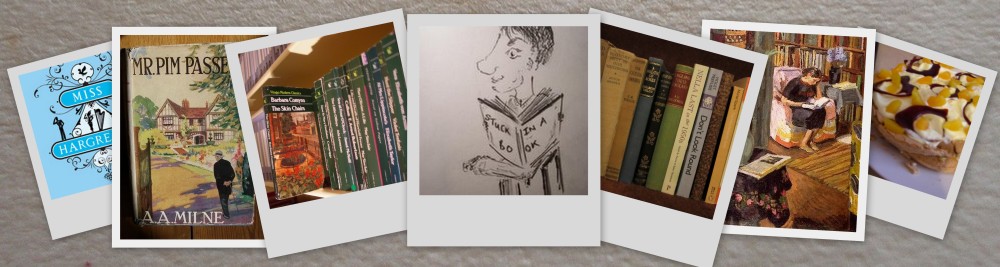
Tea and…


This picture more or less sums up my afternoon!

And, thinking about it, it’s not far off summing up my taste in novels. That’s not quite true, let me rephrase – it sums up part of my taste of novels, because it comes in two very distinct categories. I like the quirky and surreal, and also the domestic and unthreatening. I especially love it when these coalesce in Barbara Comyns… more on her later in the week, of course. But this photo – well, its atmosphere, and the way it makes me feel : that’s what I’m often after in books.

So, this is my challenge to those of you who have blogs: can you post a picture which sums up your reading taste, or a section of it? I’m looking for a picture which doesn’t include a book in it, or a character from an adaptation, or anything like that. It can be a photograph you’ve taken, or a painting you’ve seen, or anything… have fun with it!

I’d love anyone and everyone to have a go, but I’m going to ‘tag’ a few people to start the ball rolling…

Becca (Oxford Reader) – whose camera took that very photo!Claire (The Captive Reader)Claire (Paperback Reader)Claire (Kiss A Cloud)Karen (Cornflower)Nicola (Vintage Reads)Polly (Novel Insights)Rachel (Book Snob)Simon (Savidge Reads)Thomas (My Porch)

Stuck-in-a-Book’s Weekend Miscellany

Happy Weekend, everyone – and, for those in the UK, it’s a Bank Holiday Weekend. Which makes little odds to me (especially since I’m at work tomorrow) but will give you lots of time to read Barbara Comyns’ The Vet’s Daughter – for those who are joining in a group readalong, informally organised by me and Polly (aka Novel Insights) and Claire (Paperback Reader). I finished the book today, and thought it was brilliant – feel free to post a review anytime next week (pop a link in the comments, and I’ll organise them together). If you don’t have a blog but have read the book, I’d be more than happy to post your thoughts here.

1.) The link – is to 50 Iconic Book Covers, as chosen by abebooks… not perhaps all ones I’d have chosen, but it’s nice to see them as actual books, rather than just pristine pictures of their covers, don’t you think?

2.) The book – was mentioned by a few people on an email book discussion list I’m on; the new one by Bill Bryson called At Home : A Short History of Private Life. I’ve only read a couple of his books (Mother Tongue and Shakespeare) but I loved them both. Bryson is able to relay all manner of fascinating facts without ever sounding dry, and his sense of humour is a delight. To give you an idea about the sort of thing Bryson’s doing, I’ll quote the Author’s section from Amazon: Early in the course of my research for my new book I learned that houses are amazingly complex repositories. What I found, to my great surprise, is that whatever happens in the world – whatever is discovered or created or bitterly fought over – eventually ends up, in one way or another, in your house.

Wars, famines, the Industrial Revolution, the Enlightenment – they are all there in your sofas and chests of drawers, tucked in to the folds of your curtains, in the downy softness of your pillows, in the paint on your walls and the water in your pipes.

Houses aren’t refuges from history, as I hope you are about to discover in At Home. They are where history ends up. So there you are – irresistible to me, I think I might have to wait til the library gets it. Or perhaps it’ll come in at no.11 in Project 24? Tempting…

3.) The blog post – is from Claire at kissacloud, and is here. It’s about Illustrado by Miguel Syjuco, a Filipino author of whom I hadn’t heard, but am now very eager to read. But it also opens up a wider question, specifically for those who have emigrated – do you try and stay in touch with your birth-nation (if such an expression exists!) through literature? As someone who was born and bred in England, I can’t answer the question – but on a regionalist note, I do get excited if a book mentions Worcestershire, since nobody seems ever to do so…

The Man Who Planted Trees

As part of Project 24, I’ve been browsing through bookshops and then high-tailing it to the library. This won’t help Waterstones stay afloat, but it’ll stop be exceeding my book allowance… Anyway, today I was looking at the table of Books in Translation and was rather intrigued by The Man Who Planted Trees by Jean Giono. Oxford Central Library didn’t have it, but the Bodleian did, so I read it today… (and incidentally, although Giono was French, as far as I can tell the story was originally published in English.)

It’s more or less a short story – the copy I read had 50 pages, but the font was large and their are lots of woodcuts by Michael McCurdy. In fact, it’s these woodcuts which make the book really special – the edition I saw in Waterstones had a different illustrator, who was quite good, but make sure you find the edition with McCurdy’s work if you’re tracking down a copy.

But I’m getting ahead of myself – The Man Who Planted Trees was originally written when Giono was asked to contribute to the Reader’s Digest on ‘a memorable person’, or something like that. His contribution was, however, rejected – when they found out what he had never tried to conceal: that it was fictional. And instead it was published in Vogue in 1953. Don’t stop reading there – Virginia Woolf contributed to Vogue back in the day, so it can be a credible publication.

The Man Who Planted Trees tells of a narrator who hikes to a place of ‘unparalleled desolation’ – a village where the few inhabitants quietly loathe one another, and where nature has more or less given up. But he encounters Elzèard Bouffier, a shepherd who rarely speaks, but is kind and offers him somewhere to stay.

The shepherd went to fetch a small sack and poured out a heap of acorns on the table. He began to inspect them, one by one, with great concentration, separating the good from the bad. I smoked my pipe. I did offer to help him. He told me that it was his job. And, in fact, seeing the care he devoted to the task, I did not insist. That was the whole of our conversation. When he had set aside a large enough pile of acorns, he counted them out by tens, meanwhile eliminating the small ones or those which were slightly cracked, for now he examined them more closely. When he had thus selected one hundred perfect acorns he stopped and we went to bed.
Elzéard, as the title to the book suggests, is planting trees. Thousands and thousands of them. At this stage, he estimates that of the hundred thousand acorns he has planted, ten thousand will grow successfully. And he carries on and carries on, with many varieties of tree – quietly transforming the area.


The narrator fights in World War One (off the page) and returns to find Elzéard’s life unaffected by such matters – the trees abound, and the countryside is being changed in more ways than one. Streams which had been dry flow once more; people move to the village and it becomes vibrant again. The narrator leaves and returns a couple of times, and is astonished by what the unassuming shepherd has achieved.

The Man Who Planted Trees is a beautiful book, both visually and in every other way. McCurdy’s woodcuts have such energy and really enhance Giono’s simple and elegant story. It is described as an allegory – I’m not entirely sure what the allegory is, other than of creation, but that doesn’t diminish it being a delicately-told and affecting story. Giono doesn’t pluck at the heartstrings or delve into the characters’ psychology – instead he lays before us the simplicity of their acts, and allows the reader to engage and respond. And he has entirely succeeded in creating his original brief: a memorable character.

Do pop over and read Karen’s lovely review of this book… and you can read the beginning of it, including some more McCurdy images, courtesy of Google Books here.

Books to get Stuck into:

The Runaway – Elizabeth Anna Hart
: this is a similarly enchanting story, with beautiful woodcuts by Gwen Raverat. One of my favourite Persephones, it is more whimsical than Giono’s story, but equally engaging.

The Play’s The Thing

On Sunday it was Love Oxford – an annual event where many of the churches from across the city gather together for one massive service in South Parks. It’s always brilliant, and this year was no exception – although for the first time I’d volunteered to steward. Just the sort of weather you want to be adding layers, in the form of a fluorescent yellow jacket. And a mic-headset thingummy, which I never quite understood.

Anyway, once the service we over we all sat in the sun (or, in my case, the shade) for a picnic – and because I’d brought a book (Three Plays by A.A. Milne) and my housemates hadn’t, we decided to do a play reading for ourselves! Well, Mel and Lois and I did; our other housemate Liz moved far away from us and pretended she didn’t know us.


I don’t know if you ever read plays, either out loud or in the normal way, but I think it’s one of the great neglected areas of fiction. It’s very unlikely that anybody is going to put these plays back on the stage, and so it’s great fun to read them. With an author like A.A. Milne, as well, there are added advantages to reading instead of watching – his stage directions are often very funny, and purely for the benefit of the reader. Since Milne was one of my first author-obsessions, I got very used to reading plays (he wrote a lot, and was famous for them long before Mr. Winnie-the-Pooh came along) but I know a lot of people would never even consider it.

The play we read was one of Milne’s most popular, and P.G. Wodehouse said it was his favourite play (even when saying he’d like Milne to trip over and break his neck… they had a bit of a public falling-out after the Berlin Broadcasts) – it’s called The Dover Road. Leonard and Anne are running away to France together; Leonard abandoning his wife Eustacia in the process. Their car breaks down, and they are forced to come to ‘a sort of hotel’, run by Latimer. It quickly emerges that Latimer intends to keep them prisoner there for a week, in order that they can think things through before acting impetuously – and see each other in a new light. Little known to them, another couple have already been there for a week… Eustacia and her runaway partner Nicholas.

Yes, the scenario is a little contrived, but who cares about that – The Dover Road is a very funny play about the benign meddling of Latimer and the various mismatched pairings under his roof. For just a taste, here’s Anne complaining about Leonard’s failure to get her safely to France (the ellipses are all in the original) : What made you ever think that you could take anybody to the South of France? Without any practice at all? . . . Now, if you had been taking an aunt to Hammersmith – well, you might have lost a bus or two . . . and your hat might have blown off . . . and you would probably have found yourselves at Hampstead the first two or three times . . . and your aunt would have stood up the whole way . . . but still you might have got there eventually. I mean, it would be worth trying – if your aunt was very anxious to get to Hammersmith. But the South of France! My dear Leonard! it’s so audacious of you.I can’t find The Dover Road online, although quite a few of A.A. Milne’s plays can be read here. Otherwise, next time you’re in a secondhand bookshop, go and have a look in the Plays section – there’s quite often a volume of AAM’s work there.

And, to go back to the first question – do you read plays? And if not, is it because you have tried and failed to enjoy it, or just never thought about it? Answers on a postcard… or, if you prefer, in the comments box…(!)

Project 24 continues apace…


Project 24 – #10

Susan unintentionally piled hot coals on my head in the comments earlier this week, congratulating me on being on track for Project 24. Little did she know that #10 was on it’s way to me… and has now arrived. That does only take me up to the end of May, so I’m more or less on track, but…


Ok, no.10 – An Experiment With Time by J.W. Dunne. This is actually one for my studies, but I’ve been meaning to track down a copy for a while. I don’t how many of you have heard of it, but it was apparently quite famous in its day. It’s mentioned somewhere in Miss Hargreaves by Frank Baker, can’t find the quotation right now, and gets this mention in The Provincial Lady in Wartime by the incomparable E.M. Delafield:
Am rather astonished and greatly impressed when she calmly returns that she often thinks about Time herself, and has read through the whole of J. W. Dunne’s book.

Did she understand it?

Well, the first two and a half pages she understood perfectly. The whole thing seemed to her so simple that she was unable to suppose that even a baby would understand it. Then, all of a sudden, she found she wasn’t understanding it any more. Complete impossibility of knowing at what page, paragraph, or even sentence, this inability first overtook her. It just was like that. At one minute she was understanding it all perfectly – at the next, all was incomprehensible.

Can only inform her that my own experiences with J. W. D. have been identical, except that I think I only understood the first two, not two and a half pages.
Well, that is quite daunting… but it should be quite an interesting read nonetheless! Anybody read it? Or the first two pages?!

David Mitchell

You know by now, I’m sure, how keen I am to coerce my friends and family into writing reviews to appear on my blog. Well, Sceptre kindly gave me a copy of David Mitchell’s latest novel, The Thousand Autumns of Jacob de Zoet. My aversion to long books, coupled with quite a graphic opening chapter, led me to seek outside assistance… step forward Clare. A David Mitchell fan AND an ex-employee of the Bodleian, there could be no better person for the task. And of course, her rather fab review has put me to shame. As always when I’ve got someone guesting here, I’d love you to make them feel very welcome… over to you, Clare!

I very nearly never read David Mitchell at all. If it had not been that I received a free (damaged) copy of his 2004 novel Cloud Atlas from the Waterstone’s branch in which I worked as a teenager, chances are I would never have paid him much attention. My reading tastes are mostly confined to novels published before the middle of the last century, and, I suppose, could be described as rather parochial in scope. So quite why I count as one of my all-time favourite writers a man whose novels are so absolutely unlike anything I would ever usually read is really rather beyond me.

His novels are, in fact, not at all my kind of thing. Spanning countries, eras, characters, voices, tenses and, sometimes, even dimensions of reality within a single volume, they are anything but parochial. Cloud Atlas, for example, my first Mitchell experience (and what an initiation!) has been described by the Guardian’s William Skidelsky as ‘a giant Russian doll of a novel’. Containing in its pages six vastly differing yet somehow interlinked narratives (from a boat in the Pacific Ocean in the mid-nineteenth century, to a holographic narration of an executed clone in futuristic, dystopian Korea, to letters from a penniless British composer in Belgium to his gay lover…and that is only the half of it), it leapfrogs from historical fiction to science fiction, from magic realism to something even more post than postmodern. Such towering ambition and chameleonic literariness should be intimidating, or at least, should simply not work. And yet this unassuming 41-year old from Worcestershire manages to not only get away with it, but also to create worlds, voices and characters that thrill, move and enrapture. His first three novels, Ghostwritten (1999), Number9dream (2001) and Cloud Atlas (2004), all share these ‘Russian doll’ tendencies, from which Mitchell moved away with 2006’s Black Swan Green, a more linear, autobiographical ‘coming of age’ novel.

Thus it was with some degree of interest that I approached his latest offering, The Thousand Autumns of Jacob de Zoet, published this month. It, too, marks a departure from his first three novels, but it is no less staggering in ambition and scope. Opening in the year 1799, the novel is set in Edo-era Japan; more specifically, the artificial island of Dejima in the bay of Nagasaki, at that point a trading post with the Dutch East India Company. The trade with the Dutch is the only contact Japan, a country where traditions and culture are strictly guarded and Christianity banned, has with the outside world. In this restrictive atmosphere we find Jacob de Zoet, an earnestly Christian and conscientious Dutch bookkeeper whose task it is to attempt to clear up the corrupt practices of the Company’s former officials. However, the more the ‘corrective’ work continues, the more corruption continues to breed both within the Dutch Company and the Japanese officials, until Jacob finds himself inextricably and dangerously entangled with Dejima’s fate, as the Napoleonic Wars gain momentum throughout Europe and the British attempt to capture Dejima for their own uses. However, as we would expect from Mitchell, this expertly researched narrative is only one thread within the novel. Throughout the book there runs the undercurrent of Jacob’s forbidden love for the disfigured Japanese midwife, Orito Aibagawa, whose kidnapping by a demonic ‘religious’ order dealing in sexual slavery, infanticide and cannibalism is one of the more bizarre but thrilling parts of the book. Finally, Jacob climbs in station as political events unfold, and there is a sense of an epic of Tolstoyan magnitude, a personal story set against a huge backdrop of events.
Mitchell utilises Dejima expertly as a symbol of threatened insularity, and the tensions between the ever-encroaching European world are a recurring theme throughout the novel, whether it be the forbidden family Bible which Jacob carries with him, or the access to European medical knowledge which enables Orito to save lives, or the recurring problems (and political dangers) of translation and interpretation between the Japanese and Dutch languages. The story is intricate, and peopled with characters as vivid, extreme and expertly realised as those in Dickens, yet Mitchell’s greatest skills are his ability to tell and manipulate a story, to grasp a reader’s attention, and to draw one fully into whichever and whatever world he is creating. He may be one of the few young modern writers who has had a two-day conference dedicated to his work, but David Mitchell’s main talent is the reality of his writing rather than the hyperreality of his plots. His descriptions cover frequently the gritty, grimy, physically degraded elements of human existence (the opening chapter is certainly not for the faint-hearted), but also ascends to painting moments of exquisite beauty. The Thousand Autumns of Jacob de Zoet is possibly not the best way to begin reading Mitchell (for that, I would recommend my own ‘way in’, Cloud Atlas), but for his existing followers it marks an exciting and mature move. I simply cannot wait to see what the man will do next.

I will leave you, I think, with a fragment of one of my favourite passages from The Thousand Autumns; a rather Under Milk Wood-esque description of Dejima and its inhabitants towards the close of the novel, which begins with describing gulls wheeling above the port and accelerates into dizzying rhyme: tongue-tied witnesses; purchased judges; mothers-in-law nurturing briars and grudges; apothecaries grinding powders with mortars; palanquins carrying not-yet-wed daughters; silent nuns; nine-year old whores; the once-were beautiful gnawed by sores…where a puddle from last night’s rain is evaporating; a puddle in which Magistrate Shiroyama observes the blurred reflections of gulls wheeling through spokes of sunlight. This world, he thinks, contains just one masterpiece, and that is itself. Arguably, with his fifth book, Mitchell has created both a world and a masterpiece. I am very, very glad that David Mitchell is not at all my kind of thing. I hope he may not be yours either.

Stuck-in-a-Book’s Weekend Miscellany

Well, I had my viva and I don’t really know how it went… some positives, quite a few negatives – I suppose I’ll find out a fortnight on Monday, and will keep you posted! But there’s nothing I can do about it now… so let’s think about the book, the blog post, & the link instead…

1.) The blog post – is, once again, an entire blog. Hey, I made the rules and I can break them if I want to (!) The blog in question is one I stumbled upon by accident when trying to find out when the French market is next coming to Gloucester Green. I didn’t manage to find out that information (answers on a postcard, please) but I did find Oxford Daily Photo. It does what it says on the tin – for the last three or four years they’ve been posting daily photographs of Oxford and Oxfordshire, the latest being this rather lovely shot:


2.) The link – was emailed to me by Lauréne on behalf of the PR firm representing Munch Bunch. Don’t worry, I’m not being paid to advertise them or anything – but I did want to share this link which is to a storytelling-for-children competition they’re running. I.e. it’s for adults who write children’s stories, and will give them a chance to be published online or via podcast. All a bit of fun, and any company keen to promote reading to children gets a sticker on their sticker chart from me.

3.) The book – was sent to me by my lovely friend Epsie. Well, she’s known as either Esther or Phoebe, so I just combined the two. In turn, she knows me as Bill – because of the beautiful name of my birthplace: Billinge. Sounds a bit like a disease, but I’m sure it’s lovely – even if they have now knocked down the hospital where we were born. Typical. (Not sure of what)

The book, which she correctly assumed would be up my street, is called Joy Street: A Wartime Romance in Letters by Mirren Barford and Lieutenant John Lewes. I like to have a book of letters on the go, and this collection (discovered after Mirren’s death by her son, and edited by him) seems touching as well as historically interesting. Joy Street was published back in 1995, so I’m going to assume that at least *one* of you has read it…?

On not liking characters…

Using Blogger’s handy scheduled-posts function, I’m actually writing this last Saturday… but by the time you read this, I’ll be fretting over my viva. I’ve handed in the first section of my DPhil, and an outline of the whole thing, and at noon on Friday I have to go and justify it to someone. I’m pretty dreadful at this sort of thing, so wish me luck… I won’t find out the result for another two or three weeks, but at least this bit will be over.

So I’m just going to have a discussion point for today… I wrote about Jude the Obscure ‘yesterday’ (actually, last Saturday… or about ten minutes ago, for me) and it struck me during our book group discussion that I didn’t like any of the characters in it – but I still liked the novel. There was some empathy for some of the characters, especially Mr. Phillotson (who somehow didn’t even get mentioned yesterday, but he’s, er, the fourth member of Abba, if you understand what I mean) but none of them were especially likeable.

I’m a firm believer that it’s possible to like, even love, a novel without liking the character. Does anybody like Emma, Lizzie, Marianne, Elinor, Anne, Catherine, and Fanny? (As you can see, they’re fighting it out in today’s sketch.) Yet plenty of people love all Austen’s novels. For the record, Anne is my black spot there… The fatal flaw is a unlikeable character whom the author wants you to like – but I didn’t get that feeling with Hardy.

So… unlikeable characters; likeable novel. Is it possible – and, if so, examples please! And maybe let me know which Austen heroine rubs you up the wrong way, too…

In which we learn that Our Vicar is usually right…

Please note… I accidentally scheduled two posts to come out in the space of half a day… don’t miss my thoughts on Matty and the Dearingroydes by Richmal Crompton, if you fancy some indulgent middlebrow reading!

Most of the books I write about on Stuck-in-a-Book are either new(ish) novels, or older ones which are a little more obscure. In those cases it’s fine to assume that the blog reader starts off not knowing a huge amount about the book in question, and it’s also fine for me to lay down my opinion – for better or worse. That’s not quite the same with Jude the Obscure by Thomas Hardy. In fact, even writing ‘by Thomas Hardy’ makes me feel a little patronising, because of course you all know that it’s by Thomas Hardy. You also probably know a lot about it, even if you haven’t read it – and it can be taken for granted that the novel is well written, can’t it? So where to go from here…

We can have a lesson in how Our Vicar is usually right. He’s off in Cornwall at the moment, on holiday with Our Vicar’s Wife and a couple who are friends of the family (and saved Colin’s life once or twice, incidentally!) so he won’t see this for a while, but… he’s been recommending Thomas Hardy to me most of my life. The same story happened with Oxford by Jan Morris, which he gave me (or possibly lent me, I should find out…) when I went to university, and which I finally read last year. It’s great, by the way. And, although I did read Tess of the D’Ubervilles back in 2003 or thereabouts, and started The Mayor of Casterbridge once upon a time, I had never really turned my attention Hardywards.

But it really is a rather brilliant novel. And, despite my misgivings, very readable as well. I always think of the Victorians as wordy and difficult, but I more or less raced through Jude the Obscure. I suppose, with a publication date of 1895, it is on the edge of the Victorian period – but still. My misconceptions were put right.

For those who have been happily oblivious to the work of Dorset’s finest, Jude the Obscure is about a country lad with big ambitions. Those ambitions centre around getting to Christminster University – i.e. Oxford under a thin disguise. It’s all getting a little Oxford-centric, following on from Trapido’s novel the other day, but my favourite section of the novel was this first part. Especially poignant is the scene where Jude looks out over the misty fields to Christminster, with all his aspirations and hopes intact. I’m not usually affected by visual description, but Hardy really knows his onions. Cue long and rather beautiful extract: In the course of ten or fifteen minutes the thinning mist dissolved altogether from the northern horizon, as it had already done elsewhere, and about a quarter of an hour before the time of sunset the westward clouds parted, the sun’s position being partially uncovered, and the beams streaming out in visible lines between two bars of slaty cloud. The boy immediately looked back in the old direction.

Some way within the limits of the stretch of landscape, points of light like the topaz gleamed. The air increased in transparency with the lapse of minutes, till the topaz points showed themselves to be the vanes, windows, wet roof slates, and other shining spots upon the spires, domes, freestone-work, and varied outlines that were faintly revealed. It was Christminster, unquestionably; either directly seen, or miraged in the peculiar atmosphere.

The spectator gazed on and on till the windows and vanes lost their shine, going out almost suddenly like extinguished candles. The vague city became veiled in mist. Turning to the west, he saw that the sun had disappeared. The foreground of the scene had grown funereally dark, and near objects put on the hues and shapes of chimaeras. Isn’t that some spectacular writing? But, as I hinted, his ambitions don’t stay long intact. Hardy’s reputation for being all a bit tragic isn’t misplaced. This is, after all, a novel including characters who say: “All is trouble, adversity and suffering!” and “Cruelty is the law pervading all nature and society; and we can’t get out of it if we would!” Warms the cockles, doesn’t it? And of course things start to go wrong for Jude – not least owing to the women in his life, Arabella and Sue. The back-and-forth qualities of the relationships in the novel led to one inspired comment by a member of my book group, that it was all a bit like Abba.

But I don’t find Hardy gratuitously gloomy. Jude the Obscure is definitely driven by more than tragedy – I think Sue and Jude are incredibly complex characters, especially Sue. She is spontaneous, but often regrets it or changes her mind afterwards; selfish but caring; passionate but fickle; headstrong but self-doubting – so many believable contradictions go into the make-up of her character.

For those who have been hesitant about approaching Hardy, I really encourage you to give Jude the Obscure a read. Although it will never be a bedtime story or beloved companion, it’s one of the most impressive, complex, and well-written novels I’ve read for a while.

Books to get Stuck into:

I can’t think of anything like Jude the Obscure, so instead I’ll recommend some of my favourite Victorian novels. I haven’t actually reviewed any on here, because I read them six or seven years ago, but…

Agnes Grey – Anne Brontë: by the most neglected Brontë sister, and my personal favourite. This doesn’t have the power of Wuthering Heights, but it’s infinitely more likeable – and, in its neat structure, practically the perfect novel.

Cranford – Elizabeth Gaskell: We all loved the TV series, and Gaskell’s novel is a delight. A bit disjointed, because the first few chapters were initially supposed to be the whole thing, but we can forgive her that when she gives us such wonderful characters and amusing incidents.

Our Mutual Friend – Charles Dickens: don’t be scared of Dickens. This rambling novel has dozens of characters, but they’re all brilliantly drawn, and I always find Dickens absolutely hilarious.