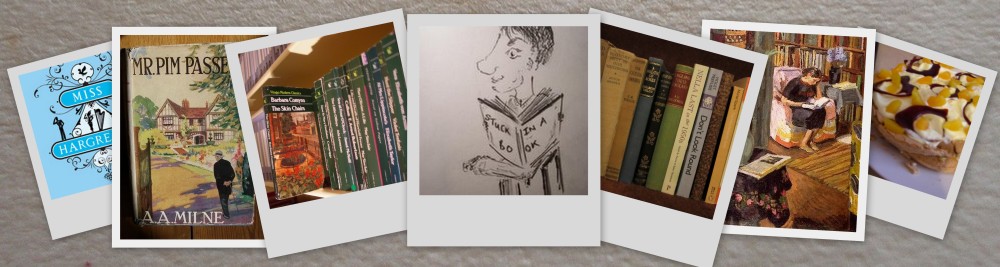
The Skin Chairs by Barbara Comyns

It’s about time I paid heed to Virago Reading Week, which has been popping up all over the blogosphere this, er, week. Thanks Rachel and Carolyn! I love it when publishers are hailed in this manner – long-term SiaB readers may recall I ran an I Love Hesperus week many moons ago, and of course have enjoyed Persephone readalongs, and cheered from the sidelines for NYRB Classics. As luck would have it – it certainly wasn’t my organisational ability – I happened to be halfway through a Virago when the week began, and even my current sluggish reading pace has allowed me to finish off The Skin Chairs by Barbara Comyns.


Props to Thomas (that’s a good American expression, right? As is that ‘right?’ there.) for his Virago banner, by the way. If you think you recognise those pics, head over here for Thomas’ competition.

It’s no secret that I love Barbara Comyns – she’s probably in my top five favourite authors, certainly top ten – and I’m fast reaching the end of her books. Just two novels to go… so I’m treasuring them as I go, and The Skin Chairs is no exception.

When I first started reading Comyns, I thought her novels were bizarrely different from one another, in terms of style. It’s only now, looking back, that I realise I started off with the three most disparate I could have chosen – Our Spoons Came From Woolworths, Who Was Changed and Who Was Dead, and The Juniper Tree. Having read more of her books, I realise that she does have an identifiable tone – surreal but matter-of-fact; an unnerving but captivating mixture, and one which leads to a very unusual angle on events. As shown most effectively in The Vet’s Daughter, but also on occasion in The Skin Chairs, even cruelties are dealt with in this unshockable, even tone. Here’s an example:

When she had gone we let Esme’s mice loose in the sitting-room, although they didn’t seem to enjoy it much, keeping close to the skirting board most of the time. There used to be a girl in our village who was continually beaten by her parents and I remembered she used to walk like that, close to the walls.

Lest you think this is a miserable book, I must add the scolding given to children when they sit on some graves: ‘Nanny found us and said that we had no respect for our bottoms or the dead.’ There are plenty of laugh-aloud moments.

The Skin Chairs is told in the voice of ten-year-old Frances, one of six children, who must go and stay with her Great-Aunt’s family: ‘My mother[…] sometimes became tired of us and would dispatch us to any relation who would agree to have one or two of the family to stay.’ Shortly after this, and having endured Aunt Lawrence’s unwelcoming home, Frances’ father dies and the rest of her family move to an unlikeable, small modern house. Relative poverty is a theme throughout Comyns’ writing, and she relishes writing of their privations – nightdresses made out of old sheets; ‘not being able to play with paint’, and so forth.

As with other Comyns novels, not much happens. This one has a little more of a central thread through it than some, in terms of the family’s destiny, but Comyns is best at her bizarre hangers-on. Chief amongst these is Mrs. Alexander, with her red-purple hair, turbans, mustard-coloured car, and golden shoes (repainted each evening by her chauffeur.) She keeps monkeys, and cleverly builds a wall after buying a piano, so that the bailiffs can’t remove it when she goes into debt. Then there is young widow Vanda, who neglects her baby, but thinks she’s doing a good job as the infant never goes short of orange juice. How Comyns thinks of all the tiny details, I can’t imagine. So many are bizarre and wonderful – unexpected, but not dwelt upon – and always mentioned so calmly.
The first day at school was not so bad as I expected. The worst part was when most of the girls trooped off into the dining-room and we had to eat our sandwiches in one of the classrooms. The only other occupant was a particularly plain girl wearing a patch plaid blouse and eating a pork pie. She said she adored eating pork pies and ate them in her bath.

And those skin chairs of the title? Yes, they’re human skin, and belong to a Major who lives in a large house in the village. They pop up near the beginning of the novel, and reappear every now and then – with some significance, but the true justification for the novel being called The Skin Chairs doesn’t rest with that. I think they’re the perfect symbol for what Comyns does best: the domestication of the surreal; the macabre passed over with matter-of-fact interest, and no more – there is probably a girl eating a pork pie close by, which will be equally involving.

If you haven’t read any Comyns yet, I urge you to do so (The Skin Chairs is going for a penny on Amazon.) The more I read of her, the more I feel sure that she has been unjustly neglected – and is one of the most intriguing novelists of the twentieth-century.

Age Shall Not Wither Her…

I know I’ve used this post title recently, but it seems so appropriate for tonight’s post that I’m using it again. And you know what it’s like – you wait months for a sketch, and you get two at once. I know my little cartoons aren’t the best in the world, but I’ve missed doing them and I think it adds something a little different to my blog – so I’ll try and remember to do more!


Anyway – this post was inspired by something a friend asked me the other day about the book I was reading: how old was the author when he wrote it? And I realised that I almost never know the answer to that question – unless it’s someone like Daisy Ashford. So, my question to you (let’s put it in bold, eh?): when reading, do you think about where the book falls in the timeline of an author’s work, and do you think about the author’s age when writing?


I’d love to know your answers. The only author I can think I do this with is Barbara Comyns – because her novels fall into two very different periods, separated by twenty years. Other than that, I rarely know whether I’m reading an author’s first, middle, or last novel – or whether they were 26 or 86 when they wrote it.

Over to you…

There is nothing like a…

I mentioned yesterday that I’d only finished one book in 2011, and that I’d be writing about it soon. Well, I’ve now finished two, and I’m going to write about the one I finished last night – because it’s rather easier to write about than Howards End, which I feel I should Think About Properly.

No insult to Dame Judi Dench, but I don’t feel I need to think so vigilantly about her book And Furthermore. (And, before I forget, thank you Becca for giving it to me for my birthday!) Well, we should be clear from the start – this is John Miller’s book, written after (presumably lengthy) conversation with Dench. He wrote her biography, and has turned Dame J’s anecdotes into book-form here. The brief diary she includes from her own pen, about attending the Oscars, reveals that she is no natural writer – but, then, she doesn’t pretend to be. But she couldn’t have picked a better man to write things down for her. One of the most amusing things about watching Miller and Dench in conversation back in 2004 was that he knew her life so much better than she did. Judi would refer vaguely to doing a play somewhere in the mid ‘sixties, for example, and Miller would know the venue, year, date, cast… bizarre!

And Furthermore is, essentially, a collection of anecdotes. For those of us who have read Judi Dench: with a crack in her voice by John Miller, they aren’t all new – but no matter. It covers Dench’s acting career – primarily in the theatre – and only occasional mention is made of her private life, and her childhood is covered in a handful of pages. As a rule, a biography focuses on the career and an autobiography on the childhood – or so I have found – so it’s nice to have an autobiography which looks mostly at the area which interests me most. Because it is Dench’s decades of theatrical experience which captivate me – each play seems to come with its own amusing or intriguing incidents, and I love the atmosphere conveyed of being part of the company. It’s a little secret of mine, but – were my talents different, and my life headed in a different direction – I’d love to be an actor. I can’t act, and I’m not confident or energised enough, so this is no genuine ambition – but I love reading about repertory companies and imagining being in one. TV and film acting doesn’t have the same appeal, in my eyes – it is the theatre that I love reading about.

And Dench doesn’t hesitate to call theatre her first love. It is through other media that I have mostly seen her – I love or admire As Time Goes By, Cranford, Iris, Mrs. Henderson Presents, Notes on a Scandal, and so on and so forth – but I have had the privilege to see Judi once on stage, in All’s Well That Ends Well. I think being alive while she is performing, and not seeing her, would be an absurd abuse of the possibility that future generations will envy. That’s how I feel about Mrs. Patrick Campell, Margaret Rutherford, Peggy Ashcroft – none of whom, of course, I had the opportunity to see. And I am determined to see Maggie Smith on the stage, if she ever returns to it. Sorry, I’m getting distracted… What I intended to do was segue into this quotation:
I am so often asked, ‘Does the audience make any difference?’ Of course! It is the only reason you bother to be in the theatre, in order that tonight it can be better than last night, that you can crack something that you haven’t yet, that this audience will be quieter, that this audience really will at the end think they have had a marvellous experience, and you have told the author’s story. I always get that very depressed feeling at the end, and then miraculously a night’s sleep somehow prepares you for doing it a step up the next day.With any autobiography, it is the author’s personality that comes across. This is mediated here, of course, by Miller – but I still think the reader can get a little closer to Judi Dench than in a biography. She is perhaps a little sharper than might be expected, a little keener to have control over performances – but what struck me most was her deep sensibilities for writing. The great actors are also, in a way, the great literary critics. True, they work only on the level of character – but what a deep understanding of character they must have. When Dench says that Hermione would think this, or Beatrice speak thus, or Portia behave in this way, I am impressed by the full and thorough life she can breathe into words on a page.

So – sometimes the anecdotes don’t quite work; there are often punchline-statements which seem a little flat, but these are miniscule quibbles in a wonderful collection of stories and a unique set of experiences. Well, perhaps Dench’s is not a unique perspective (except in the way that any would be) but hers is a highly unusual and significant vantage over more than six decades of the theatre. Even if I did not love Judi Dench – and of course I do – this would be an incredible record of the theatre by one who knows it about as intimately and broadly as anybody possibly could.

But – I shall let Dame Judi have the last word:
Actors are really remarkable people to be with. I love the company of other people, but I love the company of actors, and to be in a company. My idea of hell would be a one-woman show, I wouldn’t be able to do that, I wouldn’t know who to get ready for. The whole idea of a group of people coming together and working to one end somehow is very appealing to me. It is the thing I have always wanted to do, and I am lucky enough to be doing it. You don’t need to retire as an actor, there are all those parts you can play lying in a bed, or in a wheelchair.

More books…


As usual, I have a small stack of books waiting to be reviewied, including the only book I’ve actually managed to finish so far this year. It has been a rather lean January, for some reason – something of a reading slump. But not a buying slump, as this post will attest – I’ve been buying with abandon again.

The books fall broadly into old-and-characterful, and newish-and-colourful. Here goes:


Not very revealing, are they? I’ll illuminate you – we have:

– Going Abroad by Rose Macaulay : which I found in a charity shop. I’m building up a nice stock of Macaulay novels to enjoy.

– Uneasy Money by P.G. Wodehouse : a cheap Wodehouse never hurts, does it?

– The Houses In Between by Howard Spring : an e-friend, Carol, is a big Spring fan, so I thought I’d give him a go. Any Spring readers out there?

– To Tell My Story by Irene Vanbrugh : I mentioned the other day that this theatrical autobiography was in the post to me. In my reading slump I find myself hankering after non-fiction rather more than fiction, so this might leap-frog all the novels waiting patiently by my bed.


And the more colourful books.

– Romantic Moderns by Alexandra Harris : was a 2010 title I wanted and waited for – I anticipate dipping in and out quite a bit.

– Tarr by Wyndham Lewis : is the next read for my book group, and kindly provided by the good people at Oxford University Press. Fantastic cover image.

– The Gingerbread Woman by Jennifer Johnston : is probably coming up soon for my other book group, depending on how the online vote goes, but this archive review of Kim’s has made me want to read it.

– Housekeeping by Marilynne Robinson : I still haven’t read Gilead, but I thought I’d get this one in readiness, in case it launches me on an immediate Robinson rampage.

– The World I Live In by Helen Keller : a reader had requested this at the Bodleian, and it so intrigued me that I went and got a copy myself.

Stuck-in-a-Book’s Weekend Miscellany

Happy weekend, one and all. Col and Mum were here today, so we were a vicar and a cat away from being a whole family reunion. But I’ll whip out a quick weekend miscellany, and wish you well for Saturday and Sunday.

1.) The link – is to the South Bank Sky Arts Awards website. Leanne has sent me a nice email and asked me to ponder (and I in turn shall ask you to ponder) who I think should be awarded a South Bank Sky Arts Award for Literature.

Well… as you probably know, most of my favourite authors are dead, so this is tricky. The nominated authors are Edmund De Waal, Barbara Trapido, and Candia McWilliam. From that list, I’d give Trapido the award – not least (perhaps solely) because she’s the only one I’ve read.

Hmm.. do you know, I can’t think of any novel published last year that I actually thought was really great? I know I only read a handful… Well, I’m going to be controversial and award the prize to Debo Devonshire. Over to you…

2.) The blog post – is Lifetime Reader’s great review of Evelyn Waugh’s The Loved One, one of my favourite books read last year. Do pop over and have a gander.

(And if you’re in the mood to read a review of an Elizabeth Taylor novel, you’re rather spoilt for choice this week – see what Harriet has to say about At Mrs. Lippincote’s and Simon S’s thoughts on Blaming.)

3.) The little bit of info. – comes courtesy of David Nolan, a blog-reader who has his eye on the pulse and often spots little gems. He emailed me to let me know that Radio 4 will be playing three of Tove Jansson’s short stories. They’re on at 3.30pm Tues-Thurs (and afterwards, of course, on iPlayer). More info here. Thanks, David!


4.) The book – is a kind gift from Deanna, who got in touch to say she had a Muriel Spark going spare. It’s flown across the Atlantic, and is now sitting in my tbr pile, waiting for my next novella reading weekend. ‘Curiously disturbing’ (as the cover proclaims) doesn’t sound like something I’d leap at, but in the hands of Spark, I know I’d find it enthralling. Thanks so much, Deanna!

So…

Colin is staying, so I’m not going to be anti-social and blog at LENGTH, but I will ask this – I’m currently loving Judi Dench’s And Furthermore, and wondered if you could recommend any other theatrical memoirs? I’ve ordered Irene Vanbrugh’s To Tell My Story (anyone read this?) and would love any other ideas…

Ladies and Kittens of the Jury…

YAHOONEWSGLOBALS.thisStoryUrl = ‘/ynews/20110118/r_t_ynews_od/tod-cat-summoned-for-jury-service-045b8e8_1’;

This is a great, not-remotely-literary story I saw here on Yahoo! news…
A tabby cat has been selected for jury duty in the US after his owners registered him on a state census form.

The bizarre letter was sent to the cat, which was listed in the pets section of the census, by a court in Boston, Massachusetts calling on him for duty.Cat owners Anna and Guy Esposito wrote to the court asking the family pet, named Sal, to be excused from service because he doesn’t speak or understand English.Mrs Esposito reportedly included a letter from her vet confirming that the cat was a ‘domestic short-haired neutered feline’ and not human.However, the request for the cat’s exemption was refused by a jury commissioner and Mrs Esposito was told that Sal ‘must attend’ Suffolk Superior Crown Court.She said: “When they ask him guilty or not guilty, what’s he supposed to say – meow?””Sal is a member of the family so I listed him on the last census form under pets but there has clearly been a mix-up.”The Daily Mail reported that Sal could have accidentally ended up on the juror list when paperwork was misread at the last census.According to the Massachusetts judicial branch website, US citizens who ‘do not speak and understand English sufficiently well may be disqualified.’If Sal’s application for disqualification is denied, the cat is expected in court on 23 March.

In the presence of…

I do like it when bloggers share little snippets from books they’ve read, or are reading, especially when these excerpts are anecdotal in nature. And so I thought I’d share something I read years ago in A.A. Milne’s (brilliant) autobgioraphy, and which has stayed with me:
[J.M.] Barrie told me of an occasion when he was present at a gathering of young authors all very busy talking about style. An older man sitting aloof in a corner, but listening intently, was asked to contribute to the discussion. He confessed uncomfortably that he had never thought about the subject: he would rather listen and learn what he could: he really would have nothing to say of any value: they all knew much more than he did. Fearing to be drawn more deeply into the argument, he added that he had to go now, and slipped out. “Who was that?” Barrie was asked. Barrie, who had brought him there, explained that it was Thomas Hardy.

Strange Glory

One of the books I bought during Project 24 was Strange Glory (1936) by L.H. Myers. For some reason I had jotted down this name during my doctoral research, and so I bought it when I spotted it in my favourite shop in Oxford, Arcadia. Having read it (quite a while ago, actually) I have no idea why I decided to write it down. It wasn’t remotely helpful for my research… but it was interesting enough.

It starts with Paulina stopping her chauffeur next to a mysterious wood in Louisiana. She is off to meet her fiancee, but is captivated by the wood instead – and the equally mysterious man she spots amongst the trees. Strange Glory returns to Paulina’s life once every year, as she returns to the wood and to that man – whom she thinks a hermit – as gradually she detaches herself from her life of privilege and gravitates towards a new life.

To be honest, Myers lost me a bit sometimes. I read most of the novel on a long train journey, and when I returned to it I had great trouble working out what was going on. (That’s the sort of confession you won’t find in a newspaper review.) The second half of the novel becomes a sort of love triangle, with left-wing politics thrown into the mix, and for me it lost a bit of its mystique. Reminded me a little of David Garnett’s Aspects of Love, which I didn’t particularly love.

But why did I still enjoy Strange Glory? The aura of mystery does pervade it, and Myers’ description of the woods helped deepen a narrative which could have remained quite dull. Here’s an example – if you like this, then you might well enjoy the novel as a whole:
She woke from her musings to find herself passing through country that she had never seen before. The sun, now high overhead, was shining fiercely through a white haze. Fields of short, greyish grass bordered the road, and behind there rose clumps of huge, moss-hooded trees, the outposts of a line of forest. In the chalky, violet sunlight these mountainous forms loomed up hollow and spectral; they looked like lumps of foam left by a withdrawing tide. And the forest behind seemed to be more unsubstantial still – hoary and unsubstantial with an ancientness independent of time. A frontier of mystery, it stretched on for mile after mile; always the same distance away, it tantalised Paulina until suddenly the road made a turn, and the car rushed into it and was engulfed. At once a cool, swampy smell filled the air; pools of water glittered in the half-dark, the car plunged through clouds of noise that came from the throats of countless frogs.Even though Strange Glory proved fairly useless for my research, it was yet an entertaining diversion and a glimpse into unusual territory for my reading. The blurb describes it as ‘transcendental’. Perhaps it is no coincidence that L.H. Myers is the son of F.W.H. Myers, who wrote a rather bizarre (and very long) two volume work on the unconscious mind, called Human Personality and Its Survival of Bodily Death which enjoyed a vogue in the early 20th century. Not the sort of work I’d particularly enjoy in purported ‘non-fiction’ (although it does currently sit on my desk, for research purposes) but when this sort of thing influences fiction, it can lend a haunting quality.

One of my more unusual and eccentric choices for Project 24, perhaps, but I’m glad I’ve read it – and there a few cheap secondhand copies over the internet, should you wish to sample it yourself.

Books to get Stuck into:

The Haunted Woman – David Lindsay: Lindsay was a friend of Myers, and weaves odd metaphysical elements into this unusual novel.

The Man Who Planted Trees – Jean Giono: not the most obvious of connections, but equally captivating in its depiction of woodland as the central force of a narrative.

Stuck-in-a-Book’s Weekend Miscellany

Happy weekend, one and all. Hope the weather where you are is a little less gloomy than Oxford… roll on spring. But, before that, roll on a book, a blog post, and a link. Today’s Miscellany is a little more verbose than most…

1.) The link – (which is actually a blog post, I suppose.) The other day I reviewed Remember Remember by Hazel McHaffie, a novel with the theme of dementia. I intended (were I to summarise in a single line) to write something along the lines of ‘This is a good novel; the second half is rather better than the first half.’ That would save me an evening! And it is – a very interesting idea, executed skillfully and with feeling. Re-reading the review, from the author’s p-o-v, I realise that my quibbles seemed to dominate, and my praise perhaps get a bit lost. But I didn’t really have to try and work out the author’s p-o-v, because Hazel got in touch – and has written this response to my blog post.

I’ve got to say, I felt flattered that Hazel thought my blog post worth responding to, and read her thoughts with much interest. I was rather mortified to realise that my review had come across worse than I meant it to (Hazel and I have since exchanged friendly emails!), but it also made me want to say something which is perhaps controversial. I do believe that the very worst writer (which, of course, Hazel is not anywhere close to being) is somehow on a higher plane than the best reviewer/blogger. To be creative is so much more valuable than to analyse creation. So my view, really, isn’t that important, in comparison…

That sounds negative about blogging, doesn’t it? It wasn’t meant to – rather I wanted to celebrate writers. Of course, blogging can cross over into ‘creative writing’ territory, but generally I admire those wonderful people who create novels – and must remember to be humble as one who merely writes about them.

Oh, and my failure to get on board with Aaron in Remember Remember does (as I have told Hazel now) put him in the same category as Mr. Rochester, Mr. Knightley, and Heathcliff!

2.) The blog post – is Pamela’s beautiful list of ‘Simple Pleasures’… which just happens to include Miss Hargreaves…

3.) The book – is Vanessa Gebbie’s new short story collection, Storm Warning, which sounds intriguing. I reviewed an earlier collection by Gebbie forever ago, here. And here’s what her publisher (Salt) have to say about Storm Warning: Storm Warning explores the echoes of human conflict in a series of powerful stories and flashes inspired by life with the author’s own father, an ordinary and gentle man who fought and was decorated in WWII, but who suffered the after-effects for the rest of his life.

The conflicts range from conventional warfare through violent tribal clashes to historical religious persecution. Gebbie’s viewpoints are never predictable. War veterans are haunted by events that echo louder and louder. A prisoner sees the violent execution of a friend and mentor, a boy hides from a necklacing, a young student escapes the fighting in Iraq in the hope of continuing his education in the West and a woman tells what she knows of her parents’ torture.

Echoes of conflict are often explored from the child’s perspective. A young girl witnesses an attempted escape over the Berlin Wall. Another is present when her grandfather, a writer, is targeted in the Russian Cultural Revolution, and two small boys are unwilling bystanders to atrocities in African inter-tribal conflict.

The people in these stories are not those who go down in history. They are the ordinary troops. They are the powerless, caught up involuntarily. All are tested, sometimes to breaking point, in this extraordinary collection as Gebbie pulls no punches, exploring the surreality of conflict, the after-effects of atrocity and sometimes, the seeds of atrocity itself.