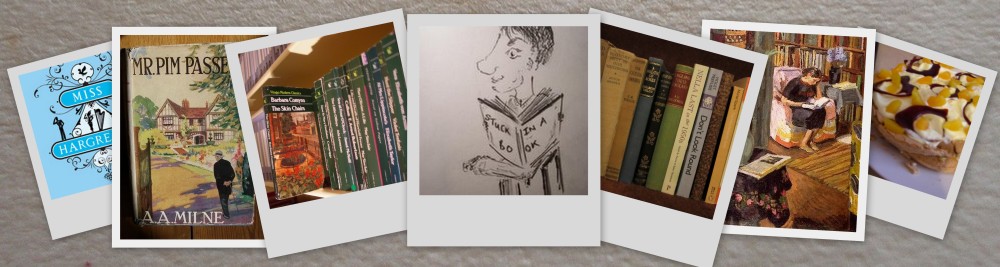
Booking Through Thursday : The Other Side of the Coin

Last week we discussed our favourite female characters… well, Booking Through Thursday have done the sensible thing and evened up the balance – who are your favourite male lead characters?

I found this much more difficult. Most of the novels I read, certainly most of my favourite novels, tend to be written by women and have female protagonists. The empathy lies with the woman, often in the first person, and so the male characters become obstacles or love interests or in some way affect the female. Difficult to treasure a character without empathy. Especially since a lot are in the Rochester / Mr. de Winter model (i.e. quite irritating and bafflingly attractive to women) or Heathcliff model (wholly loathsome) or Mr. Darcy model (ok… but mostly there to track the development of the heroine.)

I’m not getting very far, am I? Would Eeyore count, I wonder? I’m very fond of Norman, the narrator of Miss Hargreaves, but he pales in comparison to Miss H herself. I think I might have to plump for the anonymous narrator of Jerome K. Jerome’s Three Men in a Boat, alongside the loveable Mr. Bingley. Why do I have to look so far back to find any male characters who are kind without being pathetic, or witty without being crude? C’mon, novelists, we boys need some role models

Blinking, Bells and Butterflies

Doing well on yesterday’s challenge, people – keep up the good work!

I read another Oxford Book Group book today – in fact, had to request it to a reading room and read it all in my tea breaks. Luckily it was quite short. That’s what happens when the entire book is dictated by the winking of an eyelid.

I don’t know how familiar people are with Jean-Dominique Bauby’s The Diving-Bell and the Butterfly? A film is coming out soon, so perhaps that has helped it leap to the public eye. It is basically the selective autobiography of an editor-in-chief of Elle magazine who has a major stroke and is left with locked-in syndrome. As he points out, the first (and he suggests, only) character in literature to have this condition is Noirtier in Dumas’s The Count of Monte Cristo. He can no longer move any of his body, except his left eyelid, but retains total cognitive ability. The French term for it, “maladie de l’emmuré vivant”, literally means walled-in alive disease.

How does one make a book out of this? Well, if it weren’t true, it could only be used as a tasteless or lazy gimmick in the background of another narrative – as it is, Bauby writes an honest but witty account, heart-rending but not chest-beatingly gloom. Alongside day-to-day occurences, like the visit of his two children, Bauby intersperses nostalgic recollections, ironies, witty musings and a very human frustration and spirit. He is able to see the humour in a desperate situation – one of my favourite bits, which had to be translated for the version I read, was when he asked for his glasses, only to be stopped early and asked why he wanted the moon (lunettes; lune). And in some ways (forgive me if I stretch a point) that is what The Diving-Bell and the Butterfly performs – the mundane alongside the extraordinary; the glasses alongside the moon. Though a slim volume, Bauby has created a beautiful elegy to living and a pathos-filled account of life as an observer rather than participant. You will finish this autobiography recognising the fragility of existence, but laughing at the pomposity of any such idea in the face of Bauby’s humour and stubborn refusal to let even the most extreme situation crush him.

Easy as ABC

I was hoping to write a few more book reviews but, shamefully, I haven’t finished a book in a while. One of these days there will be an onslaught of recently-read books, but I’m afraid there is a review pile which is rapidly growing and never diminishing. Sorry! Instead, I shall offer a little mind-troubler. My Aunt Jacq. and I are regular correspondents (which reminds me, it’s my turn to write – will get to it soon, Jacq!) and used to often set little literary challenges for each other. One of the ones I liked best was an ABC sort of puzzle. The variety which doesn’t leave one’s mind all day…

It’s authors whose titles begin with the same letter as their surname… like Austen and… erm… no, let’s try Bronte and… wait a moment… Dickens and Dombey and Son, there’s one. Woolf and The Waves. You get the idea… harder than it thinks. Let’s see if we can cobble together an alphabet between us – I’ve got D and W sorted. Only ABCEFGHIJKLMNOPQRSTUVXYZ to cover…

Mostly Books Event

Oh, what a lovely evening. I’ve just come back from Abingdon, more specifically the wonderful Mostly Books, where Angela Young and Eliza Graham were speaking. What a lot of links for you to visit. These two novelists are on the shortlist for World Book Day’s Spread The Word competition, whittled down from a longlist of 100. Voting has finished and the winner will be announced soon, but (heartwarming truism alert) all the shortlist are winners, especially these lovely ladies. You’ll know by now that I love Angela Young’s Speaking of Love, and I broke my Lentern fast and brought home Eliza Graham’s Playing With The Moon to read when I can.

This evening was cosy, held on the shop floor, and with a genuine love of books oozing through the atmosphere, from the authors, the audience and perhaps especially Mark who runs Mostly Books. Hope he won’t mind that I’ve stolen a picture from his webpage… It is encouraging and smile-making to know that booklovers are still running bookshops – yes, there has to be the commercial side, but Mostly Books shows the two can run alongside one another, to mutual benefit if not millionairedom.

My journey to the event was a little haphazard. Someone has carelessly dug up half of Abingdon Road in Oxford, the one road which I was fairly confident would lead to Abingdon. I flung myself onto the nearest bus which mentioned the town on its board… and was slightly disconcerted when it headed off in completely the opposite direction. I think we must have visited every village in Oxfordshire on the way. But, at 7.30 exactly, I was able to dash up to the bookshop, grab my wine, meet Angela, and settle down for an extremely enjoyable evening.

Since the voting was done and dusted, Angela and Eliza didn’t need to convince us to vote for Spread The Word – well, they’d be preaching to the converted, anyway. Instead, they chatted about how they came to write their respective novels, the editing process, how they found their publishers (Google “small publishers” is a good step, apparently!), how they got the book known (Google “sell my novel” – seeing a pattern?) and finally the difference the shortlist has made to them. In my attempts to claim fame by association, I was tickled pink that Angela mentioned Stuck-in-a-Book and her original email, asking whether I’d consider Speaking of Love for my 50 Books You Must Read But May Not Have Heard About. She called the email cheeky – but turned out to be entirely justified, of course! And there it sits, at no.14.

I also had the chance to meet local author Mary Cavanagh, whose The Crowded Bed was reviewed on here a while back – and lovely Mary even gave me a lift home. Thank you Mary! It was a pleasure to finally meet Angela, and Eliza of course, and to see the much-anticipated Mostly Books. I do hope to be back for other events in the future – and if you possibly can get to Abingdon, I encourage you to do the same!

Been there, Scene it.

And now I am a graduate! The ceremony was a mystery, I said “Do fidem” but what I was fideming to do, I have no idea – hopefully nothing too nefarious. Magdalen kindly provided a three-course meal beforehand, and some tea and sandwiches afterwards – the seal on the day was going up Magdalen Tower in full Graduation regalia. Actually, going up (and especially coming down) aren’t fun experiences, but thankfully Our Vicar was on hand to give me help and encouragement. Neither Latin nor heights are my cup of tea. Cups of tea, on the other hand, very much are.

The point of today’s stitch-inducingly-funny pun is another ponderer. What’s your favourite scene in literature? Not book, not character, but scene. Might be quite a tricky one to think about – some books don’t lend themselves to being split into scenes. Mrs. Dalloway, with its lack of chapters, for example. Some are very obviously divided into separate scenes – Rebecca comes to mind, for some reason. Well, it might not surprise you that my favourite scene comes from Pride and Prejudice – an exchange between two wonderful female characters which remains sharp and witty on every syllable, not a word out of place, and a delight to read. The Jennifer Ehle/Barbara Leigh-Hunt portrayal of it is nothing short of rapturous. Know which one I mean yet? It’s so brilliant, it’s included at some length below…

As always, over to you. Favourite scene in literature, and why? Think on’t… and you have to listen to me now. I’m a graduate, doncha know.

(Pride and Prejudice by Jane Austen; from Chapter 56)As soon as they entered the copse, Lady Catherine began in the following manner: — “You can be at no loss, Miss Bennet, to understand the reason of my journey hither. Your own heart, your own conscience, must tell you why I come.” Elizabeth looked with unaffected astonishment. “Indeed, you are mistaken, Madam. I have not been at all able to account for the honour of seeing you here.” “Miss Bennet,” replied her ladyship, in an angry tone, “you ought to know, that I am not to be trifled with. But however insincere you may choose to be, you shall not find me so. My character has ever been celebrated for its sincerity and frankness, and in a cause of such moment as this, I shall certainly not depart from it. A report of a most alarming nature reached me two days ago. I was told that not only your sister was on the point of being most advantageously married, but that you, that Miss Elizabeth Bennet, would, in all likelihood, be soon afterwards united to my nephew, my own nephew, Mr. Darcy. Though I know it must be a scandalous falsehood, though I would not injure him so much as to suppose the truth of it possible, I instantly resolved on setting off for this place, that I might make my sentiments known to you.” “If you believed it impossible to be true,” said Elizabeth, colouring with astonishment and disdain, “I wonder you took the trouble of coming so far. What could your ladyship propose by it?” “At once to insist upon having such a report universally contradicted.” “Your coming to Longbourn, to see me and my family,” said Elizabeth coolly, “will be rather a confirmation of it; if, indeed, such a report is in existence.” “If! Do you then pretend to be ignorant of it? Has it not been industriously circulated by yourselves? Do you not know that such a report is spread abroad?” “I never heard that it was.” “And can you likewise declare, that there is no foundation for it?” “I do not pretend to possess equal frankness with your ladyship. You may ask questions which I shall not choose to answer.” “This is not to be borne. Miss Bennet, I insist on being satisfied. Has he, has my nephew, made you an offer of marriage?” “Your ladyship has declared it to be impossible.” “It ought to be so; it must be so, while he retains the use of his reason. But your arts and allurements may, in a moment of infatuation, have made him forget what he owes to himself and to all his family. You may have drawn him in.” “If I have, I shall be the last person to confess it.” “Miss Bennet, do you know who I am? I have not been accustomed to such language as this. I am almost the nearest relation he has in the world, and am entitled to know all his dearest concerns.” “But you are not entitled to know mine; nor will such behaviour as this, ever induce me to be explicit.” “Let me be rightly understood. This match, to which you have the presumption to aspire, can never take place. No, never. Mr. Darcy is engaged to my daughter. Now what have you to say?” “Only this; that if he is so, you can have no reason to suppose he will make an offer to me.” Lady Catherine hesitated for a moment, and then replied, “The engagement between them is of a peculiar kind. From their infancy, they have been intended for each other. It was the favourite wish of his mother, as well as of her’s. While in their cradles, we planned the union: and now, at the moment when the wishes of both sisters would be accomplished in their marriage, to be prevented by a young woman of inferior birth, of no importance in the world, and wholly unallied to the family! Do you pay no regard to the wishes of his friends? To his tacit engagement with Miss De Bourgh? Are you lost to every feeling of propriety and delicacy? Have you not heard me say that from his earliest hours he was destined for his cousin?” “Yes, and I had heard it before. But what is that to me? If there is no other objection to my marrying your nephew, I shall certainly not be kept from it by knowing that his mother and aunt wished him to marry Miss De Bourgh. You both did as much as you could in planning the marriage. Its completion depended on others. If Mr. Darcy is neither by honour nor inclination confined to his cousin, why is not he to make another choice? And if I am that choice, why may not I accept him?” “Because honour, decorum, prudence, nay, interest, forbid it. Yes, Miss Bennet, interest; for do not expect to be noticed by his family or friends, if you wilfully act against the inclinations of all. You will be censured, slighted, and despised, by every one connected with him. Your alliance will be a disgrace; your name will never even be mentioned by any of us.” “These are heavy misfortunes,” replied Elizabeth. “But the wife of Mr. Darcy must have such extraordinary sources of happiness necessarily attached to her situation, that she could, upon the whole, have no cause to repine.” “Obstinate, headstrong girl! I am ashamed of you! Is this your gratitude for my attentions to you last spring? Is nothing due to me on that score? Let us sit down. You are to understand, Miss Bennet, that I came here with the determined resolution of carrying my purpose; nor will I be dissuaded from it. I have not been used to submit to any person’s whims. I have not been in the habit of brooking disappointment.” “That will make your ladyship’s situation at present more pitiable; but it will have no effect on me.” “I will not be interrupted. Hear me in silence. My daughter and my nephew are formed for each other. They are descended, on the maternal side, from the same noble line; and, on the father’s, from respectable, honourable, and ancient — though untitled — families. Their fortune on both sides is splendid. They are destined for each other by the voice of every member of their respective houses; and what is to divide them? The upstart pretensions of a young woman without family, connections, or fortune. Is this to be endured! But it must not, shall not be. If you were sensible of your own good, you would not wish to quit the sphere in which you have been brought up.” “In marrying your nephew, I should not consider myself as quitting that sphere. He is a gentleman; I am a gentleman’s daughter; so far we are equal.” “True. You are a gentleman’s daughter. But who was your mother? Who are your uncles and aunts? Do not imagine me ignorant of their condition.” “Whatever my connections may be,” said Elizabeth, “if your nephew does not object to them, they can be nothing to you.” “Tell me once for all, are you engaged to him?” Though Elizabeth would not, for the mere purpose of obliging Lady Catherine, have answered this question, she could not but say, after a moment’s deliberation, “I am not.” Lady Catherine seemed pleased. “And will you promise me, never to enter into such an engagement?” “I will make no promise of the kind.”

The Graduate

Brief post today – just to say I’m graduating tomorrow!

A ceremony in the Sheldonian (pictured) where we will have someone speak at us in Latin, bestowing upon us the Power of Lecturing, amongst other things. After that I will be able to wear my mortar board (cap) as much as I like – up until this date it came with a £35 fine. But had to be carried to exams.

All rather silly, but also rather special. I’ll let you know how it went…

Heroines

Booking Through Thursday always comes just when my topics are drying up. You might have been treated to the anecdote about how I thought my camera had broken yesterday, only it hadn’t, or a detailed examination of a pillow – instead, there is something you might well find interesting to read and to which to respond!

Who is your favorite female lead character? And why? (And yes, of course, you can name more than one . . . I always have trouble narrowing down these things to one name, why should I force you to?)

Yes, you guessed it – I’mgoing to hedge my bets and pick a few favourites. I’ve even turned them into an Identi-Kit picture, so you can spot my ideal heroine, should you see her misformed body wandering along the street.

So which three females made the grade? First and probably foremost – well, it has to be Elizabeth Bennet, doesn’t it? I’d be astonished if she weren’t the most popular choice this week. Wit, gumption, self-knowledge, affection for those around her, intelligence, beauty, morals, self-deprecation, eventual wisdom – what is there not to like in our Lizzie? She, in case you wondered, makes up the torso and arms of our Ideal Heroine. No particular reason why those bits.

Second (the legs downwards) is the indomitable Miss Hargreaves. For more on Connie, see more or less every post I’ve ever written, or this one in particular. Incorrigible, unflappable, musical, quite selfish but often very loving, and unintentionally hilarious Miss Hargreaves is everything a comic character should be, and my life would be a duller place without her in it. She’s brought along Sarah, her dog, and a cockatoo called Dr. Pepusch, hope that’s not cheating.

And the head – The Provincial Lady. Well, it’s actually her author, E M Delafield, but needs must. Again, witty and self-deprecating, ironic, long-suffering and eternally provincial, she is the architypal everywoman, but also somehow unique.

So there we are. My three favourite female protagonists, and I can’t imagine the landscape of literature without the three of them. How amusing it would be if the three of them were in the same room. I think they’d probably loathe each other, but I would be delighted.

Letters, Pray

Following on from yesterday’s post about my own personal letters, we’ll move onto published letters. I think the topic has come up here before, and Karen has definitely discussed it, but I had a slightly different angle on the matter today.

I tend to read letters when I’m, um, otherwise occupied – useful to have something to peruse in snatches, where the thread won’t be lost if five minute bursts are the only opportunity nature affords – and have recently finished Dear Friend & Gardener by Beth Chatto and Christopher Lloyd. This is two years of exchanged letters, covering a few topics but almost always gardens and gardening. The scenario is a little unlike most collections of letters, in that these friends appear to have been approached by a publisher before the two years exchange began: this is from the last letter –

I suppose this’ll be my last letter of the year, which means of the series, but it does not mean that we shall stop writing to or telephoning each other. Just that was shall no longer be going public. I don’t think that has inhibited us much. The main difference, from a totally private letter, is the extra explanatory matter that is necessary, as, in this letter, ‘the autumn-flowering Crocus speciosus’. Obviously ‘autumn-flowering’ would be omitted in a wholly private letter, as we both know this perfectly well. Apart from that, perhaps the odd indiscertion had to be forgone, but nothing much.

Quite. I know absolutely nothing about gardening. As I read the letters, I got the feeling I was one of the people Beth and Christopher would most pity – someone who likes seeing gardens, but is content to remain in total ignorance as to how and why it looks like it does. These letters are littered with Latin plant names, and at one point Beth professes quite sweet astonishment that the public might not know them all. For subject matter, I couldn’t grasp this book – I read on because of the friendship and the passion these two writers exchanged. Dear Friend & Gardener is a small window on a practice I know nothing about, but also a thriving love of gardening that is both alien and captivating to me.

Have you ever read a book about something about which you knew nothing, only to be enthralled by the writer’s passion? A biography, perhaps, or letters or just regular non-fiction. I’ve never picked up non-fiction before unless I was confident I’d be interested in the topic, but in this genre – like any other – good writing can be read for itself, and spark an unknown interest.

The next collection of letters I’ve started is Letters to a Friend: The Spiritual Autobiography of a Distinguished Writer by Rose Macaulay. The ‘Friend’ in question is a Catholic priest in America, whose guidance and wisdom helped Macaulay rediscover her faith. Only Macaulay’s side of the correspondance is published, but so far it is proving witty, touching and interesting. And has a beautiful cover…

Boxing Day

Before I forget, anyone here regularly go to Buenos Aires? My least expected email of late was from some people who have written a guide to bookshops in Buenos Aires – if that meets a corner then have a gander here!

Now onto home territory – I thought I’d share a little purchase with you. Since I’m not buying books in Lent (which was particularly difficult when, in the same half hour, I came across a beautiful, signed book by Margaret Drabble for £3, and a ten-novels-for-ten-pounds boxset of Daphne du Maurier) I keep buying other things. Yes, I know, that’s not really the point… but I went into the shop to get a Mothering Sunday present, honest. In fact I also bought a Mothering Sunday present, but I’ll keep schtum on that for the meantime – Our Vicar’s Wife (along with Our Vicar and, from a different direction, The Caron Copy) is coming on Saturday for my Graduation, and will be given her gift then.

So what did I buy?
For a long time I’ve been looking for a box to keep letters in. Yes, yes, I know – any old shoebox would do. In fact, the shoebox was my container of choice during my degree, the result of which was a revision mountain which resembled Clarks at stock-taking time. But letters are different. I already have a small cream box with roses, for letters from my Aunt Jacq. Pictured above is a beautiful old green/wooden box for ‘general’ letters, but my friend Barbara-from-Ludlow had no receptacle for her letters. And where to find such a thing? The rose box was from a wonderful shop in Worcester, The New England Store, but we moved house and neither Oxford nor Yeovil have anything quite the same. The old wooden box was nabbed whilst sorting donations to a village fete – yes, in Worcestershire (fear not, I made a donation). So what to do?

Ah, Arcadia, you faileth me not. I wrote about this shop a while ago, in my Oxford tour, and it is perfect for gifts. And gifts to myself. In amongst potential Mothering Sunday presents lay a beauty of a box, which just had to be mine. Not too pricey, either. Cheaper than the Mothering Sunday present, which made me feel justified.

We may have chatted about letter writing before – but remind me! Do you write real-life letters to anyone? Or just email? And are there special places you keep letters you receive? Personal ones, of course, rather than bills and bank statements. I love going back and reading through old letters, and surmising (or wildly guessing) at what might have been my words between each received missive…

Mememememememe


Perhaps someone here knows – is ‘meme’ pronounced to rhyme with ‘dream’, or simply ‘me me’? It is a little navel-gazing-esque, but hopefully you will forgive that when I open up the arena to anyone who fancies joining in!
I took this from Harriet’s blog, and apparently it is quite famous as being James Lipton’s. Must confess I hadn’t heard of him, but perhaps that is not the benchmark of fame.(the picture isn’t relevant – I took it in the Lake District last Summer, and almost put running water as my favourite sound… so it’s staying!)
What is your favorite word? Solemnity What is your least favorite word? Onyx What turns you on creatively, spiritually or emotionally? creatively – reading (or reading about) Virginia Woolf; spiritually and emotionally singing worship songs to God!
What turns you off? sleep-deprivation
What is your favourite curse word? Fish. I know it’s not one, but it’s what I say….
What sound or noise do you love? Heavy rain against a window (when I’m on the right side of it) What sound or noise do you hate? things scraping against ice in a freezer
What profession other than your own would you like to attempt? Showing people around Jane Austen’s house
What profession would you not like to do? Surgery – Harriet’s answer is also mine!
If Heaven exists, what would you like to hear God say when you arrive at the Pearly Gates? Wow! Would He need to say anything? “I love you”, I think.