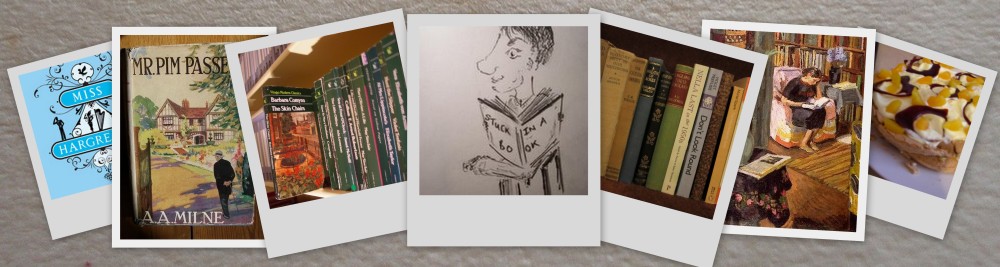

Yes, I know it’s not Thursday, but I saw this on Becca’s blog earlier in the week, and thought I’d wait until I couldn’t think of anything else to say… It’s been a while since I did a ‘Booking Through Thursday‘, and they’re always fun. Do feel extremely free to do this little quiz yourself on your own blog or in the comments here…
I’ve seen this series of questions floating around the ‘net the last few days, and thought it looked like a good one for us! What was the last book you bought? I bought two yesterday, which I’ll write about more soon… They are The Feminine Middlebrow Novel by Nicola Humble, and Lolly Willowes by Sylvia Townsend Warner.
Name a book you have read MORE than once Oo, lots. To make it more interesting, I’ll go for a book I’ve read four times, as it might be the only one – The Provincial Lady Goes Further.
Has a book ever fundamentally changed the way you see life? If yes, what was it? The Bible, of course, but aside from that… none spring to mind. Quite a few have changed the way I choose books and the type of books I read, but haven’t had fundamental effects beyond that.
How do you choose a book? eg. by cover design and summary, recommendations or reviews I usually, now, only read books I already own, or have been chosen by book groups I’m in, or if I know about the author already, or it’s linked in some way… Actually, thinking about it, most avenues of my reading started with AA Milne – after that, they’ve all somehow led from one to another and spread and spread. If I ever do a book on impulse, it will be because of the ‘feel’ of it – its age, cover, layout.
Do you prefer Fiction or Non-Fiction? Definitely fiction, but have been reading more non-fiction of late. I had a real hankering for some non-fiction when I finished my degree, and sometimes it’s just the right thing. Usually non-fiction associated with literature, though… Deceived with Kindness by Angelica Garnett springs to mind, which I STILL owe you a review of.
What’s more important in a novel – beautiful writing or a gripping plot? Has to be beautiful writing. Plot and character are great (The Time Traveler’s Wife got by on these two, for the most part) but for a novel to be truly loved by me, it has to have beautiful writing. I’ve re-read a little bit of Woolf today, and realised once more just how she’s head and shoulders above of everyone else I’ve read, for this quality.
Most loved/memorable character (character/book) Miss Hargreaves (from Miss Hargreaves by Frank Baker) always comes up here… but I do love her so. Eeyore is another. If I had to choose one to come to dinner it would be Jane Bingley.
Which book or books can be found on your nightstand at the moment? Let’s have a look… The Penguin Complete Saki (for my recent thoughts on Saki, see this post), What’s So Amazing About Grace? by Philip Yancey, and The Yellow-Lighted Bookshop by Lewis Buzbee (more here).
What was the last book you’ve read, and when was it? Orientalism by Edward Said, which I finished a couple of days ago. For class, I hasten to add… I hope to finish Alva & Irva by Edward Carey tomorrow – as book group is tomorrow evening!
Have you ever given up on a book half way in?A few times at university I had to stop because the essay was due in… aside from that, very rarely. Somehow I never got around to finishing The Mayor of Casterbridge by Thomas Hardy, so perhaps I should dig it out again…
All
End of an era

Yesterday I attended the last ever service at St. Cross Church, Oxford. I say last ever – it may still be used for the occasional service, but it was more or less the last one to be held there. St. Cross was my church between 2004-6, and I’ve been back to visit a few times since then – it’s a beautiful old Anglican church (some parts 800 years old) which has a very villagesque feel to it, and a similarly rural-feeling graveyard and cemetery which (not to sound too morbid…) I quite often go and sit in. Had my lunch there today, actually. It’s one of my favourite places in Oxford.

Anyway – the area around St. Cross is now almost entirely offices and businesses, with very few residential properties, and the congregation for the church had shrunk to the point where double figures for a service was an achievement. But despite, or perhaps because, of this, it has the warmest welcome and friendliest congregation of any church I’ve ever been to – it was a very difficult decision when I moved to the larger, more student-orientated, much less attractive Oxford Community Church, but even with two years’ absence I welled up during the farewell service. It was lovely to see fifty people there, saying goodbye – and, as the vicar pointed out, the church is not a building, it is a group of people. Even so, as the small attendance numbers made the running of St. Cross unfeasible and expensive, it was sad to think that people have been meeting there to worship God for centuries, and that was coming to an end. Its next incarnation (if plans go ahead) will be as an archival space and reading room for Balliol College – who will restore the chancel and do much-needed work throughout the church.

As I sat there, I thought of all the people who had encountered Jesus and praised God in that room, some perhaps for the first time, some spending their whole lives attending St. Cross, and I was pleased that I could join them all in a long line of people who have loved St. Cross Church.
Theatre question… and Alpha Male
Quick question for UK-readers of this blog who might be more culturally-minded than I am… any idea how you find out about who’s doing what in the theatre? Obviously I can find the ‘what’s on’ sections on theatre’s individual websites, and there are mountains of sites advertising tickets for the perpetual musicals, but where do I find out what Felicity Kendal and Penelope Wilton and Jennifer Ehle are up to? How does one know? Nothing like imdb.com for theatre, is there?
And now I’m going to wander into filmic territory, which is something of an unusual move for this book-orientated blog. I did wander through all my literary films back in the early days of this blog, but the one I wanted to mention tonight doesn’t even come under that category – except that I came to it by route of Pride and Prejudice. More particularly, the sublime Jennifer Ehle and her unmatchable portrayal of Elizabeth Bennet – since that day I have been keeping my eye out for Jennifer Ehle’s other roles. There haven’t been many. And when they exist, she tends to get shunted to a minor role (for example, the upcoming film Pride and Glory). BUT there is a gem, one which gives Jennifer Ehle a lead role, and which is beautiful and thoughtful and delicately touching. And that film is Alpha Male.

Yes, I know. It sounds like it’s about stock-car racing, but I promise it’s not. Jennifer Ehle plays Alice, mother of Jack and Elyssa, and newly widowed. The film plays out between her first marriage and her second relationship, several years later as Jack turns 21, moving back and forth between these time periods (you do have to rather rely on Ehle’s hairstyle to work out which time period you’re watching, as Danny Huston and Patrick Valli look incredibly similar). Neither child reacts well to the changes – Elyssa gently sinking into a hallucinatory illness and Jack estranging himself from the family he blames – but it is Ehle’s sophisticated, reserved, bereaved and slightly helpless Alice who stands out. Jennifer Ehle could act a three act play with just her eyes, which are endlessly expressive, and Alpha Male gives her the scope to do more or less that – though apparently there was an even better director’s cut. The DVD I have was supposedly altered in an attempt to make it ‘more commercial’ – which I imagine failed. Not much plot happens here, it is rather about beautiful cinemtography, refined, sensitive performances and an undefinable atmospheric quality. Only one other person I know has seen this film, and she found it quite dull (be warned, I might be alone!) – it’s not packed with action, but it is one of the best films I’ve seen in the last few years. And anything with Jennifer Ehle at the helm can’t be bad, now, can it?
Well Well Well(s)
Once, in our GCSE English class, we did a Weakest Link style game. My question was ‘Who wrote The Time Machine’, and I said George Orwell, and felt rather stupid. The same thing happened tonight at the latest drinks to welcome English Masters students…
Well, not quite the same thing, obviously. But an eminent and doubtless redoubtable fellow of St John’s College was asking me about my dissertation topic, and I mentioned middlebrow domestic literature and got the customary recoil – but it got worse when I started talking about the use of the word ‘middlebrow’, saying that George Orwell coined the term, but Virginia Woolf refined it. Perfectly possible, I suppose, since he was born 38 years before she died. But, of course, I had made the same mistake again, and meant H.G. Wells. And then felt very stupid while the said eminent and doubtless redoubtable fellow laughed at me and started talking to someone else…
What made matters WORSE was that I was standing next to a group which included Hermione Lee, and very much wanted to go and say hello, but didn’t want to be rude… and then she left quite early. I do hope I have the chance to see her later in the year…
Also amusing quite how many of the English doctorate students recognised me from my days behind the desk in the Bodleian.
So! Another day in the world of a new Oxford graduate. Another drinks party next Monday… Please make me feel better by sharing any similar incidents from your lives.
It was just an Occident…
First things first, your guesses on my book total have left me feeling quite inadequately stocked! Peter was closest with his guess – the actual total is 1347. To put that in perspective, it’s rather more than one a week since I was born. Eeps.
I’ve spent large chunks of today embroiled in Edward Said’s Orientalism… gosh.
Don’t know what to write about it, as it’s not going to be the sort of thing I’d read for pleasure, though perhaps I underestimate the stamina of my blog readers – perhaps theoretical history is your bedtime reading. All fairly interesting – the history of Orientalism as an acedemic pursuit, as a Western colonial concept, and as an Eastern voice. Lots of springboard topics for my Literature of Empire and Nation module, but also set for Week 1 of the core course for my Masters. Which apparently will look at the differences between modernity and Modernism, as well as at colonialism and so forth – seems quite a lot to handle in a two hour session, so will keep you posted. The modernity/modernism has some interesting avenues into the middlebrow area which interests me so much, and how this enormous section of literature can be studied to nuance an understanding of the period, rather than seeing it just as High Modernism.
Speaking of which, it won’t be very long before I have to start thinking about my Doctorate Application… gosh. In fact, I’ll have to submit my proposal before I’ve started my Masters dissertation… which seems quite silly, but there you go. Not reasoning why, and so forth. But I’m sure you’ll all come along for the ride (!)
Tigers and Time Travelling
I was waiting for Colin to reveal the answer to the Tiger puzzle on his blog, and he hasn’t… so I shall tell you… well, I’ll let newcomers have a look first. Can you spot the hidden tiger…..
no?
well… look at the stripes of the tiger in the foreground. Look realllly carefully. And you’ll spot the hidden tiger. Or should I say ‘The Hidden Tiger’. Now you’ve seen it, isn’t it obvious? I know!
Onto completely different territory, I’ve just finished The Time Traveler’s Wife by Audrey Niffenegger, for my book group. Yes, how did I manage to fit 500+ pages into my reading schedule… I wasn’t sure I was going to make it, but thankfully Niffenegger’s novel was such addictive reading (coupled with not being able to sleep for large portions of a couple of nights) that it took a matter of days.
The Time Traveler’s Wife [oh how my British blood boils at having to use only one ‘l’ in traveller] has been on my shelves for a few years, I think I bought it a few months after it was published, but the size of the thing put me off. As did, more recently, this review on Vulpes Libris. And this, rather pithy, review on Lizzy Siddal’s blog. Two bloggers I respect hated it a lot. So why did I love it?
Ok. Best to acknowledge the faults first.
Wait. Before that, I suppose some of you won’t know the plot, though it seems more or less everyone in the world has read this before me. Henry has a disorder which sends him, involuntary, back or forth in time – usually back. He can’t change the future, but he can interact with everyone around him (oh boy can he interact), and will spend minutes or days there before popping back to his present, where any amount of time (usually minutes) will have passed. The first 100 pages or so mostly follow a chronology of Clare’s youth – Clare being the time traveller’s wife in question. Henry comes to see her through most of her life, up to 18… when she is 20, they meet again… except for him it’s the first time. “Hey, I’m your wife”. More or less. And it’s a love story between these two; the difficulties of l iving with the condition, and of living with a husband with this condition.
So, those faults I was talking about.
Too much sex… there is a lotttt of sex. Some of it being Henry with himself (the part in the Vulpes Libris review which *almost* made me vow never to read the book). Whenever he shifts in time, he appears naked… Some reviews find the idea of Henry meeting his 8 year old future-wife rather disturbing, but there is, thankfully, nothing sexual about those encounters.
Erm… well, apart from that… the secondary characters were all more or less unnecessary (ex-girlfriends; ex-girlfriends new lovers; friends) but Henry’s father is a welcome addition to the ensemble.
That’s it, I’m afraid I can’t think of anything more negative to say – I think Niffenegger has achieved something incredible with The Time Traveler’s Wife. Usually books or films with time travel baffle and irritate me – either there is no consistency in whether or not characters can affect the future, or no method in the time shifting, or it all just confuses me no end. In The Time Traveler’s Wife, despite there being two characters to keep track of (only one changing time, but still) it was never difficult to follow. Each segment has the date and year, and the ages of Henry and Clare in that scene, printed at the top – a very canny device. And Niffenegger uses the idea so well – plot points are hinted at early on, the idea of Clare meeting Henry when he’s never met her, and the sudden reversal of knowledge in their relationship works brilliantly. More than anything, Niffenegger writes a convincing and moving love story. The Vulpes Libris review found both characters irksome to say the least, and I don’t think I’d be Co-founder of the Henry Fan Club, but Clare is great. Artistic and expressive, she is also patient and loving whilst still feeling jealousy and anxiety and grief. She is the novel’s main strength, I think, and Niffenegger was wise to give her the title.
What else to say? Thoroughly involving, the ending is unutterably moving, the structure and plot are flawless, and… let’s just hope the film (currently in post-production) has wafted an editing pen over the frequent sex scenes.
And back to the English Department

I spent today getting reacquainted with the English Faculty, and having all sorts of talks about the faculty in general and my course in particular. All the people on the course (well, those I got to speak to) seem really nice, and I think we’ll get along. As before, I am hopelessly outnumbered by women (14 girls; 4 boys) and rather outnumbered as an Englishman too.
Somehow I managed to volunteer myself to open a class on Theatre and Revolution, but also managed to snare Katherine Mansfield in the Literatures of Empire and Nation 1880-1930 module. We each had to pick one or two authors from the list to open a discussion about, and whilst I could have coped with Anand or Schreiner, both mentioned here recently I think, it is Katherine Mansfield whom I’ve loved for some years now. In fact, I was the only person in Oxford to write about her in my first year, according to the examiners’ report…
So. My reading will now take a swerve away from primary and fun novels and the like, into secondary. Might be rather more prosaic, but perhaps a few gems to share with you nonetheless. Tomorrow’s tomes are both by Edward Said – Orientalism and Culture and Imperialism. I’ll have to get over my dislike of Said, which is based entirely on the fact that he (I daresay inadvertently) started the silliest and least rational school of Jane Austen criticism. But I imagine he has rather more pertinent things to say about the texts for this term… (for the full list, see this post). And I have about five weeks to think about my coursework topic here… I’m thinking something about visiting… outstaying welcome… visiting vs. occupying… visitors without hosts… I just think the concept of visitors and visiting could be fruitful. I’ll keep you posted…
Back to Magdalen

I am now officially a student again!
Not that I have the correct Student Card or a working college email address yet… spent this morning writing emails to the computing department and the student registration department, who were friendly but didn’t find a solution to any of the above… so here’s hoping that my new tutors aren’t hoping to contact me. Doh.
So far my only activity as a graduate fresher has been attending the welcome dinner, which was pleasant, where I chatted to two tutors from my undergraduate days, and didn’t really speak to the other English Masters student. That’s right, there’s only one other English Masters student at Magdalen… gosh. Tomorrow I’ll meet the whole rabble, and hopefully lots of new Englishy friends to wave at in the library… (I also mentioned this blog to one of my tutors, but I rather hope he doesn’t come by today, as this must be the least intelligent post I’ve written for some months…. back to more literary matters soon, promise.)
The most exciting news of the evening, I reckon, was that each Graduate Fresher gets book tokens. Guess how much? More. More than that. Oo, close. £120. !!!
I’ve never understood how people can hold onto book tokens for months or years, as mine tend to last until I’m next within running distance of a bookshop – but even I might have my work cut out in spending £120 immediately.
Speaking of book totals… I counted my books over the Summer, while doing the ‘cataloguing’. Guess how many… go on, in the comments, and we’ll see who’s closest…
Untouchable
My Masters starts on Monday, and I’m scurrying through my reading list – so today I’ll mention another one. Would have read more this evening, if it weren’t for a rather exciting interlude when a cat decided to make our house her home. She (I think she) was very reluctant to leave, and I was very reluctant for her to leave, so she stayed for a while. And I fell a little in love…
ANYWAY. The novel I’m going to mention today is the most recent one on my reading list, being published in 1935 (not sure how this gets into Literature and Empire 1880-1930, but no matter) – Untouchable by Mulk Raj Anand. Anand takes the position of one of the ‘untouchables’ as the focalisation for his novel – a member of the lowest strand in the caste system. One of the outcastes, in fact: Bahka. He is a latrine-cleaner, but one with aspirations to become a ‘sahib’ – an aristocrat.
Anand’s decision to use Bahka as his protagonist (though not narrator) was controversial at the time, but demonstrates the unfairness and idiocy of the creation of ‘untouchables’ – wherever he goes he must shout out, to alert others to his arrival. If they touch him or are touched by him, they must wash. Imagine people screaming “Polluted! Polluted!” if they come into contact with you – and imagine becoming resigned to the supposed justice of this? Anand writes Untouchable fuelled by the injustice of this system, and his anger at it, but is wise enough to let the narrative do the work, rather than scream and shout. We see Bakha, a kind, sensitive and aspirational boy being gradually worn down by the caste stigma – which also relates to something I read yesterday in E. M. Forster’s A Passage To India, about an Adonis-like ‘untouchable’ seen in the street:
‘He had the strength and beauty that sometimes come to flower in Indians of low birth. When that strange race nears the dust and is condemned as untouchable, then nature remembers the physical perfection that she accomplished elsewhere, and throws out a god – not many, but one here and there, to prove to society how little its categories impress her.’
Untouchable is quite short, but a powerful narrative which tells me an awful lot about something of which I was almost wholly ignorant. It’s also very readable and interesting, and I definitely recommend it.
Tyger, Tyger…
P.S. Go to Colin’s blog today for a fun pictoral riddle thing! I failed…