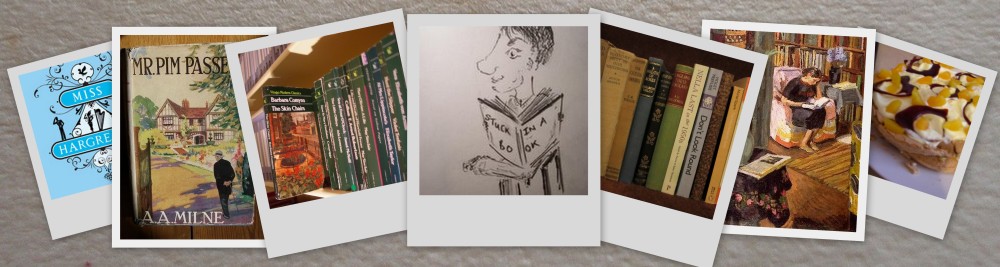
Do keep entering the draw for Yellow by Janni Visman! It’ll be up til Sunday. And thank you for all your lovely comments – especially Jennifer Dee, how nice to have you visit everyday!Yellow was, coincidentally, published by Bloomsbury – who also sent me some information today about a venture that they’ve got coming up – the info they’ve sent is below:
Bloomsbury is set to transform the relationship between publishers and libraries, and between libraries and readers, with an innovative development in public lending: The Bloomsbury Library Online.
At a time when the British library system is under pressure to reach larger audiences with tighter budgets, and when the reading public is feeling the pinch, Bloomsbury is launching a unique, affordable and user-friendly online initiative.
In association with www.exacteditions.com and using existing technology in libraries across the country, Bloomsbury is rolling out a groundbreaking e-lending strategy which will allow readers to read collections of bestselling books at local library terminals or with the use of a library card on home computers and internet enabled devices. The Bloomsbury Library Online will consist of a number of themed shelves: children’s books, sports titles, international fiction, Shakespeare plays, reference books and more. They will launch with a shelf of Book Group titles including Galaxy Book of the Year, The Suspicions of Mr Whicher, by Kate Summerscale, Orange Prize longlisted Burnt Shadows, by Kamila Shamsie, word-of-mouth phenomenon The Guernsey Literary and Potato Peel Pie Society, by Mary Ann Shaffer, and international bestseller The Death of Vishnu by Manil Suri. Embracing the advantages of the online format, users will be able to read the book, search the text, access author interviews, reviews, press features, and links to specially commissioned reading group guides. How will it work?The Bloomsbury Library Online will be sold on subscription – libraries will subscribe to a bookshelf for a year at a time and will pay according to the size of population served. • New titles will be added on a continuous basis – free of charge within the subscription year. • Users will click through from the Library terminals or through an online portal accessible via any web browser (including those found on iPhone and Blackberry) anytime, anywhere in the UK. • Text accessible through screen readers and therefore available to blind and partially-sighted users. Bloomsbury Executive Director Richard Charkin said “Libraries are hugely important to readers, communities and authors and are under severe financial constraints. While never forgetting the importance of books themselves, they’re also being pressured to adapt to the demands of the 21st century: bridging the digital divide, serving multicultural communities, attracting new users and reaching into homes. The Bloomsbury Library Online serves to fill that hole and will hopefully blaze a trail for similar developments in the library system.” Kate Summerscale added: “I’m delighted that The Suspicions of Mr Whicher will be part of The Bloomsbury Library Online – it sounds a great scheme, especially for book groups.”

Belated Birthday!

Oops… I forgot my own blog birthday. On 10th April I got to my second year of blogging – how time does fly.

To celebrate, I’ll be giving away a copy of a book I loved last year – Yellow by Janni Visman. It was in my top reads of 2008, and I first chatted about it here.

Stella is agoraphobic and neurotic and jealous – Yellow is a sparse, taut narrative which is psychologically clever without being scary (why does ‘psychological’ always come with ‘thriller’? Not in this case, really). And there’s a cat. Ideal. For a more lucid discussion of the book, see that first review.

Pop your name in the hat, as it were, and I’ll do a draw on Sunday.

Put Out More Flags

I’ve always vaguely connected Evelyn Waugh and E.M. Forster in my mind – not sure why, other than that ‘E’, since they didn’t really overlap in their writing periods. Having quite liked A Passage to India (which would have been better as a short story, I think) and A Room With A View, but failed to be overwhelmed by them, I’d also placed Mr. Waugh on the backburner. Which, I discovered as I read Put Out More Flags on the train journey down to Somerset, was a mistake. The writers have more or less nothing in common, and whilst I could read Forster for months without any danger of laughter lines, Waugh is really rather funny.


I don’t really know how popular Put Out More Flags is – certainly not one of Waugh’s more famous novels, and I hadn’t heard of it until someone mentioned it a few months ago. I found the title irresistible. It just sums up the earnest patriotism with no outlet for full venting – how shall we solve it? Put out more flags. Reminds me of a car Colin and I saw during the last World Cup, where someone had stuck seven British flags on their car. You could just imagine looking critically at their car festooned with six flags, and thinking “But will people realise that I love Britain?” Mentioning Colin gives me opportunity to shame him – when he found out I was reading Evelyn Waugh, his faux-intellectual response was “Evelyn Waugh? I love all her books.”


Put Out More Flags was published in 1942 and is about the phoney war which preceded the war proper. The central character is Basil Seal – and, through him, his mother, mistress and sister. We see the interior, informal and jokily malevolent workings of the war offices (who continually send all the volunteers and insane visitors to other departments), the recruitment and training of soldiers, responses of the rich and elderly, the bohemian socialists, the unfit, unlikely soldiers. Basically the upper-middle and upper-classes dealing with a strange situation. Barbara (Basil’s sister) features in my favourite part of the novel, and a central focus, placing evacuees:


Evacuation to Malfrey had followed much the same course as it had in other parts of the country and had not only kept Barbara, as billeting officer, constantly busy, but had transformed her, in four months, from one of the most popular women in the countryside into a figure of fear. When her car was seen approaching people fled through covered lines of retreat, through side doors and stable yards, into the snow, anywhere to avoid her persuasive, ‘But surely you could manage one more. He’s a boy this time and a very well-behaved little fellow.’


There are touches of EM Delafield – especially, unsurprisingly, The Provincial Lady in Wartime, which also features the War Office and its internal ‘workings’ – but where Waugh diverges from Delafield territory is where I had problem with Put Out More Flags. I found Basil Seal one of the most repugnant, malicious and dislikeable characters I’ve encountered since Heathcliff. Throughout the novel there were punches of nasty, unkind humour which laughed at ruining the treasured home of an elderly couple, sending an innocent man in exile to Ireland for Basil’s own ends, betraying friends for the sake of promotion. Whilst we probably aren’t supposed to see Basil Seal as a moral guide, it did seem that we were supposed to be fond of him, look on the character as something of an amusing rascal – whilst in fact he is selfish, vicious and cruel. Give me the self-deprecating humour of EM Delafield, or the affectionate, harmless fun-poking in Mapp and Lucia – Waugh’s idea of humour is mostly on the mark, and he uses comic language superbly (I laughed out loud several times) but too often the undercurrent was too nasty for me. I need to read a Wodehouse or two as an antidote.

Badly done, Emma?

This might be old news, but I’ve just found out about the casting for BBC’s Emma, so perhaps others haven’t heard. I think this is the last Austen-or-Dickens-or-Hardy etc. costume drama the BBC are planning on for the time being, and hopefully they’ll put on something special. I’m very pleased with all the names I’ve seen mentioned – mostly with Romola Garai as Emma Woodhouse. Romola Garai stars in one of my favourite films, I Capture the Castle, as Cassandra – she’s also been Angel in the adaptation of Elizabeth Taylor’s novel Angel, Briony in Atonement during her nursing stage, and the lead woman in Amazing Grace. I’m sure she’s done lots of other things as well, but those are the films I own with her in them. She’s a fantastic actress, though I haven’t seen her do something as funny as Emma before… we’ll see.
An actress who definitely does have comic ability is Tamsin Greig, and she’ll be playing Miss Bates. I saw her play Beatrice in Much Ado About Nothing at the RSC in London a while ago, and it was both the funniest and the best Shakespeare performance I’ve seen (she won the Olivier too). You might know her from sitcoms like Black Books and Green Wing, or perhaps as Debbie Archer on The Archers. She was also in the recent, very good, Anne Frank series on BBC. Who else… Michael Gambon, fresh from brevity but successful brevity in Cranford will be Mr. Woodhouse, and Jonny Lee Miller is becoming Jane Austen’s creepiest hero (in my opinion) Mr. Knightley. I’d vaguely heard of JLM, and a quick trip to IMDB.com tells me that not only was he Edmund Bertram in 1999 Mansfield Park, but Charles Price in 1983 Mansfield Park. What credentials.
As usual, I don’t think a new Jane Austen adaptation is really *essential* (there are so many books out there which haven’t had the costume drama treatment) but it is comforting and familiar and the cast looks impressive enough that it might be quite fun. But, as the BBC decide to focus instead on twentieth-century drama, I really hope that they mean all of the twentieth-century, and not just the bit Irvine Welsh was fond of. More 1920s, 1930s, 1940s drama please – and why not look through some Persephone Books for inspiration?
Which book – not necessarily Persephone, of course – would you love to see adapated?
I have two which spring to mind. One, of course, is Frank Baker’s Miss Hargreaves (have I mentioned that Bloomsbury will be publishing it?) with Dame Maggie Smith in the lead role – the other, perhaps more likely, is Eva Rice’s The Lost Art of Keeping Secrets. With dashes of Nancy Mitford and Dodie Smith, that novel would lend itself so well to filming. Watch this space…

Love Leonard


I always have a collection of the letters on the go, usually several, and the other day I finished Love Letters: Leonard Woolf and Trekkie Ritchie Parsons 1941-1968, edited by Judith Adamson. (Which, incidentally, was on my list of books I intended to read soon, back in April 2007. After two years I’ve read… 12 out of 17, having started and given up on another one. Not bad.) It was catapaulted to the top of my reading pile when my friend Phoebe gave me a second copy of it.

My interest in all things Bloomsbury, especially all things Virginia Woolf, presents something of a quandry – yes, I want to find out more about their lives, but reading Leonard professing love for someone who isn’t Ginny – ‘To know you and to love you has been the best thing in my life’ – is a little disconcerting. True, this started a while after Virginia’s death – but not that long.

Leonard’s met Ian Parsons through publishing, they were colleagues somewhere or other, and through Ian met his wife Trekkie, a painter. And they fell in love. Being the wacky world of Bloomsbury, none of the three seemed to think it particularly odd to carry on as they were – eventually Leonard moved in next door to the Parsons, and Trekkie would spend some holidays with Ian, some with Leonard – basically living two separate, but close, lives.

These letters, then, made slightly odd reading. By the second half they were the sweet, attached letters of two people who loved each other going about everyday life (with Ian usually quietly not mentioned) but the first half was quite awkward – Leonard professing his love in flowery, lengthy descriptions and Trekkie replying about her vegetable patch or latest clothing purchase. Really quite embarrassing how ardent he was and how cool she is in comparison – but obviously he wore her down.

They do make a slightly odd pair, and one with some connection with Two People – Leonard being both older and more intelligent than Trekkie – though she was an independently creative person, which Sylvia was not. She doesn’t come across as being remotely like Virginia, which is probably why Leonard’s relationship with Trekkie worked and Virginia is so seldom mentioned in these letters – but, for me, her absence spoke volumes over the entire, ahem, volume. Though interesting, this collection of letters really demonstrated to me how central Virginia Woolf is to my interest in Bloomsbury, and how bizarre I found the idea that it all carried on without her.

Puds and Psychoanalysts

Having attempted a Apricot Roulade a while ago, with fairly disastrous results (albeit very tasty ones) yesterday I returned to the Afternoon Teas recipe book. My friend Lou had half a carton of double cream which didn’t have long left to live, and thought we might be able to use it… and I knew there was a recipe that I wanted to use involving double cream. Not only that, but ‘double (heavy) cream’ – do they intentionally include the inevitable result upon the consumer?

That recipe was for Chocolate Torte. Mmmmm. As you can see from the picture, it turned out pretty well – and tastes amazing. But when the main ingredients are cream and chocolate, you can’t go far wrong. We didn’t have any liqueur, so that couldn’t go in. Being this recipe book, though, everything was slightly over-complicated. They kept wanting me to leave the pastry to rest for an hour, and thought I should use an electric mixer to make flour and fat into breadcrumbs… tsk. But it was worth all the labour, and I can feel myself getting larger just looking at it.

What else has happened lately… Today I read my first Freud! ‘Femininity’ (1933). I’m really interested in the reception to Freud, especially in middlebrow literature of the 1920s and ’30s – it’s amazing how pervasive his theories, or vague outlines of them, were – but I hadn’t ever got around to reading anything he’d actually written. Somehow it *felt* like I’d read it before… and that must be more or less how these interwar novelists dealt with Freud. I’d go so far as to say most of the novels I’ve read from the period make glancing mentions of him – for example, EM Delafield’s The Way Things Are, as quoted in Nicola Beauman’s A Very Great Profession:

‘Well,’ said Christine kindly, ‘I can’t say that I believe you. And any decent analyst would tell you that you’re doing yourself a great deal of harm by this constant pretence. It’s bound to create the most frightful repressions. What sort of dreams do you have?’

But Laura, even though she did live in the country, knew all about Herr Freud and his theories, and declined to commit herself in any way upon the subject of dreams.’

In fact, I’ve proposed a section of my doctorate on the influence of, and response to, Freud – so if ever you find a comment about Freud in an interwar novel, do let me know!

Two People

Hurray for Capuchin Classics, reprinting an AA Milne novel – Two People, which was first published in 1931. A slightly less significant event in the Two People timeline is January 2003, when I first read it. This was back in the days when I could really blitz a single author, and read everything they’d written – by the time I read Two People (doing quick sums) I had read 29 books by AAM in the space of two years. Gosh. I’ve read only nine since, so I was pretty much getting to the end of the available AAMs.

With plays, sketches, essays, short stories, an autobiography, pacifist literature, poetry and, of course, children’s books to his name, his novels have always felt a little like an afterthought. Not quite the same joyously whimsical Milne of the early days, nor yet the serious Milne of the Second World War. And, for the most part, I have forgotten everything that happens in his novels. What really remains is a single image from the book – for Mr. Pim it is a pair of orange curtains; for Four Days’ Wonder it is a haystack; for Chloe Marr it is a woman looking into a mirror. For Two People I mainly remembered those two people standing by a pond… which turned out to be fairly insignificant.

As Ann Thwaite points out in her short introduction, and is evident to any who has read her very excellent biography of AAM (in print, or available from a penny on Amazon), Two People is pretty autobiographical. Not only is the male half of those two people a writer, but the portrayed marriage between Reginald and Sylvia Wellard bears a striking resemblance to that between Alan Alexander and Daphne Milne. There are two novels in Two People – one about a naive rural novelist seeing his first book, ‘Bindweed’, become a success in London literary society; one about a man married to much younger, beautiful woman who is not his intellectual equal.

And that’s the crux. Sylvia is often wise, always kind, ludicrously good – but she doesn’t understand Reginald’s jokes, ignorantly assumes any obstacle will be simple for him, would be content to live a quiet, unassuming life in Westaways – a thinly disguised Cotchford Farm, the Milne’s Sussex residence. At first I though Sylvia’s astounding beauty was showing the prejudiced viewpoint of Reginald, but people all over the place stumble over themselves and exclaim involuntarily at her beauty – which is sweet but a little exaggerated and, it has to be said, no true depiction of Daphne Milne.

Ann Thwaite warns in her introduction that even those who ‘have an aversion to novels about writers’ will enjoy this. I didn’t know people had such aversions – I think novels about novelists are fascinatingly revealing about the author. But there is much more to Two People than that – I’d be astonished if anyone could finish the novel thinking Reginald wholly appealing (his views about laying on water for villagers are rather reprehensible, for example) but, much more importantly, it is an honest and true depiction of a marriage. Says I, who is not married, but certainly it seems to deal with the genuine, everyday issues that a marriage would face – with temperaments as catalysts, rather than adultery and murder and all those extremes.

Being Milne, the novel is also very funny. I recognise that AAM is an acquired taste – some find the whimsy a trifle sickening, whereas I find it delightful and clever. Two People isn’t the most representative of Milne’s work (I’d look towards The Sunny Side for an in-print example, from Snow Books) but I do encourage you to seek it out. Milne’s non-children’s work is seriously underrated, and I loved this novel upon re-reading it. Bright but also with a serious undertone – and possibly the nearest thing Milne wrote to an autobiography of his marriage, since his actual autobiography It’s Too Late Now rather skirted around it.

Here’s a scene which illustrates the perils-facing-a-writer strand, and the humour (they’re at a tennis party):

“Fella in the Sixtieth out in Inida with me wrote a book,” said Colonel Rudge suddenly.

“Oh?” said Reginald

“Fact,” said the Colonel. “Fella in the Sixtieth.”

Reginald waited for the rest of the story, but it seemd that that was all. The Colonel was simply noting the coincidence of somebody over here writing a book and somebody in India also writing a book.

[…]

“Tranter, that was the fella,” came from his right. “Expect you know him.”

Reginal awoke and said that he was afraid he didn’t. (Why ‘afraid’, he wondered. Afraid of what?)

“Well, he wrote a book,” said the Colonel stubbornly. “Forget what it was called.”

[…]

“What d’you say your book was called?” said the Colonel, evidently hoping that this would give a clue to the title of Tranter’s book.

“Bindweed,” grunted Reginald, feeling suddenly ashamed of it.

“What?”

“Bindweed!” (What the devil does it matter, he thought angrily.)

“Ah!… No, that wasn’t it. Bindweed,” said Colonel Rudge, pulling at his moustache. “That’s the stuff that climbs up things, what? Gets all over the garden.”

“Yes.”

“Thought so. […] Sort of gardening book, what?” said Colonel Rudge.

“What?… Oh… No.”

“It is the stuff I mean, isn’t it?”

“What is?”

“The what-d’you-call-it.”

“Is what?”

“What I said. Climbs up things. Gets all over the garden?”

“Oh yes, yes. Always!”

“What d’you say it was called? This stuff?”

“Bindweed.”

“Yes. And what d’you say your book was called?”

“Bindweed.”

“That’s right,” said the Colonel fretfully. “That’s what I said.”

This, thought Reginald, is one of the interesting people brought down from London who want to talk to me about my book.

West is West

Quick post today – slowly reading through the Paris Review Interviews, and came across this great, slightly catty, bit from Rebecca West (who was interviewed by Marina Warner):

MW: Do you do many drafts?

RW: I fiddle away a lot at them. Particularly if it’s a fairly elaborate thing. I’ve never been able to do just one draft. That seems a wonderful thing. Do you know anyone who can?

MW: I think D. H. Lawrence did.

RW: You could often tell.

Ouch!