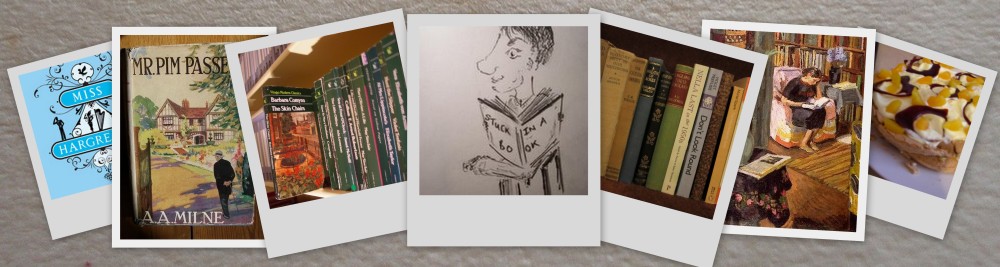
More titles…

I’m getting quite carried away by this title malarkey – whilst I was picking my favourites, I realised that I also have a weakness for titles which are quotations from other books.

The Comyns and Delafield titles from yesterday both are, but there are loads of others… and I want your suggestions! Here are the ones I thought of…

Told By An Idiot – Rose Macaulay
Of Mice and Men – John Steinbeck
The Sound and The Fury – William Faulkner
There’s Rosemary… There’s Rue – Lady Fortescue
Hostages to Fortune – Elizabeth Cambridge
All Passion Spent – Vita Sackville-West

Well, that’ll do for now – obviously there are lots more, but I don’t want to steal the ones you’re thinking of! Come on, do me proud…

And my favourite title is…

What a wonderful selection of favourite titles you all came up with! I’m almost reluctant to put my review up, as I loved hearing them all – do keep letting me know your favourite title, on the previous post, and perhaps I’ll do a post on my favourites from them, sometime next week.

A few of my favourites, before I tell you my *absolute* favourite, and then tell you that the novel was pretty good too…

I love:

Tea Is So Intoxicating – Mary Essex
We Have Always Lived in the Castle – Shirley Jackson
The Elegance of the Hedgehog – Muriel Barbery
But Gentlemen Marry Brunettes – Anita Loos
The Brontes Went To Woolworths – Rachel Ferguson
Who Was Changed And Who Was Dead – Barbara Comyns
No One Now Will Know – EM Delafield

But the one that comes out on top, because it works on at least two levels, and is intrinsically funny, is… Aunts Aren’t Gentlemen by PG Wodehouse.

Ok, wonderful title aside, this is also a great little novel. To be honest with you, I haven’t met a PG Wodehouse novel I haven’t devoured happily. According to my little drop-down author menu, the only Wodehouse I’ve written about on here was Indiscretions of Archie, another fab title, and enjoyable, but probably the worst of the Wodehouses I’ve read. Aunts Aren’t Gentlemen is back on form – and the first Jeeves and Wooster novel I’ve read.

Wooster is sent off to the countryside by a doctor because of his ‘young man about town’ lifestyle has had a disastrous effect on his general health. He plumps for an Aunt in Worcestershire (land of my upbringing!)

“Is the air pure there?”

“Excursion trains are run for people to breathe it.”

“Your life would be quiet?”

“Practically unconscious.”
Sadly, said Aunt Dahlia is herself off to Maiden Eggesford, Somerset (she’s following me around the country!) and so Wooster decides to follow her there, Jeeves in tow, naturally.

It is one of those villages where there isn’t much to do except walk down the main street and look at the Jubilee watering-trough and then walk up the main street and look at the Jubilee watering-trough from the other side. This bit amused me, because whenever Mel and I visit a little village, we look out for their Millennium Project. Every village has one, usually fairly humble, and generally unveiled in mid 2003. I’ve seen Millennium benches, signposts, woods, stones… all sorts.

This being Wodehouse, all sorts of coincidences have come together to make more or less everyone Wooster knows turn up in Maiden Eggesford. There’s a woman he once asked to marry him, as well as her more recent beau; there’s a man he once cheated and gave a fake identity to; there is even Jeeves’ own aunt. It all gets a little complicated as two rival households are going in for a horse race, only one of the horses is closely attached to a cat, and is inconsolable without it… and Aunt Dahlia (betting on the other horse) decides to have the cat kidnapped. Or catnapped, if you will. Hence the title – it’s not cricket, she is not acting like a gentleman. And so it all begins.

I love Wodehouse’s writing, with its mixture of hyperbole and litotes – I love the unbreakable calm of Jeeves, against Wooster’s exaggerations and whimsical turn of phrase (I love that he always cheerfully calls Aunt Dahlia either ‘aged relative’ or ‘old ancestor’ – but don’t think I’ll be trying this out on my own aunts. Who are not, for that matter, particularly old):

“Have you ever seen a garrison besieged by howling savages, with their ammunition down to the last box of cartridges, the water supply giving out and the United States Marines nowhere in sight?”

“Not to my recollection, sir.”
I just find Wodehouse endlessly funny. But I must confess – I thought Aunts Aren’t Gentlemen would be my favourite ever Wodehouse, centring (as it does) around a cat – but, for some reason, the cat is given very little personality. I love reading about cats, and I’d have thought Wodehouse would be on top form writing about one… but perhaps he is not a cat person. Shame.

But, even though this doesn’t reach the dizzying heights of its feline potential, it is great fun and very good – sometimes a Wodehouse just hits the spot in a way that no other book can. If you’ve never read one before – well, firstly, I’m a little horrified – secondly, why not start with this one?

Favourite title?

Never let it be said that this blog is too *deep* – enough of my posts have talked about how nice the covers of books are, to do away with that idea. And we’re sticking to surfaces here – because I want to know what your favourite book title is. Not your favourite book, nor necessarily one where the title accurately represents the book, but which is – purely and simply – your favourite title.

I ask because I’m going to be reviewing mine tomorrow… I have mentioned it recently, but I’m going to keep you guessing…

(Oh, and it’s not one of the ones above, I just wanted to put up a picture of books… for more on those titles, look back here.)

Jane’s Teas

Two of my housemates (Mel and Liz) and I decided to go for a Road Trip this Sunday. Unusually, we actually went in a car – Mel’s and my road trips have usually been by bus or train, with the added adventure of not knowing timetables or that we’ll ever see home again. To lend this frisson of danger, we entrusted our route to a coin. Several, in fact – heads for left; tails for right. Our first destination turned out to be the back of Iceland in Kidlington (which did reveal a fabric shop, about which Liz was quite excited). Though interesting, it couldn’t be called a fun filled outing for all the family, and so we took once more to the highways and byways of Oxfordshire.

And, somehow, half by the coin and half by picking roads at random, we ended up… well, next to a sewage works. But we decided to park and go for a walk, and spotted a sign saying ‘Jane’s Teas, Sunday, 12.00-5.30’. Who could resist? Certainly not us. We meandered on down a muddy pathway, past some cows and a tree-house, over a river, and eventually found…


Jane’s Teas! Unbeknown to us, we were in Kirtlington (never heard of it, but it does have its own Wikipedia page.) In amongst its 872 residents is Jane Fanner, who lives on a narrow boat, and runs a tea garden on Sundays. I think I’ve been waiting all my life to find this wonderful, wonderful place. It’s the sort of place I thought only existed in my mind. Not only were the tea and homemade cake delicious…


…the venue are a series of old-fashioned tables and chairs (and swing-seat) along the side of the river – all the crockery is vintage (we did break a cup, but Jane was very nice about it), there are silver teapots, bunting, and poems in trees, and ornamental birdcages, and….


…a piano, a gramophone, decorative milk pails, rocking horses, model railway, chandeliers, chickens… everything thrown together in the most delightful way imaginable. I felt that I’d stepped back into the 1930s, and never wanted to leave. These photos don’t even do justice to what a special place it is.

If you’re ever in striking distance of Oxfordshire on a Sunday, do try and find Jane’s Teas. She’s in the middle of nowhere (unless you happen to pass on a canal boat) and it seems that her success is all due to word-of-mouth – which is exactly the way you would expect it to be. I can’t imagine anybody going and not telling everyone who wonderful it is.


In an attempt to drag this post somewhere in the sphere of books, I will say that it reminded me of Mary Essex’s Tea Is So Intoxicating. Anybody come across this author? I read the book a fair few years ago, immediately after Moby Dick. Perhaps that is why I remember it so fondly – I will return to it and find out if it *is* as charming as I thought it back then. All about someone setting up a tea shop in a little village, hence the association… and a wonderful title, too. The only Mary Essex novel I have is called The Amorous Bicycle (not yet read) so she obviously had quite a talent for titles!


So, a fun day out, and a great discovery. I assure you it won’t be the last time I visit Jane’s Teas… though, without the use of coins, will I ever be able to find it again?

[credit: three of these photos were taken by Mel – thanks Mel!]

Stuck-in-a-Book’s Weekend Miscellany


Will you look at that, somehow it’s the weekend again. Hope you all had a lovely week – mine has not been quite as busy as perhaps it should have been, but was very nicely interrupted today as Our Vicar and Our Vicar’s Wife paid a fleeting visit on their way through to a wedding in London. Oh, and the photo above isn’t particularly relevant – I took it last summer in Cornwall – but I don’t think I’ve shared it here before, and it is rather brilliant.

Right – as per usual, the link, the book, the blog post. It’s like the good, the bad, and the ugly – except it’s the good, the good, and the good.

1.) The link – is this rather fun and interesting article about joining a book group. I may or may not have stolen this link from someone else, I made a note of it last Saturday, and can’t remember – so apologies if I’m not crediting you! I look forward to my various book groups as highlights of my month, and love reading about other people’s experiences in them…

2.) The book – came through the post yesterday, and has the rather irresistible title Love, Revenge & Buttered Scones and is by Bobbie Darbyshire. I’m hoping to read this before too long, but thought I’d alert you to it now, in case it takes a back seat while I wade through the enormous fantasy book I’ve promised my brother I’ll read… Anyway, the novel is about (I quote the blurb) ‘an innocent meeting of a reading group which sparks a series of bizarre events. Three troubled people, driven by loneliness, vanity and revenge, hurl themselves on Inverness public library to find that nothing is as they expect.’ Sounds fun, doesn’t it?

3.) The blog post – is a little unusual for a book blog, but I was struck by Spitalfields Life’s post on Postman’s Park – which commemorates those who died in ‘Heroic Self-Sacrifice’. To give an example: ‘Soloman Galaman, Aged 11, Died of Injuries, Sept. 6 1901, After Saving His Little Brother From Being Run Over in Commercial Street.’ For lots of photos of the unique commemorative tiles there (they are Victorian and the turn of the century), and a bit of the history behind it, click here. I’ve never been in person, but will try and seek it out next time I’m in London. Have you ever been there?

Congratulations…


Sorry not to give much warning that I was bringing the signed Solar competition to an end, but it’s been a few days and I think everyone’s entered who is going to be entered – and I am pleased to say (using a random number generator, since Patch is asleep) that a signed copy of Ian McEwan’s latest novel will be on its way to…

Claire from Paperback Reader!

Well done Claire – could you email me your address, and I’ll forward it to the company?

And the runners-up who win Solar T-shirts are…

AmbireBooks and A Bookish Space!

I will have to check that it’s ok to send T-shirts internationally, so fingers crossed I haven’t got your hopes up… please email me your address, and let me know whether you want size ‘small’ or ‘large’ (not Aristoleans obviously, no happy mean!)

In McEwan news, I got an email today telling me about this event, for those oop North:

Ian McEwan in conversation with Sam Leith

Monday 22nd March at 6.30pm

Royal Northern College of Music , 124 Oxford Road , Manchester M13 9RD

Tickets £7 available from the Box Office 0161 907 5555

box.office@rncm.ac.uk

supported by Waterstone’s, 91 Deansgate

Travels With My Aunt

As far as I’m aware, until this month I had never read a book with the word ‘Aunt’ in the title – and now I find myself reading two of them. Travels With My Aunt by Graham Greene, and Aunts Aren’t Gentlemen by PG Wodehouse – both very funny. Perhaps Aunts are a source of untapped hilarity (also languishing on my shelf is Cordial Relations: The Maiden Aunt in Fact and Fiction by Katharine Moore, so more to discover there, too…)

My lovely book group has themed months, where the shortlist for voting must be suggested within a theme or idea. Next month, for example, is books set in Oxford (I’m holding out for Jill by Philip Larkin). Last month was books about geographical journeys – and I suggested Travels With My Aunt by Graham Greene, which was eventually victorious. I hadn’t read it – indeed, I knew almost nothing about it – but has been told by one or two people that I should read some Greene. And I’m very glad that I did.

Henry has never met his Aunt Augusta before she turns up at his mother’s funeral: “It’s odd how we seem to meet only at religious ceremonies. The last time I saw you was at your baptism.” His quiet life working in a bank, tending his dahlias, and generally not doing very much – it’s all about to be wildly disrupted. His is not a spirit of adventure – ‘The bank had taught me to be wary of whims. Whims so often end in bankruptcy.” But Augusta is no-nonsense, fairly eccentric, and determined to change him. But I’ll let Henry do the describing:

I wish I could reproduce more clearly the tones of her voice. She enjoyed talking, she enjoyed telling a story. She formed her sentences carefully like a slow writer who foresees ahead of him the next sentence and guides his pen towards it. Not for her the broken phrase, the lapse of continuity. There was something classically precise, or perhaps it would be more accurate to say, old-world in her diction. The bizarre phrase, and occasionally, it must be agreed, a shocking one, gleamed all the more brightly from the odd setting. As I grew to know her better, I began to regard her as bronze rather than brazen, a bronze which has been smoothed and polished by touch, like the horse’s knee in the lounge of the Hotel de Paris in Monte Carlo, which she once described to me, caressed by generations of gamblers.

For Aunt A is well-travelled. When she suggests a trip, Henry thinks Brighton would be a good destination, and it does offer an interesting excursion – little does he know that their travels will later include Paris, Istanbul, Paraguay… Truth be told, the destinations aren’t hugely important in themselves (which rather relieved me, as I’m not usually a fan of travel literature, and was glad that the novel didn’t turn into it) but rather act as settings for the illicit and extraordinary activities with which Augusta is involved. I don’t want to spoil them for you, but safe to say the police get involved along the way.

Having written that, you might be surprised to learn that the character I was reminded of most, from the earliest chapters onwards, was Miss Hargreaves. In the unlikely event that you’ve missed me talking about Miss Hargreaves, probably by favourite novel, you can read my eulogies here. Miss H was written in 1939; Travels With My Aunt came out in 1969 – and Aunt Augusta is more or less what I’d expect Miss Hargreaves to be if she’d lived thirty years later, and been rather less respectable. I can’t imagine Miss Hargreaves saying, for instance, “A brothel is after all a kind of school.” But the characters have the same indomitable spirit, eccentric manner, and amusingly unpredictable speech. The success of Greene’s novel, for me, is through character – through Augusta and Henry’s conversations, where two wholly different characters meet and travel together. The first half of the novel focuses upon character (broadly speaking) and the second half more on plot – which I found perhaps less interesting, though apparently it is more akin to Greene’s literary thrillers.

I haven’t read anything else by Greene, and I’ve been told that Travels With My Aunt is the unGreenelike Greene novel, but I was so charmed and amused by this spirited novel that I’ll definitely be trying some others. Anybody got anything to suggest? I’m also keen to see Maggie Smith in the film, but (of course) it hasn’t been released on DVD… (Oh, and for the thoughts of another member of the book group – I’ve just spotted Harriet’s review!)

Project 24: The Agony and… no, just the agony, really…

Project 24 is starting to get difficult… I’m already halfway through April on my allowance (if you count the book which is winging its way to me at the moment, to be revealed when it arrives) and, though there aren’t many specific titles I’ve had to avoid, I just miss book shopping…

But today was the first time that I stood in front of a book, something of a battle of wits, forcing myself not to buy it. The book in question is The Spy in the Bookshop: Letters Between Heywood Hill and John Saumarez Smith 1966-1974. It was in the £2 bookshop in Oxford which I walk past everyday. I really enjoyed the letters of Heywood Hill and Nancy Mitford, The Bookshop at 10, Curzon Street, and would love to have the follow-up… but I’m not excited enough about it to make it one of 24. But it’s only £2. But… but… but… this is so difficult!

I need to start planning what I’m going to do in January 2011… I’m thinking trip to Hay-on-Wye, trip to the Bookbarn, rather large splurge on my Amazon basket…

Tell me – if you’re joining in, which books have made Project 24 (or whatever number you’ve chosen) especially difficult?

Can Any Mother Help Me?

I don’t remember where I first heard of Jenna Bailey’s book Can Any Mother Help Me? but it has been across the blogosphere like wildfire over the past year or so. Ironically, a few people bought it because of a mention or two here at Stuck-in-a-Book in the past – because I got my copy in mid 2008. It was one of those titles I just *needed* to own immediately, had to read immediately… and then, of course, it somehow languished on my bookshelves for the best part of two years. But no longer!

Can Any Mother Help Me? tells the story of the Cooperative Correspondence Club – known to its members as CCC – which began in 1935 when a young woman wrote to Nursery World:

Can any mother help me? I live a very lonely life as I have no near neighbours. I cannot afford to buy a wireless. I adore reading, but with no library am very limited with books. I dislike needlework, though I have a lot to do! I get so down and depressed after the children are in bed and I’m alone in the house. I sew, read and write stories galore, but in spite of good resolutions, and the engaging company of cat and dog, I do brood, and “dig the dead.” I have had a rotten time, and been cruelly hurt, both physically and mentally, but I know it is bad to brood and breed hard thoughts and resentment. Can any reader suggest an occupation that will intrigue me and exclude “thinking” and cost nothing!

The solution was to set up a collective magazine (of which there were apparently over two hundred that are known about) to which women would contribute, under pseudonyms ranging from ‘Sirod’ (Doris backwards) to ‘Cotton Goods’ (for the proudly working-class) to ‘Elektra’ and ‘A Priori’. The members came and went, but over half a century these women sent around their contributions on all manner of topics, but mostly simply about their own lives. Ad Astra organised it all, and sent them out in the beautiful homemade covers shown in a picture below.

The book is essentially a selection of articles from different magazines, with editorial material provided by Bailey. She has grouped the articles thematically: issues of raising children (members had to be mothers – the issue was raised of allowing non-mothers to join, but it was decided against); the war; everyday life; marriage; working; hard times; growing old. There are quite a few ‘voices’ in the book, and only a few become really familiar, but it’s certainly an interesting sample and cross-section of a fascinating project.

I loved the idea of the CCC, and did enjoy reading the book, but somehow it didn’t *quite* match up to what I was expecting. Or rather, what I was hoping – because I didn’t know how I expected Bailey to arrange the material. She could only really pick and choose certain pieces, it would be impossible to give the feeling of belonging to the group – instead, I felt a little like an eavesdropper. Also, once all the articles were typed up, with marginalia noted in neat little font, the feel of the magazine was lost. I’d have loved a facsimile edition of one or two copies of the magazine – so that all the original handwriting and margin notes and crossings-out would have been reproduced. But perhaps that wouldn’t be possible, or too expensive, or even illegible.
When Claire reviewed the book, she pondered over blogging as a modern equivalent of the CCC. In a way it is, but much closer (in my experience) is the Yahoo Group I’m in. Are other people in these sorts of email groups, where people send out emails to a whole group, and correspond that way? They’re not as popular as they once were, but the one I’ve been in since January 2004 (a quarter of my life!) is incredibly dear to me. The experiences of the CCC sounded very familiar – the cautious and slightly nervous initial face-to-face meetings, which become regular and joyous occasions; the feeling that you can share close, personal events with people you’ve never had the opportunity to meet; the joy of kindred spirits. Who knows whether we’ll still be going in fifty years’ time (with some record-breaking-aged people, if we do) but I know that it has been, and will continue to be, a very special part of my life.

If Bailey’s book couldn’t quite convey this sense of intimacy and special-ness, that’s only to be expected, because the reader must remain an intrigued outsider to the group. At the same time, it is the only way that we can now remember such wonderful groups and I applaud Bailey (and the Mass Observation project which held the material, and also gave rise to significant books like Nella Last’s War) for immortalising the CCC and making their venture accessible to many.

Oh, and for anybody reading this in Oxford… the £2 bookshop has a number of copies…

Signed Solar!

It’s an embarrassment of riches around the blogosphere at the moment, with at least one other blog I’ve spotted running this competition – for a signed copy of Ian McEwan’s latest offering, Solar. Thank you, Random House, for offering this!

Also, there are Solar T-shirts to be won – so mention in the comments if you’d fancy one of these, otherwise I’ll assume you’re just in the draw for the book.

And, because just saying ‘me please!’ isn’t all that entertaining for you, I’d like to know which Ian McEwan novel is your favourite, or (if you’ve not read any or many) which you fancy reading. Other than Solar, that is…

For me – it’s a toss up between Atonement and Black Dogs. I’m going to go with Black Dogs. And the one I want to read next? The Child in Time, I think.