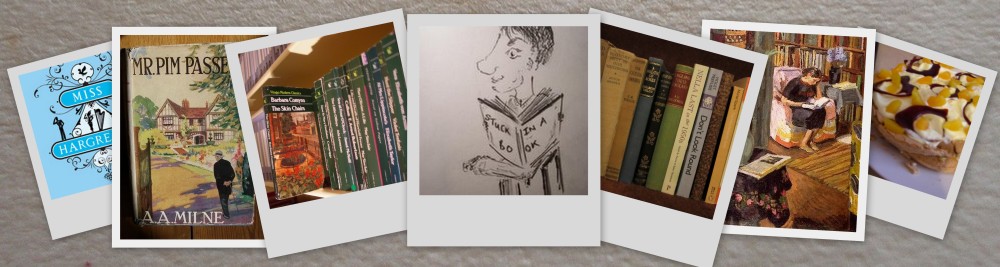
Comments Redux

Well, I’ve tried all sorts of things with comments today and none of them worked properly, so we’re back to the status quo! Apologies if you’ve tried to read my blog today and it’s all been misbehaving. If anyone could point me in the direction of HTML which allows you to reply to individual comments (i.e. have threads in the comments) which isn’t intensedebate, Disqus, or JS-Kit (none of which worked properly for me) then let me know!

Bloomsbury is Back!

Thanks for your votes on the impromptu Jane Austen poll, still not sure if the poll is itself working, so do pop your favourite JA novel in the comments too. And still a bit of time to get your hands on a copy of Travelling Light by Tove Jansson here – I (or Patch) will do the draw for the Weekend Miscellany.

Today – and I can’t believe it’s taken me this long, given how very excited I am about this – we’ll be turning our attention to the latest Bloomsbury Group titles! If you’ve been living under a rock for a year, then perhaps you aren’t familiar with this group of early-20th century reprints, including the oh-so-wonderful Miss Hargreaves by Frank Baker.

Well, there are now a further four books in the series, with a rather exciting and bright aesthetic that I love. And the return of Penelope Beech’s brilliant cover illustrations – that gal is jus too darn talented. Here are those four….


Henrietta Sees It Through by Joyce Dennys
Everyone raved about Henrietta’s War, myself included, and so we’re delighted to see Bloomsbury reprint the second volume. I’d love to see them do more and more Joyce Dennys…

Mrs. Harris Goes To Paris by Paul Gallico
I’ve had this on my shelves for ages – but a lovely Bloomsbury Group reprint is just the catalyst I need to move it up the pile. A charlady saves up to travel to Paris, and a Cinderella story begins… (Also has one of the sequels included)

Mrs. Ames by E.F. Benson
You know how much I love Mr. Benson, and this one comes with the seal of approval from Elaine at Random Jottings. The blurb starts ‘Reigning over a social merry-go-round of dinners and parties…’ and I just know the pen which crafted Mapp and Lucia has provided another gem.

Let’s Kill Uncle by Rohan O’Grady
What a great title! An orphan goes to stay with his uncle, and is sure that his uncle intends to kill him… and wants to get in first. Dastardly!

I’m so excited about this continuing publishing venture – and I hope you are too. Which of these are you most looking forward to? And what would you like to see in the future?

I amuse myself sometimes by thinking what I’d include in my own reprint publishing company in thirty or forty years’ time… I suppose my 50 Books You Must Read! (Dad pointed out that none have been added since last October.. oops! I’ll have to wrack my brains…)

An Austen poll…

Time for a little poll, methinks – and what better question to ask?
(sorry, for some reason it cut off the beginning of Sense and Sensibility and I can’t change it now!)

EDIT: for some reason the poll doesn’t seem to work, votes keep appearing and disappearing, so make sure you’ve put your answer in the comments instead!
Which Jane Austen novel is your favourite?

Speaking of Jane

The book I’m talking about tonight is one of those lovely books which just doesn’t seem to be written anymore. I bought it in Colchester as one of my first books under Project 24, and it’s as lovely as it looks and sounds: More Talk of Jane Austen (1950) by Sheila Kaye-Smith and G.B. Stern.

Now, of course, I’ve done things in slightly the wrong order, because I’ve not read Speaking of Jane Austen, the volume preceding this one. Nor, in fact, have I read anything by Kaye-Smith or Stern, though Stern’s A Name to Conjure With has been on my bookshelf for about a decade. But no matter – for anyone who has read Austen’s novels (and it is important that you’ve read all six before opening this book) More Talk of Jane Austen is delicious, self-indulgent fun.

The first chapter is called ‘What is it about Jane Austen?’ I don’t know if the scenario is real or imagined, but the question is posed by Barbara (age 17 and a half) to G.B. Stern, as Barbara’s beloved is mad on Austen: ‘”It’s his thing.” And Barbara added, being a tolerant girl: “Nobody can help their thing.”‘ Of course, the same misconceptions Barbara has are those which fly about nowadays – that she’s for ‘maiden aunts in drawing-rooms’ and so forth. And naturally Stern disabuses her – excuse the lengthy passage, but it’s too lovely not to quote in full. “She’s neither bitty nor boisterous about her people; instead, she has irony, tenderness, clear vision, and most of all a gorgeous sense of their absurdity which is never really exaggerated into more than life-size. You’re absurd, I’m absurd, and so in some way or other are most of the people we meet. She does not have to distort or magnify what they’re like; she just recognises them, delights in them herself, and then re-creates them for our benefit without illusion or grandiloquence, and without any array of special circumstance, of drama, for instance, or horror, or even topical events of the day; luckily for her and for us, to leave them out was natural and not forced for her period, unless you were a gentleman actively involved in war and politics and religion and the struggle for existence; at her period you could be one of an isolated group living in the same country neighbourhood in England, without in any way meriting the reproach of escapism. Escape need have no ‘ism’ when we escape into Jane Austen; and when we have to return there’s no wrench, no jolt, no descent from the aeroplane, no bump back to life with a shock, no subsequent daze and resentment; it’s escape from our reality into her reality, and we can fuse our world with hers which is curiously and essentially ‘unrubbishy’. So there they are, her characters, concentrated for our benefit into a small circle of time and space, deliciously giving themselves away not only in action but by the smallest working of their motives and pre-occupations; absolutely unaware, of course, that anyone is catching them out at it. It’s no crime to be a lover of Jane Austen; but if you aren’t, you can’t understand why we find her so restful, because you’re much too inclined to translate ‘restful’ into ‘soporific’; if we just wanted an author who would send us nicely to sleep, we should not go to Jane Austen; she’s restful from exactly the opposite reason: we’re alert all the time when we’re reading and re-reading and re-re-reading Jane, otherwise we might miss something, some tiny exquisite detail, an almost imperceptible movement in the mind of her characters. Her poise is unassailable; you can trust it, and that’s restful in itself. The same with her judgments; you can trust them, and relax; mind you, to be able to relax wit an author isn’t the same thing again as to say she’s relaxing; the air of Bath is relaxing, but the air of Jane Austen isn’t; she’s pungent, she’s bracing; you’re breathing good air while you read Jane, and so you feel well. Apart from her gorgeous sense of humour, her vision is so fairly and evenly adjusted that you don’t have to get distracted all the time by the author’s own prejudices and neuroses subconsciously creeping in to distort the whole thing, and having to make allowances for environment —“

“Darling, do you think you could stop talking like a handbook on psycho-analysis? Because if it’s just to please me —“

“Dear little girl, I’d forgotten for the moment that you were there.”
That should be required reading for any Jane doubters. In truth, the rest of the book doesn’t really have this tone – it’s not done ‘in conversation with’ anyone. Stern and Kaye-Smith take alternate chapters, and address topics like letters, beauty, servants etc. etc. It is well-researched but not unduly scholarly – More Talk of Jane Austen can only be described as an appreciation. There isn’t a hint of objectivity, nor would I have there be: this is the unashamed indulgence of Janeites keen to delve into every detail of Austen’s novels. Not with the mad (and maddening) conspiracy theories or secret-subtext theories so beloved of Edward Said and his chums, but a simple gleaning of all the details Jane Austen actually put in the novels.

The book never feels over-zealous or superfluous – perhaps it would, were they examining any lesser writer than Austen. Or perhaps, as a Janeite, I cannot see clearly – for I revelled in this delight of a book, and only wonder why such things seem to be so out of fashion. Or, perhaps, they’ve just transferred to the blogosphere?

ETA: after posting this, I saw Rachel’s abundantly lovely Janeite post here – transferred to the blogosphere indeed!

Things to get Stuck into:

Howards End is on the Landing – Susan Hill: unquestionably my favourite book-about-books, even if Jane Austen gets short shrift within these pages (everyone has their faults).

Mrs. Darcy’s Dilemma – Diana Birchall: one must tread carefully when it comes to Austen sequels – but Diana Birchall’s witty and loving sequel is very respectful and an entire delight.

Stranger and stranger…

One of the fun side-effects of Project 24 (although not as frequent as I’d hoped it would be) has been reading books which have lain neglected on my bookshelves for quite a while. And one of those was The Little Stranger by Sarah Waters, lent to me by lovely Curzon a long, long time ago… (and which has now become #14 on Project 24, because I accidentally tore some pages, and bought Curzon a replacement copy, keeping the original… oops! Not my usual style, promise.) It seemed the perfect sort of thing to take away with me on holiday, staying in rambling old houses converted into Youth Hostels. I read most of it in Grinton Lodge Youth Hostel, which looks like this:


So – atmosphere: check.

Everyone in the blogosphere seemed to be reading The Little Stranger around the time I was on holiday last year. I, on the other hand, was reading things by Ivy Compton-Burnett, Elizabeth Taylor, Janni Visman… well, better late than never. Still, there must be one or two people who are later than me in reading The Little Stranger, so I won’t assume universal knowledge…

Waters, who made her name with Victorian novels (including the only I’d previously read: Affinity) has been moving steadily nearer the present, and The Little Stranger is set just after World War Two. All except the first scene, which is much earlier – the protagonist is a little boy being snuck into Hundreds Hall by his mother, who is a servant there. He loves the house, and wants to take a souvenir – hacking a plaster acorn from a corridor. From little acorns…

Next we see, the little boy has become Dr. Faraday and is heading out to Hundreds Hall because the (now sole) servant Betty is complaining of illness. Turns out she just wants to get away from the house for a bit – because she senses things are wrong. Quite how they’re wrong, she doesn’t specify; but something is wrong. But this incident leads Faraday to an increasingly close intimacy with the family – plain, unmarried Caroline; her brother Roderick who is recovering from a nasty war injury, and their dignified mother, simply Mrs. Ayres. Faraday is excited about being able to visit a house he has admired since childhood, and Hundreds Hall is certainly a powerful presence in the novel. Its former glory, and its current decay, are realised wonderfully by Waters. It’s something of a truism to say that ‘the house is itself a character’, but you have to take your hat off to Waters’ ability to invest Hundreds Hall with this power without it becoming a caricature of Gothic literature. The house remains comfort and terror; mystery and simplicity; homely and unhomely.

For soon Betty’s claims that something’s wrong seem to be true. A party is held (Mrs. Ayres’ is trying to set up Caroline with a neighbouring bachelor) where a young girl is savaged by Caroline’s usually docile dog. At the same time, Roderick is experiencing ghostly goings-on in his bedroom…

I’m not going to spoil the ensuing events, but suffice it to say there appears to be a ‘little stranger’ creating all sort of havoc for the Ayres family. Since The Little Stranger is narrated by Faraday, we often aren’t ‘present’ for the events, but Waters does a simply brilliant job of relaying them later (usually a big no-no for writers) without losing the tension. And this is quite a scary book. I’ve not read many scary books since my Point Horror phase, and perhaps a slightly creepy old Youth Hostel wasn’t the best place to read this novel… I was a little scared to close my eyes.

Waters has suggested that The Little Stranger is primarily about class issues – as Faraday rises from the servant’s son to a family friend, and can’t get over some of his lingering resentment; similarly, the grounds of Hundreds Hall are being sold off to modern estates. Waters has even said that the ghost story element was a later addition. I’m glad she did, because novels which centre around class issues can be very tiresome if not done well, especially if they’re retrospective. I prefer contemporary novels (‘contemporary’ is such a frustrating phrase… I mean contemporary-to-the-period-described, rather than contemporary-meaning-modern) which don’t feel the need to hammer home how awful middle-class pretensions were, or throw their hands up in horror at the idea of servants. Waters doesn’t fall into this trap, but I fear she’d have been nearer to it had the ghost-story element not crossed her mind.

For the most part, The Little Stranger was brilliant. You know me and long books, but I read this in two or three days; got up early to finish it, etc. etc. Waters’ writing is pacy and compelling without sacrificing style, and I am really keen to read more by her. True, there was a little bit of a drag between p.100 and p.200, but only a little – and the second half of the novel flew by.

And then… the ending. Which I obviously don’t want to discuss in detail. Close your eyes and sing la-la-la if you don’t want even the remotest spoilers, but… I was disappointed and confused in about equal measure. And I shan’t say more than that. I just wish Waters had given the novel a different sort of ending – if she had, then A Little Stranger could have been one of my favourite novels of the year, possibly the favourite. As it is, it might make top ten, but only just. Possibly very clever and cunning, but… disappointing.

More or less everyone seems to have reviewed this, so I suggest you do what I did and search for it in Fyrefly’s incredibly useful Blog Search Engine. But I will point you to this excellent discussion on Shelf Love: be warned, it is spoilerific.

Books to get Stuck into:

Rebecca – Daphne du Maurier: Curzon reminded me how appropriate this would be as a companion read, and it’s the book I *always* recommend to people when they ask for reading ideas. And it’s Simon S’s favourite novel! No review on Siab yet… but see Simon S’s enthusiasm here.

The Haunting of Hill House – Shirley Jackson: my favourite American writer is definitely the Gothic side of horror, and rarely has the power of the house been drawn so chillingly or convincingly.

Stuck-in-a-Book’s Weekend Miscellany

Hello there, hope all is well with you. Doesn’t the Weekend Miscellany tone get all jovial? How will you be spending your weekend? I’m off to Kent for a wedding on Saturday, and on Sunday will be trying to cook cottage pie for fifty (with two able assistants) despite never having made cottage pie before. I panic a little bit when having to cook meat, but mince being quite similar to veggie mince, I thought I could probably manage it…

There are all sorts of book reviews to come next week, should I get the wakefulness to write them (and not just watch all the episodes of Neighbours I missed last week) including the bulk of my holiday reading. Quite a few gems to chat about, so look forward to that… and do keep on entering the draw for Tove Jansson’s Travelling Light – I’ll pick a winner sometime next week. Now, if you’re sitting comfortably, we’ll have a book, a blog post, and a link.

1.) The blog post – isn’t it exciting and lovely when you come across a blogger whose voice and taste you really appreciate? Well, I followed a comment from Nick C to his blog a pile of leaves, and hit that sort of goldmine. I haven’t felt this pleased about a new-to-me blog since I discovered Claire at Captive Reader! *And* it’s a boy writing a blog who doesn’t share one of my names… Simon and Thomas being my two favourite male bloggers. All a big preamble to this blog post. In a sense, it could have been any – but this represents the nice rambly nature of the blog, and ties in with yesterday’s post on S-i-a-b.


2.) The link – just call me Cheaty Cheaterson (but wait – our family motto was ‘Thomases don’t cheat’. Did your family have a motto?) but my link is from Nick’s blog too. Get your coveting hat on, because you’re going to need it when you see this link and, behind the scenes, this one. They’re about something called The Ark which is essentially a five-storey bookcase you can live in. Dribble…

3.) The book – is winging its way to me from Rosy Thornton, but I thought I’d give it a mention this weekend. She wrote a female version of the campus novel, Hearts and Minds, which I blogged about back here, as did lots of other bloggers. The Tapestry of Love is her newest book, is about a 40-something English woman who sells up and moves to France to be a seamstress! And it has a rather lovely cover, which never goes amiss.

A new Tove Jansson!

Right on the heels of Project 24’s #12 comes, in orthodox numerical ordering, #13. But this certainly isn’t unlucky for me – I’m very excited about it. Someone send Silvester Mazzarella a box of chocolates and a hundred red roses for translating Travelling Light (and also a balloon shaped like a kitten for having such a brilliant name).

I think I’ve mentioned before that Tove Jansson is the only author (until Edward Carey picks up his pen again… c’mon, Eddie boy!) whose books I eagerly await. Or rather, since she is dead, I await the translations. Since all my favourite authors have completed their output, by virtue of completing their lives, this is quite an unfamiliar feeling for me…

So, yes, I did get rather over-excited. And I bought two copies – one for me; one for you. Pop your name in the comments for a chance to win my second copy. And, because it’s always fun to have more than just a name, tell me which author’s books you most eagerly wait to be published.

If you’ve missed out on Tove Jansson’s earlier output, you can see my thoughts on four of her other books here. Travelling Light is a collection of short stories, and although (confusingly) there is a section in A Winter Book called ‘Travelling Light’, only one story appears in both collection (to add to the confusion, that story is called ‘Travelling Light’). Jansson’s prose is always beautiful and evocative without being remotely sentimental. She’s up there amongst my favourite writers, and I can’t wait to start this collection…

So, have a go and try to win this copy! I’m feeling generous, so the competition is open to anyone, wherever you are in the world.

Haworth provides

Project 24 – #12

Thank you, little lovely bookshop in Haworth, the name of which entirely escapes me – you have provided no.12 in Project 24! Susan cunningly spotted the number in the sidebar had gone up – and in fact it’s gone up again. More to follow soon… and my impressive self control diminished.

The book in question is one Our Vicar’s Wife won’t be asking to borrow: A Compton-Burnett Compendium by Violet Powell, the same lady behind a biography of E.M. Delafield. And the second ICB-related book in Project 24, fact fans.


It sounds a bit like an omnibus or a compendium, doesn’t it, but actually it seems to be one of those nearly-scholarly-mostly-appreciative books which are difficult to categorise but a delight to read. (In fact, watch out for a review of another one soon.) It has sections with admirably ICB-esque titles: ‘Tyranny Breeds Contempt’; ‘Parents and Possessors’; ‘Resurrections has its Difficulties’. I presume they’re quotations or something – there’s a lot of ICB I haven’t read. But I’ll definitely enjoy dipping in and out of this, and it can also be a nice souvenir of Bronte-land – although what Charlotte and co would have made of Ivy, I can’t begin to imagine.

Bloggers’ Meet-Up Number Two!


ANNOUNCEMENT!

Sorry if you’re not able to get to the UK for September 25th, it must be annoying to hear about it across the Pond or wherever else you are in the world, but this is to announce that there will be another Book Bloggers’ Meet-Up on Saturday September 25th in Oxford. Venue and time are tbc, but that should be enough info for now to let you know whether or not you can make it.

We’d love to see as many bloggers as can make it, whether you’ve been blogging for years or weeks! If you’re interested, and haven’t already received emails about it (everyone who emailed about the one in May *should* have been contacted) then let me know on simondavidthomas@yahoo.co.uk – doesn’t commit you to anything, of course.

And do pop all this info up on your own blogs, if you’d like to.

Lovely!

There is Nothing Like A Dame

Hello there, I’m back from my trips! I’ll have a rummage through my photographs at some point, and put some up for you to enjoy. Colin did *quite* well at preventing me from reading all the time, but I still managed to read quite a few books, including a mammoth one. And, being the contrary type, the first two I read weren’t even on the list I made. The first was The Seraphim Room by Edith Olivier, which I finished on the train down to Somerset, but the second was a definite read-it-on-a-whim book – usually the most fun. The Murder at the Vicarage (1930) by Agatha Christie somehow leaped to the top of the tbr pile, despite not being anywhere in sight beforehand.

Although my reading is quite diverse now – well, quite diverse – it used to go in very focused swathes. Enid Blyton – Goosebumps – Point Horror – Sweet Valley High (ahem) – Agatha Christie – AA Milne – everything else. When I was on the trail of an author or series, I read very little else for a long time. And, as you can see, Agatha Christie was one of them – and back in about 1999-2001 I read lots and lots by the Mistress of Mystery, the Empress of Enigmas, the Doyenne of Detectives… feel free to come up with your own.

Somehow it had been five and a half years since I last read a Christie novel (that one being At Bertram’s Hotel) and I had a sudden hankering for another. And it seemed quite ridiculous that, having grown up in a vicarage, that I hadn’t read The Murder in the Vicarage. So that was the one I pulled off the shelf and took on holiday.

I must add, before I go further, that I was spurred on by recent enthusiasm in Agatha’s direction from Harriet and Simon S – so thank you both for helping me revisit the Dame!

The Murder at the Vicarage is the first novel featuring Miss Marple (although she had previously popped up in a short story, my resident Christie-expert [Colin] tells me) and is narrated by the vicar whose home is unfortunately the scene of said murder. I won’t go through all the various characters and connections, because they’re much the same as any Christie novel. I don’t mean they’re stereotypes, but rather that they have complex relationships; secrets and lies; affinities and enmities – all the usual, delicious ingredients for a proper murder mystery.

All of that I was expecting. What I wasn’t expecting, what I had somehow either forgotten or never noticed, was how funny Christie is. The problems the vicar and his wife have with their servant are written so amusingly, I laughed out loud a few times. She also has the drifting ‘oh gosh how we simply shrieked’ type down pat too. Annoyingly I’ve left the book at home, so I can’t quote sections to you… so you’ll have to take my word for it.

I only had two problems with The Murder at the Vicarage. Firstly, I wasn’t bowled over by the solution – Dame A can sometimes write such brilliant denouements, that this one didn’t quite live up to her genius for plot. Secondly, although Miss Marple’s first novel, she didn’t feature very much, and I mourned her absence because I love Jane Marple. Her character hadn’t quite settled down to the Miss M we know and love, but her interest in ‘human nature’, and her catalogue of seemingly unrelated anecdotes to help her deduce – they were present and correct. I just wanted more of her in the novel.

But I imagine there are quite a few of us in the same boat – we watch Christie adaptations on TV, and have read a fair few of her novels over the years, but maybe not for a while – and don’t quite rate her as a good prose stylist or delineater of character, etc. I think it’s worth looking again, and reinvestigating the Dame. I’m definitely glad I did.

Books to get Stuck into:

To be honest, I’ve been pretty underwhelmed by some of the other Golden Age and pre-Golden Age detective fiction writers. In comparison to Christie’s plots, they just seem a bit poor – Christie never springs surprises on you at the last minute; the clues are always there if you look closely enough. So I’ve picked a couple of my favourite Christies:

And Then There Were None – my favourite, and Colin’s favourite, even without Poirot or Marple or any detective at all – it’s probably her cleverest story. Ten people are mysteriously invited to an island, and are even more mysteriously killed off one by one…

The Mirror Crack’d From Side to Side – a Miss Marple, with a simply brilliant plot, and a good one to get a feel for AC if – goodness me – you’ve not read one before.