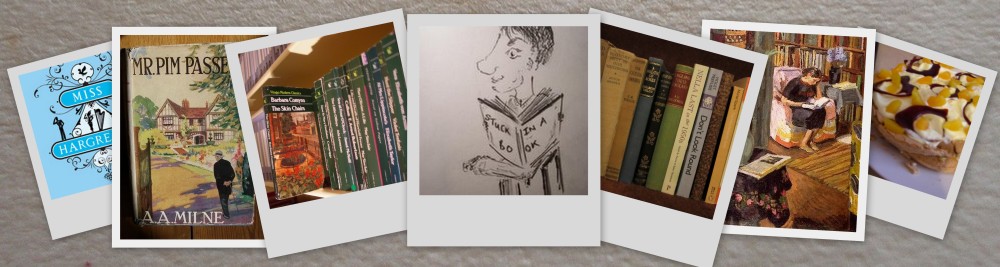
Bits and Pieces

Well, it’s nearly sorted out here… all the books are out (hurrah!) except for some which seem to be hiding – and I’ve managed to fill a box to go home with Our Vicar and Our Vicar’s Wife when they visit next week.

Sorry I haven’t responded to comments on the last few posts yet, promise I will soon. Perhaps I’d have done so in spare moments at work today, but I managed to leave my glasses at home (or rather, couldn’t find them this morning) so was avoiding using a computer screen too much. When I got home… of course they were right in front of me. Hmm.

A couple of links to keep you going, whilst I think about proper reviews and suchlike – firstly, Karen has posted the latest Wikio literary blog rankings, and I’m pleased to see lots of my favourite people there – not least Karen herself, who has rocketed into second place. I’m surprised and pleased to see I’m still in at fourth – I haven’t a clue how these rankings work or how reliable their algorithms are, but… oh, it’s a bit of fun, isn’t it?

And do pop over to Elaine’s blog to read about lovely Judi Dench at the Proms. Video of Judi Dench’s performance of Send in the Clowns should be below… simply stunning.

And, since this is supposed to be a book blog, what am I reading? Primarily Barbara Comyns’ Birds in Tiny Cages, but also The Girl With The Dragon Tattoo for book group… which is proving to be wholly unsuccessful. I may well give up on it… more on that soon. Oh, and I’ve just finished making notes from an interesting book by Rosemary Jackson called Fantasy: The Literature of Subversion.

Have a good Thursday, everyone! I shall be making Meringue Gateau Mark Two – this time with raspberries and kiwi fruit. Mmmmm….

Cake Galore!

All moved in, sadly no books yet unpacked (despite me theoretically setting aside tonight to do it… and my ironing, incidentally, which also hasn’t happened). Luckily I put a couple of books in my last minute bag, so haven’t been short on reading material.

As promised – or rather, as offered – here is the recipe for the Apricot Meringue Gateau I made the other day. Basically I took two different recipes from Afternoon Teas: Homemade Bakes & Party Cakes and doctored them a very small amount. To be honest, you can substitute any fruit for the apricot – I think this would be lovely with mixed berries and kiwi fruit, for instance. It was all much easier than I anticipated. But – warning – you will need an electric whisk. Or lots of muscles.

Whenever I put recipes up, I assume total ignorance, and that lots of things will go wrong. This is because I hate recipes which assume you have an encyclopaedic knowledge of baking (‘until it is the consistency of creme brulee’ or whatever) and especially those which don’t give warning for the things which might collapse or crumble or not work… Basically I’ve added my own irreverent comments to each step. Ok, warnings done, here is the recipe:


1.) Preheat the oven to 160C/325F/Gas Mark 3. Grease and line two circular sandwich tins. Nobody EVER does this first, but recipes always put it first, so I’m going to follow suit.

2.) Whisk four egg whites until they’re stiff – i.e. they hold their position if you make little mountains in them. (Separating eggs is, I discovered, much easier using your hands – break the egg, put the lot in your hands over the bowl, and pass the yolk between your hands until there is no egg white yet.) I couldn’t find any use for four left over egg yolks… any ideas?

At this stage, and indeed all the whisking stages, whisking too much is better than whisking too little, I find… obviously, as Goldilocks would say, whisking just the right amount it best.

3.) Add 110g/4oz/half a cup of soft light brown sugar (brown caster), and continue to whisk until the mixture softens again. Then fold in the same amount of sugar again, with a little vanilla essence. ‘Fold in’ is one of those lovely baking phrases which everyone interprets to their own discretion – I see it as stirring but with a horizontal, rather than circular, motion. Oh, and vanilla essence is one of those ingredients that surely can’t ever really be necessary, but feels fun.

4.) Put half the mixture in each tin, spread evenly, and bake for 40 minutes. Leave to cool. But of course we’ll be getting on with the next bit, not just watching it cool. A tip I nabbed from Delia Smith, and which seemed to work, is to turn the oven off after about 30 minutes or so, and then leave it in the cooling oven for… well, any time really. I left it in for about 25 minutes in a cooling oven. And I have no way of telling whether a meringue is cooked or not – it’s obvious on top, but not so obvious underneath. What with the top getting in the way.

5.) Now for the filling. Whisk (or, indeed, whip) 300ml/half a pint/1.25cups of double cream. That might be known as ‘heavy cream’ in America? Basically, the least healthy cream on which you can lay your hands. The recipe book suggests you whip it alongside 25g/1oz/4 tablespoons of icing sugar (also known as confectioners’ sugar?) which I did, but I think it would have been quite sweet enough without it. Chose, based on the sweetness of your tooth…

6.) Chop up the contents of a 150g/50z drained can of apricots into fairly sizable chunks – quarters, say? (Tinned apricots should give you a weight and a drained weight – make sure you get the drained weight, i.e. without the water.) That’s the least amount you could use – I feel it could easily have had a few more. I suppose you could use real apricots, but let’s pretend you’re not.

7.) Divide your chopped apricots into four piles. (This is where I depart from the recipe, which wants you to keep them all together.)
–If you have a food processor, then process two of the quarters, and stir into about two thirds of the whipped double cream. If, like me, you don’t own a food processor, then add them to the whipped double cream and whisk it a bit more, covering the bowl with your other hand, so that it doesn’t go everywhere…
–then loosely stir in another quarter. And put the mixture in the fridge.
–Yes, you’ve got another quarter of the chopped apricots and a third of the whipped cream left… be patient!

8.) While you’re waiting for the meringues to cool, get working on the caramelised sugar shapes. If, like me, the idea is terrifying – be calm! I found this quite surprisingly easy. That might be a fluke, and I’ll never manage it again, but… we’ll see!

9.) Line a baking sheet (or any flat surface, really) with baking paper/parchment. Heat 6 tablespoons of granulated sugar gently, until it melts, then increase the heat and cook until a spoonful hardens when dropped into cold water. The key here, I think, is heating it really gently and slowly to start with. I stared at it for ages, and it was doing nothing. I started to wonder whether the heat was turned on, whether the book was lying, whether the sugar was somehow heat resistent… but no, it just needed time to contemplate melting. And the spoonful-hardens-in-water thing sounds like fanciful recipe book nonsense, but it worked – it even made a clink against my glass bowl. It made me feel a little like a magician.

10.) Drizzle the sugar into decorative shapes. So says the recipe book. As you can see, my ‘decorative shapes’ are just blobs. But it was fun, and so easy – put a small amount on a wooden spoon, and drizzle it around. Add more to each shape if you want to. Maybe next time I’ll be ambitious and spell out my name or something, but my baking parchment wasn’t quite level, so the melted sugar ran everywhere. Perhaps you should use some to weigh down the corners first?

11.) Compiling Time!
–Turn one cooled meringue-filled-baking-tin onto a plate. This is where I accidentally dropped the tin onto the oven, and caused earthquake-like cracks throughout the meringue. Oops. Have it upside down, so the softer side is in the middle of the gateau.
–Spread the meringue/cream mixture on top
–Put the second meringue on top. Try and keep the top uppermost… might involve some judicious juggling, or turning onto another surface first, but the firm bit needs to be on top. (And you know how fragile meringue can be. Maybe use cream as an adhesive…)
–Spread the remaining cream on top.
–Scatter the remaining apricots over the top (you knew there was a reason these were left!)
–Add your decorative sugar shapes – and we’re all done for a yummy, oh-so-healthy (ahem) pudding!

Do let me know if you give it a go…

Moving with the times


I did promise you a multi-coloured Weekend Miscellany, but I’m afraid packing all day and carrying everything down the stairs has rather worn me out…

So, instead, I would like to know your reading suggestions on the topic of moving house! Can you think of any?

Only one comes to my mind – Persephone book and Virago Modern Classic The New House by Lettice Cooper. That dual honour for this 1930s novel is warranted – it’s a fascinating novel for many reasons, but especially in terms of contemporary class shifts, including those between masters and servants… Rhoda came into the kitchen and stood just inside the doorway, looking shy. She always felt shy when she penetrated to that downstairs world. The life lived so near to them and so far apart from them was a dark continent, full of unexplored mystery.And, of course, they move house! So, over to you… books about moving house, please. And I’ll see you on the other side…

Holiday Snaps


Right, recipe will come soon! Hope you liked the sketch too – it’s been a while, and I’m hoping to include more, as they’re a fun way of making my blog a little different. We’ll see…

I’m tired after bizarre sleeping patterns to and from a lovely wedding in Northern Ireland. Still got almost all my packing to do, and am moving house on Saturday… fun fun! I have found myself the perfect movers’ company which has agreed on traversing through different states to my house. So I’ll leave you with some photos from the trip Colin and I took up to Yorkshire and Derbyshire a little while ago.

Col chose Yorkshire (not sure what prompted this, but good choice Cogs) and I decided it was too far to drive from Somerset, so we stopped in Derbyshire first. And we stayed at lots of beautiful Youth Hostels – this is the path which led out behind the first one, Ravenstor. Apparently it’s where David Bellamy first developed a love of wild flowers.


We had competitions over who could take the best stairs shot… but since Col’s isn’t here, you can’t be the judge.


Mum and Dad had bought us National Trust membership (thanks OV and OVW!) and the first we visited was Ilam Hall.


The place I was most excited about visiting was Chatsworth, recent home of Debo Mitford aka the Dowager Duchess of Devonshire. The house was kind of dark and broodingly handsome (so like me, naturallement) and then the gardens were simply gorgeous. I could have stayed in them for hours and hours, but Col was waiting in the car park – owing to his irrational hatred of all things Mitford, and all things costing £9.50.


The other highlight, once we were up in Yorkshire, was of course Haworth and the Bronte Parsonage. Although I’m not an obsessive Bronte fan (and, unusually, Anne is my favourite) it still felt wonderful to be there. Even with a group of thirty schoolchildren wandering around after us, their teacher hovering outside each room we were in, saying “No, you can’t go in yet, the room is not empty yet.”


But Anne, Charlotte and Emily are not all that Haworth has to offer – they have a working steam train! I’m not a trainspotter, but still harbour a love for steam trains which probably dates to loving the Railway Children – which was filmed along this line. Here is Colin, enjoying the only first class carriage we’re ever likely to occupy.


One day we decided to visit four National Trust properties… they included the stunning Rievaulx Terrace and Temples (first pic) and a ruin, the name of which eludes me for the moment (second and third pics).


Finally, a view of the dramatic scenery that surrounded us:


Wish me luck with moving, and hopefully I’ll find some time to put together a Weekend Miscellany… then I might be quiet for a bit, depending on whether or not we get internet sorted out at the new house quickly…

Introducing…

First things first… yesterday I made this:

Mmmm… Apricot Meringue Gateau. With fancy caramelised shapes on top. Let me know if you want me to blog the recipe… it’s usually book-chat here, but I’m happy to diversify if you want to feast on this! I took it to a dinner party, and we demolished it… and it was rather nice, though I says it as shouldn’t. (Oh, and whilst I’m on the topic of baking – I made a chocolate sponge cake the other day, but used muscovado and demerara sugar instead of caster or granulated – can I recommend it? So yummy.)

Back to bakig matters… I mentioned, in the midst of my review yesterday, that John Carey’s introduction to Wish Her Safe At Home was very good. It made me realise that it is probably the first critical introduction I’ve ever read that actually added something to the book. I’ve read lots from children or spouses or similar which enhance the work for personal or sentimental reasons, and some (like E.M. Delafield’s introduction to Pont’s The British Character) which are deliciously funny, but I can’t remember any other more learned introductions which truly succeeded.

Of course – I doubt I’m alone here – I never read introductions or prefaces until I’ve finished the novel. Quite why publishers think it’s acceptable to call something an ‘introduction’ which gives away the entire plot, I can’t imagine. But once I’ve got to that last page, and flick back to the beginning… so often I’m left unmoved by what’s written.

The usual seems to be a quick history of the author’s life, and then a summary of the plot, with apposite quotations. Well, I don’t need a summary of the plot, I’ve just read the book… I’d like to unveil things I might have missed, perhaps give a new angle on something. Of course, they’re damned if they do and damned if they don’t – the worst introduction I’ve ever read was Elaine Hedges’ to The Yellow Wallpaper, which was nothing if not, ahem, ‘original’. I.e. totally unsupported by the brilliant book. Check through the archives if you want to see me having an uncharacteristic rant (!!)


So… what are your thoughts on introductions? Do you read them first or last or not at all? Any really great ones which stick in your mind, or do you – like me – tend to be a bit disappointed? And are there any books you really wish *had* had an introduction, and didn’t? (I wish the film Inception had an introduction…!)

You’re So Unreliable!

One of my holiday reads (yes, still working my way through reviewing those – it’ll probably coincide with my next holiday by the time I finish with it) was Wish Her Safe At Home (1982) by Stephen Benatar. I heard about it from this article, reprinted in The Week. I’ve only just noticed it was written by the usually rather imbecilic Cosmo Landesman (Col and I find his film reviews very useful – you can guarantee that whatever he writes, the exact opposite will be true) – had I spotted Landesman’s name on it before I wouldn’t have proceeded. Glad I did! And, had that article not appeared on my horizon, Aarti’s enthusiasm would surely have filtered through! To get an idea of how much she loves Wish Her Safe At Home, just think about me and Miss Hargreaves…

Benatar’s novel made the press mostly because of his determination to give it a readership. That article elaborates on how he (very gently) approached people in various bookshops, suggesting they might like to read Wish Her Safe At Home (and probably his other novels too). He also set up his own publisher to reprint his own novels. And it takes some gumption to approach Penguin Classics and suggest his own, moderately successful, novel should enter that hall of fame. They wanted an introduction from a notable name, John Carey was happy to oblige (if the name is familiar it might be because, like me, you’ve flicked through The Intellectuals and the Masses) – but Penguin still turned it down. The beautiful New York Review of Books Classics were, thankfully, more sensible – hence the novel’s current incarnation.

So that’s the story the newspapers enjoyed – man battles against odds; gritty determination rewarded. We Brits do love an underdog – but don’t let any of that stand in the way of Wish Her Safe At Home being read on its own merits. It’s worth remembering that it was shortlisted for the James Tait Memorial Prize (a better indication of a good book than the Man Booker Prize, I reckon). So let’s get onto the story that really matters – the one within the pages of Wish Her Safe At Home.

Rachel Waring – who had once been ‘almost pretty’ – has inherited her great-aunt’s Georgian mansion, and leaves her dull job and incompatible flatmate, having instantly fallen in love with the house when she visited it. Moving there hadn’t been the plan, but its lure is such that she is immediately certain that she must:

The exterior of the house was beautiful. Terraced, tall, eighteenth-century, elegant. Oh, the stonework needed cleaning and the window frames required attention – as did the front door and half a dozen other things. But it was beautiful. I don’t know why; I just hadn’t been expecting this.
I always find the attraction of houses fascinating in novels. As someone who could happily spend all day staring at a beautiful home, who gazes into estate agents’ windows at properties I could never possibly afford, and who regards Kirstie and Phil as something akin to surrogate parents… well, I can sympathise with Rachel thus far.

But that isn’t all – the house has a plaque to Horatio Gavin, ‘Philanthropist and politician’, who had lived there 1781-1793. Rachel develops an interest in Gavin, and determines to find out more about him…

It’s not just dead philanthropists who catch Rachel’s interest. Indeed, more or less anybody she meets is considered a potential conversational partner, even if she is appraising and judging them at the same time. Benatar’s skillful presentation of Rachel’s voice gives her inner thoughts and outer expressions all tangled up with one another, and also fuses in the odd line here and there which show that neither are quite right… more on that later. First, here’s an example of Rachel’s lack of edit-button in her outbursts to anybody in close proximity…
“I think I should like to have been somebody’s favourite aunt,” I said. “I think it might have been fun.” This, to the woman whose table at the teashop I had asked to share.

She smiled, hesitated, finally remarked: “Well, perhaps it’s not too late.”

“No brother no sister, no husband – somehow I get the feeling it might be!”

“Oh dear.”

“Did you ever see Dear Brutus?”

“Dear Brutus? Yes! A lovely play.”

“Wouldn’t it be fine if we all had second chances?”

She nodded, now looking more relaxed. “Oh, I’d have gone to university and got myself an education!” I reflected that she probably needed one. “But otherwise I don’t think I’d have wished things very different.” She gave a meaningless laugh and started gathering up her novel and her magazine. Poor woman. What a lack of imagination. (And what a dull, appalling hat.) Yet I realised that I envied her.
It’s not just strangers in cafes, though – Rachel becomes friendly with an assortment of local people, especially her youthful gardener and his wife, Roger and Celia. Their lives get increasingly tangled up, in the most cheerful and whimsical way imaginable… or so it seems.

For it quickly becomes apparent that Rachel is not a reliable narrator. Whenever this realisation dawns in a novel, I get a little shiver down my back – what to believe, what not to believe! At first she seems unhinged in a jolly way – singing to herself, accosting everyone with sunny optimism and faux-schoolma’am whimsy. She meanders along the line between being consciously eccentric and… something less healthy. She gets increasingly bizarre, and it becomes clear that she is not sane… As John Carey writes in his introduction, ‘It reminds us how thin the boundaries are between the mad and the imaginative, the mad and the sensitive, the mad and the acute.’ She becomes obsessed with Horatio Gavin, the philanthropist who’d once lived in her house. We can no longer trust her version of the events she narrates – but second-guessing the truth is a twisting and turning game, written with excellent subtlety by Benatar. So much cleverer, so much better than The Behaviour of Moths, which tried something similar.

And Rachel’s is truly a unique voice. Witty and biting and joyous and enthusiastic and… yes, rather unhinged. Whether or not it is convincingly female is another question – I don’t mean feminine, for a female’s voice needn’t be feminine, but somehow it seemed as though it might not be a million miles away from Benatar’s own voice – though presumably his is rather tempered! That aside, Wish Her Safe At Home is quite extraordinary, and would certainly bear a careful re-reading. It’s not remotely the sort of novel I was expecting from the cover, or even from the blurb. I was expecting a novel which felt much older – this novel is unmistakably modern. Not through expletives or slang or modern references, but perhaps in tone. [Edit: I think what I actually meant, having read Aarti’s comments and reassessed, is that the novel felt timeless. When I said ‘unmistakably modern’ I meant it obviously wasn’t a 1940s reprint, in the way that The Little Stranger could have been – this novel could have taken place at any time, and it takes a while to work out when it is set.] And yet it combines this with a sense of history, and a charm which is uncommon in post-war novels. It’s an extraordinary read, and I am glad that Benatar’s persistence and determination paid off.

It shouldn’t be unusual, but John Carey writes an unusually good Introduction. Not unusual for him, I mean, just unusual in general. I’ve now used the word ‘unusual’ so often that it has lost all meaning… Aside from some lazy anti-Christianity, Carey writes insightfully and with an eye that is both analytical and appreciative. More on that topic tomorrow, methinks…

Do let me know if there are any unreliable narrators I should meet (although don’t let me know if their unreliability is a huge spoiler for the book!)

Books to get Stuck into:

To be honest, this most reminded me of the book I read immediately beforehand – The Little Stranger by Sarah Waters – because of the influence of a house, etc. etc. Instead, I’ll pick a couple novels with unreliable narrators, which is always an interesting angle…
Prince Rupert’s Teardrop by Lisa Glass
– ok, being honest, this book was far too gruesome for me to enjoy – but it’s also the best and most unnerving unreliable narrator I’ve encountered.

A Kind of Intimacy by Jenn Ashworth – and this is the next most unnerving! The tale of a scarily obsessive neighbour… but told from the perspective of that self-deluded neighbour. Very clever, and decidedly gripping.

That Book

A couple of friends and I went and saw Private Lives by Noel Coward this evening, in the open air at Wadham College. Very good, and very funny. Perhaps not quite as good as the student version I saw six years ago, which used physical comedy better than I’ve ever seen it done before or since, but you can’t fault Coward’s acerbic lines. All good fun, if you’re in the Oxford area I recommend you try and see it. And a plot that is very like A.A. Milne’s play The Dover Road. Which, I might add, came first by nine years.

And then I’ve spent the rest of the evening packing up boxes of books, in preparation for moving across Oxford at the end of the week. Only a few minutes away, but that doesn’t make much odds when it comes to getting all the books off every surface, and filling boxes… my bookcases are looking very bare, but the floor and my bedside table still hold more books than the average family owns, I should imagine.

A few have been kept out deliberately, of course. To read in between packing and moving, more especially to accompany me to and from Northern Ireland this week. One of which is The Girl With The Dragon Tattoo. My book group is reading it this month, and I wasn’t remotely interested in reading it, because of all the hype – but a few people said it was good, so I decided to overcome my prejudices and give it a go.

Anybody read it? And do you have the same instinct I have to avoid things that have been hugely hyped? Then again, I know a few people who have avoided Harry Potter for that reason, and they’re missing something of a treat.

Sorry for a short post – I have kept out a few other books to review, but not sure how much energy I’m going to have to do it in between packaging up my belongings… and here’s hoping the internet behaves at our new residence!

Let me know your thoughts on the Steig Larsson, and hyped books generally. And are there any uber-popular books I’ve been missing out on because of my prejudice? (I’ve been scarred for life by giving The Da Vinci Code a try…. eurgh, makes me feel dirty).

Stuck-in-a-Book’s Weekend Miscellany

All those book reviews I promised you… well, we’ve had one or two, still more to come next week – during which I’ll be off to Northern Ireland, and at the end of which I’ll be moving house. But I’ll try and prepare some posts to appear during the week… But, without further ado, let’s have a book, a blog post, and a link.

No, wait, we will have further ado. I thought you’d like to know that Jane Austen Poll seems to be working now, and has accrued 125 votes so far (wow!) with Pride and Prejudice an unsurprising winner. Next up is Persuasion, then Emma, then ‘Don’t make me choose! It isn’t fair!’ My own favourite, Sense and Sensibility, is limping in at fifth…

AND – I promised you a winner for the Tove Jansson book! It’s a bit buried in this colourful Miscellany, I’ll put the winner in capitals… Using a randomiserthingummy (because it’s too hot for Patch to do anything but lie down and flop his ears) the winner of Travelling Light by Tove Jansson is….

MYSTICA!

So Tove will be travelling off to Sri Lanka. Email me your address, Mystica, and I’ll get it in the post to you.

1.) The blog post – I don’t think I’ve ever had such an easy choice for blog post as this week. True, I did link to a few days ago, but whoever said you could have too much of a good thing? (Oh. Oh, right.) Here’s a link to Rachel aka Book Snob’s lovely musings on she and Jane Austen – basically it says everything you’ve been thinking about JA if you’re a Janeite – and, for good measure, here’s a rather funny post about falling off the book-abstinence wagon. Snarf.

2.) The book – I’m cheating on all counts this weekend. Not only was my blog post really blog posts, my book is going to be books. Many books. Because for some reason I’ve only just discovered (or at least only just remembered, if I’d forgotten) that Dodo Press have reprinted oodles of A.A. Milne’s books. Mostly the early whimsical sketches and things – including, pictured, Once A Week which I’ve just re-read – but also some plays. I don’t own any Dodo books, can anyone else comment on their quality? They also, quite bizarrely, don’t have a website – here is a link to their Milne reprints on Book Depository. That includes a James Milne, by the way…

3.) The link – I thought I’d draw your attention to a new link I’ve added to my Places of Beauty section, down in the left-hand column. It’s Photo Books from a company called Bags of Love. Usually I turn down advertising offers, but this one really appealed to me – and I included it on its own merits. Yes, they have sent me a lovely photo canvas to say thank you, but this is the first company’s offer I’ve accepted – I think their photo books and other photo-ideas would make lovely gifts… and my birthday’s in November. Just saying ;-)

More Saki

After all the kerfuffle with comments earlier (and in the wake of my failure!) I have resorted to another taste of Saki:

The Story-Teller
IT was a hot afternoon, and the railway carriage was correspondingly sultry, and the next stop was at Templecombe, nearly an hour ahead. The occupants of the carriage were a small girl, and a smaller girl, and a small boy. An aunt belonging to the children occupied one corner seat, and the further corner seat on the opposite side was occupied by a bachelor who was a stranger to their party, but the small girls and the small boy emphatically occupied the compartment. Both the aunt and the children were conversational in a limited, persistent way, reminding one of the attentions of a housefly that refuses to be discouraged. Most of the aunt’s remarks seemed to begin with “Don’t,” and nearly all of the children’s remarks began with “Why?” The bachelor said nothing out loud. “Don’t, Cyril, don’t,” exclaimed the aunt, as the small boy began smacking the cushions of the seat, producing a cloud of dust at each blow. “Come and look out of the window,” she added. The child moved reluctantly to the window. “Why are those sheep being driven out of that field?” he asked. “I expect they are being driven to another field where there is more grass,” said the aunt weakly. “But there is lots of grass in that field,” protested the boy; “there’s nothing else but grass there. Aunt, there’s lots of grass in that field.” “Perhaps the grass in the other field is better,” suggested the aunt fatuously. “Why is it better?” came the swift, inevitable question. “Oh, look at those cows!” exclaimed the aunt. Nearly every field along the line had contained cows or bullocks, but she spoke as though she were drawing attention to a rarity. “Why is the grass in the other field better?” persisted Cyril. The frown on the bachelor’s face was deepening to a scowl. He was a hard, unsympathetic man, the aunt decided in her mind. She was utterly unable to come to any satisfactory decision about the grass in the other field. The smaller girl created a diversion by beginning to recite “On the Road to Mandalay.” She only knew the first line, but she put her limited knowledge to the fullest possible use. She repeated the line over and over again in a dreamy but resolute and very audible voice; it seemed to the bachelor as though some one had had a bet with her that she could not repeat the line aloud two thousand times without stopping. Whoever it was who had made the wager was likely to lose his bet. “Come over here and listen to a story,” said the aunt, when the bachelor had looked twice at her and once at the communication cord. The children moved listlessly towards the aunt’s end of the carriage. Evidently her reputation as a story- teller did not rank high in their estimation. In a low, confidential voice, interrupted at frequent intervals by loud, petulant questionings from her listeners, she began an unenterprising and deplorably uninteresting story about a little girl who was good, and made friends with every one on account of her goodness, and was finally saved from a mad bull by a number of rescuers who admired her moral character. “Wouldn’t they have saved her if she hadn’t been good?” demanded the bigger of the small girls. It was exactly the question that the bachelor had wanted to ask. “Well, yes,” admitted the aunt lamely, “but I don’t think they would have run quite so fast to her help if they had not liked her so much.” “It’s the stupidest story I’ve ever heard,” said the bigger of the small girls, with immense conviction. “I didn’t listen after the first bit, it was so stupid,” said Cyril. The smaller girl made no actual comment on the story, but she had long ago recommenced a murmured repetition of her favourite line. “You don’t seem to be a success as a story-teller,” said the bachelor suddenly from his corner. The aunt bristled in instant defence at this unexpected attack. “It’s a very difficult thing to tell stories that children can both understand and appreciate,” she said stiffly. “I don’t agree with you,” said the bachelor. “Perhaps you would like to tell them a story,” was the aunt’s retort. “Tell us a story,” demanded the bigger of the small girls. “Once upon a time,” began the bachelor, “there was a little girl called Bertha, who was extra-ordinarily good.” The children’s momentarily-aroused interest began at once to flicker; all stories seemed dreadfully alike, no matter who told them. “She did all that she was told, she was always truthful, she kept her clothes clean, ate milk puddings as though they were jam tarts, learned her lessons perfectly, and was polite in her manners.” “Was she pretty?” asked the bigger of the small girls. “Not as pretty as any of you,” said the bachelor, “but she was horribly good.” There was a wave of reaction in favour of the story; the word horrible in connection with goodness was a novelty that commended itself. It seemed to introduce a ring of truth that was absent from the aunt’s tales of infant life. “She was so good,” continued the bachelor, “that she won several medals for goodness, which she always wore, pinned on to her dress. There was a medal for obedience, another medal for punctuality, and a third for good behaviour. They were large metal medals and they clicked against one another as she walked. No other child in the town where she lived had as many as three medals, so everybody knew that she must be an extra good child.” “Horribly good,” quoted Cyril. “Everybody talked about her goodness, and the Prince of the country got to hear about it, and he said that as she was so very good she might be allowed once a week to walk in his park, which was just outside the town. It was a beautiful park, and no children were ever allowed in it, so it was a great honour for Bertha to be allowed to go there.” “Were there any sheep in the park?” demanded Cyril. “No;” said the bachelor, “there were no sheep.” “Why weren’t there any sheep?” came the inevitable question arising out of that answer. The aunt permitted herself a smile, which might almost have been described as a grin. “There were no sheep in the park,” said the bachelor, “because the Prince’s mother had once had a dream that her son would either be killed by a sheep or else by a clock falling on him. For that reason the Prince never kept a sheep in his park or a clock in his palace.” The aunt suppressed a gasp of admiration. “Was the Prince killed by a sheep or by a clock?” asked Cyril. “He is still alive, so we can’t tell whether the dream will come true,” said the bachelor unconcernedly; “anyway, there were no sheep in the park, but there were lots of little pigs running all over the place.” “What colour were they?” “Black with white faces, white with black spots, black all over, grey with white patches, and some were white all over.” The storyteller paused to let a full idea of the park’s treasures sink into the children’s imaginations; then he resumed: “Bertha was rather sorry to find that there were no flowers in the park. She had promised her aunts, with tears in her eyes, that she would not pick any of the kind Prince’s flowers, and she had meant to keep her promise, so of course it made her feel silly to find that there were no flowers to pick.” “Why weren’t there any flowers?” “Because the pigs had eaten them all,” said the bachelor promptly. “The gardeners had told the Prince that you couldn’t have pigs and flowers, so he decided to have pigs and no flowers.” There was a murmur of approval at the excellence of the Prince’s decision; so many people would have decided the other way. “There were lots of other delightful things in the park. There were ponds with gold and blue and green fish in them, and trees with beautiful parrots that said clever things at a moment’s notice, and humming birds that hummed all the popular tunes of the day. Bertha walked up and down and enjoyed herself immensely, and thought to herself: ‘If I were not so extraordinarily good I should not have been allowed to come into this beautiful park and enjoy all that there is to be seen in it,’ and her three medals clinked against one another as she walked and helped to remind her how very good she really was. Just then an enormous wolf came prowling into the park to see if it could catch a fat little pig for its supper.” “What colour was it?” asked the children, amid an immediate quickening of interest. “Mud-colour all over, with a black tongue and pale grey eyes that gleamed with unspeakable ferocity. The first thing that it saw in the park was Bertha; her pinafore was so spotlessly white and clean that it could be seen from a great distance. Bertha saw the wolf and saw that it was stealing towards her, and she began to wish that she had never been allowed to come into the park. She ran as hard as she could, and the wolf came after her with huge leaps and bounds. She managed to reach a shrubbery of myrtle bushes and she hid herself in one of the thickest of the bushes. The wolf came sniffing among the branches, its black tongue lolling out of its mouth and its pale grey eyes glaring with rage. Bertha was terribly frightened, and thought to herself: ‘If I had not been so extraordinarily good I should have been safe in the town at this moment.’ However, the scent of the myrtle was so strong that the wolf could not sniff out where Bertha was hiding, and the bushes were so thick that he might have hunted about in them for a long time without catching sight of her, so he thought he might as well go off and catch a little pig instead. Bertha was trembling very much at having the wolf prowling and sniffing so near her, and as she trembled the medal for obedience clinked against the medals for good conduct and punctuality. The wolf was just moving away when he heard the sound of the medals clinking and stopped to listen; they clinked again in a bush quite near him. He dashed into the bush, his pale grey eyes gleaming with ferocity and triumph, and dragged Bertha out and devoured her to the last morsel. All that was left of her were her shoes, bits of clothing, and the three medals for goodness.” “Were any of the little pigs killed?” “No, they all escaped.” “The story began badly,” said the smaller of the small girls, “but it had a beautiful ending.” “It is the most beautiful story that I ever heard,” said the bigger of the small girls, with immense decision. “It is the ONLY beautiful story I have ever heard,” said Cyril. A dissentient opinion came from the aunt. “A most improper story to tell to young children! You have undermined the effect of years of careful teaching.” “At any rate,” said the bachelor, collecting his belongings preparatory to leaving the carriage, “I kept them quiet for ten minutes, which was more than you were able to do.” “Unhappy woman!” he observed to himself as he walked down the platform of Templecombe station; “for the next six months or so those children will assail her in public with demands for an improper story!”