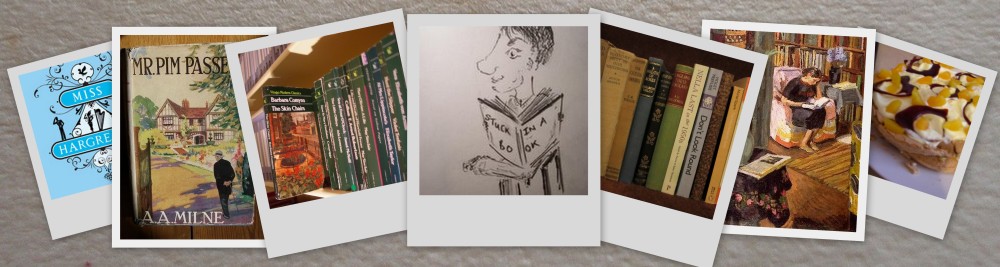
Our discussion of retitled books the other day segues neatly into a quiz I wrote for the Oxford Dictionaries blog – can you identify the early titles of famous novels? It’s HARD. Come back and let me know how you did! The quiz is here.
All
Tea By The Nursery Fire – Noel Streatfeild
![]() |
| Picture nabbed from Hayley’s review… |
I seem to be on a little run of lovely books at the moment, although Tea by the Nursery Fire: A Children’s Nanny at the Turn of the Century (1976) by Noel Streatfeild doesn’t have quite the same feel as Patricia Brent, Spinster. It’s not as funny – indeed, it’s not trying to be funny. But it’s another book that is so enjoyable and cosy that you’d be forgiven for mistaking it for a duvet.
Noel Streatfeild will be known to many of you as the author of Ballet Shoes and other books of that ilk. Indeed, she is known to me as that, but I haven’t actually read any of them – the only Streatfeild I have read is the Persephone (Saplings) which I don’t remember having very strong feelings about, but finding racier than I’d expected. Well, as you’d imagine, Tea by the Nursery Fire isn’t remotely racey. It’s the complete opposite of racey, even if there is the odd bit of illegitimacy and out-of-wedlock liaisons going on along the way.
It’s difficult to say whether Tea by the Nursery Fire is fact or fiction, and the blurb has cautiously opted for calling it a blend of the two. Noel Streatfeild is writing about her father’s nanny, from childhood in the 1870s until her death. Streatfeild never identifies which of the child characters is her father, so I couldn’t work out whether one of the last generation was Noel herself under a pseudonym, but I think it’s fair to assume that Noel either never met Emily Huckwell, or at least never spoke with her to any meaningful extent. Thus every detail of this many-detailed story comes either from passed-on memories of her father, or from her own head.
Everything progresses as you might expect – we start with scenes of a poor and big family, where boys are expected to become labourers at 14, and girls head off at the same age to find a ‘position’ somewhere. Emily is given the lowest rung at the local squire’s – basically the maid of a maid of a maid. Only a chance comment at family prayer’s, where she offers to mend the dress of a visiting family member, gives her the opportunity to move up the ranks (and escape the watchful eye of the house’s unpleasant housekeeper). She goes to the much smaller residence of the woman in question, and aids the friendly and wise nanny there.
And on it progresses – scenes full of nannies and their charges, maids and their duties, mistresses and their ways. It’s a late-Victorian world which is chiefly familiar to me through the eyes of Ivy Compton-Burnett. Of course, the tone Streatfeild takes could scarcely be more different.
I loved reading Tea by the Nursery Fire, it was heartwarming and sweet, but I think I might have really loved it if Streatfeild had taken the heartwaming down a notch. Emily is basically perfect, and never puts a foot wrong. She is very wise, very kind, and very forgiving. There are a few moments of tragedy in her life, and while it is true that she deals with these calmly, rather than with the semi-histrionic heroism so beloved to 1940s cinema, she also doesn’t seem to be impeded in her path of virtuous goodness.
All of which makes her a nice, rather than lovable, character. But it is understandable – she is the sort of paragon that you can imagine a child believing his nanny to be. Still more, the sort of person that son’s daughter would wish to believe in.
Yes, it’s lovely. Perhaps it is only the cynic in me that would have loved it rather more if Emily had let loose with an acerbic aside now and then.
Stuck-in-a-Book’s Weekend Miscellany
Hope you’re having a nice weekend – in the UK we finally have SUN! It’s amazing.
1.) The book – have you read any of Sigizmund Krzhizhanovsky’s short stories? NYRB Classics have brought out a few with lovely covers (as per) and I’m currently reading The Autobiography of a Corpse, and finding it… interesting. Jury’s out at the moment. Anybody know anything more about his writing?
2.) The review – one of my biggest surprises in recent years was when Claire/Captive Reader didn’t love the (oh-so-lovely) Guard Your Daughters by Diana Tutton. So she’s moved down to my second favourite book read in 2012 – although I suspect that is a coincidence – and did end up loving the equally-lovely Blue Remembered Hills by Rosemary Sutcliff. Go and enjoy her review here. And then make sure you read the book.
3.) The link – this one has been doing the rounds in various places, so this is just the most recent place I’ve seen it. First brought to my attention by my friend Hannah, there is an app which will cleverly scroll through words, enabling you to read a book much more quickly than you would moving your eyes across a page. Now, when it comes to reading novels I remain a technophobe, and I certainly shan’t be getting one, but I’m still impressed by the idea…
Changing titles
Reading Boel Westin’s biography of Tove Jansson, I’m struck by the significance (and flexibility) of titles – especially for a much-translated author. It’s interesting to see how Jansson’s choices of titles were changed by her publishers, and then changed again for reprints and translations and the like. It’s a bit haphazard, and sometimes misleading… in Jansson’s case it seems to be quite a lot of the publishers being keen to get ‘Moomin’ somewhere in the title. Understandable.
I love publishers – not just the one I work for at the moment! – but there have been a few name-changing culprits along the years. Here are some of the examples I’ve come across; I’d love to know ones you’ve heard about…
Agatha Christie’s American publishers had a bit of a field day I think. We’re not talking the necessary retitling to And Then There Were None, but retitling where they want to make the theme more prominent… so Hickory Dickory Dock became the oh-so-subtle Hickory Dickory Death. I love that…
Whoever reprinted Noel Streatfeild’s children’s books was really keen to capitalise on the success of Ballet Shoes. I was reading her Wikipedia page the other day, and saw that The Circus is Coming became Circus Shoes; Curtain Up became Theater Shoes; Party Frock became Party Shoes, The Painted Garden became Movie Shoes, The Bell Family became Family Shoes (ugh); Wintle’s Wonders became Dancing Shoes; Apple Bough became Traveling Shoes. Even White Boots wasn’t considered on-message enough, and became Skating Shoes.
The one that makes me crossest… E.M. Delafield’s Straw Without Bricks: I Visit Soviet Russia hasn’t appeared under that title for a while… Someone decided at some point that it would be a good idea to call it The Provincial Lady in Russia, which is incredibly misleading because (1) it doesn’t feature the Provincial Lady, and (2) it’s a very different sort of book. It’s quite funny, but it’s not a comic book – it’s not even a fictional one. Tut tut, somebody, tut tut.
Patricia Brent, Spinster – Herbert Jenkins
Although I love all the books on my 50 Books You Must Read list, I freely admit that some are better than others, as regards literary merit. Some are simply on there because they are incredibly fun and a delight to read – and Herbert Jenkins’ 1918 novel Patricia Brent, Spinster is among that number.
One of the things I love most about literary discussion online – be it on blogs or email groups or whatever – is that occasionally an unlikely novel will take centre stage. As I read in a sage review somewhere (I forget where), somebody in the blogosphere always seems to be discovering Barbara Comyns. Ditto with Shirley Jackson, and similar unexpected enthusiasms have been launched for books like Saki’s The Unbearable Bassington, Diana Tutton’s Guard Your Daughters, and (of course) Miss Hargreaves by Frank Baker. I don’t remember quite where I first heard of Patricia Brent, Spinster, but I do know that last year lots of people in my Yahoo group were reading it, and that Thomas compared it to Miss Hargreaves. So it was one of them. Right, let’s get onto the book itself, shall we?
Although officially I disapprove of lying, I love it when characters lie in books and TV shows – especially when they do it badly, or it leads to all sorts of unintended consequences. It’s such a great device, perhaps because, rather than dealing with an enemy or antagonist, the victim has caused their own chaos – and thus must steer things back onto the right path. It’s the starting point of Miss Hargreaves, and it is the starting point of Patricia Brent, Spinster.
I had assumed that Patricia Brent would be in her dotage – such are the connotations of ‘spinster’ – but in actual fact she is only in her early 20s. Thus she is rather outraged when she overhears the older residents of her boarding-house talk pityingly about her being 27 and alone. As Jenkins writes later in the novel:
A book could be written on the boarding-house mind, I think. It moves in a vicious circle. If someone would only break out and give the poor dears something to talk about.
Well, this is precisely what Patricia does. Without giving it much thought, beyond the triumph of the moment, she announces to the assembled ladies and gents that she is off for dinner with her fiancée. Her plan is simple – she will take a taxi to a fancy restaurant, eat alone, and return having scored a point. Of course, she couldn’t have predicted that two of the women would find out where she would be eating, and follow her there…
Unable to admit to the lie, Patricia takes a different step – one which severs any attachment the novel might have had to real life – and plonks herself down at the table of a man eating alone, whispering to him to play along. Rather than look startled or call the manager (as you or I might do), he is game – and they have rather a fun evening.
Peter Bowen is the man in question, an officer and a gentleman (or something like that), and – would you believe it? – he falls in love with her. The rest of Patricia Brent, Spinster follows her reluctant realisation that she loves him too, and… well, you can probably guess everything that happens.
Not a moment of it is plausible from beginning to end – and, because it is consistently absurd, it is a total delight. A likely incident would have ruined the whole thing, just as a moment of pathos deflates a farce. Nobody seems to speak or behave as anybody outside a novel would, but Jenkins has created a masterpiece, in his own way.
You might not expect to love something of this ilk, but I defy you not to be charmed by it. Along the way we meet Patricia’s aunt, her oft-stated ‘sole surviving relative’, who is every bit as interfering as you’d hope. Bowen has a kind, wise, witty sister of the sort which cheerfully cluttered up the Edwardian era; Patricia’s political employer (she is a secretary) has a simple-but-honest father. Nothing here is too original, but all is wonderful – and the writing is just as fun. This sort of thing:
Mr. Cordal grunted, which may have meant anything, but in all probability meant nothing.
Oh, I loved it. It’s a breath of fresh air, and as abundantly silly and heart-warming as you could possibly desire. There are quite a few secondhand copies available (I got mine, with its bizarre dustjacket, for £1 in Felixstowe) but it’s also free on Kindle. I’m not the first to cry the joys of Patricia et al, but I am among its most vociferous supporters.
A surprise on the shelf
Do you ever just go and look along your bookshelves, reminding yourself of the exciting and interesting books you’ve been meaning to read? It generally fills me half with joy that they’re there, and despair that I don’t have time to read them immediately. But it’s also fun to pull things off the shelf, re-read the blurb, remember where you bought, ponder on how good they might end up being…
Today I did that with an author I’ve intended to read more of for ages – Janet Frame. I read a collection of her short stories four years ago, and have bought a fair few over the years. One of the most intriguing was The Adaptable Man, with this blurb:
Electricity is coming to Little Burgelstatham, cottages are being modernised and the Overspill from London is starting to encroach on the village. While some would rather live in the past, Muriel Baldry welcomes the coming of electricity, as she can now hang her Venini Chandelier and organise a dinner party to celebrate it. But does adapting to the twentieth century demand darker deeds?
This is a vividly portrayed and poetic novel with a beautifully balanced sense of the ridiculous.
That sounds wonderfully up my street – odd and quirky, but still domestic and parochial. I moved it to my ‘must read soonish’ pile. In fact, I think I’ll read it for Kim’s ANZ Reading Week (extended to include New Zealand this year.) And then I spotted this…
Well, that was a nice surprise!
Best bookshops
I haven’t been on a good bookshop trawl for months. There’s very little I love more in life than discovering a secondhand bookshop I’ve not been to before, and falling joyfully upon its shelves. If the books happen to be reasonably priced and plentiful, then my joy is complete. This was how I felt in bookshop after bookshop in the US, but I don’t think I’ve been to any since then. Shameful.
So I’m probably going to treat myself with a day out to one before too long. And I wondered if you had any recommendations – preferably for bookshops in towns which are near enough to Oxford to permit a day trip there and back. On a trainline.
Yes, very picky, I know.
If they’re in London, that’s ok – but I’d prefer them to be in the countryside, or vaguely countrysidish.
Over to you!
(If you don’t live in the UK, please feel free to tell me about your favourite bookshops… but try not to make them sound too appealing.)
Slightly Famous People’s Foxes
It’s no secret that I’m a big fan of the Slightly Foxed Editions – I’m always so charmed and intrigued by the memoirs they publish. And now, to celebrate the 10th birthday of Slightly Foxed, they have published a fun-sounding book called Slightly Famous People’s Foxes.
It’s a gallery of fox sketches by the great and the good (including Diana Athill, Quentin Blake, Helen Mirren, Michael Palin, Libby Purves, Alexander McCall Smith, and many more – read the full list here) with descriptions introducing them all. Clicking on that link will take you to a sample, which is more than promising…
Even better, it’s only £5 in the UK (also available internationally), and all profits go to The Children’s Hospital School at Great Ormond Street. A great-sounding book for a definitely great cause! And a very happy birthday to the wonderful Slightly Foxed.
Famine or feast
![]() |
| Ten points if you can say where you’ve seen this picture before… |
Firstly, I should say – I haven’t written a book and my thesis isn’t being published (not yet, anyway), so those guesses to my cryptic post the other day have made me think it’ll be a bit of an anticlimax when it’s revealed! Well, it’s different anyway.
Secondly – I’m having a bit of a lucky streak with my reading at the moment. Some gems I’ll be talking about in a while, including the Tove Jansson biography I mentioned recently. What an interesting and creative woman! I’m also loving the reissued Shirley Jackson novels (thanks Penguin) and a novel published in 2014 (gasp) by one of the few modern authors whose work interests me a lot.
Do you find that it’s famine or feast with reading? Earlier in the year, I had about eight books on the go and wasn’t hugely enjoying any of them – none were bad enough to give up, but none were exciting me. At the moment, I’m haring to get back to most of the books I’m reading. Is it a coincidence? Am I sometimes simply more receptive to the good qualities lurking in books – or does one good book lead to another?
Sometimes I’m asked (by people who read one book at a time) how I manage to read several at once. Well, I usually want to combine many types of book (and will confess to confusion recently, when reading two novels with introspective teenage girl heroines) – and at the moment I’m definitely feeling the absence of a 1930s domestic novel in the mix. So I’m going to grab one off the shelf, and add it to the modern novel, the 1950s Shirley Jackson, the biography…
And I think it might be Elizabeth Cambridge’s Susan and Joanna. I’ll have to see if that fills a gap in A Century of Books…
Stuck-in-a-Book’s Weekend Miscellany
I’m off to Bristol for the weekend (as mentioned the other day) – but my quiz ability might be hampered by the fact that I’m not feeling very well. Doh. (That’s my excuse if I do badly, anyway.)
Here’s your usual (ahem) round-up of book, blog, and link!
1.) The book – I don’t know much about this one, but it arrived through my letterbox and looks interesting… Grace and Mary by Melvyn Bragg, from Sceptre. A quick google tells me that it was actually out in hardback and I missed it completely (or, more likely, read about it and forgot it). Well, more info here!
2.) The blog – you probably all know and love Thomas of My Porch and The Readers. Well, he can add a third string to his violin (which is, incidentally, the number of strings my violin has had for three years) with Lucy’s Forever Home. It documents the transformation of his home (which was, frankly, already sublimely beautiful) – all the planning, reasons behind choices, diagrams, mood boards, and pictures of machinery that you could wish for. I lived for property programmes during my teens, and still love them now when I’m in at the right time – and this is like watching one about people I know.
3.) The link – a neat segue. Terry’s Fabrics sent me a link to a fun infographic they’d made about homes in classic literature, from Jane Eyre to The Secret Garden. Enjoy!