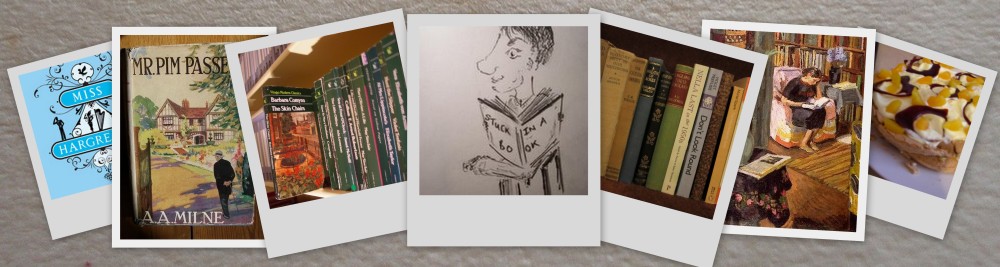
Unnecessary Rankings! Barbara Comyns

I’m back with two of my favourite things – ranking, and needlessness! I have lots of fun with this occasional series of ranking the works of authors I’ve read a fair bit by – and by seeing how much you do or don’t agree. So far I’ve done Michael Cunningham, Elizabeth von Arnim, and Margery Sharp (click the ‘rankings‘ tag up the top to see them all) and today I’m back with an author beloved by the blogosphere.

I don’t know how well known Barbara Comyns is in the wider world, though certainly there have been some lovely reprints in recent years. But in the bookish corner of the internet, she is practically a patron saint. There is one of her novels I’ve not read (A Touch of Mistletoe) because I can’t face the idea of running out. But here are her other books, in order…

10. Birds in Tiny Cages (1964)

This is a case of ‘the hardest one to find isn’t the best’, in my opinion. Based in Spain, with a very Comyns-like lead character in the naïve Flora, it’s still good. But I think Comyns is better when she can make more of English eccentricity.

9. Out of the Red, Into the Blue (1960)

And the same thing affects this – Comyns’ only memoir, about her time in Spain. It’s still entertaining, but misses a bit of the magic of her best work.

8. The Juniper Tree (1985)

When Virago started reprinting Comyns’ novels as Modern Classics, she turned her hand to writing again – or, rather, dug out some books that she’d written in the past. I’m not sure when The Juniper Tree was written, but the reason I’ve put it lower is that it’s a retelling of a fairy tale that I hadn’t heard of, so I missed a lot of nuance.

7. The House of Dolls (1989)

You’ll have noticed I’ve grouped her three later-published novels, and I do think they’re not quite her best – which is a shame, because The House of Dolls is set in a boarding house, and you know how I love them. Being Comyns, the old women in this novel have not settled down to a life of calm routine. Quite the opposite.

6. Mr Fox (1987) 

Mr Fox is a wartime spiv who lives with another typical Comyns heroine – the hopeful, muddled, surreal Caroline. Comyns is great on the countryside, but in this novel she does London excellently too. The best of her later-published books, in my opinion, and that’s perhaps because she apparently wrote it in the 1940s.

5. Sisters By A River (1947)

Comyns’ first novel is heavily autobiographical about growing up in an eccentric family by the Avon in Warwickshire. I might put it higher, but the misspellings and poor grammar (while apparently genuine) feel a bit gimmicky. In later novels, she kept the naivety without needing the gimmick.

4. Our Spoons Came From Woolworths (1950)

For a while this was her best-known novel, perhaps because of that excellent title, though it seems to have been superseded now. It’s a novel of chaotic young married life, including some deeply poignant moments dealt with matter-of-factly – the first of hers I read, I was bewildered more than anything. I need to revisit.

3. The Vet’s Daughter (1959)

And perhaps this is her best-known novel now? The vet of the title is a monstrously selfish man, domineering over young Alice’s life. It’s Comyns’ darkest book, yet with the same surreal humour that she can never leave behind. An ending unlike any of her other works, which dips into fantasy in the most brilliant way.

2. The Skin Chairs (1962)

Yes, there are chairs and they are made of human skin. But that’s just one bizarre piece of the mosaic of ten-year-old Frances’s life. I think this is Comyns at her most assuredly unhinged. I wish it could be reprinted, but publishers have shied away from those chairs (and particularly the race implications about them).

1. Who Was Changed and Who Was Dead (1954)

My favourite opening line from any novel is “The ducks swam through the drawing-room windows.” So compelling – and combining the surreal and domestic in a way that is quintessentially Comyns. This funny, strange novel (title quoting a Longfellow poem) is about a village which is simultaneously struck by flooding and an apparent outbreak of madness – all ruled over by the extraordinary and indomitable Grandmother Willoweed.

Comyns fans – do you agree with my rankings? How would you order her books? And where do you think A Touch of Mistletoe will end up on my list, when I finally read it?

Unnecessary Rankings! Margery Sharp

Another in my Unnecessary Rankings series – and another of my favourite authors (and one that so much of the book blogging world loves too). I haven’t read everything by Margery Sharp by any means, but here are the 12 that I have read. And they are, of course, RANKED.

I’d love to know which you’d put top of your list, or if my rankings provoke any reaction.

12. The Nymph and the Nobleman (1932)

There’s nothing wrong with this book, and I believe it attracts fans of Anna Zinkeisen’s artwork, but it’s only 75 pages of wide margins and big text. It’s basically a fairy tale short story.

11. Lise Lillywhite (1951)

I don’t dislike this novel (I like all of Sharp’s books), but I found Lise quite a passive, uninteresting heroine and the love triangle she finds herself in between a distant relative and a Polish count a bit lacklustre. But I did enjoy all the relentless pursuit for nylons!

10. The Flowering Thorn (1934)

People often list this story of Lesley impetuously adopting a young boy among their favourite Sharps… for me, it doesn’t have the joy or wit of my favourite Sharps. It’s also curious how the boy (Pat) is so sketchily drawn and scarcely seems to have any relationship with his adoptive mother.

9. In Pious Memory (1967)

A late, short Sharp novel, In Pious Memory is about the death of Mr Prelude – and then his family wondering that he might in fact still be alive. Even late in her career, Sharp is delightfully witty and pulls the rug from under the feet of anybody with pretensions.

8. The Eye of Love (1957)

If I’m honest, I’ve just put this here because I don’t remember very much about it. Looking back at my review, it is about a couple breaking up because of their disparate stations. Dolores’s niece Martha is an impassive viewer of the central couple, used devastatingly by Sharp. I think this would be higher if I re-read it – and I need to read the others in the Martha trilogy.

7. Britannia Mews (1946)

This is Sharp in most sombre mode. We follow all of Adelaide Culver’s long life living in Britannia Mews, exiled by her family after an elopement. Over the decades that follow, we watch the streets changing fortunes and Adelaide’s evolution from a young, naive girl into someone worn down her experiences. It is a very good but surprisingly melancholy book.

6. The Foolish Gentlewoman (1948)

My first experience with Sharp – back in 2003 – after seeing it mentioned glowingly in an edition of P.G. Wodehouse letters. A wealthy widow hears a sermon about the need to expiate old sins, and tries to do so my inviting a relative, Tilly, to live with her – where a motley crew of others already live. Sharp has great fun with this fable of good turns not always working out well.

5. Four Gardens (1935)

There’s a lot to love in Four Gardens, which takes us through the life of Caroline Smith through the four gardens she develops in her life. She is a lovable, wise character and this novel is witty but also Sharp at her most poignant.

4. The Nutmeg Tree (1937)

…whereas there is nothing poignant about the irrepressible Julia and this delight of a novel. In the glorious opening scene she is in the bath to avoid bailiffs, and that’s about the most conventional thing she does. She decides she should go and see her abandoned daughter, now on the brink of adulthood, and causes well-meaning chaos as she does so. It’s a joyful novel, with a lot more nuance than you might imagine.

3. The Gipsy in the Parlour (1954)

Sharp’s novels can be very silly or very serious, and The Gipsy in the Parlour falls towards the serious end of the scale – she is absolutely brilliant at atmosphere too. The young narrator is a niece to the Sylvester family and spends her summers at their Devon farm. Over the years, she sees shifting dynamics in the family – and how everything shifts when Fanny marries into the family and very soon becomes a permanent invalid. It’s quite dark and very, very good.

2. The Stone of Chastity (1940)

But I also love Sharp when she is being ridiculous. The Stone of Chastity is about a scientist who believes he has found a village which had a stepping stone which unchaste women would slip off. And doesn’t see why he shouldn’t interview the village about their chastity, for an experiment. It’s so silly and I loved every second.

1. Cluny Brown (1944)

I think this novel might well be number one because it’s where I first fell head over heels for Sharp – if I’d read The Nutmeg Tree first, it could have made number one. Because it was the first time I discovered what Sharp could create, in terms of a lively, well-meaning, disastrous heroine. Cluny is often told by her uncle that she ‘doesn’t know her place’, and so he puts her in service as a maid in Devon. She is naturally ill-suited to it, and it’s through this comic lens that we also take in the rest of the house – from a Polish intellectual to Betty, a woman every man is besotted with and who remains unmoved by these attentions. Lady Carmel is wonderful. As I wrote in my review, ‘She manages the household beautifully. Everybody thinks her sweet and ineffectual, whereas she is sweet and effectual.’

There we have it! I’d love to know your rankings. And, for the avoidance of doubt – if I haven’t mentioned it, I haven’t read it.

Unnecessary Rankings! Elizabeth von Arnim

I’m continuing my series on ranking all the books I’ve read by authors I like – I kicked off with Michael Cunningham, and now I’m onto the much more prolific Elizabeth von Arnim. With Cunningham, I’d read everything he wrote – with von Arnim, there is still quite a handful of her novels still sitting unread on my shelves. So if your favourite isn’t in the list, that’s why!

Ok, let’s go – from my least favourite to my most favourite.

14. Elizabeth and Her German Garden (1898)

Sacrilege! I actually like all fourteen of the Elizabeth von Arnim books I’ve read, but this one is in last place perhaps because I had such high expectations. It was such a big deal during her life, since she always appeared as ‘by the author of Elizabeth and Her German Garden’ or ‘Elizabeth’, but I found it didn’t have the spark of her best work.

13. Christine (1917)

Published under the pseudonym Alice Cholmondeley, it was initially marketed as genuine letters from a young English girl studying in Germany during 1914. It is fascinating, but one of her bleakest books.

12. Expiation (1929)

Opinions differ on this one, but I found this novel about adultery to lack the humour that is usually so characteristic of Elizabeth von Arnim. I found it a little wearingly earnest. But Persephone reprinted it and called it ‘laugh-out-loud hilarious’, so you may find that too!

11. Mr Skeffington (1940)

Elizabeth von Arnim’s final novel is about the once-beautiful Lady Skeffington trying to cling onto her appearance – and relive her youth by going to see the many men who have thrown themselves at her feet. I wrote in my review that I’d probably appreciate the book more in fifty years’ time. (Well, forty years now!)

10. In the Mountains (1920)

This is very much a novel of different parts – she starts with a nature-as-idyll description, but I much preferred the second, funnier half where two forceful English widows arrive at the narrator’s Swiss mountain home. In my review, I said: “It was a lovely, slim introduction to many of the things that make von Arnim charming, witty, and with an undercurrent of topical commentary that prevents the mixture being too sweet.”

9. The Adventures of Elizabeth in Rugen (1904)

There are quite a few sequels to Elizabeth and Her German Garden – this is the only one I’ve read, but I definitely preferred it to the original. It’s much funnier, particularly when Elizabeth is trying to avoid her burdensome Cousin Charlotte.

8. The Benefactress (1901)

The Benefactress might be higher if its story – a woman setting up home in Europe with three discontented women, and their gradual changes – hadn’t been done better by a novel we’ll find further up the list.

7. All the Dogs of My Life (1936)

Elizabeth von Arnim’s only autobiographical work is pretty cagey about the bigger upsets in her life, but I still enjoyed it a lot. She writes it through the lens of the different dogs she’s owned, and does rather expose herself as an appalling dog-owner.

6. Fraulein Schmidt and Mr Anstruther (1907)

Told in letters from Fraulein Schmidt (and we have to imagine the replies from Mr Anstruther) von Arnim expertly shows how infatuation can turn to hurt pride and the whole rollercoaster along the way. We really can picture the absent Mr Anstruther and the sorts of letters he probably writes.

5. Introduction to Sally (1926)

An impossibly beautiful young working-class woman is married off to the first man who asks, in a desperate attempt by her anxious shopkeeper father to ‘protect her morals’ – but it turns out that he doesn’t like much else about her. A sort of Pygmalion story, it’s delightfully funny with (as so often with E von A) a searing undercurrent of deeper emotions. Coming from the British Library Women Writers series later in the year!

4. The Caravaners (1909)

Elizabeth von Arnim’s most satirical work is gloriously funny. It’s from the point of view of a German man who can’t see how cantankerous, selfish and unreasonable he is. A few years ahead of the First World War, von Arnim spears German/Anglo relations – it’s the comic sister of Christine.

3. The Enchanted April (1922)

Her best-known work is deservedly loved. Four women head to picturesque Italy, described so enticingly, and go from selfish disunity into something rather idyllic. Saved from the saccharine by von Arnim’s dry wit as a narrator.

2. Father (1931)

Jen is perhaps my favourite creation of von Arnim’s. She leaves her father’s home upon his second marriage, keen to avoid a life of service to him. The novel has a lot to say about the role of women in the 1930s, but Jen is so spirited and naive a character that the whole thing feels joyful even when confronting real issues. So glad we got to do this one as a British Library Women Writers edition.

1. Christopher and Columbus (1919)

Nineteen-year-old twins Anna-Rose and Anna-Felicitas von Twinkler are half-German/half-English are packed off to America by their horrid Uncle Arthur when war breaks out. On the boat, they enchant Mr Twist, inventor of Twist’s Non-Trickling Teapot. Once arrived in America, after a series of events, they open a tea room. I LOVE a tea room plot. The twins’ dialogue is so fun, always sparkling and strange, and von A’s ironic turns of phrase are at their best in Christopher and Columbus. I think it’s still just about in print from Virago, otherwise I’d have tried to snap it up for the British Library, and I’d love to see more people meeting this wonderful cast of characters.

That was fun! Which Elizabeth von Arnims would you put at the top of your list?

Unnecessary Rankings! Michael Cunningham

There is exciting news about a new Michael Cunningham novel coming out next year – called Day – and it has prompted me to do the first in a series that I’ve been thinking about for a while. Anybody familiar with my end-of-year best books lists knows that I love ranking things. And what could be more unnecessary than ranking all the books I’ve read by particular authors?? Well, it might spark some conversations. And Cunningham is a good person to start with, if only because I have actually read all of his books.

So, here we go – some unnecessary rankings of all of Michael Cunningham’s output:

9. Specimen Days (2005)

The only Michael Cunningham novel that I dislike, the three sections of this take place in the past, then the present, and then the robot-future. And are tied together by Walt Whitman. My dislike for science fiction and historical fiction, and my complete ignorance of anything about Whitman, combine to make this one a slog for me (though I did enjoy the section set in the present).

8. A Wild Swan and Other Tales (2015)

Cunningham’s collection of fairy tales takes different angles to the traditional narratives – we see Jack and the Beanstalk from the Giant’s POV, for instance. It was fine, but this is a well-worn path, and there wasn’t much of striking originality here.

7. By Nightfall (2010)

The only reason this one is quite low is that I don’t remember very much about the story – a story of love triangle / struggle between a man, his wife and his brother-in-law? Possibly? The main thing I remember is the clever revelation that a much-feted conceptual artist is actually a bit of a charlatan.

6. Golden States (1984)

Cunningham has more or less disowned his first novel, about a boy travelling across America to try and intervene in his sister’s relationship – but I thought it was very good. You could see all the hallmarks of Cunningham’s writing that would develop further, but it’s a compelling and emotionally sensitive novel on its own terms.

5. Land’s End (2002)

Despite what Wikipedia says, I think this is Cunningham’s only non-fiction book – a memoir of sorts about Provincetown that is also a travelogue or visitors’ guide or something merging all of these.

4. A Home at the End of the World (1990)

This was marketed as Cunningham’s first novel when it was published six years after Golden States, and is the first of Cunningham’s many friends-as-unconventional-family dynamics. As ever, he is brilliant at the relationships between a curious group of people and there is much to love in this coming-of-age story. Colin Farrell, incidentally, was brilliant in an otherwise OK film adaptation.

3. Flesh and Blood (1995)

The top three Cunningham books are all absolute masterpieces. I believe this is his longest, and it covers several generations of a complex family. Cunningham is on his best form in depicting the knotty communication and miscommunication between parents and children and there are many moments of extraordinary beautiful. The best death scene I have ever read in literature.

2. The Snow Queen (2014)

His most recent novel was somehow almost a decade ago – another group of family and friends living unhealthily interdependent, but somehow beautiful, lives together. The premise is that a strange light in the sky gives a character a quasi-religious experience, but really this is a book about community.

1. The Hours (1998)

I think Cunningham is an example of the best book also being the most famous. His clever plotting interweaves Virginia Woolf writing Mrs Dalloway, a 1940s housewife reading Mrs Dalloway, and a 1990s woman whose life mirrors Mrs Dalloway’s. The writing is poetically beautiful but it’s also a page-turner. Even several re-reads in, I race through it.


So, there we go! Do you agree with my rankings? Anybody you’d like to appear in a future Unnecessary Rankings??