This is My Life in Books, Series Six, Day Six! It’s the final day of My Life in Books for this series – I hope you’ve enjoyed it as much as I have. Rounding out the week are:
Sheree, who blogs at Keeping Up With the Penguins
Rebecca, who blogs at Bookish Beck
Qu. 1.) Did you grow up in a book-loving household, and did your parents read to you? Pick a favourite book from your childhood, and tell me about it.
 Sheree: I think I grew up in a house that loved books in theory – my parents worked extremely hard, which left little time for recreational reading, but my father always had a book of some kind on the go. As a very young girl, my Nana read to me a lot, and I suspect that’s how I came to associate reading with comfort and fun.
I was a voracious reader, as soon as I could make out the words for myself, and I tore through every Enid Blyton book I could get my hands on. I can recall her Malory Towers series, starting with First Term At Malory Towers, being a particular favourite (and good insight into my future, it turns out, when I went to boarding school as a teenager).
 Rebecca: My mum was a primary school teaching assistant and has always shared my love of books and reading. She read picture books to me and took me to the public library frequently. Once I started reading for myself, I was unstoppable, filling every spare moment with the written word, even if the only thing that was available to me was a cereal box over breakfast. The Chronicles of Narnia were a birthday gift from my father and the first books I read on my own, starting on that very day I turned five. The Silver Chair was always my favourite, but I’m sure I must have read the first few books 10 or 20 times each. In those years I couldn’t get enough of series fiction and reread books compulsively, whereas nowadays I shy away from series or sequels and rarely reread a book.
Qu. 2.) What was one of the first ‘grown-up’ books that you really enjoyed? What was going on in your life at this point?
 Sheree: When I became a precocious, opinionated teenager, my father thrust a copy of George Orwell’s Nineteen Eighty-Four into my hands. It was the first book to reveal to me that my mind and experiences could be shaped by power structures beyond my imagining, and not always benevolent ones. It definitely prompted my ongoing interest in politics and identity. It’s still one of my favourite books, and I’ve re-read it dozens of times.
Rebecca: Discounting the V.C. Andrews book I snuck from my older sister’s room (that’s a rather different sort of ‘adult book’; my poor mother had to explain incest to me!), the first book I ever borrowed from the Adult Fiction section of the public library was Watership Down, at age nine. I remember crossing a big open space from the children’s area and entering the imposing adult stacks, as if I was undertaking some rite of passage. Later that year we moved away to another town, and I can see that, more so than ever, reading was my way of fortifying myself against life’s changes. Looking back, I note that, even though I grew up in the States, I developed my love of British literature early on, and my interest in animal books has remained: my 20 Books of Summer are all on an animal theme this year.
Qu. 3.) Pick a favourite book that you read in your 20s or early 30s – especially if it’s one which helped set you off in a certain direction in life.
 Sheree: Well, I’ve not yet reached my early 30s :) so this answer might be premature, but looking back over my 20s, I think the most impactful book I read was Herman Melville’s Moby Dick. Funnily enough, it’s not even a book I liked or enjoyed that much. I certainly wouldn’t recommend it to every reader; it’s one heck of a slog! But reading that book, finishing it, unlocked something inside of me. It changed my approach to reading, and from there my approach to writing about books, and from there my approach to life. I’m not sure where I’d be had I never read it.
Rebecca: In my early twenties, newly married and in my first ‘proper job’ at a university library in London, I read Heaven’s Coast, an exquisite memoir about the death of Mark Doty’s partner, Wally, from AIDS. I don’t remember how I’d found out about it, but it was a revelation to me in many ways. Though memoirs now make up a significant proportion of my nonfiction reading (which is 40% of my total reading), I had only begun reading them the previous year.
In particular, the Doty marked the start of my interest in medical and bereavement themes. I reckon I consume many more books about illness and death than your average reader, and have run a shadow panel for the health-related Wellcome Book Prize the last three years. It was through following up with Doty’s poems that I first got into contemporary poetry. Lastly, I’ve chosen this because it helped me become more open-minded about LGBTQ issues.
Qu. 4.) What’s one of your favourite books that you’ve found in the last year or two? How did you come to blogging and how has blogging changed your reading habits?
 Sheree: I started blogging about books almost by accident. I realised I’d been in a rut of re-reading my old favourites over and over again for years, and I hadn’t read any of the books that it seemed everyone else had: Wuthering Heights, To Kill A Mockingbird, and so on. So, I sat down and made a list of books I thought I “should” have read already, and committed to reading them all. I started taking notes on them as I went, and those notes became reviews, and those reviews became my blog.
It has made me an infinitely better reader, a more critical thinker, and it has completely changed my life. One particular benefit is that it’s made me far more adventurous in my reading life: I’ll pick up almost anything, even if I think it’ll be “too smart for me” or “too fluffy for me” or whatever other preconceived idea I have that might have once put me off. I was skeptical when I picked up one of my now-favourites, We Are All Completely Beside Ourselves by Karen Joy Fowler, because the blurbs were so vague and I figured that meant it must be a book about nothing much… it turned out to be one of the best books I’ve ever read. I’ll be recommending it to other readers with my dying breath. And I never would have read it if not for this book blogging project.
 Rebecca: My favourite book I’ve read in the last year and a half is Priestdaddy. In that it’s a memoir of growing up in a conservative religious setting in suburban America, it could have been my story – but Patricia Lockwood’s family was anything but conventional. She glories in her father’s quirks but never reduces him to a caricature, and highlights the absurdities of fundamentalism while remembering it fondly as her home and source. I admire her lack of bitterness, and it helps that she writes with a poet’s verve – and she’s hilarious. There’s not one dull sentence here. This is among a handful of books I wish I had written.
I’ve been writing about books since 2011, posting reviews on Goodreads or at Bookkaholic web magazine (2013‒15) before setting up my own blog in March 2015. I’m in a slightly unusual position because I’ve also reviewed books for pay since 2013. In my current stable of publications are BookBrowse, Bookmarks magazine (where I am an associate editor), Foreword Reviews, Kirkus, the Times Literary Supplement and Wasafiri literary magazine. So, for me, blogging is a break: a chance to write about my varied leisure reading in a free-form, unpressured way. I love the bookish community I’ve found online. Although I’m often drawn to shiny new books, participating in blog challenges like Reading Ireland Month and Women in Translation Month encourages me to read backlist books from my shelves.
Qu. 5.) Finally – a favourite that might surprise people!
 Sheree: Oooh, Crime And Punishment by Fyodor Dostoyevsky! If you’d asked me a couple of years ago, I’d have said there was no way I would have read that book, let alone be recommending it to others, but here we are. I read the McDuff translation, and I was amazed at how engaging it was, how accessible, how funny, how relatable! I know those are strange adjectives to use for a story about a literal axe murderer, but I stand by it. Raskolnikov is one of my favourite characters in literature.
Rebecca: It might not be fully evident from my other selections that I like reading really depressing books. Thomas Hardy, Cormac McCarthy, you name it. Caribou Island, a tragedy after the classical model, blew me away when I read it in 2011. The characters’ grand dreams cruelly mock the mundaneness of their real lives. Gary’s imagined world is an amalgamation of Icelandic and early English sagas, and in building a cabin on Alaska’s Caribou Island he pictures himself as a Viking colonizing a new world, but in reality he’s a loner and a failure, trying to escape a life and marriage that never lived up to his expectations. I fully agree with the bibliotherapy notion that reading sad books leads to catharsis, and that’s just what I felt after the horror and irony of the last chapter. Vann’s language is simple but so powerful.
What sort of reader do you think would choose these books? And which book would you recommend they read?
Sheree on Rebecca’s choices: The choice of a Narnia book as a childhood read says a lot: I would assume that they were a dreamy child that loved getting lost in fantasy worlds, and chose books that would let them learn and grow through adventure. But it also has quite dark themes (if I recall correctly) about family bonds and loss, and you can see that echoed in later choices like Heaven’s Coast and Priestdaddy. Their taste for adventure hasn’t quite left them though, because Caribou Island and Watership Down would definitely have taken them on a few! On the whole, I would say this reader loves to learn about the depth and breadth of human emotion and capacity (good and bad), and that would likely translate into their real life relationships as well – a curious, empathetic person, with a dark sense of humour that would definitely match my own! ;)
I’d recommend Too Much Lip by Melissa Lucashenko. It’s a comic novel about intergenerational trauma, with some fantastical elements, and it just won the Miles Franklin award here
Rebecca on Sheree’s choices: The only guess I would confidently hazard about my paired blogger is that they are British: Enid Blyton isn’t widely known outside of Britain, and certainly wasn’t a part of my childhood. (I will probably be wildly off-base, but my first instinct is that this is a woman in her 40s.) In any case, I can tell that this person is undaunted by BIG books that tackle big issues and ideas. Perhaps they are an animal lover, based on the Fowler and Melville – though Moby-Dick isn’t really about the whale, is it? They choose books that will challenge and surprise them. Perhaps they studied literature at university, like I did. For this person I recommend As a God Might Be by Neil Griffiths and The Overstory by Richard Powers, two hefty novels that ask serious questions about hope, purpose and responsibility.

 Karen:
  Bibi: My parents didn’t read to me and the minute I learnt to read I was off on my own with books and didn’t want them read to me. My mother would make up brilliant bedtime stories off the top of her head (usually suspiciously related in circumstance to my own life with some sort of lesson involved – not as terrible as it sounds!) The house had a lot of books, but mainly my Dad’s non-fiction hardbacks, which I didn’t read much. He would take me to the library every Saturday and I’d get my books there. My mother adored books and poetry and I did read her beloved Virginia Woolf novels, but one of the great ironies of our family life is that it was giving birth to her bibliophile daughter that stopped her reading due to lack of time. Possibly why I’ve never had children, although friends assure me it is possible to combine the two!
 Karen: The first grown-up book I remember reading was Gone With the Wind, in the sixth grade. I’m a fast reader and it didn’t take me very long, but it’s not a difficult novel, though I’m sure parts of it went over my head. I’d seen the movie on TV so I knew the basic plot, which helped. I don’t remember much about myself at that age other than I was really bookish, and there wasn’t much to do where I grew up. I was a library aide in middle school and I was always reading.
 Bibi: This is the only question I’ve had to really ponder and its made me realise how much of my formative reading was in my younger years! Reading Jeanette Winterson as a teenager set me off down an experimental fiction path, reading Isabel Allende around the same time was what got me into translated fiction, these alongside Margaret Atwood when I was in sixth-form were strong feminist voices and saw the start of my collecting Virago Modern Classics – picking something from the years after that has proved much more tricky!
  Karen:
 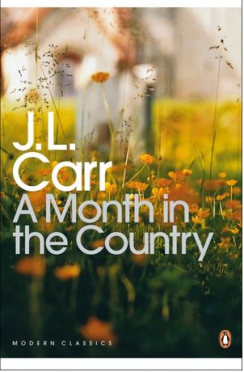 Bibi: This year I read A Month in the Country and I thought it was just beautiful. My edition comes in at slightly over 80 pages and the fact that JL Carr can write about such immense themes with so much humanity and concision is just astonishing.
 Ruthiella: I don’t remember either of my parents ever reading to me or my siblings. However, my mother was and is an enthusiastic reader. There were some, but not a lot of, books in the house growing up. I suspect this is more indicative of middle-class American consumer culture in the 1960s than anything else. My niece and nephew have 10 times the books I had as a child.
 Kay: We had books in out house, but I don’t remember anyone else reading except my Dad, and I think he read mostly on the airplane on the way to business trips. I read voraciously, however, from an early age. My mother told me that when I was only a baby, she came into the room and found me in my playpen holding a book upside down and trying to read it. I have a strong memory of being a small child and wondering what those mysterious symbols were and what they would tell me. I know that I was read to sporadically as a child. When I was a bit older, every once in a while my mother would decide to get us all together to read to us, but I don’t remember that lasting more than a few evenings, and we never finished a book. However, I am sure that I had storybooks read to me when I was little. One of my most exciting days was when I had learned to sign my name, which was when I could get my own library card. My mother took me to the library to get it and select the first books that I checked out myself, and I found this event so special that when I was a teenager I took my own much younger little brother for his first card, too. I used to pick out books that had beautiful pictures, although having pictures of fluffy rabbits and other animals or fairies was also important.
 Ruthiella: The first “grown up” book I ever read was probably Agatha Christie’s And Then There Were None which I read in 7th grade at age 12 while I was a school library aid. It was an easy job and I had lots of time to read during that hour. I remember the book was just randomly on the library table, so I picked it up. This set off a lifelong love for Agatha Christie novels. I’d always enjoyed mysteries (Nancy Drew, Encyclopedia Brown, Trixie Belden) but this was my first adult crime novel for sure.
 Ruthiella: I can’t think of any particular book that set me off in a certain direction in life. I am still lacking a direction in life despite being over 50! I didn’t’ read as much in my 20s or 30s as I do now – maybe only 15 books a year on average – I had a social life then! What I do recall from those decades in terms of reading is falling in love with the tragicomedy of John Irving, the absurdity of Kurt Vonnegut, the gravitas of Graham Greene and the evocative writing of Toni Morrison. Those are the authors I “discovered” in my early adulthood. Oddly, I rarely read any of them now, though I keep meaning to get back to them. So many books, so little time!
 Ruthiella: My favorite book of the last few years is probably The Idiot by Elif Batuman. It was published in 2017 and is about a young woman’s freshman year at Harvard in the 1990s. I would say it is a real marmite book: you either get it our you don’t. It is a rambling, plotless novel with a self-obsessed, clueless adolescent narrator who thinks way too much about meaningless things and yet I totally identified with her and laughed a lot. I totally want Batuman to write three more books about the protagonist’s sophomore through senior years.
 Kay: Gosh, this is a hard question. There are so many books I love. I was going to say Life After Life by Kate Atkinson, but then I realized I read it almost six years ago! In general, I am pleased by all of the new reprint publishing companies, such as Furrowed Middlebrow and Persephone Press that have introduced me to women writers like Margaret Oliphant, Dorothy Whipple, and Richmal Crompton (that’s down to your reviews, Simon) from Victorian, Edwardian, and early 20th century periods that I probably would have never heard of otherwise. I know that doesn’t answer the question.
 Resh: I’ve heard my mother loved books and was a incurable book worm in her younger days and my father loved medical thrillers and Russian classics. But I have seldom seen them reading; probably work and kids really took a toll. However, I have grown up seeing my retired grandfather spending long mornings, reading books in three languages.
 Jennifer: I come from a family of readers. The house was filled with books, we took regular trips to the library where I checked out the highest number of books they would allow (eight, which I thought was a ridiculous limitation) and my mom read aloud to us for years. I am grateful that I seem to have passed on a love of books to my own children. It’s a good thing; I would have to disown them otherwise!
 Resh: I read The God of small things by Arundhati Roy in my late twenties and ended up loving it and re reading it every year since. Roy brings alive the Indian-ness with her cleverly written words, plays around with time jumps and writes the most lyrical and beautiful descriptions. It took my breath away.

 Marina: The first grown up book I remember reading was Moll Flanders by Daniel Defoe. It was on my parents’ bookshelf, because at some point somebody must have recommended all the famous English classics to them. So they bought all of Jane Austen and the Brontes, Vanity Fair and other such books. I don’t think they actually read Moll Flanders, so they had no idea what it was about, and were not aware that it might not be suitable for a 9-10 year old.
 Juliana: A book that left a great impression on me in my early 20s was The Life of the Mind, by Hannah Arendt – an unfinished book in which she explored the basic faculties of the mind (contemplation, will, judgment), so as to understand the relationship between thinking and morality. I had been looking for women philosophers, and she was the first that came up on my research. They had this book at my university library, the topic seemed interesting enough, and I had some boring summer holidays ahead of me.
  Marina: Blogging has enabled me to discover so many new and marvellous books, so I have lots of new favourites! I started blogging in 2012 as a way to hold myself accountable for writing regularly. So initially my blog was mainly about poems and flash fiction. Then I started reviewing more and more books, especially once I started reviewing for Crime Fiction Lover and Necessary Fiction and other such places. I had to find an outlet for all the books I was reading for personal enjoyment rather than just the ‘review copies’, so I started using my blog for that. My most recent favourite discovery is the Transylvanian trilogy by Miklos Banffy – I became completely immersed in that vanished world.
 Marina: I have such eclectic tastes that I don’t think anything I read would surprise people. Everyone knows I love genre fiction (especially crime) and poetry, but you might not be aware how much I adore T.S. Eliot’s Old Possum’s Book of Practical Cats. I didn’t have a cat when I first read it, but I could tell that T. S. Eliot really knew his feline companions. Of course, it helps that in my student days I was part of a production of the musical Cats, which was considered ‘subversive Capitalism’ at the time and was promptly closed down after just a couple of performances.


