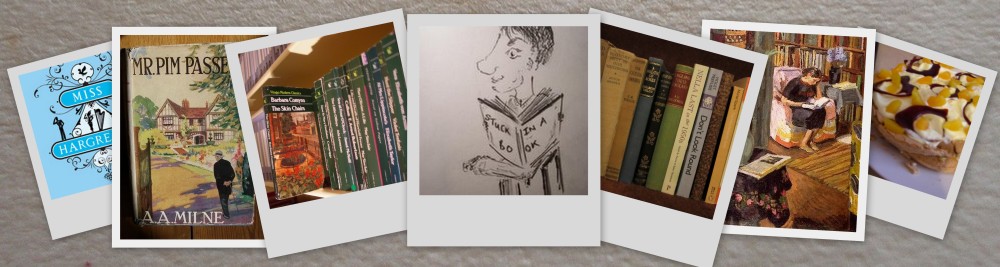

There are two authors whom I often talk about and get little response. Not on here, specifically, but in all the bookish circles (both internet and face-to-face). They are Virginia Woolf and AA Milne. I think that’s to do with preconceptions: Woolf is “that difficult feminist writer who killed herself” and Milne just wrote that children’s book/Disney film. Neither are true, of course, and it would be a shame to leave them unexamined. Not that I can blame anyone – though The Carbon Copy never tires of exhorting me to read Lord of the Rings, my preconceptions (aided by the film) persist, and I resist and desist and subsist and all other sorts of similar words.
But today we shall turn our attention to Milne. I may well repeat bits of a letter I recently wrote to my friend Barbara-from-Ludlow, but I’m sure she’ll forgive me for that. I’ve just finished a re-read of Year In, Year Out which, according to my notebook, I first read in early 2001, in the brief period before I kept more accurate records that year. It was Milne’s last book, published in 1952 (Milne died in January 1956) and Our Vicar will be pleased to know it is non-fiction. How to describe this book? It is a miscellany of musings, some whimsical, some political, some incidental. The sorts of things which couldn’t really be developed into anything more than a thought or an anecdote, and are thus collected together, di vided fairly arbitrarily into twelve months. He points out how frequently trains would have to run in The Importance of Being Earnest; he also discusses the history of his pacifism. He covers The Art of Saying Thank You (‘The schoolboy’s “Oo, I say, thanks frightfully” sets the standard. It is difficult to better this, though you may throw in an awed “Coo!” if you feel that it comes naturally to you’); he berates the food subsidies and supertax. My favourite sections are anecdotes concerning his earlier work – never Pooh et al, but his plays or his poetry.
It is improbable that such a book could ever be published now; it is indeed improbable it would have been published then, had it not been for the debt Methuen felt they owed Milne. Pooh had raised them rather a lot of money, and they felt prepared to indulge the whims of an aging author. That’s what lends Year In, Year Out its pathos – though often cheery and witty, it is also unconsciously nostalgic, not in the sense of thinking in the past, but in thinking the present can be turned into the past. His best days, authorially and in every other way, have happened – and Milne perseveres with his wonderful, inimitable, light-but-serious tone.
Year In, Year Out probably isn’t the best place to start reading non-children’s Milne, but I encourage you to give something a whirl. He did it all – plays, poetry, sketches, essays, detective novel, literary fiction, autobiography, non-fiction work on pacifism. Something for everyone.
Something special about Year In, Year Out, though, is that it is the last collaborative work of A. A. Milne and E. H. Shepard – in fact, Pooh and the gang appear (with some assorted others) in the little illustrations for January and December. Somehow that seems a fitting, and wonderful, culmination of Milne’s writing career.