The Premonitions Bureau by Sam Knight #ABookADayInMay No.17

The Premonitions Bureau: A Sunday Times bestseller: Amazon.co.uk: Knight, Sam: 9780571357567: Books

I didn’t know anything about The Premonitions Bureau (2022) by Sam Knight when it turned up in the Audible sale – but the title, the cover, and the unexpected subtitle telling me that it was a true story were enough for me to take a gamble on it.

The story starts with the Aberfan disaster in 1966 – I’m sure you all know about it, but
it’s when a colliery waste tip atop a Welsh hillside suddenly fell down into the valley with devastating effect. 144 people died, including large numbers of pupils in the village school. And several people claimed to have predicted that the tragedy would happen.

‘Claimed’ is perhaps the wrong word, since apparently two of the people who predicted it also died in the disaster – neither of them apparently having any sense that they were having a premonition. One of the children in the school told her mother “I dreamt I went to school and there was no school there. Something black had come down all over it.” Another had drawn a picture of people digging at the hillside, with the words ‘The End’.

John Barker, a psychiatrist who ran a mental hospital in an old Victorian asylum in Shropshire, was fascinated by the possibilities in this phenomenon. He had already been deeply interested in unusual psychiatric issues – such as Munchausen syndrome, or the idea that people could literally be scared to death.

Being a scientist, he decided to go about this systematically. He set up the Premonitions Bureau, inviting people to send in any premonitions they had – whether in dreams, visions, or convictions. They got hundreds of replies from all over the place – some trolling them, but others very serious. Few seemed to be particularly specific – more along the lines of ‘something terrible will happen to a plane’ – but each was catalogued carefully. The hope was to be able to present their findings to the Medical Research Council and perhaps, in turn, set up a system to warn people of impending disasters. (Though there was also a debate about whether you could have a premonition of an event that then doesn’t happen – a Catch 22 for any way of using this tool to save lives.)

I had never heard of the Premonitions Bureau, and I did find Barker a likeable, fascinating and curiously impenetrable person. And I found much the same with Knight’s book. It goes on so many tangents, exploring interesting side-roads to the main discussion – often spending large chunks of chapters talking about these other matters in great detail. And some of them are certainly interesting, but by contrast, the bits about the actual bureau seem a bit flimsy. We don’t learn much about the hundreds of contributions or contributors, or what happened when they were right or wrong (though, as an exception, we do get a lot of detail about a train crash that was apparently predicted and which one of the BeeGees survived). It does feel as though there isn’t enough material to give a thoroughly researched book about this bureau – that it is an enthralling and enticing topic which isn’t quite followed up by what we learn about it. The bureau is there throughout, but sometimes as a shadowy thread at the centre of a lot of other topics.

And Knight is careful in not committing either way to whether or not he believes premonitions can happen. There are moments which seem to defeat any scepticism, but not much on probabilities of success or alternative explanations of the ‘accurate’ premonitions.

I did finish The Premonitions Bureau having found it interesting and well-written, but thinking that I might prefer to read a fictional story that could equally well be invented for this eye-catching title. Perhaps truth is stranger than fiction, but I think fiction could have been more satisfying.

Fifty Forgotten Books by R.B. Russell

Fifty Forgotten Books | And Other Stories

One of the books I took on holiday to read was also one of the books I’ve bought under Project 24 – Fifty Forgotten Books (2022) by R.B. Russell. It’s exactly the sort of book I can’t resist, and it was every bit as enjoyable as I’d hoped. I absolutely loved reading it.

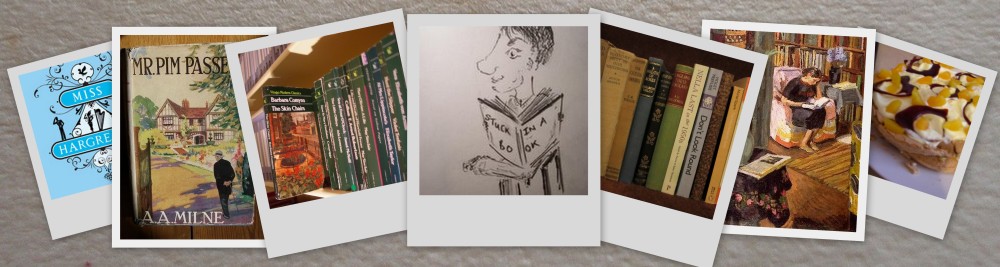
Of course, bibliophiles who tend to read slightly more obscure books will ask, ‘Are these really forgotten?’ And of course they are not all completely obscure books, but I have only read five of the 50. Four of those were actually books I discussed in my DPhil thesis (The Brontes Went To Woolworths by Rachel Ferguson, The Haunted Woman by David Lindsay, Flower Phantoms by Ronald Fraser and – hurrah! – Miss Hargreaves by Frank Baker). The fifth is The Unspeakable Skipton by Pamela Hansford Johnson, perhaps one of the best-remembered names in the book. But, yes, there were an awful lot of titles and authors I’d never heard of, and I very much enjoyed reading why Russell had chosen them for inclusion.

There certainly isn’t any attempt to make this an objective collection of titles. They are certainly books that reveal one man’s personal taste, and in some ways Fifty Forgotten Books is a memoir, a little like The Books of My Life by Sheila Kaye-Smith. Compared to something like Christopher Fowler’s The Book of Forgotten Authors (which I enjoyed, and which also includes Miss Hargreaves), Russell’s book is much more personal and he doesn’t devote each short chapter exclusively to the book being mentioned. Rather, he will use the book in question as a prompt for writing about something going on in his life. Or, I should say, his bookish life. That means we get truly delightful looks behind the scenes at the development of his literary taste, his bookshopping habits, or the origin and history of Tartarus Press – a small-edition publishing house that Russell co-runs, and which came to my attention when they reprinted Miss Hargreaves in the mid-2000s.

Tartarus Press specialises in the literary supernatural/strange/horror, and that is certainly reflected in his selection here. It overlaps with my love of the fantastic (hence the four books that were in my thesis on the Middlebrow Fantastic) and, while I’m unlikely to leap towards some of the horror or fantasy books he recommends, I still loved reading about them. I was already feeling confident that Russell was something of a kindred spirit when I got to the Miss Hargreaves section. This opening line makes me wonder if I am secretly the same person as Russell:

With limited house room, there is little excuse for owning multiple copies of the same book. I do, though, feel I can justify my five different copies of Miss Hargreaves by Frank Baker.

Why, yes, I do also have five copies of Miss Hargreaves, and would readily buy any future ones I find, so long as they’re not editions I already have. One of the differences between Russell’s bibliophilia and mine is that he cares about first editions. He often talks about replacing copies of much-loved books with first editions, perhaps then moving on to a first edition with a dustjacket, and so forth. It’s an angle of literary life that I’ve never understood. I’d definitely opt for a book with a lovely dustjacket, for aesthetic reasons, but I can never see why anybody cares if a book is a first edition or a 50th edition, so long as the text is the same. Well, it saves me money!

Threaded through a lot of sections is the memoir-esque bit that I found the most intriguing – Russell’s experiences with the Arthur Machen Society. We learn about the machinations (ho-ho) of this society along the way, including misunderstandings, draconian leaders, unsettling periods in leadership, and the start of a rival organisation.

There are times when you can find yourself embroiled in unexpected battles, even in literary societies where so little might appear to be at stake. […] Matters came to a head in September 1966 when a member from Tunbridge Wells phoned to ask why he’d had a subscription reminder when he had received no journals or newsletters in the previous year. When I passed this complaint on to Mrs X, her reaction was such that I could only share Mr Talbot’s concerns. She could not explain how the subscriptions had been spent, and when I suggested that this was an unsatisfactory situation, she launched an unpleasant personal attack upon me. I was confused and hurt, and I could see no option but to resign.

Any of us with experience of big fish in small ponds may well recognise the type of Mrs X. What I found impressive is that, even when Russell is writing about disputes and fallings-out, he comes across very well. He always seems kind, thoughtful, and eager to share passions about literature with like-minded people. He is refreshingly free from any book snobbery, taking in all genres and all types of literature equally. In short, it was a pleasure to spent these 254 pages with him – and, for that reason, I think Fifty Forgotten Books would be very enjoyable and engaging even if you’ve never heard of any of the 50 authors.

I’ve come away with a little list of books to look out for, happy reminders of some titles I’ve enjoyed and, above all, the happy experience of spending time in the company of somebody who unabashedly loves books and knows the power they can have to grow as a person, form communities, and connect with authors who are long gone.

Novella a Day in May: Days 13 and 14

I’m watching Eurovision; I’m typing up thoughts about novellas. What a day.

Day 13: Elizabeth Finch (2022) by Julian Barnes

Ooof. I’ve read a couple of Barnes novels before this one, and never really seen what the fuss was about. But I wasn’t prepared for quite how bad Elizabeth Finch would be.

The narrator is remembering a teacher – Elizabeth Finch, referred to often as EF – who has had a lasting effect on his life. Think someone with the unusual pith and dignity of Jean Brodie, dispensing philosophical insights that have her pupils thinking for decades. Except that everything she says is only a couple of notches above a ‘Live, Laugh, Love’ sign in terms of profundity.

One of the things she introduces the class to is Julian the Apostate, who hated Christians sometime many centuries ago. Don’t know much about him? Don’t worry, Barnes then includes an ‘essay’ by the narrator where he dumps all the knowledge he has about Julian. It reads like a Wikipedia article, only it’s 50 pages long. We get the facts and theories about Julian the Apostate, It’s astonishingly inelegant, in terms of novel writing.

Elsewhere, in the first and final sections, his writing is serviceable and only occasionally embarrassing (some of the dialogue he gives Elizabeth Finch is really awkward, and clearly she is a mouthpiece for a middle-aged man). But the best this novella gets to is mediocre, and at worst it is bafflingly poorly done.


Day 14: Sing Me Who You Are (1967) by Elizabeth Berridge

I bought this back in 2009 because I knew her name from the Persephone collection of her short stories, but I might equally have bought it for this glorious cover. The illustrator – Reg Cartwright – did three or four Berridge reprints in the 1980s and they are so characterful and wonderful.

What’s more, it is accurate to the premise of the novel. Harriet Cooper and her two Siamese cats arrive at the farm which belonged to her recently dead aunt, and where her cousin Magda and her husband Gregg live. Her aunt hasn’t left her the farm, or the land, or anything – except, pictured there on the cover, the bus.

Wading through the still-dewy grass – for the bus lived in shadow half the year, and this was autumn – Harriet went through the wooden gate set in a gap in the hedge and up on to the step. She unlocked the padlock and pushed open the door, which folded inwards down the middle. Stepping inside she became aware of the musty smell of disuse. How long, a month, six weeks? Enough for damp to invade this thin shell. She would open windows, light a fire, banish it.

She has stayed there on and off over the years, and now she has brought her few possessions to live there indefinitely.

The story then looks at how her life alongside Magda and Gregg brings up past and present tensions, as well as affinities. Central to them is the memory of a man known as Scrubbs – who deeply affected each of the three. He has been dead for a long time, but he is still impacting all of their lives, and the way they interact with each other. Along the way, secrets come out…

I’ve read three other Berridge books, and have yet to find one that I really love. This is a good novel, and Harriet is an interesting, layered character – but I think I’m really hoping for a book that will live up to those wonderful covers. If Berridge were a little weirder, or a little more stylised in her prose – a dash of Beryl Bainbridge, say – then I think I’d love her. As it is, her realism lacks a little something. And yet I’ll keep reading them, because I feel like there might be something even better in her oeuvre – and something that lives up to those covers.