Loitering With Intent – Muriel Spark

32. Loitering With Intent – Muriel Spark

I do love the blogosphere… all the bloggers and blog-readers, and all the talk of books going on all around the place. I am probably a little hypocritical, in that relatively few of the books I read come from blogger recommendations. So much of my reading time is taken up with book group choices and the occasional review copy (not to mention, of course, all the books I have to read for my studies) that when I can be self-indulgent and simply pick something off the shelf, nine times out of ten it’ll be something I’ve been saving for years, or know that I’ll like. If I read a great review, quite often I’ll buy the book or pop it on a bit of paper somewhere, but it’s not all that often that I’ll have the reading space for it to swoop to the top of the pile. Bloggers – you’re setting me up for my retirement. I just need the career bit in between.

Which makes me realise that I should find some more hours in the day, to fit in all your fab suggestions. If it weren’t for the blogosphere, I probably wouldn’t have bothered with Muriel Spark again. I’d read The Prime of Miss Jean Brodie and The Girls of Slender Means, and not been bowled over by either of them. It was a couple of bloggers who made me pick up The Driver’s Seat, and I loved it. I reviewed that novella here, and it led to a discussion of ‘Third Time Lucky‘ – when the third book you read by an author is the one to grab you.

Well, if third time was lucky, fourth has unearthed a gold mine, if that mixing of metaphors works. When I wrote about The Driver’s Seat I asked which Spark I should read next, and ‘N’ (gosh, isn’t that mysterious?) recommended Loitering With Intent. I have a feeling someone else did, maybe even in Real Life – and so I took myself off to the library and borrowed it. The return date was hastening, and I thought I’d take it with me to Devon.

All of which is a lengthy introduction to saying that Loitering With Intent (1981) is possibly my favourite novel read this year, and certainly proves to me that Spark is very much my cup of tea. (By the by, I don’t think I like any of the covers I’ve seen, so I’ve just gone with the one I read. Spark deserves a nice cover designer! I hope someone’s listening…) Maybe it’s too well known to get onto my 50 Books You Must Read But May Not Have Heard About, but I won’t take the risk of not broadcasting how good it is…

Loitering With Intent somehow manages to be an incredibly clever novel, without being in the least self-congratulatory or off-putting. Even more dangerous, Spark’s novel is narrated by a novelist, and largely concerns the writing of a novel – so many pitfalls to avoid, and so much potential pretension – all of which Spark skirts around without even a hint of self-importance. Fleur Talbot is writing her first novel, Warrender Chase, and it is occupying all the time that she isn’t at work, and quite a lot of her thoughts when she is at work. Her job is as a secretary to Sir Quentin Oliver and his Autobiographical Association – he has gathered luminaries and ‘characters’ to write their memoirs, which he will seal in a vault for seventy years.

Fleur is not dissimilar from her near-namesake Flora in Cold Comfort Farm, inasmuch as she sits back and records the eccentrics and strange creatures around her. But where Gibbons’ Flora documented – she got involved with their lives no end, of course, but never really seemed unduly affected by their idiosyncrasies – Fleur isn’t so invulnerable to the bizarre behaviour by which she is surrounded. It rather seems to rub off on her. She grows varyingly attached to various members of the Autobiographical Association, such as snob and scented Lady ‘Bucks’ Bernice Gilbert, and young(ish) Maisie Young, who has one permanently disabled leg and is fixated upon the Cosmos and ‘how Being is Becoming’. Above all, Flora develops a fondness for Quentin’s mother Edwina – a mad, lively, incontinent, and be-pearled old lady bursting with character, but somehow more ‘real’ than many old-women-with-gusto who crop up in fiction. In amongst these weave a whole cast of wonderful creations – focally, Dottie: the wife of Flora’s lover. Flora is an odd sort of Catholic…

As I have said, Flora is not invulnerable to the group’s eccentricity – and we’re never quite sure how far we can trust her narrative voice, or to what extent we are supposed to identify with it. Which, since Fleur is an authoress, is interesting. Throughout the novel the reader gets glimpses of a treatise or two on novel-writing – how much of it is Spark’s own view? Does Loitering With Intent have, hidden within it, the rudiments for a how-to of creative writing? Impossible to judge… but here are three snippets which I enjoyed pondering:

But since then I’ve come to learn for myself how little one needs, in the art of writing, to convey the lot, and how a lot of words, on the other hand, can convey so little.

** (I changed “beautifully” to “very well” before sending the book to the publisher. I had probably been reading too much Henry James at that time, and “beautifully” was much too much.)
**
I knew I wasn’t helping the readers to know whose side they were supposed to be on. I simply felt compelled to go on with my story without indicating what the reader should think.

But Fleur’s writing doesn’t end with her work-in-progress. As part of her secretarial duties, she has to edit the submissions of the Autobiographical Association. Spark is very funny about Fleur’s low estimation of the group’s writing abilities, and the manner in which Fleur augments the perceived dullness of their memoirs:
The main character was Nanny. I had livened it up by putting Nanny and the butler on the nursery rocking-horse together during the parents’ absence, while little Eric was locked in the pantry to clean the silver.
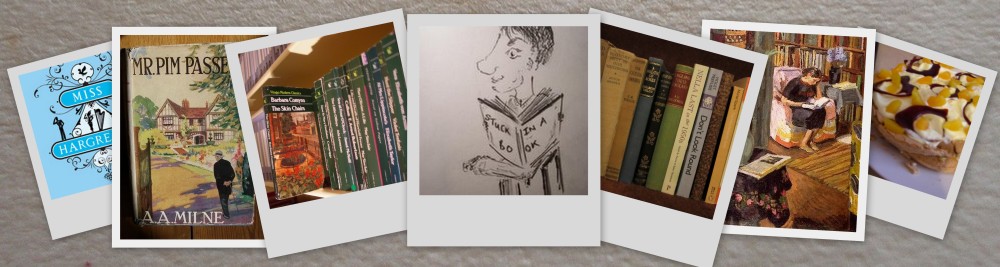
As a hint of what is to come, it turns out that Fleur’s flight of fancy does, in part, turn out to be truth. Which Stuck-in-a-Book reader could fail to notice similarities to Miss Hargreaves?

This becomes the crux of the novel – where does Fleur’s imagination end, and where does plagiarism begin? Similarities between the Autobiographical Association’s activities and the manuscript of Warrender Chase grow ever greater – how much is coincidence, how much does Fleur absorb, and how much does she write before it happens? The parallel stories – both (of course) fiction, but one accepted as ‘true’ in the novel; fiction and meta-fiction, if you’re feeling in that mood – intertwine and overlap, and Spark does it all so very, very cleverly. I won’t say any more.


As with all my favourite novelists – and Spark could swiftly join that group – style contributes heavily to my appreciation. Spark is sharp, witty, and sees straight through any form of dissemblance. I need to revisit The Prime of Miss Jean Brodie and The Girls of Slender Means sometime, as I must have missed something. I’m late to the party on this one, but the latest converts are the most enthusiastic – I foresee more Sparks being read before 2010 is over. Thank you, blogosphere!

Travelling Light

I still have a small pile of novellas to talk about (I’ve realised that it doesn’t necessarily take any less time to write posts on short books) but I haven’t yet written about Tove Jansson’s Travelling Light – which has leapt, as I rather assumed it would, onto my list of favourite books this year.

Regular readers of S-i-a-B will know that Tove Jansson is one of my favourite writers, and a new translation of her work (this one by Silvester Mazzarella, with another brilliant introduction by Ali Smith) will get me into the literary equivalent of a tizzy. I have to be in the right mood for reading short stories usually, but when they come from the pen of Tove J, they race to the top of the reading pile. And these were no exception.

Unlike Jansson’s best known adult work, The Summer Book, these stories don’t share the same sorts of settings and characters. We range from familiar Scandinavian islands to mysterious woods to the cabin of a ship to – most innovatively – an almost post-apocalyptic town. Though the scenarios vary wildly, each is clearly the work of the same writer, for Jansson brings to each and every story a stirring and extraordinary insight in the workings of the human mind and – more especially – the interaction of people. These people often covertly clash with each other, or don’t let on everything they are thinking; they feel awkward, distrustful, inadequate. Characters often say things which are disconcerting because they are so unexpected, but also because they are so perceptive and true.
“Anyway, solitary people interest me. There are so many different ways of being solitary.”

“I know just what you mean,” said X. “I know exactly what you’re going to say. Different kinds of solitude. Enforced solitude and voluntary solitude.”

“Quite,” said Viktoria. “There’s no need to go into it further. But when people understand one another without speaking, it can often leave them with very little to talk about, don’t you think?”
That comes from ‘The Garden of Eden’, one of the longest and one of my favourite stories in the collection. The mid-length story is so difficult to get right – it doesn’t have the quick impact of a five page story, but also shouldn’t meander too much. ‘The Garden of Eden’ gets it just right in its depiction of Professor Viktoria arriving in a mountain village west of Alicante, and trying to create a truce between two warring women. There are so many layers to the story, none of them overblown, and the whole piece is wonderfully more than the sum of its parts.

But Jansson’s insights into human character don’t preclude her beautiful descriptions of the natural environment. I was particularly taken with this, from the same story:
At that exact moment the setting sun broke through a gap in the mountain chain and the twilit landscape was instantly transformed and revealed; the trees and the grazing sheep enveloped in a crimson haze, a sudden beautiful vision of biblical mystery and power. Viktoria thought she had never seen anything so lovely. She remembered once a set designer saying, “My job is to paint with light, that’s all it is. The right light at the right time.” The sun moved quickly on, but before the colours could fade, Viktoria turned and walked slowly back to her house.I don’t really read in a visual way, as it were, but this description really worked for me – and it’s typical of the beautiful images that Jansson places congruously alongside the interaction of flawed and interesting characters.

If I had to choose just one story as my favourite, it would be ‘The Woman Who Borrowed Memories’ – a deliciously, deviously clever story concerning the reunion of two women, and the disunity of their shared recollections. One is vampirically changing and appropriating the other’s memories – all shown very subtly, very believably. It represents everything I love about Jansson’s ‘touch’.

‘The Summer Child’ is about a disconcerting child visitor, anti-social but not malevolent:
When it came to giving people a bad conscience, he was an expert. Sometimes all he had to do was just look at you with those gloomy, grown-up eyes and you would instantly be reminded of all your failings.I wonder if Jansson was thinking of her own writing when she wrote those words. The human mind and soul cannot be held up to such close inspection without the reader glancing at their own. But although Jansson exposes so many home truths, entirely without sentimentality, Travelling Light is far from a depressing or distressing collection. Instead, it makes you marvel with fascination, soak in the wonderful prose, and be grateful that there existed someone with so precise, perceptive and unpredictable a view of the world.

You’re So Unreliable!

One of my holiday reads (yes, still working my way through reviewing those – it’ll probably coincide with my next holiday by the time I finish with it) was Wish Her Safe At Home (1982) by Stephen Benatar. I heard about it from this article, reprinted in The Week. I’ve only just noticed it was written by the usually rather imbecilic Cosmo Landesman (Col and I find his film reviews very useful – you can guarantee that whatever he writes, the exact opposite will be true) – had I spotted Landesman’s name on it before I wouldn’t have proceeded. Glad I did! And, had that article not appeared on my horizon, Aarti’s enthusiasm would surely have filtered through! To get an idea of how much she loves Wish Her Safe At Home, just think about me and Miss Hargreaves…

Benatar’s novel made the press mostly because of his determination to give it a readership. That article elaborates on how he (very gently) approached people in various bookshops, suggesting they might like to read Wish Her Safe At Home (and probably his other novels too). He also set up his own publisher to reprint his own novels. And it takes some gumption to approach Penguin Classics and suggest his own, moderately successful, novel should enter that hall of fame. They wanted an introduction from a notable name, John Carey was happy to oblige (if the name is familiar it might be because, like me, you’ve flicked through The Intellectuals and the Masses) – but Penguin still turned it down. The beautiful New York Review of Books Classics were, thankfully, more sensible – hence the novel’s current incarnation.

So that’s the story the newspapers enjoyed – man battles against odds; gritty determination rewarded. We Brits do love an underdog – but don’t let any of that stand in the way of Wish Her Safe At Home being read on its own merits. It’s worth remembering that it was shortlisted for the James Tait Memorial Prize (a better indication of a good book than the Man Booker Prize, I reckon). So let’s get onto the story that really matters – the one within the pages of Wish Her Safe At Home.

Rachel Waring – who had once been ‘almost pretty’ – has inherited her great-aunt’s Georgian mansion, and leaves her dull job and incompatible flatmate, having instantly fallen in love with the house when she visited it. Moving there hadn’t been the plan, but its lure is such that she is immediately certain that she must:

The exterior of the house was beautiful. Terraced, tall, eighteenth-century, elegant. Oh, the stonework needed cleaning and the window frames required attention – as did the front door and half a dozen other things. But it was beautiful. I don’t know why; I just hadn’t been expecting this.
I always find the attraction of houses fascinating in novels. As someone who could happily spend all day staring at a beautiful home, who gazes into estate agents’ windows at properties I could never possibly afford, and who regards Kirstie and Phil as something akin to surrogate parents… well, I can sympathise with Rachel thus far.

But that isn’t all – the house has a plaque to Horatio Gavin, ‘Philanthropist and politician’, who had lived there 1781-1793. Rachel develops an interest in Gavin, and determines to find out more about him…

It’s not just dead philanthropists who catch Rachel’s interest. Indeed, more or less anybody she meets is considered a potential conversational partner, even if she is appraising and judging them at the same time. Benatar’s skillful presentation of Rachel’s voice gives her inner thoughts and outer expressions all tangled up with one another, and also fuses in the odd line here and there which show that neither are quite right… more on that later. First, here’s an example of Rachel’s lack of edit-button in her outbursts to anybody in close proximity…
“I think I should like to have been somebody’s favourite aunt,” I said. “I think it might have been fun.” This, to the woman whose table at the teashop I had asked to share.

She smiled, hesitated, finally remarked: “Well, perhaps it’s not too late.”

“No brother no sister, no husband – somehow I get the feeling it might be!”

“Oh dear.”

“Did you ever see Dear Brutus?”

“Dear Brutus? Yes! A lovely play.”

“Wouldn’t it be fine if we all had second chances?”

She nodded, now looking more relaxed. “Oh, I’d have gone to university and got myself an education!” I reflected that she probably needed one. “But otherwise I don’t think I’d have wished things very different.” She gave a meaningless laugh and started gathering up her novel and her magazine. Poor woman. What a lack of imagination. (And what a dull, appalling hat.) Yet I realised that I envied her.
It’s not just strangers in cafes, though – Rachel becomes friendly with an assortment of local people, especially her youthful gardener and his wife, Roger and Celia. Their lives get increasingly tangled up, in the most cheerful and whimsical way imaginable… or so it seems.

For it quickly becomes apparent that Rachel is not a reliable narrator. Whenever this realisation dawns in a novel, I get a little shiver down my back – what to believe, what not to believe! At first she seems unhinged in a jolly way – singing to herself, accosting everyone with sunny optimism and faux-schoolma’am whimsy. She meanders along the line between being consciously eccentric and… something less healthy. She gets increasingly bizarre, and it becomes clear that she is not sane… As John Carey writes in his introduction, ‘It reminds us how thin the boundaries are between the mad and the imaginative, the mad and the sensitive, the mad and the acute.’ She becomes obsessed with Horatio Gavin, the philanthropist who’d once lived in her house. We can no longer trust her version of the events she narrates – but second-guessing the truth is a twisting and turning game, written with excellent subtlety by Benatar. So much cleverer, so much better than The Behaviour of Moths, which tried something similar.

And Rachel’s is truly a unique voice. Witty and biting and joyous and enthusiastic and… yes, rather unhinged. Whether or not it is convincingly female is another question – I don’t mean feminine, for a female’s voice needn’t be feminine, but somehow it seemed as though it might not be a million miles away from Benatar’s own voice – though presumably his is rather tempered! That aside, Wish Her Safe At Home is quite extraordinary, and would certainly bear a careful re-reading. It’s not remotely the sort of novel I was expecting from the cover, or even from the blurb. I was expecting a novel which felt much older – this novel is unmistakably modern. Not through expletives or slang or modern references, but perhaps in tone. [Edit: I think what I actually meant, having read Aarti’s comments and reassessed, is that the novel felt timeless. When I said ‘unmistakably modern’ I meant it obviously wasn’t a 1940s reprint, in the way that The Little Stranger could have been – this novel could have taken place at any time, and it takes a while to work out when it is set.] And yet it combines this with a sense of history, and a charm which is uncommon in post-war novels. It’s an extraordinary read, and I am glad that Benatar’s persistence and determination paid off.

It shouldn’t be unusual, but John Carey writes an unusually good Introduction. Not unusual for him, I mean, just unusual in general. I’ve now used the word ‘unusual’ so often that it has lost all meaning… Aside from some lazy anti-Christianity, Carey writes insightfully and with an eye that is both analytical and appreciative. More on that topic tomorrow, methinks…

Do let me know if there are any unreliable narrators I should meet (although don’t let me know if their unreliability is a huge spoiler for the book!)

Books to get Stuck into:

To be honest, this most reminded me of the book I read immediately beforehand – The Little Stranger by Sarah Waters – because of the influence of a house, etc. etc. Instead, I’ll pick a couple novels with unreliable narrators, which is always an interesting angle…
Prince Rupert’s Teardrop by Lisa Glass
– ok, being honest, this book was far too gruesome for me to enjoy – but it’s also the best and most unnerving unreliable narrator I’ve encountered.

A Kind of Intimacy by Jenn Ashworth – and this is the next most unnerving! The tale of a scarily obsessive neighbour… but told from the perspective of that self-deluded neighbour. Very clever, and decidedly gripping.

Stone in a Landslide

The weekend miscellany will be a bit delayed this week, as I wanted to write about Stone in a Landslide by Maria Barbal (translated by Laura McGloughlin and Paul Mitchell), and the launch event in London yesterday evening… which I would have done last night, but we provincial folk have to travel back to our provincial homes, all provincially. (By the by, sorry for only one pic… Blogger is doing something where it won’t accept any pics if they go below the first few paragraphs. Thanks, Blogger…)

Which to talk about first? Erm… let’s start with the book, and move onto the event, because after all that’s the order in which I did things. Chronology, folks – it’s your friend.

Stone in a Landslide by Maria Barbal is a Catalan classic, originally published in 1985 (which was described last night as ‘modern’, but since it’s the year I was born I couldn’t feel it was that modern) and – like all Peirene’s titles – very short. At just 126 pages this novel (novella? Let’s stick to ‘novel’ for now) manages to encapsulate an entire life, from childhood to death – and never does it feel rushed.

Anyone could see that there were a lot of us at home. Someone had to go.
The opening line of the novel – and I think it’s rather a great one – sets the tone for the narrative throughout. Conxa’s voice could be called dispassionate, but perhaps a fairer description is ‘stoical’ or ‘resilient’. She moves to her aunt’s house; later gets married and has children; sees her family disrupted in the Spanish Civil War, and ends the novel in a state that, in other hands, would be tragic. But Conxa never bewails her fate, there is no gnashing of teeth – rather, her story is told simply and honestly. I love what Polly wrote in her review – “Barbal’s writing is simple but not simplistic”. Conxa is given a voice that is undemonstrative, flowing along in a way that is unobtrusive but never dull. I don’t know how Barbal does it, because each individual sentence is very plain, but somehow they combine to make a voice that is startlingly present and human.

Polly has done much better than me with her review, as have the others out there, because all I can think to say is that it’s a good, good book, with ingredients that shouldn’t quite have worked, but in Barbal’s capable hands it does so. It seems to me impossible to analyse Stone in a Landslide’s component parts and discover why it works, but suffice to say: it does.

I’m so grateful to Meike and Peirene Press for making these European modern classics available in English, and in such beautiful editions too. For more details see their website and their witty blog. If you have any suggestions for European books published after 1945 and under 200pp. long (and which haven’t yet been translated into English) do let Meike know your ideas: meike.ziervogel@peirenepress.com

And… onto last night! Meike very kindly invited some bloggers along to the launch of Stone in a Landslide, and so it was a mini-reunion for me, Simon S, Polly, and Sakura. Which was lovely, nice to see you guys, sorry I was teasing you all… The four of us – and seemingly the rest of London – piled into the tiny bookHAUS shop to hear a bit of introduction to the novel, and Claire Skinner (yes, the mum from Outnumbered, though doubtless she has Shakespeare under her belt too) read sections from the novel. It was very hot, but very good – Skinner’s readings were an especial treat; she really ‘got’ Stone in a Landslide and brought its simplicity and truthfulness alive.

And Meike wins gold stars and suchlike for being one very lovely lady! Although there were lots of very important-looking folk there, she made us feel really welcome – we had a nice chat, and I realised afresh just how brilliant the people behind independent publishers are. The relationship between bloggers and smaller publishers is still in its early days, but can be so mutually joyous – last night being a great example. Long live bloggers, and long love Peirene!

Books to get Stuck into…

I’ve chosen a couple of books which you might like if this review’s whetted your appetite. I think they both work as links, but for very different reasons…

Life and Death of Harriett Frean – May Sinclair: for another short book encapsulating an entire life, you can do little better than Sinclair’s excellent 1922 novel.

Homage to Catalonia – George Orwell: completely different tone, and non-fiction to boot, but this incredibly well written account of Orwell’s experience fighting in the Spanish Civil War gives an alternative angle and would make a fascinating companion read.

Brother of the More Famous Jack

Back in the mists of time, Bloomsbury very kindly sent me a set of Barbara Trapido’s novels – which featured in a Stuck-in-a-Book’s Weekend Miscellany back here – but somehow I’ve only just got around to reading the first: Brother of the More Famous Jack (1982). I’m afraid the title remained a mystery to me to the end – they do mention that it is in reference to W.B. Yeats, but I’d never heard of Jack Yeats (is that the point?) and I couldn’t see why the title had been chosen… anybody able to enlighten me, do pop your answer in the comments, please.

But that’s by-the-by, really, because I was very impressed by Brother of the More Famous Jack. It is, although I hate the expression and usually hate the genre, a coming-of-age novel. That phrase always makes me shudder and think of ghastly books like The Catcher in the Rye (which we didn’t much like as a whole, remember?) but Trapido’s novel is much better than that. We see Katherine start off as an ingenuous eighteen year old, thrown into the maelstrom of the Goldman household. And since the novel is in the first person, we feel thrown into it as well. Eccentric, forthright Professor Jacob – a ‘creative and inspired grumbler’ – his kind but sharp wife Jane, and their six children (especially Roger and Jonathan, competing at various points throughout the novel for her affection) provide a world of which Katherine has no experience. They are in turns enchanting, frustrating, and bewildering – for the reader as much as Katherine. Katherine herself it is difficult not to like, if only for this: ‘I reverted, as I do in moments of crisis, to rereading Emma, with cotton wool in my ears.’ A sound course of action for anyone, I think you’ll agree. At the same time, Katherine is not a wholly endearing character – more an empathetic one. Watching her grow wiser, we understand rather than adore Katherine.

And aside from the characters, Oxford is often a star of the novel. Although a country bumpkin like me is captured more by the descriptions of the Goldmans’ rural estate, I must admit to being won over by this depiction of Oxford, as experienced by Roger Goldman: Oxford was a place of magical cobbled lanes which led to the sweet-shop. It was a place where tea came with strawberries before the peal of bells for Evensong, where Grandmother, in a Pringle sweater and thick stockings, took one to watch punters from the bridge over the High Street, and where one went through doors into secret gardens with high stone walls. He never came to see it as a place afflicted with too much trad and old stones. He was not, as I was, embarrassed by the idea of privilege. He described to me with an almost hol joy the journey he would make from the railway station, past the litter and grot beside the slime-green canal, past the jail and on into St. Ebbes towards the ample splendour of Christ Church. The middle section of the novel, where Katherine heads off to Rome and a volatile relationship with a jealous Italian, is less successful and at times a little wearing. Trapido is much more successful when back amongst the Goldmans – my only quibble about them is that all their names begin with J. With Jane, Jacob, Jonathan, John and all the various appellations therefrom, it did get a bit confusing… I suppose it was deliberate, and with ‘Jack’ from the title being conspicuously absent… I don’t know. Another potentially interesting angle about which I require enlightening.

Like many of the novels I enjoy, Brother of the More Famous Jack is more about character and style than it is about plot – which makes it difficult to describe or recommend successfully. So I suggest you just pick up a copy and give it a go. It’s not my favourite novel this year and it isn’t cosily enchanting or anything like that, but I might just be inclined to agree with the blurb which claims that, with this novel, Trapido redefined the coming-of-age novel.

Books to get Stuck into:

Dodie Smith – I Capture the Castle: I’ve never actually blogged about it, but this is THE quintessential coming-of-age novel – and the only one before Trapido’s that I’d ever enjoyed. Funny, wise, and I’m even prepared to use the word ‘enchanting’.

Angelica Garnett – The Unspoken Truth: fiction, but heavily influenced by her own life, these four stories evoke the same ingenuousness amongst wry bohemia.

In the Garden…

.
I’ve been taking part in a Faith and Fiction Round Table discussion of Tobias Wolff’s In The Garden of the North American Martyrs – to be honest, the ‘Faith’ bit didn’t seem to come into the discussion that much, but it was still fun to compare notes. Quite a few of us have sections of the discussion on our blogs – check out the links at the bottom. It’s my first dabble in this sort of thing, hope you find it of some interest… let me know if you’ve read any Tobias Wolff.

Amy: I have to admit I’m not a huge fan of the short story form. Unless a story is particularly well written with strong momentum and a sort of “punch to the gut” feeling, I often wonder why I even read it. There were a few stories in this collection that I thought were excellent, but for the most part, I simply appreciated the perceptive writing. I am curious as to how all of you feel about short stories and additionally how often you read them.

Hannah: I’m not a big fan of the short story form, either, Amy. However, this may be my favorite short story collection I’ve ever finished — at least since college. (That’s not exactly saying much, though, because I don’t read many.)

Pete: I have a sort of love/hate relationship with short stories and this book is a great example of why. There’s no doubt that the author is an incredibly perceptive writer and I was engaged throughout the book on that strength alone. But there are quite a few of the shorts that left me feeling like I hadn’t ‘gone’ anywhere. To my way of thinking, that’s the point of a story, to take the reader with you somewhere. At times, I felt like these shorts just sort of ran out of gas before any destination was reached.

Now, let me say also that I’m often wrong about such things. My first reaction to something like No Country for Old Men is similar. Sometimes endings have to work on me a bit before they sink in and satisfy (and sometimes dissatisfaction is the point, right?). But in the case of a short story, I feel like there’s not enough journey in the first place to necessarily earn that open ending.

I have several shorts myself that I’ve never published anywhere for this very reason. I feel like they contain a lot of solid writing and solid characterization, adequate conflict, etc. but they just don’t really ‘go’ anywhere. So in the drawer they sit.

RC: I actually really appreciate the short story form for the fact that the goal isn’t necessarily to go somewhere, but use a few characters, a simple setting, and a short period of time (usually) to say something, and it’s often in the going nowhere that fosters the discussion because if you walk away saying “nothing happened” that that probably means you have to look deeper at what the author is saying. (Whether you like it or not).

Simon: Like a few of us, I have a love/hate relationship with short stories. One of my favourite writers is Katherine Mansfield, and I think the short story can create some of the best writing – but also some of the worst. For the most part I found that Wolff’s stories veered towards the former, but some of them didn’t do anything for me.

Kate: I pick up a short story collection every once in a while, but it isn’t my typical type of book. I know what I like to read and tend to stick to it. I decided to participate in this discussion to force me out of my comfort zone. I’m glad I did, but I didn’t like the book.

Stephen: Amy, I don’t read many short stories either, but I really liked these because it felt like there was something to talk about with every one of them, a lot going on beneath the surface. I think you make a good point, RC, that these stories require you to look deeper at what the author is saying when at first it seems nothing much is happening.

For the rest of this discussion, check out these blogs:
The Quirky Redhead, My Friend Amy, Strange Culture, The Fiddler’s Gun, Rebelling Against Indifference, Wordlily

Nella Last

30. Nella Last’s War

I’ve mentioned a couple of times on here about Nella Last’s War, which I’ve been reading gradually for a few months. I knew that I was one of the last (no pun intended) to pick this up, but hadn’t realised that it was first published back in 1981 – before I was born! So it’s taken me my whole life so far, but I’m delighted to have finally come upon this – I’ll be very surprised if it doesn’t feature in my favourite books of 2010.

For those not in the know (or thought it was Nella’s Last War – or, like me, confused Nella Last with Nella Larsen) this diary is taken from a Mass Observation diary compiled by ‘Housewife, 49’ Nella Last during World War Two. She documents the war from the perspective of a mother in Northern England, with solider-age sons (Cliff and Arthur), living a fairly ordinary life with an ordinary husband in an ordinary neighbourhood.

But this diary is anything but ordinary. Though Nella did not think herself a clever woman, nor believe that she had fulfilled her half-held ambition to be a writer, she has a quite astonishing gift. I’ve read quite a few diaries and letters and similar, but only Virginia Woolf compares – they both have an intelligent voice, a way of describing everyday events with unusual images or perceptive insights which reveal so much about them. Unlike most people’s diaries (certainly unlike mine) there is little repetition, no undue introspection, no references to unknown people who appear and disappear. True, these may have been edited (I don’t know how substantially) but had Nella Last intended to write a novel, the structure, and precision in her language, couldn’t be bettered.

And of course, the period was not uneventful. I find reading about major events from an individual’s perspective so illuminating.

Wednesday night, 5 June, 1940
This morning I lingered over my breakfast, reading and re-reading the accounts of the Dunkirk evacuation. I felt as if deep inside me was a harp that vibrated and sang – like the feeling on a hillside of gorse in the hot bright sun, or seeing suddenly, as you walked through a park, a big bed of clear, thin red poppies in all their brave splendour. I forgot I was a middle-aged woman who often got up tired and who had backache. The story made me feel part of something that was undying and never old – like a flame to light or warm, but strong enough to burn and destroy trash and rubbish. It was a very hot morning and work was slowed a little, but somehow I felt everything to be worthwhile, and I felt glad I was of the same race as the rescuers and rescued.I could quote so much from this book, but I’m just going to give you another – one of my favourite excerpts, a beautiful passage, all the more beautiful because it is from true experience, and not a honed image from a novel.
Saturday, 6th November, 1943
How swiftly time has flown since the first Armistice. I stood talking to my next-door neighbour, in a garden in the Hampshire cottage where I lived for two years during the last war. I felt so dreadfully weary and ill, for it was only a month before Cliff was born. I admired a lovely bush of yellow roses, which my old neighbour covered each night with an old lace curtain, to try and keep them nice so that I could have them when I was ill. Suddenly, across Southampton water, every ship’s siren hooted and bells sounded, and we knew the rumours that had been going round were true – the war was over. I stood before that lovely bush of yellow roses, and a feeling of dread I could not explain shook me. I felt the tears roll down my cheeks, no wild joy, little thankfulness. Oddly enough, Cliff has never liked yellow roses. When he was small, he once said they made him feel funny, and his remark recalled my little Hampshire garden and the first Armistice. Now Cliff is in another war – and we called it the ‘war to end all war.’
A year or so ago Nella Last’s Peace was published, which carries on her diaries until 1965 – Our Vicar’s Wife has a copy, so I’ll borrow it from her at some point. I didn’t see the TV programme Housewife, 49, based on Nella Last’s War, with the rather wonderful Victoria Wood – but apparently it was rather good. Which is only fitting for a book, and a woman, so exceptional as Nella Last. As a diary, it can scarcely be bettered – and as a perspective on the Second World War from the home front, this book is invaluable and should be read for many years to come.

One Valium or Two?

Now, I am neither a housewife in the 1980s nor a single woman in the 1990s, but I have recently been discovering what these predicaments are like – through fiction-based-on-fact and fact-based-on-fiction, respectively. Today I’ll talk about the housewife in the 1980s…

I picked up Diane Harpwood’s Tea & Tranquillisers: The Diary of a Happy Housewife (1981) in a charity shop for a pound. I was enticed by the cover, and the fact that it was published by Virago, into thinking that it might be a 1980s version of EM Delafield’s superlatively wonderful Diary of a Provincial Lady. In some ways it fits… Jane Bennett has been married for ten years, has two children, and is a housewife always watching the pennies. Where Delafield’s experience as a housewife was in this house in Devon…


…Diane Harpwood and her heroine are based in a small, rather depressing neighbourhood. Jane constantly fights with her husband David, despite also being rather smitten by him. She admires her friend Cathy for doing a correspondence course to get some A Levels (or perhaps O Levels, I forget) but is herself stuck in domestic drudgery. Here’s an illustrative excerpt:
Saturday 28th: I left home tonight, flew the nest, scarpered. I’d had E-nough, and enough they say is as good as a feast, or in my case a glut. So the atmosphere in the old homestead has been a trifle chilled tonight.

I’ve been on my feet since half-past six this morning and my bum has scarcely come into contact with a chair all day. I’ve been making beds, tidying up, changing sh*tty nappies, tidying up, washing sh*tty nappies, tidying up, preparing, cooking and clearing up after breakfast, lunch and tea, washing the kitchen floor which is permanently filthy with bits of petrifying food and assorted muck carried in on everyone’s shoes, except for today, when it was clean for a while.By now you’ll be getting the gist. Perhaps you’re nodding your head in thoughtful sympathy. Or perhaps, like me, you’re wishing she’d drowned herself in the sink at breakfast. The blurb describes Tea & Tranquillisers as ‘hilarious and heartbreaking’ and… well, it’s not. There were moments of pathos in amongst the whinging, but for the most part this book was utterly humourless. Just page after page of complaining about her lot. If you want a book about being a poor housewife (though a bit earlier) look at Our Spoons Came From Woolworths by Barbara Comyns. For an updated look at provincial motherhood, you can do no better than Provincial Daughter, by EM Delafield’s own daughter, RM Dashwood. But not this book… oh, that EM Delafield could have written it! Yes, her life was probably rather easier, at least on the manual labour front – but she turned a wry, self-deprecating eye upon her life and her dilemmas. There is a world between self-deprecating and self-pity.

And, lest you think I’m being all chauvinistic, this is not a feminist book by any stretch of the imagination. There are all sorts of household jobs and decisions that she can only envisage a man doing, and quite often you want to shake her and say “a woman is quite capable of a bit of DIY, you don’t have to wait for your husband to do it while you make the dinner!”

As you can see, I was quite frustrated by Tea & Tranquillisers… it wasn’t all bad, there were some quite touching moments, but on the whole I thought it was an ill-conceived, humourless whine. If you’ve read it, I’d love to hear your thoughts…

Tomorrow I’ll be writing about that single woman in the 1990s… and, just to give you a sneak preview, the book in question meets with rather more favour! Oh, and it’s not Bridget Jones’ Diary…

The True Deceiver

Since most of the authors I like are dead, it’s unusual for me to wait with excitement for a book to be published. I can normally just buy the backlist from abebooks, and work my way through them… well, Tove Jansson is dead, but she also wrote in Swedish, so I’m having to wait for the wonderful Thomas Teal to translate them. Tove Jansson is one of my favourite writers, and I couldn’t wait for The True Deceiver to be published – it’s coming out in October, but I begged an advance copy because I just couldn’t wait any longer.

All my reviews of Jansson’s previous books are under this link, which will take you to my thoughts on The Summer Book, A Winter Book, and Fair Play. Those who don’t like Jansson call her books boring – and if you read books primarily for plot, then she won’t be the author for you. But if you choose your books for character, writing style, and atmosphere – I’ve never come across any better writer. As Ali Smith writes in her wise introduction, Tove Jansson is ‘the opposite of charming’. Her books do not charm, they are far too honest for that, but they certainly appeal. She does not believe that the opposite of charming is repulsive – the opposite of charming is truth. So many modern novels assume human nature is disgusting, and that the only significant acts are ugly ones – Tove Jansson’s writing quietly, mesmerically shows characters who are beautifully real.

The True Deceiver is a little different from the other Jansson books I’ve read. Still set in snowy Sweden, still focusing on the co-existence of two women (a theme found in The Summer Book and Fair Play), there is more of an edge to this novel. Katri Kling is blunt, friendless, and entirely honest without being malevolent. She is blunt not because of malice, but because she sees truth as far more important than etiquette, and isn’t encumbered by emotions. She loves only two things – numbers, and her brother Mats, ‘a bit simple’. Katri’s character is shown in the way she is said to speak: ‘Other people talk, you make pronouncements’. Living away from the village, in ‘the rabbit house’, is Anna Aemelin. She is a disorganised, semi-reclusive illustrator of children’s books (yes, Tove was the illustrator of the Moomin books, but the very opposite of disorganised). Anna’s talent is the depiction of the woodland floor, in great, caring detail. But she has to include rabbits in her pictures, and the rabbits are covered in flowers – all the letters from fans, young and old, ask her why they are covered in flowers, and she always makes up a different answer. She never works on these books in the winter, so her paintbrushes are hibernating, as it were.

Katri takes some food up to Anna’s house, and develops an interest in the lady… but why? She fakes a break-in at the elderly artist’s home, to persuade her that she needs companionship… and so, with her brother and her dog, moves in. The motives for her actions are mysterious; the unacknowledged battle for power between Anna and Katri continues silently and subtly. Who is deceiving whom? And what effects are the women having on the lives and personalities of each other?

Katri starts sorting out Anna’s muddled finances and contracts. A portion of each financial victory is set aside for her brother – ‘Every time she wrote a captured sum of money into her notebook, she felt the collector’s deep satisfaction at finally owning a rare and expensive specimen.’ She even perfects the forging of Anna’s signature, and her writing style. And yet her motives remain unclear.

“Attention,” Anna said. “Giving another human being your undivided attention is a pretty rare thing. No, I don’t think it happens very often… Figuring out what someone wants and longs for, without being told – that probably requires a good deal of insight and thought. And of course sometimes we hardly know ourselves. Maybe we think it’s solitude we need, or maybe just the opposite, being with other people… We don’t know, not always…” Anna stopped talking, searched for words, raised her glass and drank. “This wine is sour. I wonder if it hasn’t stood too long. Don’t we have an unopened bottle of Madeira in the sideboard somewhere? No, let it go. Don’t interrupt me. What I’m trying to say is that there are few people who take the time to understand and listen, to enter into another person’s way of living. The other day it occurred to me how remarkable it is that you, Miss Kling, can write my name as if I’d written it myself. It is characteristic of your thoughtfulness, your thoughtfulness for me and no one else. Very unusual.”

“It’s not especially unusual,” Katri said. “Mats, pass the cream. It’s simply a matter of observation. You observe certain habits and behaviour patterns, you see what’s missing, what’s incomplete, and you supply it. It’s just a matter of experience. Get things working as best you can, then wait and see.”

“Wait and see what?” said Anne. She was annoyed.

“How it goes,” Katri said, looking straight at Anna, her eyes at this moment deeply yellow. She continued very slowly. “Miss Aemelin, the things people do for one another mean very little, seen purely as acts. What matters is their motives, where they’re headed, what they want.”
Jansson’s talent lies in showing the great depths of human interaction in the most unassuming ways. Skim through The True Deceiver and it might seem that not much happens, but read at the gradual pace her writing deserves, you realise what an unusually talented writer Jansson is. I haven’t read anything better than her collected output, especially in terms of style, from the last fifty years. Of course I am reading at one remove, and I cannot praise Thomas Teal’s translation enough – though I can’t compare it to the original, the result is so perfect that I can only assume Jansson and Teal are on the same wavelength. A real treat, and I do hope desperately that Sort Of Books continue to publish further translations of Jansson’s novels – and in such beautiful editions, too.

Henrietta’s War

I’m sure it won’t have escaped your notice how excited I am about The Bloomsbury Group – not Virginia et al, but the reprints being published by Bloomsbury this year. Amongst them is my favourite novel, Miss Hargreaves by Frank Baker – but they are coming out in instalments, and the first two are The Brontes Went To Woolworths by Rachel Ferguson, and Henrietta’s War by Joyce Dennys. I believe the latter was suggested by Karen at Cornflower (see the links on the left; she now has a book blog and a separate domestic blog) and is the first one I’ve read. Not published until 7th July, I believe, but available for pre-order in quite a few places. (I also wrote about The Brontes Went To Woolworths a while ago, a book I now have in three different editions, though looking back at that review it’s pretty vague and woolly, sorry.)

It’s just as well that I’m using stock pictures, rather than taking a photograph of my copy of Henrietta’s War, as it’s pretty battered. I took it up to London, and carried it around all day, loth to be apart from it. (And what a beautiful book it is too, I love the designs of this series, so well done Sarah Morris for your design, and Penelope Beech for your illustrations – delightful.) Quite simply, Henrietta’s War is wonderful, and I never wanted it to stop.

Henrietta’s War was originally a series of articles in Sketch magazine during the Second World War. In the 1980s (the year I was born, actually) Joyce Dennys was doing her Spring Cleaning and came across the articles – and they were published in two collections. Henrietta’s War and Henrietta Sees It Through. They take the form of letters from Henrietta to Robert, a childhood friend away at war.

It is very Provincial Lady-esque, which can only be a good thing. In the first few pages we had a Robert, a Lady B. and even advice concerning the planting of bulbs, which happens on page one of The Provincial Lady (EM Delafield, but I’m sure you knew that). They’re even both set in Devon. It took me a while to cope with a Lady B. we were supposed to like, unlike Delafield’s condescending Lady B. – but, of course, this hindered me little. The humour is very similar – self-deprecating, and appreciative of the ridiculous even while she is proud of England’s bravery. The letters are also accompanied by Dennys’ own delightful sketches – have a look at Elaine’s review of Henrietta’s War over at Random Jottings to see some examples (one of which I have stolen) as well as reading Elaine’s wonderful thoughts, of course.

Henrietta represents the middle-class women in England, plucky and determined to carry on as normally as possible. They garden and chat and squabble – resisting the overly-zealous scrap metal collectors, and slowing down the knitting bee so as not to finish too soon, can be slotted into their daily lives. ‘There’s not much glamour on the home home-front. Ours not the saucy peaked cap of our untrammelled sisters [in the ATS]. Ours rather to see that the curtains are properly drawn, and do our little bit of digging in the garden. Ours to brave the Sewing Party and painstakingly make a many-tailed bandage, and ours to fetch the groceries home in a big basket.’ In the background are Henrietta’s husband, Dr. Charles; friends and occasional enemies Faith, Mrs. Simpkins and Mrs. Savernack; Henrietta’s children Linnet and Bill.

I think this quotation demonstrates the mixture of pluckiness and ability to laugh at oneself, which characterise both Henrietta’s War and so much writing of the period:

‘I was thinking to-day,’ said Lady B dreamily, ‘that if all we useless old women lined up on the beach, each of us with a large stone in her hand, we might do a lot of damage.’
‘The only time I saw you try to throw a stone, Julia, it went over your shoulder behind you,’ said Mrs. Savernack.
‘Then I would have to stand with my back towards the Germans,’ said Lady B comfortably.

Henrietta’s War is quite simply a wonderful, witty, charming, and occasionally very moving book. It deserves to be in the company of Diary of a Provincial Lady and Mrs. Miniver as great chroniclers of the home-front – and I can only hope that Bloomsbury will reprint Henrietta Sees It Through at some point in the future.