The Man Who Planted Trees

As part of Project 24, I’ve been browsing through bookshops and then high-tailing it to the library. This won’t help Waterstones stay afloat, but it’ll stop be exceeding my book allowance… Anyway, today I was looking at the table of Books in Translation and was rather intrigued by The Man Who Planted Trees by Jean Giono. Oxford Central Library didn’t have it, but the Bodleian did, so I read it today… (and incidentally, although Giono was French, as far as I can tell the story was originally published in English.)

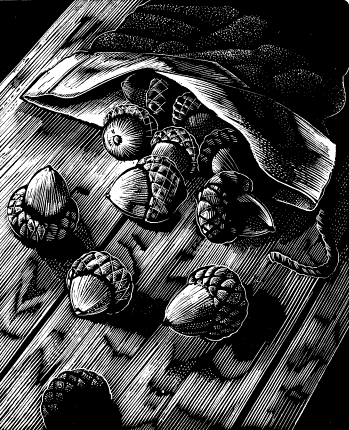
It’s more or less a short story – the copy I read had 50 pages, but the font was large and their are lots of woodcuts by Michael McCurdy. In fact, it’s these woodcuts which make the book really special – the edition I saw in Waterstones had a different illustrator, who was quite good, but make sure you find the edition with McCurdy’s work if you’re tracking down a copy.

But I’m getting ahead of myself – The Man Who Planted Trees was originally written when Giono was asked to contribute to the Reader’s Digest on ‘a memorable person’, or something like that. His contribution was, however, rejected – when they found out what he had never tried to conceal: that it was fictional. And instead it was published in Vogue in 1953. Don’t stop reading there – Virginia Woolf contributed to Vogue back in the day, so it can be a credible publication.

The Man Who Planted Trees tells of a narrator who hikes to a place of ‘unparalleled desolation’ – a village where the few inhabitants quietly loathe one another, and where nature has more or less given up. But he encounters Elzèard Bouffier, a shepherd who rarely speaks, but is kind and offers him somewhere to stay.

The shepherd went to fetch a small sack and poured out a heap of acorns on the table. He began to inspect them, one by one, with great concentration, separating the good from the bad. I smoked my pipe. I did offer to help him. He told me that it was his job. And, in fact, seeing the care he devoted to the task, I did not insist. That was the whole of our conversation. When he had set aside a large enough pile of acorns, he counted them out by tens, meanwhile eliminating the small ones or those which were slightly cracked, for now he examined them more closely. When he had thus selected one hundred perfect acorns he stopped and we went to bed.
Elzéard, as the title to the book suggests, is planting trees. Thousands and thousands of them. At this stage, he estimates that of the hundred thousand acorns he has planted, ten thousand will grow successfully. And he carries on and carries on, with many varieties of tree – quietly transforming the area.


The narrator fights in World War One (off the page) and returns to find Elzéard’s life unaffected by such matters – the trees abound, and the countryside is being changed in more ways than one. Streams which had been dry flow once more; people move to the village and it becomes vibrant again. The narrator leaves and returns a couple of times, and is astonished by what the unassuming shepherd has achieved.

The Man Who Planted Trees is a beautiful book, both visually and in every other way. McCurdy’s woodcuts have such energy and really enhance Giono’s simple and elegant story. It is described as an allegory – I’m not entirely sure what the allegory is, other than of creation, but that doesn’t diminish it being a delicately-told and affecting story. Giono doesn’t pluck at the heartstrings or delve into the characters’ psychology – instead he lays before us the simplicity of their acts, and allows the reader to engage and respond. And he has entirely succeeded in creating his original brief: a memorable character.

Do pop over and read Karen’s lovely review of this book… and you can read the beginning of it, including some more McCurdy images, courtesy of Google Books here.

Books to get Stuck into:

The Runaway – Elizabeth Anna Hart
: this is a similarly enchanting story, with beautiful woodcuts by Gwen Raverat. One of my favourite Persephones, it is more whimsical than Giono’s story, but equally engaging.

Matty and the Dearingroydes – Richmal Crompton

I spent most of my childhood reading Enid Blyton (before I moved onto Goosebumps and Point Horror… eugh, don’t remind me) and thus missed out on quite a lot of classic children’s literature. But one series I did include alongside a diet of all things Blyton is the William series by Richmal Crompton. I’m sure everyone knows about the escapades of this eternal eleven-year-old, but if not – hie thee to a library. Anarchic without being too anarchic, and always well-meaning, William Brown is one of the great creations of children’s – indeed, any – literature.

It was about eight years ago that I started reading Richmal Crompton’s novels for adults, and I was hooked. (This all fits in nicely with Polly’s post that I highlighted at the weekend.) There are over thirty, and plenty of them are very scarce, so it gave me a treasure hunt with wonderful rewards. Frost at Morning is one of my 50 Books You Must Read But May Not Have Heard About, over in the right-hand column, but there are plenty of other wonderful books by this neglected novelist. They are a bit patchy, and the quality is variable, but at her best Crompton is infectious and very comforting.

I’ve recently re-read one of my favourite Crompton novels, Matty and the Dearingroydes. The title is a bit of a mouthful, but it does what it says on the tin. Matty Dearingroyde makes her living buying clothes door-to-door, and selling them in a secondhand shop. Her method of going door-to-door is a little unusual:

“We’ll go down this street and we’ll go into the first house with blue curtains.”… “We’ll go into the first house we come to with a bird-cage in the window.”… “I’m going to say the beginning of Paradise Lost to myself and we’ll go into the house we’ve got to when I’ve reached ‘And justify the ways of God to men’.”
You begin to sense the sort of character Matty is: irrepressible, a little eccentric, and exactly the sort I always love. Anyway, she knocks at a door and gives her card… and by coincidence she has stumbled upon her extended family.

The rest of the Dearingroydes are well-to-do, and Matty is something of poor relation crossed with a family secret. Some misplaced family loyalty, and some inherited guilty, prompt supercilious Matthew Dearingroyde to ‘welcome’ Matty into the family circle. But it would be too burdensome for her to live solely with his family, and instead she is to spend a section of the year in various different households.

The plot and its many characters would be too much to summarise here, because Crompton always wields huge casts in fairly short novels, but it’s all well drawn. There are parents using their daughter to battle with each other; aging members of respectable families forced to live in a hotel; a shop-owner who pours a little too much alcohol into her cups of tea; a pair of teachers in a silent power struggle – a whole canvas of characters.

Crompton does often use the same sorts of characters across her novels (the pair of friends, one sucking the other dry of energy, crops up a lot and is always affecting) but they’re so involving that I can forgive her. In Matty and the Dearingroydes, because Matty is peripatetic, characters do tend to be left and forgotten once Matty has moved onto the next house – but so, I suppose, they would be. As long as exhuberant Matty is always in the foreground, then that’s fine.

Crompton will never be a prose stylist of genius, or even of a very high standing. Her writing certainly isn’t bad – it will never make you squirm – but it is mostly just functional. It gets the job done, without being in itself memorable. But Crompton’s novels are, and they are definitely comfort reads. I have a stock of ones I’ve yet to read, and I love knowing they’re there waiting for me. Matty and the Dearingroydes is quite tricky to track down, although Oxford country library has it and probably others do too, but you can pick up one of many Richmal Cromptons and be equally diverted. As I said, they are variable, but ones I’ve loved include Family Roundabout (published by Persephone; currently reprinting), Frost at Morning, Mrs. Frensham Describes a Circle, Narcissa, Millicent Dorrington, Four in Exile, There Are Four Seasons, Linden Rise, Westover, The Ridleys…

Books to get Stuck into:

So many suggestions I could make for this sort of book, but looking back through my past posts, I’m going to plump for…

Miss Mole – E.H. Young: similarly irrepressible older woman encountering a staid and jaded family…

Miss Hargreaves – Frank Baker: always popular here, can’t blame a boy for trying – if you haven’t read this novel yet, and the idea of an eccentric lady appeals, then you can do no better than this novel which is hilarious, moving, and even sinister, in turns.

A Game of Hide and Seek

I promised a Virago Modern Classic, and a Virago Modern Classic I will deliver. I’ve already read a couple Elizabeth Taylor novels, Angel and Mrs. Palfrey at the Claremont (click on the titles if you fancy reading my thoughts on them, but to summarise – they’re very good) and Nicola Beauman’s biography of Elizabeth Taylor, but there’s plenty of way to go – and when my supervisor told me I should take a look at A Game of Hide and Seek, how could I resist?

The ‘game’ in question is both literal and metaphorical. The novel opens with Harriet and Vesey (query: is this actually a name?) playing a game of hide-and-seek – and this game follows them throughout the rest of their lives… they chase each other, misunderstanding each other’s emotions and failing to say the right thing at the right times, and often saying the wrong thing. Vesey goes to Oxford; Harriet remains behind – and marries somebody else. Later, of course, Vesey reappears – and the same old feelings reappear as well.

I didn’t really want to write out the plot of A Game of Hide and Seek because, like so many of the best novels, the plot isn’t that important. A thousand novelists have written novels with this plot (for another good one, see EM Delafield’s Late and Soon) and explored the emotions that such a recrudescence can have. But few of them will have Elizabeth Taylor’s talent.

Confession time: I read the first half of this on the bus to and from London, and wasn’t very excited about it. I was tired, I had a headache, I was reading the words but not really getting anything out of it. It was only when I returned, busless, to my reading that I understood what an exceptionally well written novel A Game of Hide and Seek was. Taylor excels at the metaphor which is unusual and yet exactly conveys an image. One of my favourites was this:
Harriet tried to put on a polite and considering look. She loved the music, but could not allow herself to enjoy it among strangers. Sunk too far back in her too large chair, she felt helpless, like a beetle turned on its back; and as if she could never rise again, nor find the right phrases of appreciation. How many authors would think of that image, of a beetle turned on its back? And yet it works so very well. That is, to my mind, what sets Taylor apart from other authors – and makes it hard to explain exactly why – that she writes the sort of novel that many could write, but concentrates so much on avoiding cliche and finding new life in her characters, that she is on another level. Another example? It’s always difficult to ‘show’ good writing, isn’t it? But this is a paragraph I highlighted as being representative – the sort of writing which one has to read slowly, to enjoy it fully. The fog lay close to the windows. The train seemed to be grovelling its way towards London, but the banks on either side were obscured. Harriet wondered if they were passing open fields or the backs of factories, and she cleaned a space on the window with her glove, but all she could see reflected were her own frightened eyes.You can just tell that every word is carefully chosen, can’t you? This is all sounding a bit earnest, so I’m also going to quote my favourite line from the novel, which is often humorous as well as serious: “The meat has over-excited them,” Harriet thought. She had always heard that it inflamed the baser instincts.Quite so, Elizabeth, quite so.

I won’t go over the top, this isn’t the best novel I’ve ever read – but it is some of the best writing that I’ve read for a while. If you chose novels for their plot, you might not think too much of A Game of Hide and Seek. If you chose novels for their writing style and characterisation, this may well be something you’ll love – and admire. Not often that those two can go hand in hand – but Elizabeth Taylor is the woman for the job.

In the Frame

Thanks for all your contributions on the previous post, that was both interesting and reassuring – I thought I might be single-handedly holding up the biography market! I couldn’t think of any better way to express why I chose to read biographies (and their ilk) except the rather obvious one ‘to find out more’ – but Karen put it so adroitly when she wrote in the comments “A good auto/biography tempts a different part of the appetite from that which fiction satisfies.”

Onto another section of that appetite tonight – short stories. Those in the collection The Lagoon by Janet Frame, to be precise. I’ve said it before – every time I blog about a book of short stories, I come up against a brick wall, and find it more or less impossible to write coherently (or, rather, cohesively) about the book. But I’ll do my best…

I have Lynne (aka dovegreyreader) to thank for bringing Janet Frame to my attention, which she did with one of these posts. I’d been meaning to read more New Zealand authors, and so the name was stored in the back of my mind… when I found The Lagoon in an Oxford charity shop, I pounced. And I thought it was very good. This is Frame’s first published work, from 1951, and it went on to win the Hubert Church Award – which basically saved her from a leucotomy operation, which had been due to take place at the psychiatric hospital where she’d been diagnosed as schizophrenic. Gulp. As I wrote yesterday, an author’s life and experiences probably oughtn’t overly influence how I read their work, but with Frame she makes no secret of it. A lot of the stories take place in institutes, and the themes are often of seeking mental freedom, of experiencing life in independent and rich ways. This excerpt from ‘Snap-Dragons’ is quite representative: If you were free did you always fly away? Or were you ever free? Were you not always blundering into some prison whose door shut fast behind you so that you cried, let me out, like the bee knocking in the snap-dragon, or the people beating their hands on the walls of their ward.Frame often uses a sort of off-kilter stream-of-consciousness intended to reflect an mind going through imbalance, using structure to unsettle. Sometimes it works, sometimes it gets in the way of the narrative a little… it was a technique which didn’t really succeed for me in Emily Holmes Coleman’s A Shutter of Snow, but with Frame it is more subtle, and only sometimes irksome rather than effective.

A more successful way of unsettling the reader is Frame’s technique of disconcerting endings to her stories. They often end disjointedly, suddenly touching another topic or emotion. For example, ‘The Pictures’ is about a girl and her mother visiting the cinema. All the emotions they feel in response to the film are explored, and the world outside once they leave the cinema, and then the final words are: ‘But the little girl in the pixie-cap didn’t feel sad, she was eating a paper lolly, it was greeny-blue and it tasted like peppermints.’ It introduces a new tone, and shows that the close of a short story is only really the reader turning to face something else, it isn’t really an end.

I usually write in reviews of short story collections that they’re not as good as my first experience, with Katherine Mansfield – Janet Frame is no different, but she is perhaps closer than anyone else I’ve read. These stories, like Mansfield’s, are often very short, very perceptive and affecting. One of my favourites was one of the shortest – ‘A Short Note on the Russian War’. If people are interested to sample Frame’s work, I’ll type it out and post it in a day or too? Anyway, I wholeheartedly second Lynne’s recommendation. Once you’ve exhausted all of KM’s output, there is another New Zealander worth putting in the Frame…

Persephone Week: The End

Apparently Persephone Week finished on Friday… but here at Stuck-in-a-Book we’re going to keep it going right until the end of the week. No Weekend Miscellany this weekend, then, but instead the final two Persephones will be proffered. (And maybe even a redux tomorrow). No, I didn’t manage to read six (though I’m quite pleased with four), but today you’re going to hear about Lettice Delmer by Susan Miles and, more excitingly, see the product of Our Vicar’s Wife’s interaction with Good Things in England by Florence White (which is also coming out in November as a Persephone Classic, with a really beautiful cover, below)


Right – Lettice Delmer, my first novel in verse, and the only one which Persephone have published. [Edit: Sorry, I forgot, Amours du Voyage by Arthur Hugh Clough is another one.] Not in rhyming verse, at least most of the time, but in blank verse. (If you need a brush up on what blank verse is, have a look here.) I bought this in a secondhand bookshop a while ago and, to be honest, I might not have bought it otherwise – like a lot of people, I suspect, the concept of a novel in verse was a little off-putting. Me more than most, since I’ve always struggled with reading poetry – probably because I read quite quickly, and poetry really needs to be read slowly, or even aloud.

But, nothing daunted, I gave Lettice Delmer (1958) a go for Persephone Reading Week. If I’m ever going to read it, thought I, now is the time. The Publisher’s Note writes that it is ‘a novel, i.e. narrative with plot, characterisation and psychological insight, where the verse form is readable, not too intrusive – but essential.’ Lettice Delmer is the privileged daughter of extremely charitable parents, who are always seeking to help others for the sake of Christ. She herself is uncertain at the welcome her parents give to Flora Tort and her young son Derrick. Flora was a patient at a Special Hospital (a euphemistic title) and her son is rather an unpredictable, savage creature – at first. The rest of this novel looks at the Delmer household; Lettice’s leaving of it, and her subsequent life of difficulties, weaknesses, loves, losses and spiritual journey. The secondary depiction of a Christian girl struggling to communicate with God, and seeking further depth in her relationship with Christ, was very honest, moving, and genuine.


The Persephone edition has a Plot Summary section at the end, giving summaries of each 10-20 pages – I occasionally flicked to it to clarify a point or two, but largely didn’t find I needed it. Its inclusion does speak volumes about an anticipated readerly response – you can’t imagine a plot summary at the end of a novel, can you? It is true that, now and then, I’d miss a pivotal event – perhaps because I read verse a little too fast, and the nature of its lay-out, with dialogue incorporated into stanzas alongside everything else, means that it’s trickier to make significant points stand out. But this didn’t happen very often, and in general, I didn’t find the verse format a problem.

I suppose that’s the central part of this review, in terms of whether or not I’ll convince others to give Lettice Delmer a try – was I able to read it? For the first thirty pages, I thought I wouldn’t be able to. It was tricky, I get stumbling, and realising I hadn’t taken in anything on the page – but then it clicked. Something suddenly worked – and, though every time I picked the novel up it would take a few lines before it clicked again, I was immersed more quickly each time.

But, of course, unobtrusive wouldn’t be good enough. If a verse format did nothing but disappear into the background, it would be pointless. Of course, Susan Miles uses it to much better effect. Difficult to pin down what the verse *does* achieve: it is more of an atmosphere than anything specific. A subtle beauty and poignancy is lent to the pages, an almost ethereal quality. The verse enables Miles to discuss hard-hitting topics such as death, suicide, abortion, and depression without this feeling at all like a gratuitously gritty novel – they are serious topics, dealt with seriously, but almost through a glass darkly.


The lines I really want to quote give away a big spoiler. So I’m going to post them in white, and you can decide whether or not to read them. Below that are two other quotations, little moments in Lettice Delmer which were illuminating examples of how the verse can be used to accurately reveal a character. The last shows just how well this book fits into the Persephone canon.

He lets the subtle Tempter’s guiding hand
direct his footsteps to the sea-dashed brink.
Not till the waters close above his head
does any plea for mercy stir in him.

* * *

“It’s want of confidence, I truly think,
that keeps him so resentful.
I’ve watched poor Flora hold a stick – quite low –
and try to make him jump.
It seemed as if he were afraid to raise
both feet at once in case when they came down
the earth would not be there!”

* * *

For Lettice insists scratchily
that aching to be in the war is a whim that merits contempt.
“You are doing far better serving at home humbly
than seeking false glory, it seems to me, Hulbert,
out on the battlefield,
for unmarked, unpraised, wholly unheroic home service
is, to my mind, self-satisfying or not self-satisfying,
much more admirable than a soldier’s blatant offering.”

To conclude, I thought I’d find Lettice Delmer impossible to read – but I was pleasantly surprised. Though it won’t become one of my favourite Persephones, the novel has a lyrical beauty for which it is worth acclimatising yourself to the unusual form. Do have a step outside your comfort zone, and give this novel a try.

Onto the second Persephone title of the post:


Our Vicar’s Wife had a flick through Good Things in England, (in its Persephone Originals edition) trying to decide what to make – the first thing she found was something involving a pig’s head, and thought not. Which is nice for me, because I’m vegetarian. Instead, she opted for gingerbread. ‘Eliza Acton’s Gingerbread’, no less, appropriately enough a recipe submitted from a Rectory. Here Mum is, holding her offering (doesn’t she look nice?)


And this is what it looked like when sliced up…. it’s even nicer than it looks. The yummiest gingerbread I’ve ever eaten, and a fitting end to Persephone Reading/Eating Week. Mmmm.

Elizabeth, Beth, Betsy, and Bess…

Those with a more encyclopediac knowledge of nursery rhymes than I might automatically finish the blog post title with:

…all went together to find a bird’s nest.
They found a bird’s nest with five eggs in it.
Each took one and left four in it.

I told you I’d get excited about being able to click on the quotation function. This could be a case of Picasa 3 all over again, where I get giddy with excitement for a fortnight, then forget all about it. (It’s just a button I press on the making-a-blog-post screen…)
This is all a long preamble to talking about Shirley Jackon’s The Bird’s Nest (1954). Today’s post might be of more interest to American readers of Stuck-in-a-Book, since there seem to be a lot more copies available Stateside than in old Blighty. I had to read it in the Bodleian. Shirley Jackson is known to me as the author of The Haunting of Hill House (which I wrote about briefly here) and the brilliant We Have Always Lived in the Castle, which I’ll write about in October when the new Penguin paperback comes out in the UK. Having been very impressed by these chilling novels – very Gothic, not horror – I was really intrigued to see what Jackson’s pen made of multiple personality disorder. Or dissociative identity disorder, depending upon which guide you use.

For this is the central concept of The Bird’s Nest, which takes its title from that nursery rhyme. The novel starts with Elizabeth – reticent, uncharismatic, a little moody – who is experiencing headaches, insomnia, and occasional black-outs. With the help of Dr. Wright, it quickly becomes apparent that Elizabeth is only one personality amongst many – and the others become increasingly dominant. There is sweet, gentle Beth; feisty, selfish Betsy; airs-and-graces Bess. Much of the novel is from the perspective of Dr. Wright, debating his dealings with these personas, and pondering how to bring them all together into one being. (Lizzie, if you will. Or Elspeth or Eliza or Liz or Betty or Bette… what a versatile name Elizabeth is.) Other chapters are from the perspective of one of the four personalities – but towards the end of the novel these chop and change so quickly that it’s more or less a hotpot of different points of view. A film was made in 1957 (called Lizzie) and I’ve no idea how the actress, Eleanor Parker, managed to portray all these transformations.

And that’s a problem Shirley Jackson encounters occasionally. It’s difficult enough to keep one protagonist consistent throughout a novel – four incarnations must be a nightmare. The most obviously shifting is Beth, who starts as an ideal of Elizabeth, kind and sweet – by the end she weeps at the slightest provocation, and forever moans that nobody likes her. Betsy, contrarily, becomes much more likeable as the novel progresses. But these changes do not materially affect the novel – nor diminish the fact that, though inaccurate, The Bird’s Nest is impressively prescient about multiple personality disorder. The condition was not officially medically recognised until 1980 – this novel was published in 1954. It is a bit fanciful about the interaction of the various personalities, but the patient’s symptoms do match many of those discussed in the Wikipedia article on the subject… so, unless the person who created that article used The Bird’s Nest as their sole source text, I’m quite impressed.

The Bird’s Nest isn’t in the same league as We Have Always Lived in the Castle. The writing isn’t as pacy, the atmosphere not so intense, the characters not so well drawn – but it is still an eerie, involving, and unusual book which doesn’t shame Jackson’s oeuvre. Probably not good enough to bring back into print on its own merits, but as a fascinating example of the beginnings of a genre, and as a novel from a writer showing promise of her later brilliance, I can recommend The Bird’s Nest.

Someone at a Distance

Continuing the week of Persephone Birthday celebrations here at S-i-a-B (and do keep telling us in the previous post about your favourite Persephones and how you found out about them, and put your request in for a chance to win a Persephone book of your choice) – I don’t think I’ve ever talked about one of my favourite Persephone books. Appropriately enough it was one of the first three to be published, so it’s now ten years since it came back into print.


Someone at a Distance by Dorothy Whipple was Whipple’s last novel, published in 1953 and received no reviews at all. For a once bestselling novelist, this was quite a blow – and, what’s worse, it was a wholly undeserved silence. I’ve only read four of Whipple’s books – SaaD, They Knew Mr. Knight, Greenbanks, The Closed Door and other stories, all except Greenbanks published by Persephone – but Someone at a Distance is the best of those. A lot of people agree that it’s her best novel, and it should have been treated with fanfares and red carpets.

The plot appears, on the surface, to be conventional. A contentedly married couple, Ellen and Avery, are disrupted when a French companion arrives and runs off with Avery. The narrative moves back and forth across the channel, looking at the dignified devestation of Ellen and the homeland and family of Louise, the French interloper. What starts as a not unusual trio is given enormous depth and believable emotion when we investigate why Louise acts as she does; witness Avery’s confusion and attempts to organise his life and mistakes; Ellen’s need to look after her two children as well as retain her dignity and integrity. And all the time the reader is asking him/herself – who is the ‘someone at a distance’? Whipple sometimes creates some great titles that make you think all the way through the novel, and while I have set views on which character the ‘someone’ is, others disagree.

I’m a big believer in judging books on their writing, rather than plot – and Whipple is a prose writer par excellence. Not showy or grandiose, but both moving and compulsive – Someone at a Distance is a fairly long book, but I wouldn’t be surprised if you read it in one or two sittings. Dorothy Whipple may well be the great undiscovered English novelist – certainly Someone at a Distance is an excellently constructed, sophisticated and emotionally taut novel which should never have been allowed to go out of print.

As well as being one of the first three Persephone Books titles published, Someone at a Distance was one of the first Persephone Classics, and treated to a wider publication and beautiful cover. I love the uniformity of ther Persephone library, but I also think this Persephone Classics cover is the most beautiful cover I’ve ever seen. And so I had to own both…

I’m sure lots of people here have read Someone at a Distance – thoughts? Who do you think the ‘someone’ is? If you’ve not read it, I really encourage you to give Dorothy Whipple a try.

After the Fox

Just to prove I have read *something * this month…

Quite a while ago I wrote about second-book-syndrome. By that I meant the second book you read by an author, after you’ve loved one. You might be reading them in order they were written, might be completely different – but it’s so difficult for the second book to live up to the first. I wrote the first blog post about Frank Baker’s Before I Go Hence, which was good, but nowhere near as good as Miss Hargreaves, which is one of my ’50 Books’. I haven’t read another novel by Baker since, though I have a few waiting on my shelves. Today’s post is about another ’50 Books’ author, and the second book I’ve read by him – Aspects of Love by David Garnett.

I bought this in a secondhand bookshop in London a while ago, and read most of it on the train home – then a lull, and read the rest last week. I was attracted to it, other than by Garnett’s name, by its brevity. The blurb says:

‘Alone in a villa in the South of France, a penniless French actress and a star-struck English boy enjoy an idyll which they thought could not last. The years prove them wrong. Their entanglement endures, changing slowly, bringing in others – all of them concerned to keep the taste of life on the tip of their tongue.’

Well, that was quite misleading. I was anticipating a beautiful love story, but nuanced by Modernist whirls, as it were. Lady Into Fox, though it put some people off with its metamorphosis, was at heart a moving love story, told with a spectacular linguistic skill. Aspects of Love was like reading a rollercoaster – dramatic event after dramatic event whisked past me, before I had time to work out what was happening. When the blurb says the central relationship is ‘changing slowly’, they mean she goes off with his uncle; he shoots her, she has a daughter with the uncle, who falls in love with him… I usually love short novels, as they give the opportunity for something simple and polished, portraits of characters which shine like gems. Aspects of Love had some good points, but should either have cut out half the plot or doubled its length. I don’t know what Garnett was trying to say, but whatever it was didn’t convince me – I am rather disappointed, and can’t say I recommend this novel. The odd sentence was beautiful, but you some sentences do not a great novel make. Shame.

And now the question is… will I bother with a third book by Garnett?

I’m back! / Mockingbirds and Cousins

Hurray! The internet has arrived at Marlborough Road!

For those of you thinking “That’s not news, you blogged on Saturday”, I have to say – that wasn’t me. Well, in a way it was, but it was a phantom post – I tried to link to the video on Youtube a couple of weeks ago, and failed. Obviously it was hanging around in the ether, waiting for someone to authorise it or something, and suddenly it appeared at the weekend. Strange.

I’m afraid my return to the blogosphere will be short-lived, since I’m away on holiday on Friday, and back on 29th August – so more then. I do hope some people are still here, even with all the disruptions of late… blame the world of technology which eludes me. Thankfully one of my housemates has a very savvy boyfriend, who kindly tip-tip-tapped away at the keyboard and got everything sorted out. I am living proof that young + male doesn’t necessarily = good at internetty things. In fact, if you use the word ‘internetty’, then you probably don’t qualify. Though I once plugged an ethernet cable in upside down (no easy task), so I’m in a league of my own.

In the time I’ve been away from blogging, I’ve had quite a build-up of books to talk about, so that will probably take us up til I head off to Northern Ireland. Today I’m going to write about the last two book group books I’ve read in recent weeks, both classics of the twentieth century.

My Cousin Rachel is the third novel I’ve read by Daphne du Maurier – I wrote about The Flight of the Falcon here, having not been overwhelmed, but Rebecca is one of my favourite novels. My Cousin Rachel probably fell between the two. (There are some spoilers here, but not too many…) It tells the story of Ambrose and Philip Ashley, cousins who are more or less father and son, living in Cornish rural simplicity, away from women and contentedly reliant upon one another. Ambrose is taken off to Italy, and it is here that he meets and marries Rachel – and dies. Rachel comes to see Philip in England, and he is prepared to hate her – but their relationship becomes increasingly complicated, as does the readers’ thoughts about Rachel’s potential culpability.

The novel has a lot in common with Rebecca – and not just the setting. The same intrigue, power, and issues about what is left unspoken in relationships. Though not as successful as Rebecca – I found the first 80 pages dragged a little, in fact until Rachel arrived – My Cousin Rachel is brilliantly successful in the sense that I have never left a novel so uncertain as to a character’s guilt or lack of it – and either interpretation seems quite valid. Brilliantly done. There are such sophisticated themes of obsession and attracting obsession without being aware of it, the cyclical nature of the men’s experiences… The group discussing the novel were divided from absolute loathing to absolute loving, and thus an ‘interesting’ meeting was held!

My other book group were rather more agreed on To Kill A Mockingbird. This is one The Carbon Copy has been telling me to read for years, and I’ve continually meant to, so was glad when someone recommended it for book group and spurred me on. What a great book. I don’t think there’s any point in me giving a synopsis, since almost everyone has read this novel before me, but having seen the film I was surprised that so little of the book was concerned with the trial of Tom Robinson. To Kill A Mockingbird is much more a depiction of Southern life for the Finch family, and a portrait of a daughter’s relationship with her father – and a beautiful portrait at that. When I did the Booking Through Thursday about heroes, Colin put forward Atticus Finch, and I have to agree. The man is incredible – a very worthy father, a moralistic lawyer and a humble citizen, a combination which is tricky to write without seeming unrealistic or irritating. Atticus, though, remains wholly admirable and likeable throughout, and is one of the great male characters in literature, I’d say. I could eulogise about him, and this novel, for ages – but I won’t. I want to hear what you think.

There, written about two books without quoting from either of them. Tsk. Here’s one I like: “If I didn’t take this case (Scout) then I wouldn’t be able to hold my head up, I wouldn’t be about to tell anyone what to do, not even you and Jem.” Or this:

“I’m no idealist to believe firmly in the integrity of our courts and in the jury system – that is no ideal to me, it is a living, working reality. Gentlemen, a court is no better than each man of you sitting before me on this jury. A court is only as sound as its jury, and a jury is only as sound as the men who make it up. I am confident that you gentlemen will review without passion the evidence you have heard, come to a decision, and restore this defendant to his family. In the name of God, do your duty.”

Speak of an Angel…

…and you shall hear the fluttering of its wings. I think that’s what the expression used to be, before the Great British cynicism and dark sense of humour altered it…

Before I start talking about another book I read in Northern Ireland, I must point you in the direction of the Carbon Copy’s blog for today… have a look here… it’s usually plain blue background etc., so quite witty what he’s done today, and made me double-take…

Elizabeth Taylor is a name which has been on my horizons for a few years now – and no, I don’t mean Mrs. Burton, the actress, but the novelist of the same name. She’s often mentioned on dovegreybooks, the online book discussion list I’m in, to the extent that I have four of her novels on my shelves, all unread. It seemed time to rectify this, so I took Angel away with me, devoured and loved it.

Well, I say loved. It was an incredibly sad novel.

Angel Deverell starts as a humourless young girl, intent on making her way out of her working class background, by fantasy if not by any other means. She finds a potential route out when she starts writing a novel in an exercise book – writing becomes compulsive, and before long she has finished her first romance. Elizabeth Taylor based Angel on similar contemporary romance novelists – Marie Correlli, Ethel M. Dell and so forth; all the people Q. D. Leavis so despised. Like them, Angel’s style and scenarios are over the top and exaggerated, with minimal verisimilitude. Somehow, she is accepted by Gilbright & Brace publishers – Brace finds her absurd, but Theo Gilbright has an unavoidable fondness for Angel, despite her complete lack of humour, her unwarranted self-confidence, arrogance and fierce opposition to criticism:

(Theo:) ‘I daresay I know more about the reading public than you, and you will take my word that I have an idea as to what will pass among the weakest of them. We publish for them, alas, ‘the bread-and-milk brigade’ my partner calls them. They decide. They bring the storms about our ears. For them we veil what is stark and tone down what is colourful and discard a lot that – for ourselves – we would rather keep. So will you take away your manuscript for a while and see what you can do for us?’
‘No,’ said Angel.

Success greets her – a mixture of unquestioning loyalty from the uneducated, and amused delight from the over-educated. When she can afford to leave Volunteer Street, her working-class birthplace, however, she does not enter the sublime world she’d envisaged…

Angel takes us to the end of Angel’s life, and, though the novel is only about 250 pages long, Elizabeth Taylor packs so much in that it really feels like a saga – a compulsive one. Some of the most moving passages concern Angel’s mother, as she moves with Angel to a ‘better’ neighbourhood, and loses all her lifelong friends:

‘Either they put out their best china and thought twice before they said anything, or they were defiantly informal – “You’ll have to take us as you find us” – and would persist in making remarks like “I don’t suppose you ever have bloaters up at Alderhurst” or “Pardon the apron, but there’s no servants here to polish the grate.” In each case, they were watching her for signs of grandeur or condescension. She fell into little traps they laid and then they were able to report to the neighbours. “It hasn’t taken her long to start putting on side.” She had to be especially careful to recognise everyone she met, and walked up the street with an expression of anxiety which was misinterpreted as disdain.’

Angel Deverell is never a likeable character; quite the reverse. Even so, Elizabeth Taylor creates in her a character of pathos, and it is difficult to take any pleasure in her downfalls, however deserved. It is testament to Taylor’s talent that such an unpleasant protagonist can inhabit a thoroughly compelling novel. I shall certainly be making sure I read the other Elizabeth Taylor novels I have, though if they’re all this sad, I’ll be pacing them out.