(Don’t) Keep The Woolf From The Door

First off, a big well done to Carole! I haven’t got an email from you yet, though (Yahoo is playing up a bit) so do let me know – what do you think about taking your pick from the current ’50 Books You Must Read…’ list? They are down the left hand side – only eleven to choose from so far, but hopefully something you’d like, Carole – if you don’t mind the book being secondhand, as most of those are out of print. Oh, except no.8, which is impossible to find… In related news, I was excited to see my ‘umble blog mentioned on the BAFAB blog. How exciting, and another thanks to BAFAB for their great idea!

Now, I’ve blogged about Virginia Woolf before. Possibly more than any other author, come to think about it, so forgive me if I do it again. I still have the feeling that mention of Ginny brings people screeching up to a blank wall – Susan Hill has run her Woolf For Dummies, and bloggers great and disparate have mentioned her, but I still always feel the need to apologise, to find ‘starting points’ for Woolf. Truth is, she’s not a difficult author, not if you don’t start off with The Waves. But you do have to give her all your attention, just for a little bit… and so, if there really any people out there still unconverted, please turn to The London Scene.

The lovely people at Snow Books sent this beautiful book to me – it’s a slim volume, and produced exquisitely. I even stole the picture from them. Must mention Suzanne Burton, before I forget – wonderful illustrations, Suzanne. You can see one on the cover, and they head up each of the essays. Oops, dirty word. These are ‘essays’, six of ’em, describing various areas and activities in London, but don’t go thinking you’ll need to reference footnotes and look up Latin epigrams. These are more musings – intellectual musings, but musings nonetheless. I don’t know London very well, and I have the feeling this book would be even better if one did, but even with my yokel unfamiliarity, this collection is intensely evocative. Comissioned by Good Housekeeping in 1932 (imagine!) these have never been published together since – apparently the final essay (and the best) was lost until recently.

These essays move between the public grandeur of Westminster Abbey and the House of Commons, and the private detail of Mrs. Crowe’s social parlour, and those shopping on Oxford Street. In under a hundred pages, Woolf encapsulates every aspect of social and historical London, in her ever-precise and enveloping language:
And again the moralists point the finger of scorn. For such thinness, such papery stone and powdery brick reflect, they say, the levity, the ostentation, the haste and irresponsibility of our age. Yet perhaps they are as much out in their scorn as we should be if we asked of the lily that it should be cast in bronze, or of the daisy that it should have petals of imperishable enamel. The charm fo modern London is that it is not built to last; it is built to pass. Its glassiness, its transparency, its surging waves of coloured plaster give a different pleasure and achieve a different end from that which was desired and attempted by the old builders and their patrons, the nobility of England.

How… how Woolfean. But don’t forget, she is more than capable of humour: in Mrs. Crowe’s drawing-room ‘if anyone said a brilliant thing it was felt to be rather a breach of etiquette – an accident that one ignored, like a fit of sneezing, or some catastrophe with a muffin’.

Because I’ve blogged about Woolf a few times, I’m going to repeat a cartoon. It still makes me laugh.

50 Books…

9. One Pair of Hands – Monica Dickens

First of all, apologies for what is probably the worst piece of photo-editing you’ve seen this week. I felt I should get both hands into a picture celebrating ‘One Pair of Hands’, and couldn’t fathom how to do this without one hand on the camera. So I took two photographs, and spliced them together. Lucky you pop in for bookish natter, and not computer expertise, isn’t it? Oh, and this is the first time I’ve appeared in one of the blog entries, so deduce what you can of my character from my hands. Probably – just – that I bite my nails. And am not married.

Enough of that – you might have noticed Monica Dickens’ book creep up from my ‘what shall I read next?’ post, to my ‘what I am now reading’ post – and has now joined the acclaimed ranks of the 50 Books You Must Read But May Not Have Heard About. It’s reminded me how much I can enjoy reading, for fun rather than for deadlines. Dickens is related to that Dickens (great-granddaughter, according to the blurb) and is just as funny, though in rather a different way – the novel is Dickens’ first (1939) and documents her time spent as a cook/maid in various households, through a year and a half. She came from a wealthy family, but became rather disillusioned, and thought she’d see what life was like on ‘the other side of the green baize door’.

Well, I’m sure it wasn’t nearly as funny as this novel (/autobiography?) is – Dickens’ style of writing is intrinsically comic, in a gentle way, though with laugh-out-loud moments. Very similar to Delafield’s Diary of a Provincial Lady in stylistic respects – if you enjoyed the former, you’ll love this. In amongst what must have been tedium, Dickens chronicles some hilarious events (the first dinner she cooks, especially the lobster cocktail…) and has a wealth of engagingly odd secondary characters. All of them, in fact – just on the right side of absurdity. Look out for E. L. Robbins, the vacuum cleaner salesman; Polly, the maid who runs around with her apron over her head, if spoken to sharply; inept young wife Mrs. Randall, and The Walrus, a builder in the same house.

This could have been a dozen novels, but Dickens makes the brave decision to put all her experiences into one – which means it’s impossible to get tired of any situation (in both senses of the word). The Times comments on the back: “Riotously amusing as the book is in parts, Miss Dickens also manages to make it a social document.” Well, how like The Times. But I can’t say they’re wrong – having seen the Servant Problem from the Provincial Lady’s point of view, Dickens’ is a fascinating comparison. Must use self-discipline to prevent myself immediatly reading One Pair of Feet, about her time as a nurse. It’s looking at me from the shelf…

Onto something entirely different. A good friend from my old village has just joined the blogging community – do go on over and give her a hearty welcome. It’s always lovely to know people are reading, and that’s all the more true when one first dips a toe into the blogging water… She’s called Apprentice Brick Counter… I’ll let you discover why.

50 Books…

5. It’s Too Late Now – A. A. Milne

It was only a matter of time before Mr. Milne got a mention on these pages. Wait, he had one the other day, didn’t he?

The Secret Option to my potential Summer Reads may be the only way in which most people have come across Alan Alexander – but he wrote far more than the children’s books. In fact, like almost every successful author of children’s books that you could care to mention, he came to look on them as something of a distraction from his other work. During his lifetime, though, he was a renowned playwright, novelist, detective-novelist, poet, sketch-writer, essayist and even wrote one of the only three official works for the national Pacifist movement. Busy man.

Back in 2001, I decided to familiarise myself with the adventures of Mr. W. Pooh et al (still some of the best children’s books ever written – like most, wasted on children and most adults), and this led to me reading Christopher Milne’s autobiographical trilogy, The Enchanted Places, The Path Through The Trees, and The Hollow on The Hill. Look out for mention of them later. My Aunt Jacq, who shares many of my reading tastes, lent me several volumes of his work for Punch (of which he was sometime Assistant Editor) and the rest, as they, is history. I’ve read nearly everything he wrote (which is a LOT) and can recommend all of it – for those wishing to dabble, and don’t mind doses of whimsy, track down The Holiday Round as a starting point. If you don’t like whimsy, then try Two People, his best novel. His most popular non-children’s work was the detective novel The Red House Mystery, which was written before the Golden Age and thus looks a bit like a poor cousin – but still highly enjoyable.

BUT. The reason I’ve chosen It’s Too Late Now as the fifth book in my ’50 Books You Must Read But May Not Have Heard About’ is that is the perfect ‘way in’ to going beyond Winnie. This is his autobiography (in fact, published in the US as just An Autobiography), and is as representative of his work as anything else – funny, self-deprecating, anecdotal… and provides a great companion to the rest of his work. If you’d prefer a more impartial work, which also focuses more on his literary output, rather than his childhood, try Ann Thwaite’s excellent book A.A. Milne: His Life. She writes with evident enjoyment of his work, and presents extensive research without hitting you over the head with it.

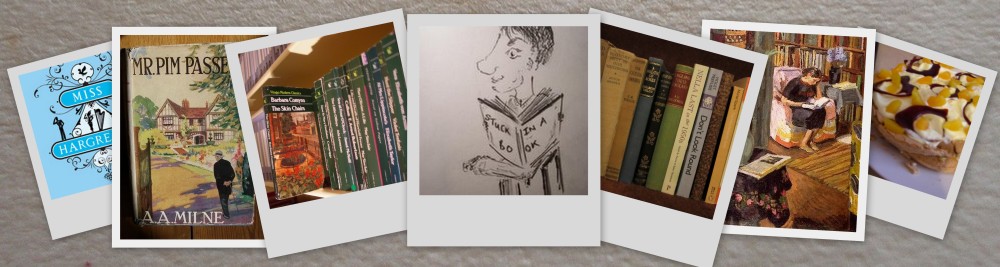
Sadly, both books are out of print (well, the Thwaite keeps wavering, and is easier to come across) but both certainly worth locating. Milne’s ‘other work’ has become unjustly neglected, and needs re-discovering. Hope I’ll make some converts! He is such an amusing writer, and once you enter his world, you’ll never want to leave. Joie de vivre characterises almost all his work, especially the early plays and sketches. Oh yes, read Mr. Pim Passes By too, in either novel or play form. Oh yes, he did it in both. Another interesting point of comparison is the play The Great Broxopp, which is about an advertising tychoon whose child features in the adverts, as a baby – and the effect childhood fame has on the boy as he grows up. All written before Christopher Robin Milne was even born.

P.s. sorry for lack of cartoons over the past few days – hope people do enjoy them when they appear?? Instead, you have a nabbed picture of Ashdown Forest, the inspiration for the Hundred Acre Wood. The Clan went a few summers ago, and it is a wonderful place. An enchanted place, if you will.

50 Books…


2. The Provincial Lady

Now, this is probably the book which will best guide you in an understanding of my literary tastes. Perhaps even whispering the word ‘Persephone‘ would do that for many of you? Early twentieth-century domestic fiction doesn’t come better than today’s entry.

Next to be presented for inclusion in ’50 books…’ is The Provincial Lady, possibly well known to a lot of you out there. If it’s not, then BUY IT! Yes, it is not often that I shall wander into the forceful, but I cannot see any valid reason why this book is not in every household. Possibly several times. For backing up on this, may I direct you to the enthused ear of Random Jottings, one of my oldest (by which I mean, of course, longest-standing) e-friends. We bonded over EM Delafield about three years ago, and have sent a flurry of her books back and forth – is there a better basis for friendship than sharing a cherished author? Can’t think of many.

For those who don’t know, this is a fictional diary, based heavily on Delafield’s own life and family. Not a great deal happens, but as we meander through the struggles of middle-class village life, the heroine’s resigned, deadpan approach to everything becomes utterly irresistible. The book you see in the photo contains all four in the series – The Diary of a Provincial Lady; The Provincial Lady Goes Further (my favourite); The Provincial Lady in America; The Provincial Lady in Wartime. For stateside readers, the fourth of those is ‘…in London’. Don’t be fooled by The Provincial Lady in Russia. This was initially published as Straw Without Bricks, and is an account of Delafield’s time in a Soviet collective (!!), and only later did publishers see the potential profit in labelling it one of the series.

Alongside the book is the cassette. Dramatised, with Imelda Staunton as PL, and rather wonderful – do try and track it down if you can.

And once you’ve read Provincial Lady… well, I love As Others Hear Us, Faster! Faster!, Mrs. Harter… I do hope Random Jottings will comment and give us further info, for she is the true mine of knowledge on all things EMD. As is this website – it includes extracts, which should lure you in.

In other news, today was the Grand National. The Clan have an annual habit of picking a horse each, based entirely upon name and colours. This year, failing to notice one was called Simon, I plumped for Silver Birch – on the basis that Richmal Crompton wrote a book of short stories with the title. And it won! Shame our bets are of the imaginary kind…