Blindness by Henry Green

Normal weekend posts are suspended, since I failed to write my review of Blindness (1926) during weekdays of Henry Green Reading Week (run by Stu) – indeed, I didn’t finish reading the book until last night.  But let’s hope the weekend counts, and get on with the show!  And it’s going to be quite a long show, as I ended up having a lot to say about Mr. Green…

I decided to start with Blindness because it was Green’s first novel, and I’ve never read an author chronologically before.  Blindness was great, and so I’ll be reading the rest of Green’s novels chronologically… over the course of many years, I suspect.  I wasn’t sure I’d like him, based on excerpts I had seen around the blogosphere – perhaps he has to be read in context, rather than piecemeal?  Perhaps the first novel is different from the others?  I don’t know, but I do know that this novel has left me keen to try more.

Blindness starts with the diary of John Haye, a privileged boy at a posh school.  He is something of a dandy and an aesthete, pontificating on art and culture and how to best the boys who try to best him.  He’s not unpleasant, but nor is there much depth to his diary.  Even though orphaned (with an attentive stepmother who has been ‘Mamma’ for nearly all his life) it seems that nothing of great emotional moment has ever affected his life.  Here’s a sample diary entry:

Bell’s, across the way, have bought as many as seven hunting-horns.  Each possessor blows it unceasingly, just when one wants to read.  They don’t do it all together, but take it in turns to keep up one forced note.  Really, it might be Eton.  They can only produce the one note during the whole day.

In addition to this trifling detail, it is “the thing to do” now to throw stones at me as I sit at my window.  However, I have just called E.N. a “milch cow,” and shall on the first opportunity call D.J.B. a “bovine goat,” which generally relieves matter.  These epithets have the real authentic Noat Art Society touch, haven’t they?
Contrast that which the first paragraph of the second section.  In between there is a brief letter, from B.G. to Seymour, which tells the reader what they have suspected from the title onwards: John has been blinded.  I shan’t tell you how (it’s good to have some specifics left for the reading experience) but immediately we drop out of the self-conscious intimacy of John’s diary, and into this paragraph:

Outside it was raining, and through the leaded window panes a grey light came and was lost in the room.  The afternoon was passing wearily, and the soft sound of the rain, never faster, never slower, tired.  A big bed in one corner of the room, opposite a chest of drawers, and on it a few books and a pot of false flowers.  In the grate a weary fire, hissing spitefully when a drop of rain found its way down the chimney.  Below the bed a yellow wardrobe over which large grain marks circled aimlessly, on which there was a full-length glass.  Beyond, the door, green, as were the think embrasures of the two windows green, and the carpet, and the curtains.
The buoyancy has gone; the repeated word ‘weary’, and ‘tired’, drag the writing down with heaviness which doesn’t need to be overstated.  Green is excellent at conveying emotion through simple thoughts, allowing the reader to interpret the characters and their states of mind without giving too much overt direction.

John is at home, now, and the main characters change.  They are too well written to be accurately described in brief, but I’ll give a vague sketch.  John’s stepmother, Mamma, is of huntin’-shootin’ stock, doesn’t understand her arty stepson, but would (and does) do everything for his sake.  Nanny has cared for him from infancy.  And then there is Joan – the daughter of a local defrocked clergyman.  She isn’t particularly intelligent, although she has greater depth than her conversation suggests… and her relationship with John is as awkward as it is enlivening.  This is John’s thoughts after first meeting her:

Voices as become his great interest, voices that surrounded him, that came and went, that slipped from tone to tone, that hid to give away in hiding.  There had been wonder in hers when he had groped into the room upon them both; she had said, “Look.”  But before she had opened her mouth he had known that there was someone new in the room.

Voices had been thickly round him for the past month, all kinds of them.  Mamma extracted them from the neighbourhood, and all had sent out the first note of horror, and some had continued horrified and frightened, while others had grown sympathetic, and these were for the most part the fat voices of mothers, and some had been disgusted.  She had been the first to be almost immediately at her ease, when she spoke it was with an eager note, and there were so few eager people.
It is an interesting coincidence that I am reading this so soon after reading Helen Keller’s The World I Live In.  Of course there are differences (not least fact and fiction) but, although I can’t really know, I think Green writes a plausible narrative of dealing with sudden blindness.  And it certainly gives Green restrictions which he approaches impressively: to use, from John’s perspective, no visual descriptions.  I jotted down a line which I thought summed up much of the novel, and later (because I always read introductions at the end) discovered that Jeremy Treblown had begun his with the same quotation:

It was so easy to see and so hard to feel what was going on, but it was the feeling that mattered.
That’s a pretty good summary of any author’s task.  It’s essentially ‘show: don’t tell’, isn’t it?

Many of the novelists I love from the interwar years have spent the subsequent decades hovering between ‘canon’ and ‘non-canon’.  The Leavises et al may not have welcomed them, but they have been reclaimed by later critics – or left out in the dust.  Ivy Compton-Burnett, Elizabeth Taylor, Elizabeth von Arnim, E.M. Delafield… to my mind, von Arnim is every bit as good as Taylor, but the latter has risen in critical appreciation where the former has not.  These seemingly arbitrary decisions can be found everywhere.

As for Green, he is a curious case.  You’d be hard-pressed to find a literary critic who didn’t think him significant – but equally hard-pressed to find one who’d bothered writing about him.  His style is often compared to Woolf’s or Joyce’s (although I don’t think those two authors should be grouped together) – what struck me is that Henry Green writes like James Joyce would if Joyce were a lot less arrogant, and more concerned with making his prose enjoyable as well as experimental.  There are several pages from Nan’s perspective, meandering hither and thither, reminiscing and wondering, that Joyce would have given his back teeth to be able to write.

Does Henry use stream-of-consciousness?  Yes, I suppose he does.  But whereas Woolf (whom I love) incorporates beautiful imagery and stylistic wanderings like waves on a shore, Green does the opposite.  He never uses a word or a metaphor that the character wouldn’t speak aloud.  It is beautiful, but it is resolutely simple.  And thus probably incredibly difficult to write – especially for a 21 year old.  Yes, Green was 21 when he finished this novel – and at school when he started it.  Sickening, isn’t it?

Blindness isn’t just from John’s perspective, though.  In fact, the perspective is a bit like a butterfly – flying about, settling for a few paragraphs on one person, then moving onto another – dipping in and out of people’s minds, and giving their thoughts, feelings, and worries in an honest, perceptive manner.  Green builds character so well, from the inside out.  Nobody is considered too insignificant for this treatment – the reader hears from the nurse, the cook, even a cockerel, alongside the principal cast.  If that feels dizzying, don’t worry, it is not – simplicity always remains Green’s mantra.  Sometimes this flitting between different consciousnesses does, though, create intriguing uncertainties.  Take this excerpt, during a conversation between John and Joan – Joan is speaking:

“Yes, an’ there’s the chicks that get lost in the grass, I love them, an’ there’s a starling that nests every year in the chimney, and my own mouse which plays about in my room at night, an’…”

G-d, the boredom of this.

“… but sometimes I hate it all.”
With my apparent knack for pre-empting Jeremy Treglown’s introduction, he also quotes this section – although unambiguously attributing the mental interjection to John.  That’s certainly the most likely reading, but I like the ambiguity that Green does incorporate.  It could easily be Joan’s thought (it would certainly match the other thoughts we’ve heard from her in this scene) or even a shared moment of bored despair – connecting mentally where they do not connect verbally.

I daresay I have delighted you long enough, so I will conclude.  Blindness is such an interesting novel, written so well.  As a first novel by a very young man, it demonstrates astonishingly maturity; I’m very excited about reading his later works.  This wouldn’t be a great choice for those who prize plot above character and style, but for anyone who likes the idea of modernism, but struggles to enjoy it in practice, Henry Green’s style (on the basis of Blindness, at least) is perfect for you.

Do head on over to Stu’s blog to see what he and others have read during Henry Green Reading Week.  And thanks, Stu, for giving me the incentive finally to read up my Greens!

Time Importuned – Sylvia Townsend Warner; or, Why Do Poetry and I Not Get Along, Wherein our Reader Struggles With Verse

Well, I can tick off 1928 on A Century of Books, because on Saturday I read Time Importuned by Sylvia Townsend Warner.  This volume of poetry was published two years after Lolly Willowes, an excellent novel about which I’ll soon be writing a chapter of my thesis – but which I only wrote about very briefly on SiaB.  I intended to write another post last year, when I reread it.  I worry that, if I tried, I would end up writing ten thousand words… well, perhaps I’ll give it a go one day, since the review I wrote doesn’t do it justice.

Anyway, I read Time Importuned hoping that there would be something useful to include in that chapter (which, incidentally, there was) but I can’t say I’ve converted to a poetry lover.  This isn’t going to be a proper review, because I don’t really know how to write blog posts about poetry.  I can analyse them in a doing-an-English-degree sort of way, and I used to quite enjoy doing that, but blogs are chiefly about reading for pleasure.  The activities of the student are not those of the ardent reader – I enjoy both aspects, but they are distinct in my head.  You don’t want to know what I think of Warner’s use of syntax.  You might want to know whether or not I enjoyed reading Time Importuned – and the truth is, I don’t know.

Some poetry I hate.  If it doesn’t make sense to me on three readings, I’m not interested.  If the poet name-drops all manner of classical mythology, I raise my eyebrows; if they name-drop 21st century technology, I raise them still more (these were both frequent crimes in the Magdalen poetry society I occasionally visited.)

Some poetry I enjoy.  But mostly comic verse, or things which are probably considered doggerel by those in the know (does Longfellow fall into this category?  Does Walter de la Mare?)

Oddly enough, I enjoy writing poetry – but I’m under no illusion that it’s very good, and I do it entirely for my own amusement or catharsis, as case may be.  Since I rarely read poetry, I feel wholly unqualified to write it, and a little ashamed that I have the audacity to put pen to paper…

Something like Time Importuned… I just don’t know.  The topics covered tend towards hopeless love and countryside matters, often combined, and with an atmosphere almost as though they are old wives’ tales, passed down in small villages for many years.  Which was nice, but I did end up reading the poems mostly as though they were paragraphs of prose laid out in an unorthodox manner.  Perhaps that is a valid way of reading poetry… but perhaps it also misses a lot?  I don’t know how else to benefit from verse.  I deliberately slow myself down, by mouthing the words (I’m quite a fast reader of prose, in a manner which loses poems completely) but I still can’t imagine reading a volume of poetry for pleasure.  It’s not that I need prose, because often I read plays for pleasure – and that’s more or less as unusual a trait as poetry-adoration, so I’m led to understand.

Well, I’m going to type out a couple of the poems which I did quite enjoy, although I am far from the ideal reader for them.  Poetry washes by me, enchanting others who dip in their toes, and merely splashing me slightly.  So, before I get to some excerpts, I have a question… which poet/poetry would you recommend to the prose lover?  How would you go about converting me to the possibilities of poetry?

Over to Warner…

The Tree Unleaved

Day after day melts by, so hushed is the season,
So crystal the mornings are, the evenings so wrapped in haze,
That we do not notice the passage of the days ;
But coming in at the gate to-night I looked up for some reason,
      And saw overhead Time’s theft ;
For behold, not a leaf was left on the tree near by.

So it may chance, the passage of days abetting
My heedless assumption of life, my hands so careless to hold,
That glancing round I shall find myself grown old,
Forgotten my hopes and schemes, my friends forgotten and forgetting ;
      But all I can think of now
Is the pattern of leafless boughs on the windless sky.

Walking and Singing at Night

Darkened the hedge, and dimmed the wold,
We sang then as we trudged along.
The heart grown hot, the heart grown cold,
Are simple things in a song.

The lover comes, the lover goes,
On the same drooping interval,
Easy as from the ripened rose
The loosened petals fall.

Between one stanza and the next
A heart’s unprospered hopes are sighed
To death as lovely and unvexed
As ’twere a swan that died.

Alas, my dear, Farewell’s a word
Pleasant to sing but ill to say,
And Hope a vermin that dies hard ;
As you will find, one day.

Safety Pins – Christopher Morley

I seem to write my reviews in protracted parts now – there are the bits I can’t help typing out and posting as soon as I read them, and then, rolling along months later, comes the actual review proper.  The snippets are probably more enjoyable to read, and certainly speedier to write, but I’ll leave that sort of blogging to people like Claire who does it so beautifully.  Me, I like the sound of my own voice.  So not only did I give you Christopher Morley’s delightful, wonderful essay ‘On Visiting Bookshops‘ back in July (go and read it now, if you didn’t then) but I’ll cover the whole collection it came in: Safety Pins (1925).  (I’m pretty sure these essays are collected elsewhere under another name, or scattered through different collections – grab any book of essays with Morley’s name on it!)

Morley was best known to me as the author of Parnassus on Wheels, which I love, and its sequel The Haunted Bookshop, which is a curate’s egg.  I love little literary or personal essays, and was delighted to find that he had written some – doubly delighted when I discovered that it included bibliophilia of that order.  The rest of the collection is something of a mixed bag – brilliant at its best, and humdrum at its worst.  Actually, that assessment isn’t quite fair: I find him fascinating when our interests overlap, and less so when they don’t – only the greatest essayists can make a subject compelling which would otherwise be considered dull.  I don’t even remember the topics of those that I skimmed through, so let’s move on to those I loved?  And when I love Morley’s essays, I really love them.

When he writes about books and writing, I am besotted – ‘The Perfect Reader’ is sweet and sensible; ‘On Unanswering Letters’ is farcical and yet oh-so-true (how letters are accidentally left unanswered for so long that it is impossible to do so, and no greeting works); he even admits to ‘the temptation to try to see what books other people are reading – this innocent curiosity has led me into many rudenesses, for I am short-sighted and have to stare very close to make out the titles.’  But beware the man who falls asleep while reading in a chair:

And here our poor barren clay plays us false, undermining the intellect with many a trick and wile.  “I will sit down for a season in that comfortable chair,” the creature says to himself, “and read this sprightly novel.  That will ease my mind and put me in humour for a continuance of lively thinking.”  And the end of that man is a steady nasal buzz from the bottom of the chair where has collapsed, an unsightly object and a disgrace to humanity.

Not even Shakespeare is safe from Morley’s attentions – in ‘On Making Friends’, he gives his own views on those tenets laid down in Hamlet:

Polonius, too, is another ancient supposed to be an authority on friendship.  The Polonius family must have been a thoroughly dreary one to live with; we ave often thought that Ophelia would have gone mad anyway, even if there had been no Hamlet.  Laertes preaches to Ophelia; Polonius preaches to Laertes.  Laertes escaped by going abroad, but the girl had to stay at home.  Hamlet saw that pithy old Polonius was a preposterous and orotund ass.  Polonius’s doctrine of friendship – “The friends thou hast, and their adoption tried, grapple them to thy soul with hoops of steel” – was, we trow, necessary in his case.  It would need a hoop of steel to keep them near such a dismal old sawmonger.

You probably sense Morley’s tone – and have a good idea whether you’ll love him or loathe him.  Some people do have an odd hatred for insouciant humour.  Morley’s essays are like A.A. Milne’s or Stephen Leacock’s or anybody who deals in slightly over-the-top whimsy – but rooted in a love of ideas and a passion for literature.  Morley becomes earnest, when on the track of his hero R.L. Stevenson, but is equally adept at cod-earnestness – for example, in the title essay, in praise of ‘Safety Pins’:

The pin has never been done justice in the world of poetry.  As one might say, the pin has no Pindar.  Of course there is the old saw about see a pin and pick it up, all the day you’ll have good luck.  This couplet, barbarous as it is in its false rhyme, points (as Mother Goose generally does) to a profound truth.  When you see a pin, you must pick it up.  In other words, it is on the floor, where pins generally are.  Their instinctive affinity for terra firma makes one wonder why they, rather than the apple, did not suggest the law of gravitation to some one long before Newton.

Well, quite.  I keep using the word ‘delightful’, but it is the perfect word for Safety Pins.  If he is not entirely consistent, at least that is better than being consistently dull.  There is plenty here for the bibliophile, and plenty more for those who like to laugh at the little things in life.  I love it – I think a lot of you will too.

Other things to get Stuck into:


Once a Week by A.A. Milne – every now and then I eulogise about AAM, and hope that one or two of you will try him and love him.  The review I link to is really more about Punch, but hopefully you’ll be inspired to try Milne’s whimsical, clever essays.


Literary Lapses by Stephen Leacock – the great Canadian humorist deserves a better post than I gave him, but you can at least read one of his pieces there.  His sketches and essays brim over with humour, and he was wonderfully prolific too.

Any other humourous essayists you think I would enjoy?

A Fairy Leapt Upon My Knee by Bea Howe

Most of you, my lovely readers, chose the obscure novel yesterday – which goes to show how lucky I am to have you lot reading my blog!  I’ll probably end up writing about both – perhaps the well-known author will even pop up tomorrow in my absence, whilst I’m gallivanting in London.  Dark Puss suggested I wrote about the one I enjoyed more… well, I enjoyed this one more, but the other one was probably better.  (Other people used to that feeling?)

As you might have spotted from the post title, this is an obscure book, but I have mentioned it before.  A Fairy Leapt Upon My Knee (1927) by Bloomsbury Group hanger-on Bea Howe lent its paper to my new blog background – I thought it was time I told you what was on the pages (other than David Garnett’s signature!)  (Some of you may even have spotted a very brief section of this review in your blog readers yesterday… oops!)

The outline of the novel is pretty simple – William and Evelina have fallen in love, and deal with the difficulties of not being able entirely to understand one another.  Much of the narrative flicks back and forth between their minds, as they grapple with starting a new stage of their life together – melding two rather different personalities into one prospective marriage.  Oh, and along the way a fairy turns up.

Evelina is not unlike a fairy herself – she is fanciful, thoughtful – bright, light, and sparkling:

She was dressed in a silver frock with a deep jewelled belt that gripped her waist.  Her light brown hair was cut quite short like a boy’s and brushed softly over her ears; it was shot with gold at its curling tips.  But it was her eyes, of an odd green colour, that William first noticed.  They regarded him so intently; like a child’s.  They were also very bright.  Eyebrows thin, dark, arched, gave a flying look to her face.  Her face which was painted and pale.

William, on the other hand, is a little more staid and grounded.  Where Evelina is concerned with her ‘secret self’, and often wanders off into realms of imagination (although not in an annoying way, for the reader at least) William is an etymologist – the fluttering world of moths is his chief concern, and he approaches it with the eyes of a scientist.  (Scientists will doubtless tell us – indeed, my brother does tell me – that there is a greater beauty in the structure and order of numbers/nature etc. than in its aesthetics.  Well, horses for courses.)  William’s captivation by lepidoptera is all-consuming, and colours even his attempted romantic overtures:

“One day I will tell you all about my moths.  In some odd way you remind me of them.”  His voice was low and gentle.  Evelina did not know that this was the first compliment he had paid a woman.

Yet it is he, the scientist, rather than she, the wistful romantic, who stumbles upon the fairy.  I once attended a nighttime moth hunt, and sadly no fairies turned up.  The one William finds has not quite the daintiness of Tinkerbell et al:

A pale, extremely ugly, wizened-looking little face, about the size of a hazel-nut, stared up at him.  And this face did not belong to a giant moth or beetle!  The filmy stuff, the cobwebby matter which had first stuck between his fingers and given such a peculiar sensation to his skin, was evidently part of this creature’s clothing.  Underneath its thin protection, William could see the vague outline of a tiny body.  It was a woman’s body, shaped quite perfectly, like a minikin statuette.  With a vague feeling of embarrassment he knelt down and rolled his prisoner gently off his palm on to the ground.  The fairy did not move.  She only remained looking in a dazed way at him.  William gazed back.  He still felt completely bewildered.  

A Fairy Leapt Upon My Knee is a strange little book, not least because the fairy doesn’t do very much, except sit listlessly in William’s house.  She emphasises, however, the disparity between William and Evelina.  He has no personal curiosity in the fairy, except as a scientific specimen – ‘It had not even occurred to him to think of her as another living being.’  Evelina, on the other hand, is jealous that she did not make the discovery – and the existence of the fairy propels her even further into realms of the fanciful and fey.

A Fairy Leapt Upon My Knee is a simple story which I found charming and enchanting – but which really could have done with a better structure.  It feels a little as though Howe started writing on page one, and put down anything that crossed her mind – which does give the novel a feeling of freedom and flow, but it ultimately lacks the impression of unity and progression which a properly planned novel has.  Evelina and William fall out and make up and fall out and make up – often without even seeing each other in between – which is possibly more life-like, but a little dizzying to read.

This was Bea Howe’s only novel (although she wrote a few biographies) so it’s impossible to tell how her style might have progressed.  For a first novel, A Fairy Leapt Upon My Knee is rather delightful, and I’d definitely recommend it to anyone with a taste for a touch of whimsy – as an only novel, it does lead one to speculate what Bea Howe could possibly have followed it with, and gives me an altogether bemused impression of Howe as an authoress.  That creative inspiration should hit only once in this manner, and in such a manner, is curious and amusing.  Perhaps, just once, a fairy leapt upon her knee?

Tomorrow… another strange book, but one from almost eighty years earlier and a different language altogether.  Ten points to anybody who can guess…

Early Young

One of the best books I’ve read this year was William by E.H. Young – a few of us did a joint read back in February, and I became a confirmed fan of Emily Hilda’s, after having previously enjoyed Miss Mole. In a manner not unknown to me, I had stockpiled EHY novels long before I knew whether or not I would like her, and so when I saw that someone at the conference I’m attending this week would be discussing The Misses Mallett (1922), I was able to prepare.

My received understanding about EH Young, from various reviews and from Virago’s judicious selection of novels to reprint in the 1980s and 1990s, was that her first three novels were rather mediocre and that The Misses Mallett (also published as The Bridge Dividing) was something of a momentous turning point. After that (so I understood) she wrote nothing but gems. After all, nothing separates those early rural novels from the sophistication of William except one novel: yes, The Misses Mallett.

I had great expectations. And, I’m sorry to say, they rather faltered. The topic showed such promise, especially given my predisposition towards spinster novels of the 1920s. And there are plenty of spinsters around – let me hand you over to my favourite one, Caroline:
“The Malletts don’t marry, Henrietta. Look at us, as happy as the day is long, with all the fun and none of the trouble. We’ve been terrible flirts, Sophia and I. Rose is different, but at least she hasn’t married. The three Miss Malletts of Nelson Lodge! Now there are four of us, and you must keep up our reputation.”Caroline, Sophia, and Rose are sisters, Rose being rather younger than the first two – who are drawn rather two-dimensionally, if amusingly. Caroline is fairly feisty, and spends her autumnal years reliving imagined conquests of her youth, and alluding to improprieties which she, in fact, has never had the opportunity to commit. Sophia is mousy and quiet and traipses after Caroline, excusing, correcting, and loving her. They have their own touching dynamic, even if their characters aren’t hugely evolved. It is with Rose, and later their feckless brother’s daughter Henrietta, that the reader is supposed to sympathise. They are from the same mould – affected intensely by their emotions, but compelled by society to quash their wilder affections, etc. etc. And they’re both tangled up with love for the (to my mind) wholly unattractive Francis Sales. He’s off the market anyway, married to an invalid wife of the variety who alternates catty remarks with lunges after her smelling salts.

To be honest, much of this plot reminded me of the most unlikely excesses of Thomas Hardy. People fall in love from distances of a hundred metres, flash their eyes all over the place, and emote wildly through woodland and over moors. Here’s an excerpt:
She did not love him – how could she? – but he belonged to her; and now, if this piece of gossip turned out to be true, she must share him with another. Jealousy, in its usual sense, she had none as yet, but she forged a chain she was to find herself unable to break. It was her pride to consider herself a hard young person, without spirituality, without sentiment, yet all her personal relationships were to be of the fantastic kind she now experienced, all her obligations such as others would have ignored.I haven’t read anything by Mary Webb et al, but this has to be the sort of thing Stella Gibbons was parodying in Cold Comfort Farm, no? (Which reminds me – review of Stella Gibbons’ Westwood coming soon, promise.) I’m being a little cruel to EHY here, perhaps, but only because her later novels are so brilliant. It’s somewhat reassuring that she wasn’t born with inherent subtlety and style.

I’m skimming over the plot rather, because it’s a bit predictable. I’ve watched enough corny films to know that the Rugged Hero will eventually be passed over for the Male Best Friend. In Henrietta’s case, the latter appears in the wonderful character of Charles. He is like a lump of real gold amidst fool’s gold – when EH Young went on to write better, much better, novels, she need not have been ashamed of creating Charles. He is a wonderful mixture of the aesthetic and inept. He lives for beauty in music, much in the way that characters in EM Forster might, but he also lacks confidence and is unnervingly self-aware.
Charles blinked, his sign of agitation, but Henrietta did not see. “He’s good to look at,” Charles muttered. “He knows how to wear his clothes.”

“That doesn’t matter.”

Charles heaved a sigh. “One never knows what matters.”As a hero he defies cliche, and thus is a nod towards the sort of complex characters which Young would later form. It’s just a shame that the Misses Mallett themselves, inoffensive though they might be, never really reveal any inspiration on Young’s part. A novel about 1920s spinster sisters living together could have been deliciously fun or painfully poignant, or even both, but there are only brief moments when The Misses Mallett could be said to be either. A serviceable novel, certainly, and good enough to pass the time – but unworthy of the pen which would later create William and Miss Mole, and goodness knows whatever other sparkling or clever works.

I’m very glad that this wasn’t my first encounter with EH Young, as it might well have also been my last. Instead, I shall chalk this up to experience – and go foraging for one of her later novels next time. Can anybody at all step forward to defend Young and, equally importantly, those Misses Mallett?

Still – William

Everytime I revisit Richmal Crompton’s William series, I have a nudging fear that they won’t be as good as I remembered, that what seemed screamingly funny to me when I was eight will have palled…

…and everytime I realise I needn’t have worried. (Photo credit, btw.) If you’ve never read one of the books, you’re in for a treat. Think how PG Wodehouse might have written about an eleven year old boy, if PGW tempered his exaggeration a little and developed an intimate knowledge with the minutiae of village life. Here’s one of the passing characters, for instance: ‘He was extraordinarily conceited and not overburdened by any superfluity of intellect.’

This isn’t a fully-fledged review or anything, it’s just a little overflow of joyfulness at revisiting William – in this case, Still William. Richmal Crompton wrote over thirty William books between 1922 and 1970, this being the fifth – each is a collection of stories about the well-intentioned mishaps of William Brown, who is eternally eleven. They’re hilarious, and warming. Although everything almost always goes lamentably wrong, and William ends up being hounded by his relatives and neighborus, there isn’t a malicious bone in his body. If anything, most of his misfortune comes from an irrepressible desire to help. In Still William he proposes on behalf of his brother, and later on behalf of his sister. He determines to be truthful on Christmas Day, with disastrous results. He determines to live a life of ‘self-denial and service’ with (you guessed it) disastrous results. He has only marginally more success when attempting to put on a show of ‘natives’, or teaching a visiting French boy idiomatic English.

I suspect most of us have read some William books at some point – but perhaps you’ve neglected them for a while, or somehow have never read one. Get one now. And get one with Thomas Henry’s excellent illustrations, not the more modern, awful ones. Richmal Crompton also wrote lots of wonderful novels (and some less wonderful ones) but, although she deserves wider fame for those, equally she deserves the immortality she has secured through William Brown.

In case you’re still not convinced, here is an excerpt between William and his uncaring older sister:William’s mother was out to lunch and Ethel was her most objectionable and objecting. She objected to William’s hair and to William’s hands and to William’s face.

“Well, I’ve washed ’em and I’ve brushed it,” said William firmly. “I don’ see what you can do more with faces an’ hair than wash ’em an’ brush it. ‘F you don’ like the colour they wash an’ brush to I can’t help that. It’s the colour they was born with. It’s their nat’ral colour. I can’t do more than wash ’em an’ brush it.”

“Yes, you can,” said Ethel unfeelingly. “You can go and wash them and brush it again.”

Under the stern eye of his father who had lowered his paper for the express purpose of displaying his stern eye William had no alternative but to obey.

“Some people,” he remarked bitterly to the stair carpet as he went upstairs, “don’ care how often they make other people go up an’ downstairs, tirin’ themselves out. I shun’t be suprised ‘f I die a good lot sooner than I would have done with all this walkin’ up an’ downstairs tirin’ myself out – an’ all because my face an’ hands an’ hair’s nat’rally a colour she doesn’t like!”

Ethel was one of William’s permanent grievances against Life.

Patricia Takes a Bus Ride

As I predicted, I dove straight into the books by Kitty Vincent – I’ll write about them properly soon, maybe tomorrow, but I don’t think I can really do so without giving you a taste of her writing. So I thought I’d copy out the piece I love most so far – ‘Patricia Takes a Bus Ride’ from Gin & Ginger.


Patricia’s companion said something to the lady seated next him in the bus, but she regarded him with an icy stare. When they reached Patricia’s flat, and she was pouring out tea, she remonstrated with him.

“I shan’t take you out again,” she said, “if you don’t observe the proper etiquette. It has taken me years to learn it, but I am absolutely infallible now. I believe I could write a book on how to be a perfect lady in a bus.

“If you are travelling on top it is quite in order, I might almost say desirable, to enter into conversation with your neighbour. If it should happen to be raining a little light badinage is allowable as you snuggle beneath the cover, so thoughtfully provided by the company.

“If you are a woman you begin (I beg your pardon, you commence) the conversation by hoping that your umbrella is not objectionable, and the correct retort is, ‘Some weather for the ducks, what!’ Then you discuss the latest murder, or some interesting trifle of the description, being careful to keep the conversation within strictly suitable limits. It is advisable to preface your remarks with, ‘Well, what I always say is —‘ and you finish up by observing that ‘Murder is always a mistake; it comes out in the end.’

“You must never be original, because it may lead you into being daring, and to be daring on a bus is not good form.

“When you or he come to the parting of the ways, I advise you to murmur, ‘So long,’ or ‘Well, ta, awfully.’ I know that the latter remark is frightfully ‘bon ton’ because the most immaculate young man bade farewell to me in these terms, and he was so marvellously dressed that I am sure he was a dancing, partner or something really smart of that description.

* * *

“You should never speak to anyone inside a bus, as it violates every canon of deportment. If you should be forced to speak – if, for instance, you want to leap across the body of the person next you – you merely ejaculate ‘Pardon!’ This will have the desired effect.

“When the conductor asks for your fare, do, please, not enter into a long description of where you are going, it sounds excessively vulgar, and shows that you are not conversant with your world. If, for instance, you desire to alight at South Kensington, merely hold up one finger, and mutter, ‘South Ken.’ This places you, at once, as being ‘all right,’ while if you explain that you want to get to a square somewhere near the Underground, you are making yourself conspicuous.

“Many contretemps may occur in buses, and the way in which you meet them places you at once. If you are seated opposite a child who appears to be rapidly growing more and more ashen, you may assume that it is suffering from mal de bus. You must either pretend that, although you took a ticket to Piccadilly Circus, you recollect that you have pressing business at Hyde Park, and leap from the bus, or you must accept the consequences with sang-froid.

* * *

“Bus laws lay down that a child who is violently sick is ‘a poor little dear,’ and you are expected to behave accordingly, although in your heart of hearts you know that it is a gluttonous little pig. But if you so much as lift an eyebrow, child-lovers glare at you with muttered expressions of, ‘Well, I suppose she as a child once.’ It is useless and exhausting to explain that, although you were once a child, you were not a sick-in-a-bus one, and you merely become an object of universal execration.

“As one spends so many hours in buses, it is so important to learn how to behave,” Patricia said a little plaintively.

Mr. Pim (Passes By)

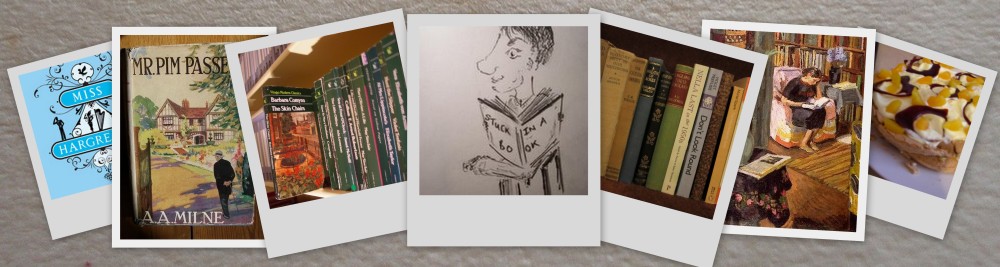
I have come back from a really wonderfully enjoyable Possibly Persephone? event, which I will write more about soon – hopefully tomorrow. But tonight I shall leave you in no further doubt as to the choice I took along with me – it’s Mr. Pim Passes By by A.A. Milne, and I left my copy with lovely Nicola Beauman, so I will wait and see what she thinks. Onto my review…

Every now and then I write about A.A. Milne’s works, and mention that he was my first great grown-up-books love – ironically, given that he is best known as a children’s writer. Two People and The Red House Mystery have both recently come back into print, and yet there is a huge amount of AAM’s work which is mostly overlooked. Some of his whimsical sketches are currently appearing on Radio 4 – thanks for the heads-up, Barbara! – and you can listen to previous episodes and read more info here.
But today I’m going to write about the most amusing of A.A. Milne’s novels, and the first that he wrote – Mr. Pim (1921). It has a slightly confusing publication history. It is an adaptation of his (once) very popular play Mr. Pim Passes By – and in later editions of the novel it reverts to this title. Confusing, no? Incidentally, it is dedicated to Irene Vanbrugh and Dion Boucicault (the picture is them in the play version, nabbed from Wikipedia) – the former’s autobiography is one of the more interesting and unusual books I’ve read this year. I read it in 2002, and recently re-read it – finding it just as much a joy this time around.

Mr. Pim concerns the family living at Marden House. George Marden is a very proper gentleman, with very proper views. His niece and ward Dinah is rather flighty; her very-nearly-fiance Brian is modern and sweet; George’s wife Olivia is… well, here description rather falters. Milne’s strongest suit is his female characters, and Olivia is perhaps the best role he ever wrote for the stage – and then novel. Olivia, like many of Milne’s heroines, though doubtless infuriating should one encounter her in real life, is an absolute delight on the page. She is strong-willed without ever being remotely antagonistic; she is sweet without being saccharine; she can be flippant or passionate with equal conviction, and yet never quite lets her guard down. Being married to George must be rather difficult, yet one feels that Olivia is the only person who could possibly ameliorate him in any way – and it’s rather lucky that she happens to love him.

Here’s a conversation between Dinah and Brian which rather sets the tone of the family:

Brian, lying back on the sofa, looked at her lazily with half-closed eyes.

“Yes, I know what you want, Dinah.”

“What do I want?” said Dinah, coming to him eagerly.

“You want a secret engagement –“

She gave an ecstatic little shudder.

“– and notes left under doormats –“

“Oh!” she breathed happily.

“– and meetings by the withered thorn when all the household is asleep. I know you.”

“Oh, but it is such fun! I love meeting people by withered thorns.”

Her mind hurried on to the first meeting. There was a withered thorn by the pond. Well, it wasn’t a thorn exactly, it was an oak, but it certainly had a withered look because the caterpillars had got at it, as at all the other oaks this year, much to George’s annoyance, who felt that this was probably the beginning of Socialism.

As the novel opens, Olivia wishes to hang some orange curtains which George considers far too modern for his house. Of such things are narratives spawned – Milne wrote in his autobiography that this idea was the catalyst for the whole story. Elsewhere, Dinah and Brian are almost engaged, and Dinah is trying to find a way to tell her uncle. George himself is busy pontificating: “Tell me what a man has for breakfast, and I will tell you what he is like.” George, I’m sure you will.

Milne was keen to point out that Mr. Pim isn’t simply the play with ‘he said’ and ‘she said’ thrown in, and indeed it is not. The plot is the same, and the characters are the same, but the authorial comment and wry narrative (at which Milne was such an expert) come fully into play. At this juncture, Milne himself breaks off into an amusing account of various breakfasts at Marden House. It’s too long to type out, but he does this sort of thing so well.

And we haven’t even got to Mr. Pim yet. His passing-by is the spark which sends the whole household into frenzy – and quite inadvertently. Mr. Pim is delightfully absent-minded – he takes absent-mindedness into a whole new category. And, lucky Mardens, Mr. Pim has a note of introduction to George. Here he is on his way, being sent off by mutual friend Brymer:
“You’ve got the letter for George?” [said Brymer]

Mr. Pim looked vague.

“George Marden. I gave it to you.”

“Yes, yes, to be sure. You gave it to me. I remember your giving it to me.”

“What’s that in your hand?”

Mr Pim looked reproachfully at the letter which he held in his hand, as if it had been trying to escape him. Then he put it close to his eyes.

“George Marden, Esq., Marden House,” he read, and looked up at Brymer. “This is the letter,” he explained courteously. “I have it in my hand.”

“That’s right. It’s the first gate on the right, about a couple of hundred yards up the hill. He’ll put you on to this man, Fanshawe, that you want. His brother Roger used to know him well – the one that died.”

“Dear, dear,” said Mr. Pim gently, emerging from his own thoughts to the distressing fact that somebody had died.
Mr. Pim ends up coming to Marden House several times that day, for various reasons – George being busy, or realising that he has said the wrong thing. But mostly he doesn’t know quite what a stir he creates – for, on one of his little visits, he happens to mention having seen an ex-convict from Australia, named Telworthy. What Mr. Pim doesn’t know is that Olivia’s first husband, missing presumed dead, was a convict from Australia named Telworthy…

Cue all manner of confusion and upset, panic and madness. Bigamy appears to have arisen at the most proper, law-abiding house in all the county. More importantly, this crisis in George and Olivia’s ‘marriage’ allows Olivia to see exactly how much George esteems reputation, and how much he loves her…

Milne inherits just enough of the wit of the 1890s to let his characters chop endless logic, and has enough of the 1920s to let them do it for a reason. Although all the insouciant characters give off the impression of taking nothing even remotely seriously, in fact there is an overtone where decisions do matter, and changes can happen. It is all incredibly funny, and fairly fanciful – one can only imagine what would have resulted had George Bernard Shaw turned his hand to it – but it is not flimsy.

I’m so pleased that I loved Mr. Pim as much the second time around as the first. I worried that I’d outgrown whimsy, which is a dirty word for some, but I think it would be impossible to outgrow the joy of reading Milne. I encourage you to hunt this one down – it’s quite different from Two People, and very different from The Red House Mystery, and different again from Winnie the Pooh – and it is an absolute delight. Go on – let Mr. Pim pop in for a bit. You never know what might happen.

William

.
34. William – E.H. Young

I hope some of you have been able to get hold of William (1925) by E.H. Young (sorry for doing readalongs of out-of-print books… there is one coming up for an in-print book, which will be revealed soon!) – today I’m posting my review, and tomorrow you can – nay, must! – head over to Darlene’s blog for a discussion of William. I’m not great at understanding time differences etc., so I’m not sure when people will be awake or asleep across the globe, but pop in when you can – it will be a rolling discussion, as it were. For my part, I’ll be collecting links to reviews underneath this review – there are some already there, from past blog reviews, and I’m delighted to add Karyn’s as the first for this readalong. Pop back here tomorrow for your chance to win a copy.


I’ve got to start by saying that William is an exceptionally good, rich novel. You’ll see that it’s entered my 50 Books You Must Read list. I’d enjoyed Miss Mole a lot, but that was mostly for the exuberant and delightful central character. In William Young has exchanged a blazing light for a gentler, more even flame (albeit that William came first). Her cast of characters in William’s family are drawn beautifully and fully: William is the ex-sailor patriarch of a large family of children and grandchildren, and happy, loyal husband to Kate. Despite being a sensible business, he often speaks fancifully and at tangents, with a ‘trick of saying disturbing things in a cheerful manner’, to which Kate responds with good-natured logic. They’re a lovely married couple (although my opinions of William as a character – which differ from a few I’ve seen posted on blogs – will be explored below.)
“You never know. Things pop up unexpectedly. Life’s a long road. It looks safe enough: you jog along, with nice trim hedges at each side and fields all buttercups and daisies, and suddenly you come to a dark place where there’s a man with a gun.” “You talk a great deal of nonsense, William.”
In Kate and William, Young has created a realistically happy couple who are still interesting to the reader, because they are not wholly of one accord, and do not completely understand one another.
“Why are you looking at me like that?” she asked.

“I was thinking how pretty you are. None of the girls can hold a candle to you.”

“Oh, William, absurd,” she said, pleased but restive under his puzzling regard.
‘The girls’ are the majority of their offspring. There is reliable Dora, whose life may not be as picture-perfect as her mother believes; grumbling Mabel who is forever making unnecessary savings and complaining about her illusory poverty; Lydia who is married to a man who cannot hold her attentions, and quiet, contemplative Janet, still living at home. Besides these is a solitary brother – Walter – heir to William’s business.

I’m quoting a lot from this novel, but it’s worth seeing what William thinks of his children.
He saw their children and their children’s children as so many by-roads on their own highway of life and from all those roads there lurked the possibility of assault. He saw Mabel as a dusty path, Walter as a plain country road with neat, low hedges and fields beyond, Dora as a lane rich with flowers on the banks and overshadowed by splendid trees, and Lydia came to him like a winding footway across a stormy moor, Janet like a stiled path across a meadow, and all those roads were capable of producing tramps, highwaymen, snakes and pitfalls. He shook his head in dismay. “One’s own fault for having children,” he said.It is impossible to tidy up William’s family with these brief character sketches, for they are far more fully realised than that. Harriet, in her review (link at the bottom) mentions that William could be compared to Pride and Prejudice, and I definitely agree. These are two authors par excellence when it comes to observing family dynamics, and the myriad relations between parents and children in a large family.

You are led into believing that Young has simply written an observant, often funny, always intriguing, family drama. And then, about ninety pages in…
This was at the end of June and it was in September that Mrs. Nesbitt learnt to look back at her past happiness and see that it had been almost perfect. The little frets and worries which had oppressed her had been no more than summer waves, breaking with hardly a sound on a sandy shore; and suddenly a storm had risen, not with splendour, not with a call to fight the elements and emerge gloriously victorious, salt on the face and mighty wind in the soul, but one that rose with a dull, threatening rumble and a lowering of clouds which hung and would not break. They hung, ponderous, black, immovable, edge with angry colours, and the world was darkened.Isn’t that simply beautiful writing? This is the sort of prose which fills every page of Young’s novel, and makes it so rewarding to read slowly and carefully. The passages I’ve picked are probably more imagery-based than the majority of the novel, but at all times Young’s choice of words is obviously pain-staking.

But I shan’t leave you wondering what the twist is (unless you don’t want to know – in which case, stop reading now!) Most of the reviews I’ll link to mention it, and it would be difficult to write properly about William without doing so. After all, the event is not as important as the ways in which people react. Ok, I’ll stop teasing – it is no coincidence that Lydia shares a name with one particular Bennett sister, as like Lizzie’s troublesome younger sister, Lydia Nesbitt runs off with another man. The difference being she has no intention of getting divorced; she is committing adultery.

As with all the greatest novels, what happens is less significant than the way in which it happens, and the way in which it is described. Young is primarily concerned with the fall-out of Lydia’s actions, as they ripple through the family and in-laws. The responses are all very nuanced, and make for some wonderful dialogue. In fact, the dialogue throughout William reminded me of the wonderful Ivy Compton-Burnett. ICB has few admirers throughout the blogosphere, it must be said, and William is rather more likely to find favour – but in Young’s precise and patterned use of dialogue, I couldn’t avoid thinking of ICB’s brilliant novels (which are almost entirely dialogue.) Both authors use conversations to reveal huge amounts about the characters, in what is said and unsaid, and make for captivating reading.

Back to William. William himself is sympathetic with Lydia, and refuses to hear a bad word against her. Kate is aghast. Each character responds differently… but… I couldn’t work out quite what was ringing untrue, for a while, and then I realised it. Despite appearing to offer a spectrum of opinion in a sensitive manner, Young actually paints all those who think Lydia’s adultery wrong as near-hysterical and unsympathetic. Even wise Kate is shown to be the victim of societal pressures rather than her own moral conclusions – and her upset at her daughter’s actions is evinced through wild absenteeing and impassioned statements. How much richer this rich novel could have been if there had been at least one character who could see sympathetically, and yet conclude that Lydia’s actions were wrong. I don’t mind a novel being didactic, but it rankles a bit when one is didactic under the guise of open-mindedness.

And so we come to William himself. Many reviews I’ve read see him as a wonderful character and inspiring father. I’m afraid I disagreed. He is a spectacular character, and further evidence that Young can create strikingly original people – but I do not see him as unflawed at all. William considers himself so wise and so subtle in his responses to events – but he is as guilty as any of considering his subjective views to be objectively the only reasonable ones. He is also incredibly manipulative of his children, always seeming (to me) far more concerned with being able to second-guess their thoughts than with their happiness. Kate is spot on in analysing her husband here: “Yes, you are very sympathetic,” she said slowly, “when I do as you please.”

But – the mark of a great novel is that the characters are this complex and this open to debate. And that is the conclusion I hope is obvious throughout this winding review: William is a great novel. It is subtle, human, beautifully and intelligently written, and compelling. If, like William himself, it is not without its flaws, that is a small quibble in the face of its many qualities. For it is a truth universally acknowledged that a single reader, in possession of a good taste, must be in want of a book.

I hope you can join in this readalong – let me know if you’ve reviewed it, and I’ll add your link to this list. And do remember to join in the discussion over at Darlene’s!

Other (great!) reviews:

Roses Over A Cottage Door (Darlene) – also discussion in the comments

Harriet Devine’s Blog
I Prefer Reading (Lyn)
A Penguin A Week (Karyn)
Life Must Be Filled Up
Verity’s Virago Venture

The Play’s The Thing

On Sunday it was Love Oxford – an annual event where many of the churches from across the city gather together for one massive service in South Parks. It’s always brilliant, and this year was no exception – although for the first time I’d volunteered to steward. Just the sort of weather you want to be adding layers, in the form of a fluorescent yellow jacket. And a mic-headset thingummy, which I never quite understood.

Anyway, once the service we over we all sat in the sun (or, in my case, the shade) for a picnic – and because I’d brought a book (Three Plays by A.A. Milne) and my housemates hadn’t, we decided to do a play reading for ourselves! Well, Mel and Lois and I did; our other housemate Liz moved far away from us and pretended she didn’t know us.


I don’t know if you ever read plays, either out loud or in the normal way, but I think it’s one of the great neglected areas of fiction. It’s very unlikely that anybody is going to put these plays back on the stage, and so it’s great fun to read them. With an author like A.A. Milne, as well, there are added advantages to reading instead of watching – his stage directions are often very funny, and purely for the benefit of the reader. Since Milne was one of my first author-obsessions, I got very used to reading plays (he wrote a lot, and was famous for them long before Mr. Winnie-the-Pooh came along) but I know a lot of people would never even consider it.

The play we read was one of Milne’s most popular, and P.G. Wodehouse said it was his favourite play (even when saying he’d like Milne to trip over and break his neck… they had a bit of a public falling-out after the Berlin Broadcasts) – it’s called The Dover Road. Leonard and Anne are running away to France together; Leonard abandoning his wife Eustacia in the process. Their car breaks down, and they are forced to come to ‘a sort of hotel’, run by Latimer. It quickly emerges that Latimer intends to keep them prisoner there for a week, in order that they can think things through before acting impetuously – and see each other in a new light. Little known to them, another couple have already been there for a week… Eustacia and her runaway partner Nicholas.

Yes, the scenario is a little contrived, but who cares about that – The Dover Road is a very funny play about the benign meddling of Latimer and the various mismatched pairings under his roof. For just a taste, here’s Anne complaining about Leonard’s failure to get her safely to France (the ellipses are all in the original) : What made you ever think that you could take anybody to the South of France? Without any practice at all? . . . Now, if you had been taking an aunt to Hammersmith – well, you might have lost a bus or two . . . and your hat might have blown off . . . and you would probably have found yourselves at Hampstead the first two or three times . . . and your aunt would have stood up the whole way . . . but still you might have got there eventually. I mean, it would be worth trying – if your aunt was very anxious to get to Hammersmith. But the South of France! My dear Leonard! it’s so audacious of you.I can’t find The Dover Road online, although quite a few of A.A. Milne’s plays can be read here. Otherwise, next time you’re in a secondhand bookshop, go and have a look in the Plays section – there’s quite often a volume of AAM’s work there.

And, to go back to the first question – do you read plays? And if not, is it because you have tried and failed to enjoy it, or just never thought about it? Answers on a postcard… or, if you prefer, in the comments box…(!)