Booking Through… some day or other…

I do wonder if I’ll ever manage to do Booking Through Thursday on an actual Thursday… signs aren’t good. But they say that any day can be Thursday, so far as Booking is concerned, and I couldn’t resist this week’s set topic. Here it is:

Do you have multiple copies of any of your books?
If so, why? Absent-mindedness? You love them that much? First Editions for the shelf, but paperbacks to read?
If not, why not? Not enough space? Not enough money? Too sensible to do something so foolish?

Being a twin, duplicates are a necessary feature of my everyday life. And there, dear reader, I may have found the world’s worst excuse for buying too many books. What did I just say?! Too many books! Must wash my mouth out with soap.

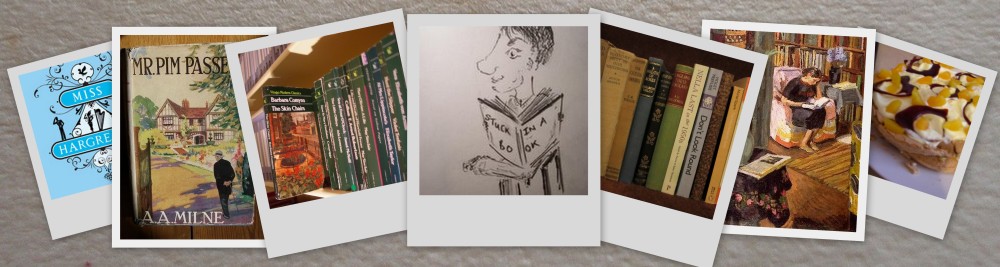
It will probably surprise none of you to discover that I do have mutliple copies of some of my books. And not a small number. They fall into three rather specific categories, which are helpfully illustrated by photographs. The first is connected to Persephone Books; as you may remember, I’ve been a fan of their lovely books for a few years – and, as a complementary collection, I often buy earlier editions of their reprints. Only if they’re cheap, mind. I may be book-mad, but I set myself some (very flexible) limits.


Category number two happens to be AA Milne – one of my favourite authors, especially when I was starting to buy books at an Olympic rate. Somehow I’ve managed to accumulate quite a few duplicates here, usually because I like the covers, or the newer one is cheap, or I want to keep an uncut version of Michael and Mary, or Snow Books print a lovely new edition of one, or… you see, always a reason.


And the final category just happens to be… er… miscellaneous. Books I love.


Miss Hargreaves couldn’t just possess one corner of my bookshelf, could she? And I bought a second copy of The Waves because my first fell apart, but I couldn’t bring myself to throw away the first. Hostages to Fortune just kinda happened, and I ‘needed’ a second copy of Portraits because I’d scribbled notes in the other. The Mapp & Lucia series – well, I’d coveted the Folio editions for a while, but decided I couldn’t afford them and collected the Black Swan paperbacks, but later found the Folio ones for, erm, not a huge amount of money…

My plea is guilty. Any one else want their crimes to be taken into consideration?

Foxy Lady


Today I’m going to multi-task, and address a new entry on ’50 Books You Must Read But May Not Have Heard About’, while chatting about one of the books I read on holiday. Smooth, no?

UPDATE: a longer and better review has been done by Simon S here!

The first, to become no.13 on the list of books you should read, is Lady Into Fox by David Garnett, published in 1922. Don’t really know how renowned this novel is already, but I didn’t know anything about Garnett when my piano teacher mentioned Lady Into Fox. This is the lady who recommended Miss Hargreaves, so I was confident that the novel would find favour. The fact that Garnett was Virginia Woolf’s nephew-in-law could only be a bonus.

Lady Into Fox – can you guess the plot? Sylvia (clever name) suddenly turns into a fox – the novel follows Mr Tebrick, her husband, as he witnesses Sylvia increasingly lose her human nature, and degenerate into vixenhood. What could be quite an absurd narrative is dealt with cleverly, and the fantasy never takes over. Instead, Garnett delivers a gentle tale with strong and genuine emotions, which becomes an admirable story of pathos.

Sylva (which presumely sounds like the precious metal, and makes referring to the novel audibly rather tricky) was written in 1962 as a response to Lady Into Fox, though I didn’t know that when I bought the book. Interestingly, I bought it because I’d just read Garnett’s novel. Gosh. Anyway, this novel is actually a French one, by ‘Vercors’ (Jean Bruller), though of course I have a translation. It acts as ‘Fox Into Lady’, if you will, reversing the central conceit of Garnett’s work, and making it all a little grittier. Drug abuse is thrown in along the way, but Vercors’ novel is mostly interesting as a study of development and psychology – Sylva’s progress is intended to resemble that of mankind, but the centuries are condensed into weeks. A few too many ponderous expostulations, but enough charisma in the characterisation to make up for it. Both fun novels, but with thoughtful backgrounds and premises, and it’s always interesting to read books in a pair like this. Who’d have thought foxes could be so entertaining?

Pottering About


I must start by saying that there will be spoilers in this post, so anybody who hasn’t yet read that Harry and Hermione were really the same person all along…. heehee… ok, that one’s a lie, but don’t read on if you want to keep everything else secret.

I had intended to talk about some of my other holiday reads, but they will have to wait as Mr. Potter et al get their appraisal first. I suppose the best way for me to sum up my response to Harry Potter and the Deathly Hallows is that it is my least favourite book in the series, and that I loved it. Yes, nothing to approach Harry Potter and the Prisoner of Azkaban as my favourite (and also the first one I read), but still a compulsive dash through the hundreds of pages. It felt very strange to come to the end of a eight year journey, knowing that I’d never read new accounts of Harry again – unless, of course, I learn Chinese and read ‘Harry Potter and the Large Funnel’, which I believe is in the offing.

Any more specific response? Well, I felt the absence of Hogwarts keenly. In amongst the admirable good/evil battle, and Harry busy discovering himself and his past, I’d always loved the school atmosphere, and the lessons and teachers we were treated to. Couldn’t you just imagine Maggie Smith reading the latest book, and thinking “Shan’t bank on that film to cover the weekly shop”? The omission of Quidditch I could cope with happily, but McGonagall, Trelawney, Sprout and Flitwick were sadly underused. In their place came endless wandering through fields to rival the first Lord of the Rings film. In fact, the whole Deathly Hallows plot felt rather unnecessary – but perhaps that was only because, like most people, my mind was wholly fixated on “who dies?!” and I didn’t allow enough of my attention to be caught by the matters of the book itself, rather than the series.

Oh, the deaths. Rowling cleverly killed off characters of increasing importance, through the last few books. I mean, who cared at all when Cedric died? But Sirius… and then Dumbledore. Must confess, I kept expecting him to come back to life… more on that later. We were similarly eased in with HP7 – Hedwig was sad, as was Mad-Eye, but nothing to whip out the Kleenex for. Dobby, on the other hand… and by the time we got to Fred, I was positively inconsolable. Mostly because the twin thing is a little too close to home.

Onto Albus. What WAS that half-dead/half-alive thing? “Of course it is happening inside your head, Harry, but why on earth should that mean that it is not real?” was rather a clever line, but didn’t make the whole scene less confusing. Any thoughts?

All in all, a satisfying end to a brilliant series – my thoughts about the books as a whole, and Rowling’s ability, were mentioned a while ago – and Harry Potter and the Deathly Hallows shouldn’t just be remembered for the deaths it contains.

Being away from the blogging world for the Launch Day, I’ve no idea about the general consensus…???

The Prodigal Returns

I’m back, I’m back!

Oh dear, it has been a long time since I was here, hasn’t it? I’ve been on holiday for a couple of weeks, attending weddings and a Christian camp, and doing some Youth Hostelling with the Carbon Copy up in the Lake District. But now I’ve returned, and I’m looking forward to getting into the blogosphere again… I do hope you’re all still here, and willing to join in a bit of bookish chat.


Let’s kick off with a few pictures of where I’ve been. The Lake District is possibly the most beautiful part of England, and certainly the most beautifully dramatic. The above picture is the view from the first Youth Hostel we stayed at, Windermere YH. The dining room/conservatory looked out over this view – this is why I love youth hostelling; even if the beds aren’t comfortable and the facilities are basic, you get to stay in some wonderful houses and stunning locations.

In amongst our wanderings, I went to Blackwell. An Arts & Crafts house designed by Baillie Scott between 1898-1900 (according to the website), it’s also an amazing place to be. Go and try the virtual tour on the website, though it’s no substitute for visiting the actual place. Coming from the dark, wood-panelled hall into the white drawing-room, radiant with light and overlooking Lake Windermere… well, make sure you visit if you’re ever in the area.

Before I transmute into the Cumbrian Tourist Board, I’ll stop my ramblings. It should surprise nobody that I managed to read a few books in my time away. To whet your appetite, here’s a rather blurry pile of perused tomes. More anon. It is nice to be back…

Animal Magic


Sorry my posts have been a little sporadic of late – I’m afraid that’s going to continue for a while, as I’m off on several exciting little trips – to Momentum (a Christian student camp thing), a couple of friends’ weddings, and Youth Hostelling with the Carbon Copy. Will try and get a few quick ‘hello’s in when I’m near a computer, but otherwise… To placate you, Patch has made a return, in cartoon form.

Anyway, plenty of books to chat about before I head away. And when writing about Three Men In A Boat, I got thinking about animals in literature – Montmorency the dog being rather a wonderfully comic creation… Animals must be quite a tricky thing to pull off successfully in a novel, especially if they’re made to speak – even the idea of introducing animals to a book brings out all sorts of unpleasant connotations of whimsy and saccharine kittens (actually, I can never dislike kittens in any context; throw more of ’em into novels, I say). When done well, though, novelistic pets can be witty, illuminating about the other characters, and a very valid contribution to literature. My favourite has to be the cat in Ivy Compton-Burnett’s Mother and Son – sardonic, selfish and unfeeling, he is the most sympathetic character in the novel. Any other animal favourites?

…and so, of course, I went to scout out some other books on my shelves. To be honest, the chosen tomes merely have animals in their titles, but that’s a valid alternative…
1. Tortoise by Candlelight – Nina Bawden
2. The House of the Deer – DE Stevenson
3. Lady Into Fox – David Garnett
4. The Curious Incident of the Dog in the Night-Time – Mark Haddon
5. Toad of Toad Hall – AA Milne
6. Mr. Fox – Barbara Comyns
7. Flaubert’s Parrot – Julian Barnes
8. Love Among The Chickens – PG Wodehouse (my personal favourite title!)
9. Performing Flea – PG Wodehouse
10. Lobster Salad – Lynne Doyle
11. The Go-Away Bird – Muriel Spark
12. Animal Farm – George Orwell

So… which is your favourite animal in literature? And any other titles to contribute?

Three Men In A Boat… is that all?


Today I finished Three Men In A Boat. I suspect that isn’t how this day will go down in family history, since it was also the Carbon Copy’s graduation – one of those events which is extremely exciting for about four seconds, and quite irrelevant for the remaining hundreds of hours. Even so, it wasn’t too bad, and I made a respectable “wooo!” when Col tramped across the stage, which he claims not to have heard.

The other thing of note is that I have joined the list of links on Susan Hill’s blog – thank you Susan! If you’ve found Stuck-in-a-Book that way, then welcome, welcome, welcome. Even if Susan doesn’t like Jane Austen…(!) Personality Test Results In Soon For Everyone. Maybe.

Back to Jerome K. Jerome. What a wonderful book! Three Men In A Boat is far too well known to get onto my list of fifty, but I’m still going to shout about how funny and well written it is. When I lent someone a book of AA Milne’s sketches from Punch, they responded by saying Jerome’s book was similar, and they are right. Though a 1889 book (according to my Preface) it feels much more 1910/20s than Victorian – lots of litotes and hyperbole in turns, absolutely everything is anthropomorphised (very amusingly) and basically the book is style, not plot. In fact, the ‘plot’ is that three men, er, go boating. Not forgetting Montmorency the dog. From this, the narrator ‘J.’ produces more a series of anecdotes than a narrative, though there is a central thread of the current outing, running, if you will, like a river through… no, sorry, too much. If you’re looking to read a multi-layered Victorian novel, look elsewhere – but for an uncomplicated laugh, you can’t go far wrong. And the postcard-bookmark I used was Ernest Proctor’s Porthgwarra (c.1926) which I bought in a gallery in Cornwall.

Have they ever made a film of Three Men In A Boat? Somehow, I can’t see the complete absence of plot working very well on the big screen…

Housing Development


Hurray! I have somewhere to live next year. Regent Street is my new address, though it is a humble row of Victorian houses in Oxford, rather than a premier London road on the Monopoly board. So far, we only have three of the required four housemates, but I’m sure we’ll find the fourth – and from 1st September this year, my blogging will come from this building here. Though hopefully not from either of these rooms, as I’ve requested a room which doesn’t face the road…

50 Books…


I’ve posted pictures of this book a couple of times, exemplifying either its attractiveness, or the fact that it contains short stories, but I’ve never really commented on its contents properly. And Kate Chopin’s Portraits was always going to be an inclusion on my 50 Books You Must Read… and here it is, as we reach (just about) a quarter way through the list.

I came across Chopin in 2004, when dovegreybooks started up their Postal Book Group. The idea was – indeed, still is, as it is still going strong – that you select a book, and a nice notebook, and send them on to a given address. Repeat every two months, and eventually your book comes back to you with a notebook of comments, and you’ll have read lots of other, interesting books, across which one might not have come, were it not for the group. Great fun. I sent off AA Milne’s The Holiday Round, whilst dovegreyreader – or just plain Lynne as we knew her then (I mean we knew her as Lynne, not as plain Lynne) – sent Kate Chopin’s The Awakening. I read it in a caravan in Devon, one of the last books I read before heading off to university. And I loved it. I wanted more.

That brings me onto Portraits. You know by now that they’re short stories – but when Chopin does short, she really does short. Some are less than two pages in length, and these, to my mind, are the most successful. They either hinge around a specific denouement or surprise – like ‘Desiree’s Baby’, give or take an accent or two – or are miniature portraits (!) of characters. My favourite of these is ‘Boulot and Boulotte’, a tiny story about twelve-year-old twins, deemed old enough to buy shoes; they go and select them at the market, but are incredulous when asked why they return barefoot: “You ‘spec’ Boulot an’ me we got money fur was’e – us?” she retorted with withering condescension. “You think we go buy shoes fur ruin it in de dus’? Comment!”

As you can see, Chopin often adopts typographical means to portray black or Creole vernacular – I find this quite wearying, quite apart from being a potential p.c. minefield. But the quality of Chopin’s writing more than rises above these issues (Chopin does, I must add, show a great deal more respect to other races than many of her other late-Victorian contemporaries… can one be late-Victorian and not British? Well, you know what I mean.) She uses language in a sparing but powerful way, and is great to flick through and pick stories arbitrarily. That’s how I read it, anyway. And, if nothing else, the cover is great…(!)

Book Through Thurs… er, Friday

Sorry, I always seem to forget it’s Thursday when it’s Thursday… at the moment, am fiddling around with trying to get a house next year (need another housemate, but want to get the house before someone else does… bah)… anyway, this will be a little fill-in, as it is surely Thursday SOMEWHERE in the world… are Australia behind us or ahead of us? Not sure. It’s either just-Thursday or almost-Saturday there, anyway.

This week’s Booking Through Thursday is:
1. In your opinion, what is the best translation of a book to a movie?
2. The worst?
3. Had you read the book before seeing the movie, and did that make a difference? (Personally, all other things being equal, I usually prefer whichever I was introduced to first.)

1. Remember this post? This is quite an easy one, because my favourite film is The Hours. In terms of translating the book to the screen, I think it’s fairly accurate, and certainly faithful to the feel of the novel. Michael Cunningham was certainly happy enough to do a commentary on the DVD.

2. Without question, Winnie-the-Pooh. It was a film, wasn’t it, not a TV series? Either way, it was a travesty. Amusing, yes – but why-oh-why did they feel the need to jettison EH Shepard’s amazing illustrations? Why was Christopher Robin American? Why was Rabbit on drugs? Why Gopher at all? Nothing makes me seethe quite as much as the Disneyfied Winnie. Oh, and Mary Poppins, whilst a great film, bears very little resemblance to P. L. Travers’ books.

3. I always try to, and feel quite cross when people don’t, but must admit to seeing Memoirs of a Geisha and The Shipping News without ever having read them, and only read Notes on a Scandal this week, despite seeing the film when it first came out. Bad Simon.

Universally Acknowledged


Thought I’d answer a question from the comments, with this post. Linda asked what edition these Jane Austen novels were – and that’s a good excuse to show you them all! They’re Book-of-the-Month Club editions, from 1996, published in the UK by Softback Preview. And they’re gorgeous! They were bought for me by Our Vicar’s Wife and Barbara-from-Ludlow when we went on a book-buying trip to Blaenavon, the Welsh equivalent of Hay-on-Wye. I don’t know how the town is faring now – certainly business hasn’t been booming on the two occasions I’ve visited. A shame.

I expect most of this blog’s readership has read all six Austen novels, and there probably isn’t anyone here who’s not read at least one… so the question is, which is your favourite? I think you can tell a lot about a person by which Austen novel is their favourite… own up!