Surely it’s a Sport?


It’s all been a bit literary round these parts of late, and I’ve even been lured into the twenty-first century, so it’s time to mention something a bit more quotidian and old-fashioned.


I do like Scrabble. When board games are concerned, it’s always the simplest which are the best – when you don’t have to be rifling through the rulebook every few minutes, or remembering that you can’t take contraband substances onto blue squares when travelling back to the moon (points for anyone outside The Clan who recognises that game?) We had a game called Investor once, and each go took about ten minutes of mathematical calculations. Our family isn’t adverse to maths (two of ’em have degrees in it) but…


Sometimes we play Scrabble because it’s the only board game Our Vicar isn’t guaranteed to win. In the dozens of times we’ve played Trivial Pursuit, for instance, I can remember him only twice not winning. Sometimes Our Vicar’s Wife, The Carbon Copy and I team up against him; we still lose.


When playing Scrabble, I tend to go for words which are nice, or form pleasant cubes of words on the board. I become increasingly irascible as the Carbon Copy places ‘words’ like ‘yep’, ‘hi’, ‘oh’, ‘qi’, ‘mo’… he’ll probably try to defend his actions in the comments, but I maintain that Scrabble should be played for the beauty of the language, not to use lots of two-letter-words which would be employed in no other context. The difference between an English student and a Mathematician, I suppose…


Any more aficionados out there?

Beg Pardon?


Thanks Lynne for bringing The Loudest Sound And Nothing to my attention, and thanks Faber (or should that be Faber and Faber?) for sending me a copy to review, on my request.

You may well know about my recent penchant for short stories – and I couldn’t resist reading a collection with such a great cover. Very simple-but-effective, which is the perfect recipe for a short story.

Very difficult to know what to say about Clare Wigfall’s collection of stories. What The Loudest Sound And Nothing has made me realise is that, though many collections of short stories contain a lot of variety, they always have some identifiable style or wording or topic which is unmistakably consistent. Not so Ms. Wigfall. She covers so many periods, personas, styles, situations, nationalities and (though I haven’t counted) no great imbalane in gender of narrator too. If they do share a common trait, it is the focus upon the unspoken. That’s rather a truism of all literature post-1950, but rarely have I read it done without being irritating or merely included for effect. Wigfall’s stories allow glimpses into lives, and wherever the image hinges on an untold aspect of these lives, it is the surrounding existence which grabs out attention. Sure, we don’t know, say, what it is the barman tells the girl in ‘Free’; we don’t know what Mr. Turbridge’s crime is in ‘Night after Night’ (though one can perhaps guess); we don’t know what’s going on in ‘Safe’, the most enigmatic story of them all. But in each of these cases, and throughout the collection, the portraits are complete enough to leave you satisfied. Not every story has an omission to illuminate the rest – in ‘On Pale Green Walls’, for example, understanding what’s happening, when the narrator doesn’t, is the crux.

Whichever way the story is structured, they all involve the reader in a way which I hope Wigfall can bottle and sell to potential writers. Because they’re such a varied bunch, each must stand on its own merits – and I found that all but one of them did. Within sentences, Wigfall creates a miniature landscape of narrative, and even stories which last a few pages feel like complete entities. This is how the modern short story should be written.

Reading Groups


I re-read Jenny Hartley’s Reading Groups today, which looks very like the picture here, except I couldn’t find an illustration without Amazon’s chirpy ‘Search Inside!’ addition. Since the sentiment is admirable, I’ll let it stand.

Apparently there is an updated version available, but my 2001 edition is fascinating nonetheless. Hartley (et al, I daresay) sent out questionnaires to reading groups, and this guide is based on the 350 responses they received. If you’re like me, this information is enough to make you immediately order a copy of the book – I love book club, I do. Of course the internet equivalents are wonderful, and I think the blogging community can be pushed into this category, but this is nothing to beat a face-to-face reading group. I haven’t attended one for a couple of years, since university and moving house separated me from the one I spent a year at in Eckington. The other day, though, I discovered an Oxford book group in its initial stages, sent off an email, and shall be joining them from September – I daresay you’ll be hearing about that in due course.

Where was I? Hartley’s book, oh yes. As well as basic information about the number, location and gender of book clubs (statistically, apparently, the most common one is a rural, all-female group of 6-10) Reading Groups frequently cites questionnaires on all reading-group-related-topics. We hear why Beryl Bainbridge doesn’t find much favour, about Bristol’s four continuing book groups which were around in the early nineteenth-century, and the various reasons why men are considered miscreants in the world of collective reading. Hearing about the rituals and practices of all-male book clubs (one group sits in order of seniority, clockwise, and must consume no more and no less than two pints of ale per meeting) I’m not surprised that my gender is looked upon with some suspicion. Shame.

I could cite all the examples, but you should instead pop along to Amazon and pay the £0.01 + p&p required to own one yourself. Well, since you asked, here is another titbit: “One woman rarely reads the assignment but gives great excuses: for Camus’s The Plague she read one page only and said she does not like books about rats.”

Anyone reading this is self-evidently a peruser of blogs, and most of you will write your own – but what about your ‘terrestrial’ reading groups? Are you in one, two, twenty? And how do they compare to the blogosphere?

Honour and Obey


Wonders will never cease; I am Booking Through Thursday on a THURSDAY. True, there are only 35 minutes left on Thursday, this side of the Pond anyway, but the principle stands. A round of applause, if you will.

One book at a time? Or more than one? If more, are they different types/genres? Or similar? (We’re talking recreational reading, here—books for work or school don’t really count since they’re not optional.)
A fine question. One of the things I like best about finishing my degree (and it is certainly a mixed blessing) is that I can read more than book at once, purely because I don’t have deadlines for reading, and it doesn’t matter whether it takes me a day or a month to read a book. I like to have a few reads at the same time, but generally not more than one novel. So perhaps a novel, a factual book, a selection of letters, the diaries collection I have The Assassin’s Cloak… but if I were reading two novels at the same time, it would be too confusing.

How about you? Less easily confused than me?

Young Love


You’ll forgive me if I start this post with a little bit of trepidation. I’ve never written a review of a book before with the knowledge that the author would peruse my musings. Takes me back to the first review I had printed in the Oxford Student newspaper, of Ian McEwan’s Saturday. As he was busy filling his pockets with money, it probably troubled him little that I found the novel ill-conceived, cliché-ridden and rather dull. Luckily for Angela Young – the first ‘Y’ in my Book Journal, for those keeping tabs – I didn’t find her debut novel Speaking of Love to be guilty of any of these crimes.

In fact, and Stuck-in-a-Book knows no higher accolade, it’s going straight into ’50 Books You Must Read But Might Not Have Heard About’. Not something I do lightly, you understand. As Mr. Bennet might say, read on.

Angela Young’s novel has similarities with a couple of other modern novels I’ve mentioned on here – Maggie O’Farrell’s The Vanishing Act of Esme Lennox, and Margaret Pelling’s Work For Four Hands. The main similarity is that one reads investigatively; there is a central mystery to be unfurled, which will help explain why the characters act as they do, respond (or, rather, don’t) to each other in the ways they do. Even without all the other reasons to read on, the need to discover how all the pieces fit together is enough to keep anybody hooked.

Speaking of Love is divided into three narrative strands, Iris’s Story; Vivie’s Story; Matthew’s Story. At first I thought this was overkill, and did get a little confused – surely we don’t need all three voices? How wrong I was. They are distinct personas, and Young cleverly presents Vivie in the third person, alongside Iris and Matthew in the first person, so little overlap occurs. No character has more than a few pages at any one time, and they always took up the narrative again at exactly the moment I was thinking “Hmm, we haven’t heard from Iris/Vivie/Matthew in a while, I hope they’re next”.

Iris is, appropriately enough, a storyteller – though one who has suffered destructive illness – and is heading towards a storytellers’ festival. Vivie, her daughter, hasn’t seen her for years, and is suffering her own personal crises. Matthew, Vivie’s childhood friend, is also off to the festival, with his father, to hear Iris. As these characters and their relationships are explored, so too are their shared and separate pasts – pieces of the puzzle are continually proferred, though never in such a way as they feel incongruous in the narrative. Nothing in Young’s novel is forced, and, given the often stark or emotional subject matter, she does amazingly well to avoid being either saccharine or maudlin. The tagline, as it were, is “Speaking of Love is a novel about what happens when people who love each other don’t say so.” While true, I hope that doesn’t undermine the depth of this novel, the beautiful character portraits and the true humanity which Young has depicted.

Thought I’d give you a little quotation. This makes the novel seem perhaps rather more enigmatic than it is, but it’s also a great, tantalising taster of Speaking of Love, which demonstrates the importance of its key themes; storytelling, relationships, the impact of the past.

‘If life was a story, Vivie,” said her mother, “I could retell it. But it isn’t and I can’t. I just wish that what happened to me never happened in front of you. I wish that you hadn’t had to do what you did and I wish that you hadn’t been so very frightened by it all. That’s what I wish.’

I don’t want to give too much away, but do go and look at the Amazon page for more information, or Angela’s blog, or the book’s website. Above all, read Speaking of Love.

Signed, Sealed, Delivered…


What do these books have in common?

Give up?

Well, they have all been signed by their authors. A book presents such a complex relationship between the author and reader, which has been documented and investigated and debated by hosts of literary critics over the decades and centuries. This is all made more complicated and fun when the author’s own handwriting appears on the title page – how strange to think that the author has held the book before me! Well, not so strange for A Very Great Profession by Nicola Beauman, and the biography of Judi Dench, for I was present on both those occasions, but for the other three…

When We Were Very Young, I must admit, was not written by Christopher Milne – one of these days I hope to have an AA Milne signature, but alas, not yet – but he has a very close association with the lead character. This copy was sold to me by a man named Peter Guppy, who lived in my old village and did a small business in books, but since he sold it to me for £2, it was really more of a gift. Dorothy Whipple’s The Priory was bought at the Bookbarn in Somerset (or Heaven on Earth, as it may be re-labelled), but it was not until I got home that I realised it was signed. Very exciting! EM Delafield’s novel set me back the most, but as one of my favourite authors, I found the offer irresistible.

How about you? Any signed copies? It’s easy enough to find signed modern novels and biographies, Waterstones seems to stock little else, but what about older authors and treasured novels?

A-Z


I finished reading another Persephone Books publication this week – Doreen by Barbara Noble – which Carole very kindly sent me, as a sort of reciprocal gift in BAFAB. Thanks so much Carole! Really good novel, as all of PB’s books are, but I shan’t say much about it now, as dovegreybooks@yahoogroups.co.uk are soon to embark on a group discussion about it, and I don’t want to forestall myself. So I haven’t started talking about Barbara Noble’s book to give a review, this time – Doreen makes an appearance for a subtler reason.

For my birthday last November, a friend of the family (who happens to be a vicar’s wife and mother of twins, but is not Our Vicar’s Wife) gave me a notebook entitled ‘Books I’ve Read, Books I Want To Read’. Well, this was rather a perfect little gift, I’m sure you’ll agree. There are pages for every letter of the alphabet, which invite you to write the author, title, date completed, and compose a comment. I’m afraid I jettisoned the comment section straight away – I need all the space I can get to include all the books I’ve read, and, since I’ve kept a record since 2001, there were plenty to include. What I didn’t realise is that, from 2001 until last week, I had read nothing by an author whose surname begins with N. I, Q, U, X, Y, and Z are similarly empty, but N is now no longer virgin territory – step forward Barbara Noble. I know for a fact that I’ve read E Nesbit, if no other N-ers, but Noble is the first to be entered into the book.

And so I’m going to follow the advice of a particularly unpleasant article I read about ‘How To Make Money From Your Blog’, and present a list. Feel free to send wads of cash in the post afterwards, if it takes your fancy. It interested me, and it might interest you, to see the oldest and most recent entry for each letter of the alphabet. The first book listed is the oldest one under each letter; the second is the most recent, and probably has been mentioned on the blog at some point. If that sounds deadly dull to you, then here’s a question to answer instead – do you keep a list of the books you read? If so, where? And in chronological order, or by author?

Jane AUSTEN – Pride and Prejudice
Jane AUSTEN – Lady Susan

Lynne Reid BANKS – The L-Shaped Room
A.S. BYATT – The Matisse Stories

Lewis CARROLL – Alice’s Adventures in Wonderland
Jackie CLUNE – Extreme Motherhood: The Triplet Diaries

E.M. DELAFIELD – The Provincial Lady Goes Further
Monica DICKENS – One Pair of Feet

Mary ESSEX – Tea Is So Intoxicating
George EGERTON – Keynotes

Helen FIELDING – Bridge Jones: Edge of Reason
E.M. FORSTER – A Room With A View

Gillian GILL – Agatha Christie: the Woman & Her Mysteries
Joyce GRENFELL & Katharine MOORE – An Invisible Friendship

Anne HART – Agatha Christie’s Hercule Poirot
Zoe HELLER – Notes on a Scandal

Tove JANSSON – The Summer Book
Jerome K. JEROME – Three Men In A Boat

Felicity KENDAL – White Cargo
Barbara KINGSOLVER – The Bean Trees

E.V. LUCAS – Mixed Vintage
John LYLY – The Woman in the Moone (sic…)

Christopher MILNE – The Path Through The Trees
Elizabeth MYERS – A Well Full of Leaves

Michael ONDAATJE – Anil’s Ghost
Maggie O’FARRELL – The Vanishing Act of Esme Lennox

David PELZER – A Child Called ‘It’
Margaret PELLING – Work For Four Hands

J.K. ROWLING – Harry Potter and the Chamber of Secrets
J.K. ROWLING – Harry Potter and the Deathly Hallows

Elizabeth D. SHAFER – Exploring Harry Potter
Jan STRUTHER – Mrs. Miniver

Ann THWAITE – A.A. Milne: His Life
Claire TOMALIN – Katherine Mansfield : A Secret Life

VOLTAIRE – Candide
VERCORS – Sylva

P.G. WODEHOUSE – Quick Service
Leonard WOOLF – Hunting The Highbrow

Booking Through… some day or other…

I do wonder if I’ll ever manage to do Booking Through Thursday on an actual Thursday… signs aren’t good. But they say that any day can be Thursday, so far as Booking is concerned, and I couldn’t resist this week’s set topic. Here it is:

Do you have multiple copies of any of your books?
If so, why? Absent-mindedness? You love them that much? First Editions for the shelf, but paperbacks to read?
If not, why not? Not enough space? Not enough money? Too sensible to do something so foolish?

Being a twin, duplicates are a necessary feature of my everyday life. And there, dear reader, I may have found the world’s worst excuse for buying too many books. What did I just say?! Too many books! Must wash my mouth out with soap.

It will probably surprise none of you to discover that I do have mutliple copies of some of my books. And not a small number. They fall into three rather specific categories, which are helpfully illustrated by photographs. The first is connected to Persephone Books; as you may remember, I’ve been a fan of their lovely books for a few years – and, as a complementary collection, I often buy earlier editions of their reprints. Only if they’re cheap, mind. I may be book-mad, but I set myself some (very flexible) limits.


Category number two happens to be AA Milne – one of my favourite authors, especially when I was starting to buy books at an Olympic rate. Somehow I’ve managed to accumulate quite a few duplicates here, usually because I like the covers, or the newer one is cheap, or I want to keep an uncut version of Michael and Mary, or Snow Books print a lovely new edition of one, or… you see, always a reason.


And the final category just happens to be… er… miscellaneous. Books I love.


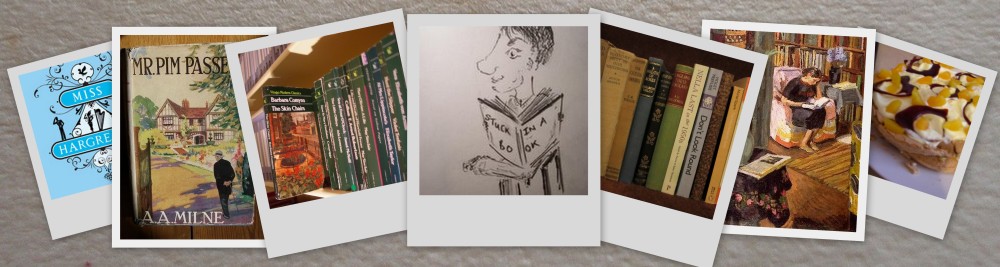
Miss Hargreaves couldn’t just possess one corner of my bookshelf, could she? And I bought a second copy of The Waves because my first fell apart, but I couldn’t bring myself to throw away the first. Hostages to Fortune just kinda happened, and I ‘needed’ a second copy of Portraits because I’d scribbled notes in the other. The Mapp & Lucia series – well, I’d coveted the Folio editions for a while, but decided I couldn’t afford them and collected the Black Swan paperbacks, but later found the Folio ones for, erm, not a huge amount of money…

My plea is guilty. Any one else want their crimes to be taken into consideration?

Foxy Lady


Today I’m going to multi-task, and address a new entry on ’50 Books You Must Read But May Not Have Heard About’, while chatting about one of the books I read on holiday. Smooth, no?

UPDATE: a longer and better review has been done by Simon S here!

The first, to become no.13 on the list of books you should read, is Lady Into Fox by David Garnett, published in 1922. Don’t really know how renowned this novel is already, but I didn’t know anything about Garnett when my piano teacher mentioned Lady Into Fox. This is the lady who recommended Miss Hargreaves, so I was confident that the novel would find favour. The fact that Garnett was Virginia Woolf’s nephew-in-law could only be a bonus.

Lady Into Fox – can you guess the plot? Sylvia (clever name) suddenly turns into a fox – the novel follows Mr Tebrick, her husband, as he witnesses Sylvia increasingly lose her human nature, and degenerate into vixenhood. What could be quite an absurd narrative is dealt with cleverly, and the fantasy never takes over. Instead, Garnett delivers a gentle tale with strong and genuine emotions, which becomes an admirable story of pathos.

Sylva (which presumely sounds like the precious metal, and makes referring to the novel audibly rather tricky) was written in 1962 as a response to Lady Into Fox, though I didn’t know that when I bought the book. Interestingly, I bought it because I’d just read Garnett’s novel. Gosh. Anyway, this novel is actually a French one, by ‘Vercors’ (Jean Bruller), though of course I have a translation. It acts as ‘Fox Into Lady’, if you will, reversing the central conceit of Garnett’s work, and making it all a little grittier. Drug abuse is thrown in along the way, but Vercors’ novel is mostly interesting as a study of development and psychology – Sylva’s progress is intended to resemble that of mankind, but the centuries are condensed into weeks. A few too many ponderous expostulations, but enough charisma in the characterisation to make up for it. Both fun novels, but with thoughtful backgrounds and premises, and it’s always interesting to read books in a pair like this. Who’d have thought foxes could be so entertaining?