Hesperus Week : Hesperus Competition

FREE BOOK ALERT!

That ought to grab your attention, if you’re anything like me. I’m delighted to tell you that, as part of Hesperus Week, the lovely people at Hesperus are offering one of you lot any one of their backlist, gratis. Hurray!

You probably know the drill – just put your name in the comments, or email me at simondavidthomas@yahoo.co.uk if the comments box is playing up, and I’ll put your name in.

The list of books Hesperus print can be found at their website, just click on the ‘titles’ or ‘authors’ or ‘subjects’ in the left-hand column, and have a look through. You can even search by the Foreword Writers – and they have snared some wonderful writers for these. Doris Lessing, Margaret Drabble, A.S. Byatt, Germaine Greer, Victoria Glendinning, Umberto Eco, Hermione Lee, Simon Schama, Fay Weldon, Zadie Smith, Will Self… I absolutely defy anyone to leave their catalogue without wanting something. Personally, I want more or less the lot…

It might be nice if, with your name in the comments, you suggested the book you’ve got your eye on – though this is, of course, completely optional. A word of warning, though – some of the books listed aren’t yet published, or aren’t on the backlist. Have a look at the publication date – anything 2007 or earlier and we’re cooking with gas, as they say.

Don’t worry if this is your first time to Stuck-in-a-Book, or you’ve never commented before – the more the merrier.

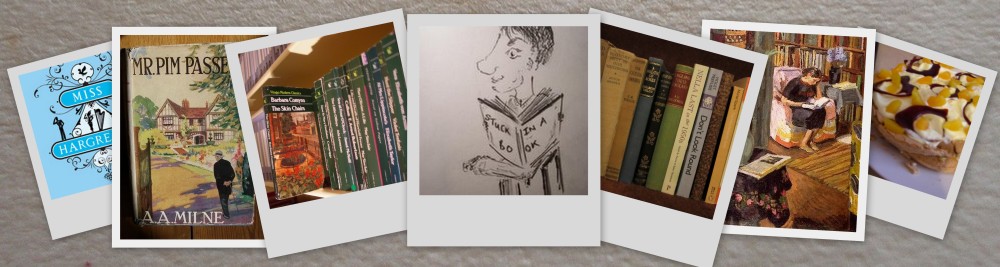
I’ve littered this post with a few pictoral suggestions… but don’t let me influence you… have a look for yourself! And don’t forget to put your name in the comments. Good luck! I’ll leave it open until Saturday.

Simonetta


No, today’s title doesn’t suggest a foray into the world of female impersonation (for the record, Simone is my preferred equivalent) but rather the beginning of what I will whimsically call Hesperus Week!

Hesperus have been mentioned a few times on here before, but it’s worth doing again. A while ago they sent me four books, and I gobbled up Jerome K. Jerome’s The Idle Thoughts of an Idle Fellow very speedily, loving every word. It’s taken me a while to read the other three, since I decided I’d finish them all before I wrote about them individually. Before I get onto the first of those, I’ll remind you a little bit about Hesperus Press. They specialise in reprinting the neglected works of famous authors, and also translations of modern foreign novels. It is the former in which I am especially interested, with authors including Austen, Woolf, Bronte, Alcott, Pope, Balzac, Dickens, Defoe… etc. etc.

On the train to London I read L. P. Hartley’s Simonetta Perkins. My first experience with LPH was The Go-Between, which I read last year and was a very close contender for my favourite ten books of 2007. Simonetta Perkins was also an absolute delight, told with panache and a wry wit. The novella opens with Lavinia Johnstone perusing a book in Venice, a book which makes bold statements such as “Love is the greatest of the passions; the first and the last”. She cannot agree, having turned down several suitors and felt little more than irritation towards them. It is not long, however, before the romance of Venice persuades her otherwise – but she is attracted in an inconvenient and unsuitable direction. Through this slim volume Hartley explores a hypothetical relationship of unequal power, obsession and self-exploration. Think the scenario of Lady Chatterley’s Lover in the hands of an author who is Lawrence’s opposite.

What of Simonetta, you ask? Well, she takes a while to appear in her own novella, but is quite significant and intriguing when she does.

Hartley’s work is subtle, sensitive and, above all, extremely funny. We can laugh at Lavinia because she laughs at herself, and not compromise pathos. For example, Lavinia’s proper, dignified, insensitive and gently xenophobic mother warns her against letting any situation, especially of the male variety, get the upper hand of her: ‘[Lavinia] sighed, realising from past experience how improbable it was that any situation would put itself to the trouble.’

Do go and enjoy Simonetta Perkins – there is a wonderful novella waiting for you.

Back from Londontown

I’ve just had a very enjoyable and busy weekend in London, seeing a few friends who have migrated there from university. The downside is that I’ve lost my glasses – last seen on a table in the coffee bar at Tate Modern. Perhaps they will become an exhibit. Very irritating, and blearily made my way home – and had to cancel my driving lesson. Oh dear. But, aside from this, had a wonderful time in the Big City. Too many bookshops around, which wrought temptation… So, thanks to Lorna, Ashini, Matt, Joy and Becky for providing such a fun couple of days!

Postjudiced

It seems Mrs. Darcy has been a busy woman, paying calls on more or less every blog in the neighbourhood, and Stuck-in-a-Book is no different. In fact, despite Diana Birchall (whom I know from an online literary discussion list) contacting me a while ago, her book Mrs. Darcy’s Dilemma has been hither and thither, all around Oxfordshire and most of the departments of the Bodleian. Hallowed company indeed. Finally she landed at my doorstop (or, more precisely, the janitors’ desk) and I read this lovely novel in little under a day.

I have a healthy scepticism of prequels and sequels and so forth, if not written by the original author, and no author comes more sacred than our Jane. Advocacy has bordered on obsession ever since the earliest days of general access to her writings, and though national Jane-addiction comes in peaks and troughs, it has never truly been absent. I came to Pride and Prejudice in 1995 along with so many others, through the BBC TV version, when I was nine or ten. Though I’ve only read the novel once, I have listened to an unabridged cassette and watched a fairly faithful television version probably some hundred or so times. There is not a book in the world I would less like to see sullied.

Lucky Diana Birchall feels the same, isn’t it?
What shines from every page of Mrs. Darcy’s Dilemma is a love of Jane Austen, a respect for her great craft, and a deep affection for every single one of her characters, whether likeable or not. We have moved on twenty-five years, the wedding which concluded Pride and Prejudice has become a lengthy marriage and produced three children – Fitzwilliam, Henry and Jane. When Lydia’s progeny, Bettina and Cloe, come to visit their Aunt, Uncle and Cousins, romance, scandal and a sororal reunion cannot be far behind.
Within the first few pages, I had to make a decision – as will any reader, and it is the only way to read a sequel, I think. That decision was to read Mrs. Darcy’s Dilemma as a exercise in hypothetical speculation; a diverting game of “what if?”, not “and then…” For there were a hundred times when I thought “No! She wouldn’t have ended up like that”, or “Surely they would have…” and so forth. I am certain that Diana would welcome such a response – she is not laying down Mrs. Darcy’s Dilemma as a definitive continuation of Pride and Prejudice, but rather a skilful and witty piece of fantasy. If I were writing (or, rather, plotting) a sequel, then I’d have been kinder to Lydia and Kitty, certainly given Jane a pleasing and humble daughter, and maybe even… no, you see, each reader has her/his projections, affinities and affections.

To return to the novel. It has been many months since I read something so addictively, so keen to dedicate all my spare time to reading it. Yes, it even entered read-whilst-walking-to-work territory, which only happens once or twice a year. This was helped by the fact that Diana cleverly divides the narrative focus between revisiting old characters, and exploring the antics of their children. Most of P&P’s characters appear, or are at least mentioned. We see Lizzy and Lydia making the same mistakes as their father and mother respectively, and watch the good ‘uns and bad ‘uns (as usual in Jane country, the bad ‘uns are foolish more than wicked) from the next generation make a mess of things, and, of course, sort themselves out.

Naturally, Diana Birchall isn’t as good a writer as Jane Austen – it would be an odd coincidence if she were, since nobody else has achieved that in the last two centuries – but I can think of no finer hands into which to place this playful task. Playful in theory, of course, but I daresay terribly difficult in practice. Diana gets the tone so right: witty and ironic and moving and very, very Austen. I think the greatest compliment I can pay Mrs Darcy’s Dilemma is that I was left not mourning the handling of beloved characters who appeared, but wondering what she’d have done with the ones who did not.

Booking Through Thursday : The Other Side of the Coin

Last week we discussed our favourite female characters… well, Booking Through Thursday have done the sensible thing and evened up the balance – who are your favourite male lead characters?

I found this much more difficult. Most of the novels I read, certainly most of my favourite novels, tend to be written by women and have female protagonists. The empathy lies with the woman, often in the first person, and so the male characters become obstacles or love interests or in some way affect the female. Difficult to treasure a character without empathy. Especially since a lot are in the Rochester / Mr. de Winter model (i.e. quite irritating and bafflingly attractive to women) or Heathcliff model (wholly loathsome) or Mr. Darcy model (ok… but mostly there to track the development of the heroine.)

I’m not getting very far, am I? Would Eeyore count, I wonder? I’m very fond of Norman, the narrator of Miss Hargreaves, but he pales in comparison to Miss H herself. I think I might have to plump for the anonymous narrator of Jerome K. Jerome’s Three Men in a Boat, alongside the loveable Mr. Bingley. Why do I have to look so far back to find any male characters who are kind without being pathetic, or witty without being crude? C’mon, novelists, we boys need some role models

Blinking, Bells and Butterflies

Doing well on yesterday’s challenge, people – keep up the good work!

I read another Oxford Book Group book today – in fact, had to request it to a reading room and read it all in my tea breaks. Luckily it was quite short. That’s what happens when the entire book is dictated by the winking of an eyelid.

I don’t know how familiar people are with Jean-Dominique Bauby’s The Diving-Bell and the Butterfly? A film is coming out soon, so perhaps that has helped it leap to the public eye. It is basically the selective autobiography of an editor-in-chief of Elle magazine who has a major stroke and is left with locked-in syndrome. As he points out, the first (and he suggests, only) character in literature to have this condition is Noirtier in Dumas’s The Count of Monte Cristo. He can no longer move any of his body, except his left eyelid, but retains total cognitive ability. The French term for it, “maladie de l’emmuré vivant”, literally means walled-in alive disease.

How does one make a book out of this? Well, if it weren’t true, it could only be used as a tasteless or lazy gimmick in the background of another narrative – as it is, Bauby writes an honest but witty account, heart-rending but not chest-beatingly gloom. Alongside day-to-day occurences, like the visit of his two children, Bauby intersperses nostalgic recollections, ironies, witty musings and a very human frustration and spirit. He is able to see the humour in a desperate situation – one of my favourite bits, which had to be translated for the version I read, was when he asked for his glasses, only to be stopped early and asked why he wanted the moon (lunettes; lune). And in some ways (forgive me if I stretch a point) that is what The Diving-Bell and the Butterfly performs – the mundane alongside the extraordinary; the glasses alongside the moon. Though a slim volume, Bauby has created a beautiful elegy to living and a pathos-filled account of life as an observer rather than participant. You will finish this autobiography recognising the fragility of existence, but laughing at the pomposity of any such idea in the face of Bauby’s humour and stubborn refusal to let even the most extreme situation crush him.

Easy as ABC

I was hoping to write a few more book reviews but, shamefully, I haven’t finished a book in a while. One of these days there will be an onslaught of recently-read books, but I’m afraid there is a review pile which is rapidly growing and never diminishing. Sorry! Instead, I shall offer a little mind-troubler. My Aunt Jacq. and I are regular correspondents (which reminds me, it’s my turn to write – will get to it soon, Jacq!) and used to often set little literary challenges for each other. One of the ones I liked best was an ABC sort of puzzle. The variety which doesn’t leave one’s mind all day…

It’s authors whose titles begin with the same letter as their surname… like Austen and… erm… no, let’s try Bronte and… wait a moment… Dickens and Dombey and Son, there’s one. Woolf and The Waves. You get the idea… harder than it thinks. Let’s see if we can cobble together an alphabet between us – I’ve got D and W sorted. Only ABCEFGHIJKLMNOPQRSTUVXYZ to cover…

Mostly Books Event

Oh, what a lovely evening. I’ve just come back from Abingdon, more specifically the wonderful Mostly Books, where Angela Young and Eliza Graham were speaking. What a lot of links for you to visit. These two novelists are on the shortlist for World Book Day’s Spread The Word competition, whittled down from a longlist of 100. Voting has finished and the winner will be announced soon, but (heartwarming truism alert) all the shortlist are winners, especially these lovely ladies. You’ll know by now that I love Angela Young’s Speaking of Love, and I broke my Lentern fast and brought home Eliza Graham’s Playing With The Moon to read when I can.

This evening was cosy, held on the shop floor, and with a genuine love of books oozing through the atmosphere, from the authors, the audience and perhaps especially Mark who runs Mostly Books. Hope he won’t mind that I’ve stolen a picture from his webpage… It is encouraging and smile-making to know that booklovers are still running bookshops – yes, there has to be the commercial side, but Mostly Books shows the two can run alongside one another, to mutual benefit if not millionairedom.

My journey to the event was a little haphazard. Someone has carelessly dug up half of Abingdon Road in Oxford, the one road which I was fairly confident would lead to Abingdon. I flung myself onto the nearest bus which mentioned the town on its board… and was slightly disconcerted when it headed off in completely the opposite direction. I think we must have visited every village in Oxfordshire on the way. But, at 7.30 exactly, I was able to dash up to the bookshop, grab my wine, meet Angela, and settle down for an extremely enjoyable evening.

Since the voting was done and dusted, Angela and Eliza didn’t need to convince us to vote for Spread The Word – well, they’d be preaching to the converted, anyway. Instead, they chatted about how they came to write their respective novels, the editing process, how they found their publishers (Google “small publishers” is a good step, apparently!), how they got the book known (Google “sell my novel” – seeing a pattern?) and finally the difference the shortlist has made to them. In my attempts to claim fame by association, I was tickled pink that Angela mentioned Stuck-in-a-Book and her original email, asking whether I’d consider Speaking of Love for my 50 Books You Must Read But May Not Have Heard About. She called the email cheeky – but turned out to be entirely justified, of course! And there it sits, at no.14.

I also had the chance to meet local author Mary Cavanagh, whose The Crowded Bed was reviewed on here a while back – and lovely Mary even gave me a lift home. Thank you Mary! It was a pleasure to finally meet Angela, and Eliza of course, and to see the much-anticipated Mostly Books. I do hope to be back for other events in the future – and if you possibly can get to Abingdon, I encourage you to do the same!

Been there, Scene it.

And now I am a graduate! The ceremony was a mystery, I said “Do fidem” but what I was fideming to do, I have no idea – hopefully nothing too nefarious. Magdalen kindly provided a three-course meal beforehand, and some tea and sandwiches afterwards – the seal on the day was going up Magdalen Tower in full Graduation regalia. Actually, going up (and especially coming down) aren’t fun experiences, but thankfully Our Vicar was on hand to give me help and encouragement. Neither Latin nor heights are my cup of tea. Cups of tea, on the other hand, very much are.

The point of today’s stitch-inducingly-funny pun is another ponderer. What’s your favourite scene in literature? Not book, not character, but scene. Might be quite a tricky one to think about – some books don’t lend themselves to being split into scenes. Mrs. Dalloway, with its lack of chapters, for example. Some are very obviously divided into separate scenes – Rebecca comes to mind, for some reason. Well, it might not surprise you that my favourite scene comes from Pride and Prejudice – an exchange between two wonderful female characters which remains sharp and witty on every syllable, not a word out of place, and a delight to read. The Jennifer Ehle/Barbara Leigh-Hunt portrayal of it is nothing short of rapturous. Know which one I mean yet? It’s so brilliant, it’s included at some length below…

As always, over to you. Favourite scene in literature, and why? Think on’t… and you have to listen to me now. I’m a graduate, doncha know.

(Pride and Prejudice by Jane Austen; from Chapter 56)As soon as they entered the copse, Lady Catherine began in the following manner: — “You can be at no loss, Miss Bennet, to understand the reason of my journey hither. Your own heart, your own conscience, must tell you why I come.” Elizabeth looked with unaffected astonishment. “Indeed, you are mistaken, Madam. I have not been at all able to account for the honour of seeing you here.” “Miss Bennet,” replied her ladyship, in an angry tone, “you ought to know, that I am not to be trifled with. But however insincere you may choose to be, you shall not find me so. My character has ever been celebrated for its sincerity and frankness, and in a cause of such moment as this, I shall certainly not depart from it. A report of a most alarming nature reached me two days ago. I was told that not only your sister was on the point of being most advantageously married, but that you, that Miss Elizabeth Bennet, would, in all likelihood, be soon afterwards united to my nephew, my own nephew, Mr. Darcy. Though I know it must be a scandalous falsehood, though I would not injure him so much as to suppose the truth of it possible, I instantly resolved on setting off for this place, that I might make my sentiments known to you.” “If you believed it impossible to be true,” said Elizabeth, colouring with astonishment and disdain, “I wonder you took the trouble of coming so far. What could your ladyship propose by it?” “At once to insist upon having such a report universally contradicted.” “Your coming to Longbourn, to see me and my family,” said Elizabeth coolly, “will be rather a confirmation of it; if, indeed, such a report is in existence.” “If! Do you then pretend to be ignorant of it? Has it not been industriously circulated by yourselves? Do you not know that such a report is spread abroad?” “I never heard that it was.” “And can you likewise declare, that there is no foundation for it?” “I do not pretend to possess equal frankness with your ladyship. You may ask questions which I shall not choose to answer.” “This is not to be borne. Miss Bennet, I insist on being satisfied. Has he, has my nephew, made you an offer of marriage?” “Your ladyship has declared it to be impossible.” “It ought to be so; it must be so, while he retains the use of his reason. But your arts and allurements may, in a moment of infatuation, have made him forget what he owes to himself and to all his family. You may have drawn him in.” “If I have, I shall be the last person to confess it.” “Miss Bennet, do you know who I am? I have not been accustomed to such language as this. I am almost the nearest relation he has in the world, and am entitled to know all his dearest concerns.” “But you are not entitled to know mine; nor will such behaviour as this, ever induce me to be explicit.” “Let me be rightly understood. This match, to which you have the presumption to aspire, can never take place. No, never. Mr. Darcy is engaged to my daughter. Now what have you to say?” “Only this; that if he is so, you can have no reason to suppose he will make an offer to me.” Lady Catherine hesitated for a moment, and then replied, “The engagement between them is of a peculiar kind. From their infancy, they have been intended for each other. It was the favourite wish of his mother, as well as of her’s. While in their cradles, we planned the union: and now, at the moment when the wishes of both sisters would be accomplished in their marriage, to be prevented by a young woman of inferior birth, of no importance in the world, and wholly unallied to the family! Do you pay no regard to the wishes of his friends? To his tacit engagement with Miss De Bourgh? Are you lost to every feeling of propriety and delicacy? Have you not heard me say that from his earliest hours he was destined for his cousin?” “Yes, and I had heard it before. But what is that to me? If there is no other objection to my marrying your nephew, I shall certainly not be kept from it by knowing that his mother and aunt wished him to marry Miss De Bourgh. You both did as much as you could in planning the marriage. Its completion depended on others. If Mr. Darcy is neither by honour nor inclination confined to his cousin, why is not he to make another choice? And if I am that choice, why may not I accept him?” “Because honour, decorum, prudence, nay, interest, forbid it. Yes, Miss Bennet, interest; for do not expect to be noticed by his family or friends, if you wilfully act against the inclinations of all. You will be censured, slighted, and despised, by every one connected with him. Your alliance will be a disgrace; your name will never even be mentioned by any of us.” “These are heavy misfortunes,” replied Elizabeth. “But the wife of Mr. Darcy must have such extraordinary sources of happiness necessarily attached to her situation, that she could, upon the whole, have no cause to repine.” “Obstinate, headstrong girl! I am ashamed of you! Is this your gratitude for my attentions to you last spring? Is nothing due to me on that score? Let us sit down. You are to understand, Miss Bennet, that I came here with the determined resolution of carrying my purpose; nor will I be dissuaded from it. I have not been used to submit to any person’s whims. I have not been in the habit of brooking disappointment.” “That will make your ladyship’s situation at present more pitiable; but it will have no effect on me.” “I will not be interrupted. Hear me in silence. My daughter and my nephew are formed for each other. They are descended, on the maternal side, from the same noble line; and, on the father’s, from respectable, honourable, and ancient — though untitled — families. Their fortune on both sides is splendid. They are destined for each other by the voice of every member of their respective houses; and what is to divide them? The upstart pretensions of a young woman without family, connections, or fortune. Is this to be endured! But it must not, shall not be. If you were sensible of your own good, you would not wish to quit the sphere in which you have been brought up.” “In marrying your nephew, I should not consider myself as quitting that sphere. He is a gentleman; I am a gentleman’s daughter; so far we are equal.” “True. You are a gentleman’s daughter. But who was your mother? Who are your uncles and aunts? Do not imagine me ignorant of their condition.” “Whatever my connections may be,” said Elizabeth, “if your nephew does not object to them, they can be nothing to you.” “Tell me once for all, are you engaged to him?” Though Elizabeth would not, for the mere purpose of obliging Lady Catherine, have answered this question, she could not but say, after a moment’s deliberation, “I am not.” Lady Catherine seemed pleased. “And will you promise me, never to enter into such an engagement?” “I will make no promise of the kind.”

The Graduate

Brief post today – just to say I’m graduating tomorrow!

A ceremony in the Sheldonian (pictured) where we will have someone speak at us in Latin, bestowing upon us the Power of Lecturing, amongst other things. After that I will be able to wear my mortar board (cap) as much as I like – up until this date it came with a £35 fine. But had to be carried to exams.

All rather silly, but also rather special. I’ll let you know how it went…