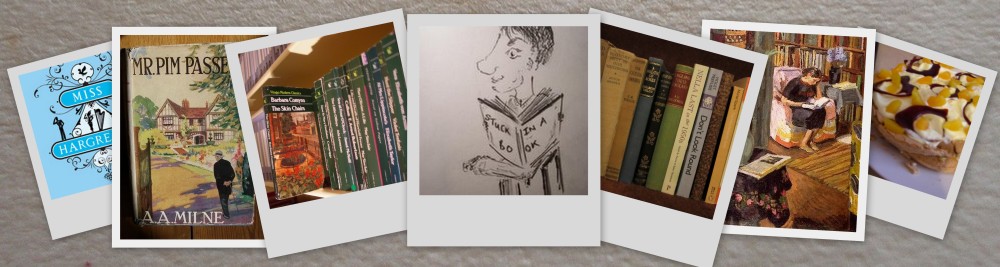
Friend or…

Wow! Unanimous for ‘music’ – I thought the results would be a little more even… and, in fact, I’m going to put in the lone vote for ‘art’. I counted doing-it-myself, and pictures on the covers of books, etc. etc. – I couldn’t cope without it, whereas music has always been an enjoyable peripheral to my life. But I feel a little culturally out of my depth now that I know what aficiandoes you all are! Art 1: Music 20.

Without any attempt at a link here, I’m going to mention a book I read the other day for my course – Foe by J. M. Coetzee. I’d always avoided him, mostly because I got him mixed up with another author, whose name I can’t now remember… somehow these prejudices stick, even when they are proved irrational, and I’d never picked up one of his books. After Foe, I think I might change my mind.

Foe is a novel related to Robinson Crusoe – which I haven’t read, so I daresay I missed hundreds of nuances, but I know *enough* not to miss them all – not really a retelling or a new perspective, but an exercise in the idea of storytelling, narration, truth… The lead character is Susan Barton, washed up on Crusoe’s island after having been victim to a ship’s mutiny. The Cruso (note the missing ‘e’) and Friday she encounters are subtly different to Defoe’s, and sometimes not so subtly different (Friday’s race is changed; Cruso seems to have no real knowledge of his background and continually gives different versions of it). But the most interesting part comes when Susan is back in England, meeting the author Foe – or (De)Foe if you will – who is turning her story into a novel. But here the tussle for control over the narrative begins – and becomes increasingly complex as Susan’s long-lost daughter arrives, though Susan is adamant that she is not her daughter – has Foe invented her? What power does he have over their lives?

As a venture into the stormy waters of postmodernism, this is happily an utterly accessible and enjoyable novel (the overlap of experimentation and readability is sometimes narrow in this field, isn’t it?) – Foe raises all sorts of fascinating questions, but also lets you nod at these with interest and still read a rather good novel. Oh, and it’s short – always a tick in the ‘pro’ column for me!

With the Woolfs

Glad you all took a trip down memory lane with me – I’m sorely tempted to buy the DVD of The Herbs… but probably shouldn’t.

That book I was going to talk about… A Boy at the Hogarth Press by Richard Kennedy, which my friend Barbara gave to me, and which (I hear) is being republished by Slightly Foxed. I’ve had my eye on this for a while, but somehow hadn’t got around to buying it when Barbara sent me a copy, and so I was rather delighted. The list of Woolf-related books I’ve read isn’t small, and it is growing – I like to dip back into Bloomsbury waters every now and then, especially the books which are first-hand, but from the peripherals. The most recent addition to 50 Books You Must Read But May Not Have Heard About was one of these – and while Kennedy’s isn’t *as* good, it’s still rather wonderful.

Richard Kennedy was just what the title suggests – a boy at the Hogarth Press, the small publishing venture started by Leonard and Virginia Woolf. Kennedy did the day-to-day tasks, but was also occasionally asked his opinion about the books people sent in – winning something of a victory when he (with the help of his uncle) called Ivy Compton-Burnett a genius, while Leonard Woolf dismissed her as being unable to write. His book was written about forty years after his time there, but is still in the form of a diary, which leads to a rather odd mix of naivety and disingenuosness – but an uncomplicated eye amongst the complicated which is difficult to resist. All new angles of Virginia are welcome to me, but perhaps especially one who wasn’t all that afraid of her, and judged her by such standards as it being ‘bad form to laugh at your employees’. Love Virginia Woolf though I do, sometimes contemporary accounts of her can be a little nauseating. How much more precise is: ‘I think she is rather cruel in spite of the kind, rather dreamy way she looks at you.’

Richard Kennedy would never rival his employers in terms of writing – the boyish charm is needed to carry a patchwork of recollections, tied together by similarly boyish sketches – but A Boy at the Hogarth Press is a refreshing and amusing addition to the canon of Bloomsbury onlookers.

The Road to Revolution

I mentioned that I’d read Richard Yates’ Revolutionary Road last week, for part of my Masters course, and Lucy added in the comments that a film is coming out – which probably means the novel (complete with Leonardo DiCaprio and Kate Winslet on the cover, no doubt) will be rocketing up bestseller lists again. Well, whatever small amount my influence can do will, I hope, give the book a start on its way.

Published in the early 1960s, Revolutionary Road was successful in some respects, but widespread popularity doesn’t seem to have been one of them, at least not for very long – Yates’ is now described as a ‘writer’s writer’, whatever that means. Has to be a good thing, one assumes. Revolutionary Road tells the story of Frank and April Wheeler, idealists who live in non-ideal suburbia. The novel opens with a play in which April plays the lead – and it is an unmitigated failure. So (watch out for the simple transferral of allegory) is April’s performance as a housewife; so is her performance as a latent revolutionary. The Wheelers dream of better things, and think they are hiding their gold amongst dross – but the credentials of that gold come under question when April decides to put their long-held plans into action.

Revolutionary Road is unmistakably American, and I don’t know why. It’s not just the “Geez, baby”s that crop up from time to time, but… well, I just don’t know. The American Dream in the background, perhaps. The striving for an achievement, even when that achievement is impossible – striving where the English would have cynically given up and put on a pot of tea.

Similarly, I don’t know why this novel is so good. All the usual – writing that grabs you, situations which need resolution, a subtle wit throughout – though undeniably sad, too. As I was reading (and before I knew that the Titanic co-stars would be reuniting) I kept thinking the book would make an excellent film – the plot is so event-led. Lots of emotions on the surface, or lots of surface emotions anyway. Kate Winslet rarely does a bad film, and never turns in a bad performance, so I’m quite excited at the prospect of seeing this one on the silver screen. Hopefully Yates will become a readers’ writer.

Miss Read et al


Thanks for thoughts on Miss Read – they seem to be overwhelmingly positive, so I shall have to un-neglect this author! I always had her down as quite bad romance, but that was based on the covers seen in my local library – I was rather taken with the covers on the ones I bought. So I might read on and make my judgement on something more literary… the two which I have to sample are Miss Clare Remembers and Gossip from Thrush Green, which seem to be from vaguely the beginning and end of Miss Read’s writing career respectively.

These were called comfort reads by a few of you – we were chatting about comfort reads at Book Group last week, and two people there didn’t really understand the concept, and thought they’d probably never re-read a book… gosh! I don’t re-read much (though have done more this year than usual) but some comfort reads are essential for me.

What else did I buy? Against my better judgement, a book by Jeremy Paxman, who irritates me a great deal – but The English was mentioned so often with fondness in Kate Fox’s excellent Watching the English (my thoughts on it here), and seems to attempt a similar thing. Hopefully his writing isn’t anything like his presenting/reporting… But it’s non-fiction, so that will please Our Vicar (Dad, I’ve read 28 non-fiction books this year! Proud of me?) Also related to one of my 50 Books… is David Garnett’s Aspects of Love: I was in the book shop and toying with spending £3 on a secondhand copy, then saw that there was another copy a few books away for £1.50. I love it when that happens. And I bought it, and read quite a lot of it on the train home – not up to Lady Into Fox, and rather hurried… I daresay I’ll write about it soon.

And to finish with, Richard Yates’ excellent novel Revolutionary Road – we had a class on this on Friday, and I read a library copy, so am delighted to have a copy of it myself. Will doubtless blog about Revolutionary Road soon too – I’ve been finishing so many books recently that I’ll be able to fill days and days with them! Then again, sometimes there are so many that I forget… I never did blog about Passage to India, and now I can’t remember much about it. So I’d better get onto these soon…

But for now, bed. With Miss Buncle’s Book, the latest Persephone title.

Back

Hello! I’m back from a lovely time in London, where I attended a fantastic talk (as detailed below) and saw Elaine (Random Jottings) – also, unexpectedly, Lynne (dovegreyreader). After that, and during today, I saw many friends from uni who have made the move to London… Emily, Karina, Will, Hannah, Matt and Joy. Gosh! What a busy couple of days. Started and finished two books, too. And it won’t surprise you to learn that I bought a few books… five, in fact, but four were in a charity shop. Shall reveal all later, when I’m not too tired to get my camera… but for a little preamble I shall ask… Miss Read: yes or no?

The Home-Maker and The Home-Wrecker

Just to make people jealous… I’m going tomorrow to London, to the fourth Persephone Lecture. I haven’t managed to get to the others – where previous speakers have been Penelope Lively, Hermione Lee (my supervisor for my thesis!) and Salley Vickers – but shall be attending ‘The Home-Maker and The Home-Wrecker: Dorothy Canfield Fisher, Susan Glaspell, and 20th Century American Women Writers’ by Elaine Showalter. Quite a combination there – one made perfectly for Elaine from Random Jottings, who very, very kindly bought me a ticket and will be going with me. For those not in the know, The Home-Maker by Dorothy Canfield Fisher, and Fidelity and Brook Evans by Susan Glaspell, are novels published by Persephone Books. They’re rather good, especially The Home-Maker, which is about a ruthlessly efficient mother and wife who is forced to let her husband become a househusband when he is injured and becomes a wheelchair user. From 1924, it is very ahead of its time in gender/job ideas – even ahead of today, I’d say. While a lot has been done to level the field in gender equality at work (still some way to go, of course) there is still enormous stigma attached to a househusband, and men don’t really have the career/housework and parenting choice which is becoming open to more and more women, and so often debated.

But I don’t think it’s the plight of men which Elaine Showalter will address, and that’s fine. She’s probably best known (to me, anyway) as the author of A Literature of Their Own, about British women novelists, though I’ve been using it recently in regards the South African writer Olive Schreiner.

(As an aside, I know men have dominated literary history, but I was thinking the other day… my knowledge of it is swayed completely towards female writers. Those were the choices I made both academically and recreationally… which is really good on one hand, but means I’m quite ignorant of the path for male writers through the ages! And if I had to label three genii in writing… it would be Jane Austen, Lewis Carroll, Virginia Woolf. Women are winning…)

Anyway – I fully expect to have a fascinating evening, and will report back in due course – might not be until Thursday, as I’m spending Wednesday catching up with friends who’ve moved to London. And don’t they all eventually!

(Results) – Letters from Menabilly

What a nail-biter the Dickens vs. Hardy match was – and the final result was… a tie! 9 votes each, and 3 going for neither. And, what was even more interesting, most voters seemed not to have to hesitate for a moment. I wasn’t sure which way it would swing, but didn’t expect it to be so close as to be identical. Which, I suppose, means that my vote will be the decider… and I choose Dickens. Something unique in his writing, so witty but grotesque, a world which is unmistakably his. I admire Hardy a lot, but… Charles wins it.

Onto a wholly different topic, I finished Letters From Menabilly today. These are letters from Daphne du Maurier to Oriel Malet (Persephone author; I read the introduction ages ago, so can’t remember the reasoning behind excluding Oriel’s letters. Perhaps they weren’t saved?) Bought it in the midst of my *intended* du Maurier spree, which ended up being just The Flight of the Falcon and My Cousin Rachel, and now this. Somehow it hasn’t worked out exactly as I’d hoped… instead of building on my deep love of Rebecca, and hopeful adoration of Daphne du Maurier, she has rather faded in my estimation, both as a writer and a person. I shouldn’t have expected her to be able to match Rebecca, but I found The Flight of the Falcon fairly tedious at times, though My Cousin Rachel was rather good. It was more on the personal front…

Others have read Letters from Menabilly and loved Daphne as a result. Lynne aka dovegreyreader rather liked it, I think Becca Oxford Reader was also a fan. I enjoyed reading it, but found Daphne to be rather cold-hearted, a little selfish, and not altogether charming. I think opinion shifted irredeemably when she wrote this to Oriel Malet: “If I had never married, and hadn’t had financial success with my books, I think I’d have lived the same life you do”. I paraphrase a little, because I can’t find the quotation, but that’s more or less it. How insensitive! Yes, perhaps I can’t judge the friendship from outside, but so many of these letters seem to gloss over Oriel’s concerns and talk about Daphne’s own.

And then the in-jokes and funny neologisms. We know, from reading the Mitford letters, that these can be adorable or witty – I just found them “tarsome”, as Georgie would say, in Daphne’s letters. Tell-him and crumb and a shilling and beeding and waine and pegging and Doom… incomprehensible without a glossary and so often used, and without any noticeable charm. Am I being contrary? Perhaps. But ‘Tell-Him’ (used to describe more or less anything Daphne found dull or lecturey, to the slightest degree) was a label for almost everything she encountered, and seemed a bit cruel.

There was one exciting bit, which I’d already read about in Lynne’s review – when she writes about Frank Baker, the author of my beloved book Miss Hargreaves. He sent Daphne du Maurier a copy of his novel The Birds, which predates her short story which Alfred Hitchcock adapted so memorably – Daphne writes, ‘So I began his, rather smiling derisively, thinking it would be nonsense, and it’s frightfully good! Much more psychological politics than mine, and going into great Deep Thoughts, I was quite absorbed!’ I have The Birds but have yet to read it…

One final thing I must say – Oriel Malet comes across as a lovely, lovely person. Not only the recipient of the letters, so intersperses letters every now and then with prose for context. Usually explaining where they both were at the stage of their lives when writing, but also with such interest and charm and I looked forward to these sections the most. Her experiences living on a houseboat are especially delightful. So, though Daphne comes across as no fairy godmother, the book is worth seeking out – and I shall be turning my Daphne-fest into an Oriel hunt.