Winners!

I’ve done the draw for the children’s books/magazines, and the winners are as follows:

Swati wins the Story Box

Ann P. wins the Adventure Box

Gill wins the Discovery Box

Congratulations one and all! (And sorry Mum… that picture is adorable.) If you could email your addresses to simondavidthomas@yahoo.co.uk, I’ll get your books/magazines in the post as soon as I’m near a post office which is open…

A Family Affair

I spent this evening at the Oxford Playhouse with Becca from Oxford Reader, and her mother, watching Prunella Scales, Tim West, and Sam West in A Family Affair. The show took the form of a revue, with various excerpts from plays representing the different facets of family. How nice to have a show-business couple who have been married for 45 years, and even better to have a son happy to act with them – and all three are prodigiously talented.

Through the evening we were treated to sections from:

The Importance of Being Earnest – Oscar Wilde
Brideshead Revisited – Evelyn Waugh
Hamlet – William Shakespeare
It’s All Right If I Do It – Terence Frisby
When We Were Married – J.B. Priestly
The Birthday Party – Harold Pinter
A Number – Caryl Churchill
Who’s Afraid of Virginia Woolf – Edward Albee
‘Father William’ – Lewis Carroll

And Harold Pinter’s Family Voices in its entirety.

The event was apparently rather thrown together, since all three have been appearing in plays up and down the country, all performing yesterday and travelling to Oxford today – but that made the event more endearing. They read from a folder, but never did reading seem more like fully rehearsed acting. No, what made it endearing was the odd slip, where both Prunella and Tim called Sam “Sam” when he was playing Stan in The Birthday Party; Sam pointed out Prunella’s place in her script when she lost it, and pointed her in the right direction when she was sat on the wrong chair. All very easy-going and, indeed, familial.

A simply wonderful evening – and has made me want to investigate some of these plays further. When We Were Married and It’s All Right If I Do It were especially good – very, very funny. They’d chosen comedic sections, for the most part, and the audience roared with laughter. It’s my first time seeing Prunella Scales or Tim West on stage, though I have seen Sam West in TS Eliot’s Family Reunion. I certainly hope it’s not the last time I see any of them, separately or together – a brilliant night out.

Stuck-in-a-Book’s Weekend Miscellany

Something new I thought I’d kick off here – at the weekend I’ll pick three or four things I’ve noticed in the week beforehand, and point you in their direction. It’ll usually be other bloggers or blog posts which I’ve enjoyed, but will also include books I’ve spotted or snippets of information I’ve been emailed.

1) First off, Libby Cone’s novel War on the Margins was published on Thursday by Duckworth. She sent me a copy ages ago, but sadly I’ve not got to it – but it’s definitely the right territory for Stuck-in-a-Book, based as it is in wartime Guernsey. All of us loved Mary Ann Shaffer’s The Guernsey Literary and Potato Peel Pie Society, didn’t we? Lynne at dovegreyreader wrote about War on the Margins here, in its self-published incarnation. Isn’t it great when a self-publisher manages to get published in the conventional way as well? Libby sent me a very sweet email asking me to mention that the book was now out, suggesting I say the following: “She’s barmy! She’s driving me nuts! I haven’t been able to read it; read it for yourselves, for goodness’ sake, so she’ll leave me alone!” But I will read it one day, Libby, I will… see if you can beat me to it.

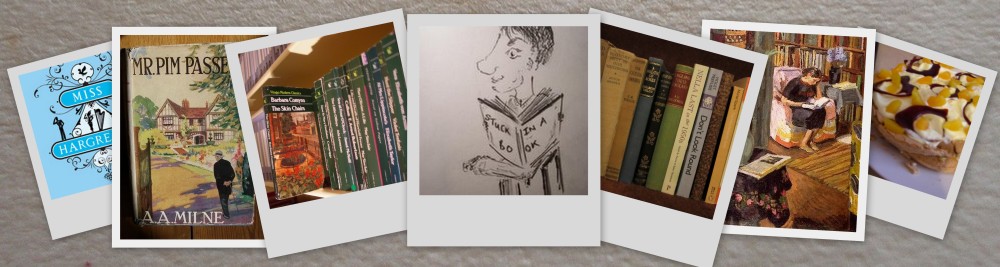
2) There are quite a few things that readers of Siab agree on, more or less – two of them are that reading is great, and that Virago Modern Classics are wonderful, when they appear in their dark-green covers. Witness the Virago collage I made a while ago:


Well, Verity (of The B Files, see left-hand column) has set up a subsidiary blog, Verity’s Virago Venture, documenting her attempt to read as many of the VMCs as possible. I can’t remember how many there are, but it’s A LOT. Go along and see her progress – authors/books already covered include Barbara Comyn’s Sisters By A River (which I wrote about in April) and the works of Antonia White.

3) I’m a little in love with Lisa’s blog A Bloomsbury Life, which has (I quote) “sporadic posts about style, travel, food, literature, gardens, eccentrics and their foibles.” It’s a quirky riot of colour, very stylishly so, and is a simply beautiful place to be. Most adored post recently is this one, in which Lisa compares the photographs taken on her travels with objects and designs around her home – how the one has influenced the other. For example, below – she has drawn connections between the beautiful saris she saw, and the way she shelves her books… beautiful. Do go and read the whole post, with lots of great photographs.


Bayard Books 2

As promised, the giveaway! I’ll be sending off these magazines to three winners – each getting two copies of either Story Box, Adventure Box or Discovery Box.

If you have children or grandchildren, or children at your church or wherever – anybody who’d be interested – do pop your name in the comments, or email me at simondavidthomas@yahoo.co.uk . Oh, and include which of the three Boxes you’d be interested in, please. Story Box is for 3-6 yrs.; Adventure Box for 6-9 yrs.; Discovery Box for 9-12 yrs. Of course the reading age of the child in question may be out of their actual age bracket…

Taking a bit of a risk here, as it’s not the usual kind of thing I write about on Stuck-in-a-Book, so please do pop your name in, even if you’ve not commented before!

Bayard Books


Before I start – all the books/magazines mentioned today will form a giveaway competition tomorrow – so do come back for that!

I’ve had a little selection from Bayard Books for quite a while, so apologies for not writing about them sooner. I don’t have children, of course, and my own childhood was spent immersed in a diet of Enid Blyton and Richmal Crompton and more or less nothing else – so I don’t posit myself as a children’s books expert. But these look really good quality, well put together, and good fun. Not usual fare for Stuck-in-a-Book, but perhaps of interest…

First off, I must alter my semantics. These aren’t actually classified as books, but rather as magazines – they come with issue numbers – but there’s so much in them, and they’re so durable, that the word magazine doesn’t seem to do them justice. At £3.95 each, they’re more or less magazine price, but book value. (Gosh, I sound like a marketing wizard…)

Bayard Books sell these magazines for three separate ages ranges.
Story Box: 3-6 yrs. (www.storyboxbooks.com)
Adventure Box: 6-9 yrs. (www.adventureboxbooks.com)
Discovery Box: 9-12 yrs. (www.discoveryboxbooks.com)

Each magazine comes with an astonishing amount of stuff in it, and a great variety. Let’s have a little look through one of each of those three categories…

Story Box
-Issue 131 kicks off with a rather adorable story about ‘Taffy’s bag of secrets’, with some really charming illustrations.


-Then onto ‘How Are Babies Made?’ – gosh, do they really tell 3-6 year olds this now? A sciency section is regular throughout the issues – another has How Do Bones Grow. Given my rather dreadful biological knowledge, I can probably pick up a thing or two.
-SamSam ‘the smallest of the big heroes’ seems to be an ongoing cartoon – in this issue he deals with cloning, as you do.
-Alligators! Some fun cartoons and facts about them.


-And then, of course, the wonderful old standards of dot-to-dot and mazes, secret codes, colouring spots and picture puzzles. Since this is a magazine, there’s even space to send in your own drawings.

Adventure Books


-Cats! The story in Adventure Books is much longer, with more words and smaller pictures, appropriate for the age group. And it’s about cats, at least in issue 133, which has instantly won me over.
-CraftBox section – I’m so glad that children still make things, not just play them on computers. Nintendo and suchlike (I would be behind the times, but I never knew anything about computer consoles, we never had one) can’t live up to making something from an old plastic bottle, in my opinion. In this case, a cow money box. Economical and ecological – perfect at the moment.


-The rest of the magazine is filled with puzzles and a cartoon. I don’t think Adventure Box offers quite the same scope as Story Box, but by the time children are 6-9 this sort of product is read alongside other things (like Enid Blyton! Do it!) rather than forming the majority of their reading.

Discovery Box
And finally…
-Issue 133 looks at volcanoes, with plenty of great illustrations, including a fold-out. There’s an interview with a volcanologist, an experiment to try, and so forth.
-Then onto albatrosses!
-And jeans! The range of topics covered by these magazines is phenomenal, and very impressive. Not to mention thorough – the section on jeans, for example, is far more interesting than I’d have thought the topic could be.
-And then the ‘World’ section. If there’s something I’m worse at than biology, it’s geography – I didn’t even know where Tanzania was, now I can tell you its capital (Dodoma), the fact that it has 126 different languages (eek!) and, most excitingly for me, it has flamingos. I do love flamingos.
-Oh, I’ve always loved these – a Choose Your Own Adventure style story, where your choices navigate you through the story (in this case, of an Egyptian Pharaoh).

Well.
I hope that’s been thorough enough an overview for you! I didn’t think I could do justice to the depth and breadth of Bayard Books without doing something like this. While I don’t think these magazines (especially the ones for older children) should in any way replace traditional book reading, they are a brilliant way of adding extra reading. Especially if the child in question has a scientific bent – and I definitely got the impression that Discovery Box would appeal to the types of boys and girls attracted by explosions and machines and so forth, which isn’t for everyone, perhaps.

If you have children or grandchildren in those age brackets, why not buy an issue or two, and see what they think? Even better, come back tomorrow for the chance to win two magazines. I’ll be giving them away in three sets – 2 x Story Box; 2 x Adventure Box; 2 x Discovery Box. See you then.

Fabiola

I know I promised more posts about children’s books this week – and for a taster, see Karen’s post today on Cornflower Books, which might well spill over here later – but I realised that I still hadn’t written about the Fabiola exhibition at the National Portrait Gallery. It’s open until 20th September, so if you’re in London and have any chance to get to it, I really recommend that you do.

I saw this advertised in The Week magazine, and was hooked by the idea. The artist, Francis Alys, has collected homemade images of the 4th-century Saint Fabiola (patron saint of abused women, I believe) from around the world. They are from flea markets, antique shops, and private collections – and are all of the same image. The original painting – which portrays Fabiola’s head and headwear, facing left, in profile – was a nineteenth century work, and has been lost. The image is replicated in all of the 300+ pieces in this exhibition – paintings, embroideries, miniatures, jewellery, even one crafted from seeds.

But, of course, this is not replication. Each version is unique – varying in period, style, talent, resources. It is simply stunning, seeing this image in all the works, but different in each. You can see disparate visions of what beauty is, or what sainthood should look like. It is, quite simply, the best, most affecting, and most striking exhibition I’ve ever seen. Unforgettable. And think of all the time Alys must have spent on this – and the triumph and excitement she must have felt when coming across another find in a flea market! Read more about it here, and do beg, steal or borrow to get to London to see it. Oh, and it’s free!

Has anyone else seen this exhibition? It’s been in a few places around the world, before the National Portrait Gallery. I don’t know if all the sites for it have used the same turquoise colour on the walls, but it was a stroke of brilliance to do so – the contrast with the orangey-reds of the works is the final touch to a fascinating exhibition.

My School Book Club

At Stuck-in-a-Book I’m always happy to share exciting initiatives, and when Lucy emailed me about a new scheme for schools to run book clubs. I’ve copied and pasted the press release that she emailed – I’m all for anything which encourages children to read (more on that this week – some children’s books I’ve been meaning to write about for ages, and also the latest Harry Potter film to discuss, which has sent me off on a Harry Potter re-read).

‘The best new idea in school book clubs for years’ – Michael Morpurgo
My School Book Club is an innovative new literary initiative that benefits children, parents and schools.
The My School Book Club project represents the 21st century evolution of the familiar school book club concept. This new online service provides children with an engaging interactive literary community, offers parents direct access to a wide range of quality assured and competitively priced titles, whilst also delivering a significant new revenue stream for schools.
My School Book Club offers free registration and the development of a personalised school book club website. The site is free to run and is automatically updated each month with new titles. Significantly, the school earns 20% of the value of each purchase through its My School Book Club site in redeemable book vouchers.

For Parents… My School Book Club offers a hassle-free, online book club service. The books are competitively priced, with discounts of up to 50% off the most popular titles, and quality-assured, with each title individually selected by a panel of experienced literacy professionals and leading children’s authors. The books, which include perennially popular classics and the latest works from contemporary authors, are divided into categories covering Baby and Toddler to Age 9 and Upwards, with Pocket Money books for as little as 99p and Graphic Novels for less confident readers. The service allows parents to actively participate in the literary development of their child, whilst also providing the opportunity to enhance the literary environment of their school.
For Children… My School Book Club presents a child-friendly, interactive literary community aimed at engaging children with books and reading. Each site includes downloadable audio and video clips, informative and entertaining articles on all aspects of reading and literature, competitions, access to signed copies from popular authors and illustrators and a range of carefully vetted literary links.
‘A brilliant way of accessing 60 fantastic titles each month’ – Jacqueline Wilson
The Founder My School Book Club is the brainchild of David Teale, who founded the hugely successful Red House Children’s Book Club in 1979. He has four daughters and six grand-children and is available for interview and comment.
For further information please visit www.myschoolbookclub.com or contact Digby Halsbyat Flint Public Relations on digby.halsby@flint-pr.com or 0207 224 8191

Hours and Hours

It is many moons ago that I promised to write about The Hours by Michael Cunningham, and the 2001 film adaptation. And now, finally, I’m doing it – I daresay you haven’t been nervously scratching away at the computer keyboard, wondering when it would be posted about, but it’s always good to keep one’s promises. (On a side note – my surname is Thomas, and my parents used the phrase ‘Thomases Don’t Cheat’ throughout our childhood, in a bizarrely successful attempt to instil partisan responsibility in us. It’s only lately that I’ve been thinking ‘Thomases Keep Their Promises’ would have been equally noble, with the added advantage of rhyme.)

Anyway. Onto The Hours. Like many people my age, I suspect, the film of The Hours was my first introduction to Virginia Woolf. Having really enjoyed watching it, but remaining rather confused, I went away to read Mrs. Dalloway and the novel The Hours – setting me off down a Ginny track which hasn’t stopped, and which has significantly influenced my research at university. Mrs. Dalloway remains one of the books I have read most often – I think four times, maybe more.

Does anybody not know the plot of The Hours? Perhaps. I’ll summarise the premise as quickly as I can… the novel follows three separate trajectories. In 1923 Virginia Woolf is writing Mrs. Dalloway; in 1949 Mrs. Brown is reading Mrs. D, and in 1998 Clarissa Vaughan’s life in many ways mirrors Mrs. Dalloway’s. Michael Cunningham had originally intended simply a modernising of Mrs. Dalloway, the thread with Clarissa Vaughan, but eventually decided to write a more nuanced, and much cleverer, novel. The strands are all complete in themselves, telling in miniature the struggles and triumphs of three different women, but the true greatness of this novel (and it is great) comes from the ways in which the strands reflect upon each other. Mrs. Brown is trying to cope with marriage to the war veteran, popular at school, who feels that he did her a favour by marrying her. The scenes where she tries to pull on the guise of motherhood for the sake of her son, while feeling utterly adrift, are powerful and excellent. Clarissa Vaughan, similarly, is trying to find her place in life – a lesbian regarded by others as abandoning a ’cause’, and another slightly bewildered mother, her qualms about the superficiality of her life are those shared with Mrs. Dalloway herself. And the difficulties of Virginia Woolf’s life are not secret – the novel opens with her drowning herself, in 1941.

As well as an involving and ingeniusly-crafted novel, I’d argue that The Hours is a fascinating piece of social history investigation, and a not inconsiderable contribution to an understanding of Virginia Woolf. No novel, least of all one with three competing heroines, could wholly encapsulate a novelist’s life – but Cunningham certainly develops a credible and well-researched angle from which Woolf can be viewed. (For another excellent portrayal of Woolf’s life, through fiction, see Susan Seller’s Vanessa and Virginia).


So that is the book, deserved winner of the Pulitzer Prize for Fiction in 1999. Onto the film. Did it do the book justice? Well, my quick answer to that is YES, since it’s my favourite film ever. I should add that I am not particularly well versed in film history, and my points of reference are probably not that sophisticated – but it’s still my favourite film, and you might well like it too, if you haven’t seen it.

Stephen Daldry’s direction is spot-on – what is best about the film, and impossible in the book, is the swift comparison of the three strands. This is best demonstrated in the opening sequences, the morning passages of the three women, viewable here (about halfway through). The scenes shift between Virginia, Laura and Clarissa going about their morning rituals, and is done very cleverly, as the actions of all three conflate.

The lead performances by Nicole Kidman, Julianne Moore, and Meryl Streep are all quite brilliant, any of them would have been worthy of the Oscar (and, no, Nicole didn’t win because of the fake nose any more than she did for the fake hair. Why do people say that about her, and not about the make-up-frenzy – not to mention snooze cruise – that was Lord of the Rings? Cat now officially amongst pigeons). The Hours is one of those rare films where all the casting is incredible. Aside from the three leads, the film can also boast Ed Harris, Toni Collette, Claire Danes, John C. Reilly, Eileen Atkins, Miranda Richardson, Stephen Dillane, and Allison Janney. Quite an embarrassement of riches. The way it is shot, the script adaptation by David Hare, the beautiful soundtrack by Philip Glass – The Hours doesn’t put a foot wrong. The portrayal of Virginia Woolf may be simplified a bit (film doesn’t have the scope for characterisation that novels do) but, again, it shows an angle of her. Both book and film The Hours are exceptional, and should be classics of their respective media for decades to come.

The Latest

I like to keep an eye on what people are reading, always good for suggestions and just to know what’s what – so today I’m simply throwing open the question: what was the last book you bought? Either in person, or which arrived through the letterbox.

And how did you hear about it? A trusty author, a new recommendation, or a complete impulse buy? None of the above?

I’m quite excited about my latest purchase, which arrived in the post this morning – Observatory Mansions by Edward Carey. I loved his novel Alva & Irva last year (and wrote about it briefly here) but for some reason hadn’t got around to buying this, his first book.


The cover pictured is the one I have, but there is also a more haunting edition which has lots of outstretched hands on top of one another. Ooo. This one is jumping to the top of my reading pile, so you should hear about it soon – otherwise more info, including a fairly comprehensive review, is at the book’s Amazon page.

More importantly – do let me know your most recent purchase, with as many details as you’d care to give! A later post will probably be devoted to your answers.

Prize Draw! (though not here…)


You’ll probably have gathered that I’m rather a fan of Henrietta’s War by Joyce Dennys, and its sequel Henrietta Sees It Through which I read squirrelled away in the Bodleian. The good people of Bloomsbury are also rather passionate about it – well, they have published it after all – and if you go over to Elaine at Random Jottings you can be in with a chance to win a copy of Henrietta’s War. No, sorry, in with FIVE chances – there are five copies to be won if you click on this link.

Elaine does add some conditions – namely that you must read it, and enthuse to everything, animate and inanimate, that you encounter from then on in.