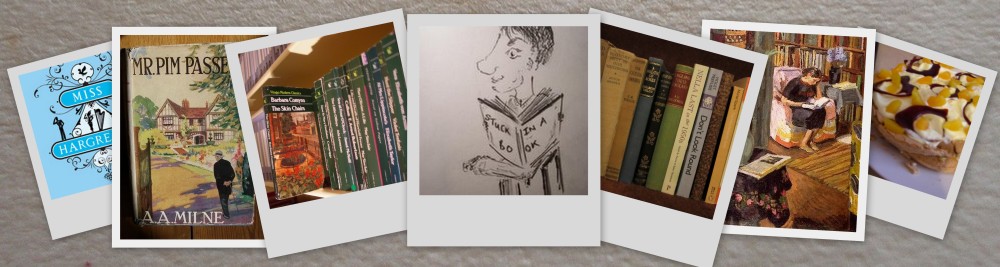
Stuck-in-a-Book’s Weekend Miscellany

Happy weekend, all. Next week I will, honest, promise, definitely be putting up my review of Miss Hargreaves, and a giveaway to go along with it – so watch this space. I’m trying to re-read it first… not much time at the moment.

1) The link – is a rather fun, bookish competition from The Big Green Bookshop. I saw about this at Chasing Bawa‘s blog – basically tell this bookshop (in email, post, ‘phone or person) your five favourite books (in no order). You have until November 22nd to do so – after that somebody clever with a spreadsheet will compile a Top 50. And one lucky person, randomly selected, will win 20 books of their choice from that 50. What’s not to like? Click here for all their info, or here for their blog, or just email enquiries@biggreenbookshop.com.
My top five? Well the first three are always there, in some order or other, but after that I improvise based on my feelings for that day.

1. Miss Hargreaves – Frank Baker
2. Pride and Prejudice – Jane Austen
3. Diary of a Provincial Lady – EM Delafield
4. Winnie the Pooh – AA Milne
5. Family Roundabout – Richmal Crompton

And whilst I’m at it, I found this name-the-book-from-the-photo competition in their archives… it’s hilarious, and groan-inducing. Go and have a try, you’ll love it. I got none of ’em.

2) The book is in fact books. At the Kisses on a Postcard launch the other day, Alexandra Pringle was saying how jealous she felt of those who hadn’t read Barbara Trapido before, because of all the bookish pleasures ahead of them… at which point I raised my hand and confessed my sins of omission. And so the lovely people of Bloomsbury have sent me their new editions of her novels… any Barbara Trapido fans out there, and if so, where should I start? So far I’m hearing ‘start at the beginning’ with Brother of the More Famous Jack, a fantastic title.

3) And for the blog post this week, I really enjoyed Rachel’s (aka Book Snob) tales of recent buying. The first line will make you realise what an affinity Rachel is: I went out on my lunch break today to Brompton Road, ostensibly to buy a dress for a wedding I am going to on Saturday, but somehow I returned back to my office with no dress and a bag full of books.Now it’s true that I’ve never set out to buy a dress, but most of my errands turn into impromptu book buying trips. You can read more about it here, and find out what she bought. (Rachel, if you’d like me to post you the sketch as a souvenir of sorts, just email me your address!)

Katherine Mansfield – Selected Stories

Thanks so much for your response yesterday, everyone, that was really interesting – and lovely to have comments from new people. I have to check these things sometimes – doing an English degree tends to make one a bit blinkered, in terms of which authors are well-known and which aren’t. I usually ask Colin – he knows rather more about literature than most, but isn’t as obsessed, and he assured me that nobody at his office would have heard of Katherine Mansfield. I knew the literary-blog-reading-and-writing world would be rather more keyed up, but wasn’t sure where our Kath featured on the scale of things. So, whilst more or less all of you have heard of Katherine Mansfield, she remains an untapped mine for many – and so I shall put her into my ongoing list of 50 Books You Must Read etc. etc….


27. Katherine Mansfield – Selected Stories

Katherine Mansfield only wrote for a few years, in the 1910s and ’20s. She was on the outskirts of the Bloomsbury Group, in an ambivalent friendship with Virginia Woolf. Born in New Zealand, her stories are set in both NZ and England, but also often an indeterminate mixture of the two. I wrote about Claire Tomalin’s biography of KM a couple of years ago, if you’re interested… but onto her writing.

Though you can read anything by KM – I recommend buying her collections as they were published, especially The Garden Party and Bliss, as well as various others – the Selected Stories is an excellent place to start. Plus Oxford University Press just sent me their latest World’s Classics edition of it, and it’s rather beautiful – as well as including nearly all of my favourite stories. But – and this might be make or break in terms of appreciating KM – don’t start at the beginning. This Selected Stories, perhaps unsurprisingly, lists her stories chronologically. KM’s writing got better and better, most of her best work appearing in the two years before she died, age 34, of TB. Who knows what she’d have gone onto achieve had she lived – or perhaps it was facing her death which drew such genius out of her?

If you do get this collection, which I’d encourage – or indeed any collection – then start with something from The Garden Party. ‘The Garden Party’, for example. Other favourites from around this period include ‘Miss Brill’; ‘Bliss’; ‘The Daughters of the Colonel’; ‘Her First Ball’; ‘A Cup of Tea’. All of these are included in the OUP selection. Others prefer her longer stories, ‘Prelude’ and ‘At the Bay’, but I think her craft and talent are shown best in the short, short stories.

What is it that makes KM so very, very good? It is this ability to demonstrate so much in such short works – to capture entire lives in mere sentences. Even if you don’t usually like short stories, I can’t imagine anybody not appreciating these. They manage to show everyday events, which at the same time completely turn people’s lives upside down. They are about people dealing with grief, or change, or power shifts, or the strange. ‘The Garden Party’ is all about class, on one level, but also a girl’s first encounter with death. And her writing – it is absolutely sublime. Virginia Woolf said ‘I was jealous of her writing. The only writing I was ever jealous of.’ It transports you to another world when you’re reading it – everything delicate and observant without being cloying or obtrusive. A quiet modernist, her stories owe as much to Chekhov as to any later writers.

I don’t want to give away the plots of these stories, because quite often only one significant event happens, and it is the stunning crux of the story. Like ‘Bliss’ – incredible story – to give away the ending would be treason! But when the pivots take place, they are not sensational – they are life, and KM’s talent is in sensitively showing how people respond to events which are externally almost insignificant, but of huge personal enormity. And, because it’s impossible to judge a writing style without evidence, here’s a link to ‘The Garden Party’, and here is one to ‘Bliss’ (note the significance of the first word, in conjunction with the title). Do go and read them, slowly, and see if you wouldn’t like to read more. I do hope you’ll give KM a try, if you haven’t before – and if you’ve not read her for years, why not get a copy and read one story a night for a few weeks? Just remember, contrary to everything we learnt in The Sound of Music, don’t start at the beginning, it’s not a very good place to start.

Katherine Mansfield

I’m going to be writing about Katherine Mansfield later in the week, inspired by Danielle recently getting her selected works, and I just wanted to do a straw poll today… so if you’re popping by for the first or the hundredth time, just let me know:

a) whether or not you’ve heard of Katherine Mansfield?

if yes…

b) whether or not you’ve read anything by KM?

if yes…

c) what your favourite story by KM is?

Kisses on a Postcard

As promised, tonight I’m going to chat about Terence Frisby’s Kisses on a Postcard, and there isn’t really a better way to begin than the way in which Elaine started her review – ‘Gosh what a lovely lovely book.’ (She also has a draw to win copies, do go and enter). But I’m going to start by mentioning how Terence Frisby had arrived on my horizons before – in the revue with Prunella Scales, Tim West, and Sam West, which I saw back in July. They performed an excerpt from It’s All Right If I Do It which was hilarious, and I’ve requested a copy of the play to the Bodleian to read.

But back to Kisses on a Postcard. This is an autobiographical book about Frisby’s years as a ‘vackie’, evacuee to you and me, sent to Cornwall with his older brother Jack in 1940. This tale has previously made appearances as a play, Just Remember Two Things: It’s Not Fair and Don’t Be Late, and then as a stage musical from that play. The musical hopefully being staged in London at some point… watch this space. Frisby warns in his Foreword ‘What memoir of childhood could be entirely true?’ Kisses on a Postcard combines all the facts of his experiences with the elaborations playwriting brought, as well as being seen through the wrong end of the telescope. But no matter – this book is true, in spirit if not in dialogue.

Like Emma Smith’s wonderful The Great Western Beach, Frisby’s book is an antidote to those misery memoirs which crop up everywhere. With MisMems (as they are apparently called – what you do learn at a book launch) I always say: I understand why people write them, but not why people read them. Thankfully Frisby, and Smith, take situations which could have been horrific, and write lively, joyful, invigorating books about them. Kisses on a Postcard even opens ‘I was the luckiest of children: I had two childhoods’. What a wonderful way to see a potentially heartbreaking event.

The beginning of the book looks at his first childhood, at home in London – his tough-but-sensitive father, his loving, well-educated mother who had perhaps come down in the world a little. Her background of suffragettes and society became one of marriage to a railway man – but a contentedly proud one. The Frisby neighbourhood and friendships sets the tone for a cheerful, resilient upbringing.

And then, of course, September 3rd 1939 arrived. And, more significantly for Terry and Jack Frisby, June 13th 1940 – when they were sent off to Cornwall. Mrs. Frisby devised the code from which the title comes – a number of ‘x’ kisses on their first postcard home, dependent upon how much they liked their evacuation home – three kisses if they were very happy; two if it was ok; one kiss and she would come straight there to collect them. What a remarkable woman. The parents who had to say goodbye to their children, knowing it could be forever – they are the unsung heroes of the war.

I don’t remember seeing any tears on that platform [when Terry and Jack left for Cornwall] but there must have been plenty. Jack and I stood at a window, waving and shouting at Mum, who stood in a crowd of waving, smiling mums. She mouthed, ‘Don’t forget the code,’ as though we could have. She told me years later that she went home and sobbed. Like all the other mums, I expect. I still cannot think of her inventiveness and bravery, even now nearly seventy years later, without my eyes filling.
You and me both, Terry. You can mark Kisses on a Postcard by the places it makes you cry – this was Tears No.1 for me, with plenty more to come. But thankfully, Terry and Jack were very fortunate with their host and hostess – known as Uncle Jack and Auntie Rose by everyone, regardless of generation, they lived in a tiny terraced cottage by the railway. Of all the lovely, lively characters in this book, it is Auntie Rose whom I shall remember most. Endlessly kind, honest, and selfless, she makes the boys welcome – acts as wise disciplinarian when needed, but never tries to replace their absent mother. It was a great privilege that Rose and Jack’s granddaughter was at the launch yesterday – now she will have to share fond memories of Auntie Rose with thousands of others now.

Terence Frisby relates so many things in this book that it would be impossible to list them all – we see a village community undergoing great changes, but also keeping true to a village spirit which with wider travel, communication, and resources has now all but disappeared. Kisses on a Postcard is a paean to rural life, to all the discoveries an urban child had to make – it makes me grieve for the generations since, including my own, who know so little about the natural world. (I blame electricity!) There are so many vivid characters portrayed – I was left feeling desperately sorry for Miss Polmanor, an ardent Methodist, but lonely lady, to whom Uncle Jack was often unkind. She could be interfering, perhaps, but… These were the only bits of the book which left me a little uncomfortable – Uncle Jack’s fairly constant, strident bellows of atheism, and his consequent unkindness to the attendants of Church and Chapel. But he had been through trench warfare, and was inevitably damaged by his experiences, despite being able to overcome this most of the time.

And on the tears front… when you’ve read Kisses on a Postcard, simply the names ‘Teddy Camberwall’ and ‘Gwyn’ will be enough to make you blink furiously, and pretend you’ve got an eyelash in your eye.

Perhaps Kisses on a Postcard is open to accusations of cosiness or even (a word I can never understand, or view as censure) tweeness. Well, it ought not be thought ‘cosy’ to commemorate acts of great human kindness, nor twee to rejoice in the possibilities of happiness amongst widespread sadness and turmoil. What Terence Frisby has done so excellently is write an honest account, with moments of desperation, which avoids misery without being falsely cheerful.

Sadly there cannot be many more decades of first-hand experiences of WW2, and those which we get now must be from the child’s viewpoint. All the more reason to treasure something as special as Kisses on a Postcard – I predict a classic, and one which can be enjoyed with joyfulness, thankfully, and not solely sympathy.

Launch Pad


I’ve just been at the launch of Terence Frisby’s Kisses on a Postcard in London, to which the lovely people of Bloomsbury invited me. I haven’t mentioned the book on here yet because I only finished it on the coach to London – and now I’m far too tired – but suffice to say it had me (discretely) weeping on the Oxford Tube, and is a wonderful autobiographical account of being an evacuee to Cornwall. More very soon…

But I couldn’t let the day end without saying what a joy and a pleasure it was to attend the launch, with Elaine from Random Jottings, and everybody I met was so lovely, welcoming, and uniting in praise of Terry Frisby’s book. I can’t remember everyone’s names, so I shan’t mention any of them, but everyone at Bloomsbury – I loved meeting you, and had a great evening! And now I want to come and work with you all. I will mention *one* name, actually, and say how nice it was to meet Penelope Beech, the talented artist behind the covers of the Bloomsbury Group series. Oh, but everyone else too – perhaps you might break anonymity and say hello in the comments?

More about Kisses on a Postcard as soon as my brain is alert (isn’t this just the journalistic fervour so needed in this day and age? Ahem.)

BBAW Shortlists

Well, the Book Blogger Appreciation Week shortlists are out here, and I must say I’m pretty disappointed. Not because I wasn’t shortlisted for anything (I was only a little hopeful) but because, out of the nearly 200 shortlist spots, only two have gone to blogs I’ve ever read – well-deserved congratulations to Danielle of A Work in Progress, and the good people at Shelf Love! But how many great blogs have sadly been missed… and is the UK represented at all?

I’ve voted for the two I’ve heard of, and also felt qualified to vote in the ‘Best Blog Title’ round, but otherwise I’ve had to leave things blank… Maybe there’s room for a British Book Bloggers Appreciation Week?!

Checkout

To move onto something very light, probably not for the annals of literature, but an amusing read nonetheless.

Gallic Books
, who print ‘the best of French in English’, sent me a copy of Checkout: A Life on the Tills by Anna Sam. This was originally published as Les tribulations d’une caissiere, and stems from a blog Anna Sam kept about her eight years working in a supermarket. You can tell it was a blog – lots of little snippets, anecdotes from her working day, the traits of customers who come really early or really late, those who ignore her, etc. etc. It’s mostly in the second person (is this more common in French?) in the style of a how-to guide to anybody considering becoming une caissiere.

I shan’t type out vast reams, partly because The Independent has done it for me – click here to read quite a few extracts from the book. It’s very silly, quite diverting, and I found it perfect after a stream of heavier books. Took less than an hour for me to read it, but it might make a fun present for someone.

Only after reading an old article about the French version of Sam’s book did I suspect that Morag Young’s translation may have dumbed down the book… The Telegraph had done their own translation on a bit of the text, before Gallic’s publication: it described the till as ‘one of the most desirable vantage points from which to enjoy the full panoply of human idiocy.’ The sentence has a nice balance, good rhythm, rich words, and well-phrased wit. What do we get in this English version? ‘You are in a perfect position to witness the entire range of human stupidity.’

Perhaps I should learn French…

Persephone Week Redux

I never did quite finish off Persephone Reading Week properly, in the manner of others – which is to say the Persephone Books I’m keen to read next. I had hoped it would clear my backlog a bit, but instead it just made me very keen to read lots of others…

Before I do that, Rachel’s recent post at Book Snob included a picture of all her Persephone titles in non-Persephone editions, as well as a picture of her Persephones. It seemed a fun idea, so here’s mine:


I also have Flush by Virginia Woolf, of course, but not in Somerset. Me being me, I don’t see these collections as competing, but rather complementary… i.e. I’ll buy a Persephone copy and a non-Persephone copy if I come across it cheaply enough.

And my copy of The Priory by Dorothy Whipple came with an exciting surprise, once I got it home…


As for the Persephones I’m now keen to read – here’s the top five.

The Village – Marghanita Laski

Little Boy Lost – Marghanita Laski

Saplings – Noel Streatfeild

Farewell Leicester Square – Betty Miller

A House in the Country – Jocelyn Playfair

Luckily I have all of these waiting on my Persephone shelf. I wonder how many I’ll have read by the time we get to next year’s Persephone Reading Week…

Beg, Borrow, Steal

It’s always nice when a book arrives which isn’t at all my usual kind of thing, and it blows me away. Michael Greenberg’s book Beg, Borrow, Steal: A Writer’s Life sounded like my cup of tea – I have his memoir of his daughter’s mental illness, Hurry Down Sunshine, as yet unread. I thought Beg, Borrow, Steal might be about writer’s block, the publishing process, amusing anecdotes of book signings, seeing your book on the shelf for the first time… well, for the last few chapters it was. But before that there are nearly 40 chapters of an aspiring author talking about nearly everything except writing.

I say chapters. These were all previously columns in the Times Literary Supplement, between 2003 and 2009. And Greenberg writes about everything and anything – this is a writer’s life in one sense: all of his experiences are ignited by a desire to gather stories, create a viewpoint on the world – or rather, New York City. He has had almost every imaginable job – he’s sold fake make-up kits under a bridge; interpreted Spanish in a law court; driven a taxi until he was car-jacked; been a hopeless waiter; even played the stock market. Seemingly able to blend into any scenario, he writes of each with disarming simplicity, always engaging, however unpalatable the topic might be in the abstract.

His life in New York is as a struggling dreamer – one familiar with, and even fond of, the darker, grimier, desperate side of the city. Whereas I get anxious walking down a dim footpath in Oxford. Despite being so different from my usual choice of domestic literature of the interwar years, I was utterly captivated, and it never felt that Greenberg was bragging about his urban experiences – simply documenting them with a writer’s eye. And occasionally this was jolted against his experiences as a father – spending his first two weeks alone with his young son, for example.

Along the way, he garners some writing experience. He never mentions having the TLS column in the columns, but recalls his times keeping a log of his subway journeys; writing for unsuccessful films; being told by an editor that “This manuscript represents everything I hate in fiction.” An example of this book’s humour is seen when Greenberg writes the voiceover for a television programme about golf in America. ‘”Golf. Simple. Majestic. Timeless,” I begin.’

I complete the script and send it off to Zebra. A week later he ‘phones. An executive at the network has complimented my “intimate feeling for the game.” Would I be available to play a round with him at the Westchester Country Club next Thursday? I confess to Zebra that I have never played golf, except for a few holes of miniature golf on Kings Highway in Brooklyn when I was a boy.

“We’ll tell him you’re sick,” says Zebra without skipping a beat. “Something highly contagious.”
Who’d have thought that a book with topics so disparate as beheading chickens, waiting in the dark to see owls, and recording a Talking Book, could make such addictive, coherent reading. All is linked by Greenberg’s distinctive, but unobtrusive, voice.

Sadly for UK readers, this book won’t be published here (by Bloomsbury) until early 2010 – but it is out from Other Press in the US next week. See it here, on their website. The fact that Greenberg’s style and viewpoint are so different from my usual fare makes it easier for me to recognise a writer of great, but unassuming, talent. His clarity, honesty, and simple style reminded me of Homage to Catalonia, and I think it is possible that Greenberg is, stylistically, as quietly brilliant as George Orwell.

I want…

This comes out on 5th November – can it be *any* coincidence that my birthday is the 7th November?

It’s 100 book jackets, as postcards. I don’t know whether I’d stick them on the wall, use them as bookmarks, or just rifle through the box smiling – but what a unique and brilliant idea on Penguin’s behalf. Present-givers, take note. (Though also maybe confer amongst yourselves. I don’t want twelve sets of this come November).

But by the time you read this it will be Our Vicar’s Wife’s birthday. Happy birthday Mum! I made a cake, but it looks something of a failure… not the oven I’m used to, and all that. Still, might taste good, and as Mum says – at least she didn’t have to bake it herself.