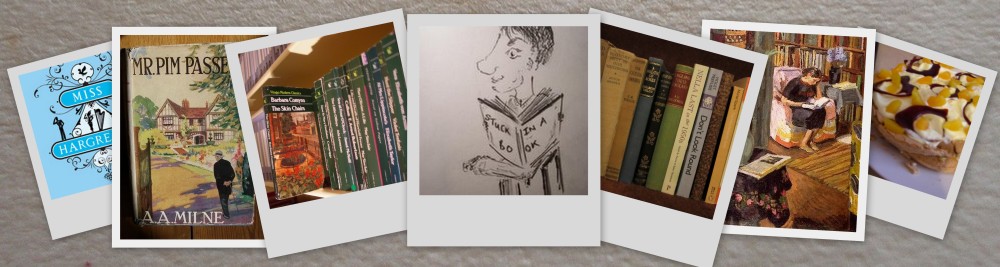
Howards End is on the Landing – Susan Hill

29. Howards End is on the Landing – Susan Hill

I’ve teased you long enough, and now I am going to write about Howards End is on the Landing by Susan Hill. I’m not sure of the exact publication date, but apparently it’s already being shipped by some, er, depositories of books. So will be hitting shelves soon, if it’s not there already. As you can see, it’s gone straight into my list of 50 Books You Must Read But May Not Have Heard About – though I suspect *everyone* will have heard about it before long. It’s just too good not to put into the list.

To set the tone: this is my favourite book of the year so far. It’s everything bookish and literary that you could possibly ask for – basically, if you sigh happily when glancing at the cover (which Hill herself thinks is the best one she’s ever been given) then this is the book for you.

The premise is that Susan Hill will spend a year reading only books she has on her shelves. Not just unread books, but revisiting those from the past – much-read favourites alongside ones she’s always meant to read. As she beautifully writes: ‘a book which is left on a shelf is a dead thing but it is also a chrysalis, an inanimate object packed with the potential to burst into new life.’

And so the year begins. Hill avoids spending much time on the internet – explaining the sudden disappearance of her blog – since it can ‘have a pernicious influence on reading because it is full of book-related gossip and chatter on which it is fatally easy to waste time that should be spent actually paying close, careful attention to the books themselves.’ I find this chatter wonderful, of course (for what is Stuck-in-a-Book but book-related chatter?) and a great resource for finding more books – but I think Hill’s decision is a dream a lot of us have. Wouldn’t it be lovely to retreat into our bookshelves, finally tackling those tbr piles, having everything spontaneous and undecided?

In truth, most of Howards End is on the Landing is speculative, wondering which books might be read, and remembering her experiences with them, rather than reappraisals of the re-reads and newly reads. Is this an autobiography through reading? In a way, perhaps. But it is much more embracing than that – personal anecdotes, yes (her meeting with Iris Murdoch is quietly heart-breaking), but also chapters on how books can be shelved, whether or not to write in them, what constitutes a funny book… It’s a bit like a very well-edited, and selective, blog. And I mean that as a compliment. Individual authors treated to their own chapter include Virginia Woolf, Roald Dahl, Ian Fleming, WG Sebald, Penelope Fitzgerald, Anthony Trollope… a huge range, for Susan Hill is no book snob. How cheering to hear her say:

Adults may say what they like – parents, teachers and other know-alls. Enid Blyton excited us, took us into worlds of mystery, magic, adventure and fun. Yes, her prose is bland, yes, the vocabulary is not particularly stretching. But Blyton had the secret, the knack.There are sections on diaries, e-readers (not a fan), detective fiction, and how she doesn’t like Jane Austen (intake of breath, but she keeps trying to see what’s what with Jane, and at least she’s honest…) Oh, and lots more.

Towards the end, Hill tries to decide upon the 40 books she’d read for the rest of her life, if she could have no others. I shan’t spoil her list, for the book builds up to it, but it’s a great idea for a gradual, contemplative exercise.

Above all – and I am aware that I haven’t done justice to Howards End is on the Landing, for it is impossible to put across her tone – Susan Hill has written something delightfully, wisely, enchantingly bookish. I feel I have been around her old farmhouse, with its rooms full of bookcases – I feel her surprise when she happens upon an unexpected old friend on her uncategorised shelves. Mostly, I have fallen even more deeply in love with my own books – with those which have lingered for years unread; with my own personal library as a whole.

She picks and chooses, yet is also somehow comprehensive. She writes subjectively, but – whether or not I agree with her – it feels like the last word has been spoken; the whole spectrum of opinion addressed. And Hill can be sweeping (‘Girls read more than boys, always have, always will. That’s a known fact.’) and naive (‘if [some listed Elizabethan plays] were any good we would have heard of them’) but that doesn’t seem to matter a jot. Perhaps it is her sheer love of books that make her the everywoman – or at least everyreader – even whilst having a determined set of views.

There are some books which are read reluctantly; others so addictive that they are read walking down the street. Then there are those – and this is a rare, wonderful category – that are laid aside often, because the thought of finishing them, of having no more to read, is awful. Howards End is on the Landing is in this category – what higher praise can I offer? This might only truly delight those of us who have hundreds of unread books, lists everywhere of books we intend to read. For us (and if you’ve read this far, that includes you) this is a treasure, from the pen of a like-minded friend, to which we will often, happily, joyfully, return.

Stuck-in-a-Book’s Weekend Miscellany

1.) The link: Well, there it is above. This weekend I’m feeling quite silly, and those much-promised book reviews will have to take a back seat for… a video of a kitten discovering a mirror. When people feel low they might eat chocolate, watch a favourite film, have Prozac… I go to YouTube and search for ‘kitten’ and ‘mirror’. Not that I’m feeling down at the moment – I just thought it would be a good ‘link’ to choose for the link, book, and blog post… Ok, I wanted any excuse. This is something you don’t get in The Telegraph.

That’s the link, then… now for the others.

2.) The blog post: Hayley at Desperate Reader has written a rather lovely post today, which covers all the wonderful bases of blogging – good news to share, a good book, a good recipe. And she links back to my blog too, so what more could you *possibly* ask for? Go along and enjoy all three… and enjoy the beautiful pictures she has along the side column, too.

3.) The book: I try to write about something interesting which is in the backlog… so step forward Lord Lucan: My Story ‘edited’ by William Coles. You might remember Coles from the Othello-meets-Notes-on-a-Scandal and rather good novel The Well-Tempered Clavier, which I wrote about here. And, what do you know, he’s happened to stumble across the secret memoir of Lord Lucan, the peer who disappeared in 1974… (In case you don’t know who the real Lord Lucan is, have a shufty here. Don’t you love Wikipedia.) Coles is very amusing and this could prove a quirky, interesting, and unique read… I’ll let you know what I think one day, but for now there’s a heads-up in case you’re interested!

Wolf….

So, Wolf Hall by Hilary Mantel has won the Booker. This could have led into my thoughts about the Booker Prize, musings on Mantel’s suitability to win, thoughts about the use of history in fiction.

Instead, it reminded me of this post I wrote a couple of years ago, where I asked you to think of books with animals in the title.

Ahem.


Sorry, proper reviews soon, promise. I do have a pile of ten books I’ve finished, and am going to write about… maybe I’ll just blitz them all one night. But not tonight.

Badly done… or not?


Have any of you seen the first part of Emma, the BBC’s latest costume drama? And last for a while, if reports are to be believed. There hasn’t been a big production of Emma for over a decade, so Romola Garai has rooted through the bonnet cupboard, and a four part series started last weekend.


I’ve watched the first episode, and I enjoyed it a lot, though am still more or less straddling the fence. I love Romola Garai in everything she does – mostly I Capture the Castle, but also Amazing Grace, Elizabeth Taylor’s Angel, and Atonement. She makes a feisty, self-confident Emma, and could turn out to be rather great.

Michael Gambon is a wonderful hypochondriac as Mr. Woodhouse, wrapped in scarves and uncertainty. Tamsin Greig wasn’t quite as funny as I know she can be, but perhaps her Miss Bates is played more for pathos than humour.

My issues? Their Mr. Knightley (Johnny Lee Miller) was young and handsome and everything a modern film hero should be, but not remotely like Mr. Knightley is. Miller is much too young, and the match is much too suitable… on the page, I found it a little creepy, since they are much more brother and sister than anything else… Still, Miller may do for Knightley was Alan Rickman appears to have done for Colonel Brandon in Sense and Sensibility, and made a rather bizarre, unromantic match seem like a dream come true.

And the other thing… the language was so often too modern. I found myself muttering to the television, ‘is there no historical advisor?’ When the credits rolled, I saw that there was… and he is my tutor at Magdalen! Well, there you go.

All in all, fun and fresh way to ‘do’ Emma, and only slight misgivings. I’ll certainly be watching the rest. (Any UK readers who missed it, the programme is available through BBC i-Player.)

London Books…

Some would say that I don’t absolutely, definitely, incontrovertibly *need* any more books, especially after my recent haul in Edinburgh, but going through two of the cheapest bookshops in London left me with quite a few, then a trip to Charing Cross Road revealed a couple of gems which it would have been foolish to leave behind… I’m going to start with them, in fact.


Like a lot of us, I loved Henrietta’s War by Joyce Dennys, recently republished in the much-beloved Bloomsbury Group series. When in Henry Pordes Books, on Charing Cross Road, I spotted the name ‘Joyce Dennys’… only true book-lovers will recognise that leap in your stomach you get, when you spot a book you never expected to find. And there were two of ’em… Repeated Doses (a sequel to a book I don’t have, Mrs. Dose the Doctor’s Wife) and the sublimely titled Economy Must Be Our Watchword. They were both *quite* pricey, but – in an unprecedented act of technological capability – I crept into a corner of the bookshop and used my mobile ‘phone to check whether or not Amazon and Abebooks had cheaper copies. They didn’t – in fact Economy Must Be Our Watchword doesn’t seem even to be available anywhere – and these beautiful 1930s books, complete with Dennys’ quirky illustrations, were quickly mine.


Less exciting, but still great, were my other finds:

In the Springtime of the Year – Susan Hill
A Bit of Singing and Dancing – Susan Hill
– I will write about Howards End is on the Landing soon, promise, but it’s already sent me away to find more of her work. The first of these is one I really want to read.

Saraband – Eliot Bliss
Cousin Rosamund – Rebecca West
Beyond the Glass – Antonia White
– Three Virago Modern Classics which I couldn’t leave behind. Never heard of the Eliot Bliss or her/his book, but it charts the emotional life of a girl in the 1930s, so the blurb says. The other two are sequels to books I haven’t read, so might be on the back burner for a while… but were found in the wonderful Book & Comic Exchange in Notting Hill Gate, which has a large three-room basement of books for 50p each.


The Shadow of the Wind – Carlos Ruiz Zafon
– a friend recommended this to me, but now several others have told me not to bother… what do you think?

The Lottery and other stories – Shirley Jackson
– this beautiful new edition, already secondhand! You’ll have realised by now that I think Jackson is great – looking forward to delving into these. I have read ‘The Lottery’ online, and it is beyond chilling… you can do the same, here.

The House in Paris – Elizabeth Bowen
– I struggled with The Last September a while ago, and took great encouragement from your similar tales of woe. But Susan Hill says this is her best, and at 40p for a rather nice paperback, I thought I could give Lizzie another shot…


Family and Friends – Anita Brookner
– Susan Hill has a lot to answer for. HEioTL has sent me off in Anita B’s direction…

And I also came away with three lovely gifts, celebrating our fifth birthday:

Hostages to Fortune – Elizabeth Cambridge
– my second favourite Persephone book, after Richmal Crompton’s, but somehow I didn’t own a copy… thank you Nichola!

Virginia Woolf: An Illustrated Anthology
– everything Woolf is good in my book – thanks Barbara!

The Love Affairs of a Bibliomaniac – Eugene Field
– a late-19th Century book with a rather apt title – many thanks Sherry!

As always, any comments and thoughts on my new arrivals? Thanks everyone!

Ready Stead… Ivy!

Ok, have you got your copies of Manservant and Maidservant by Ivy Compton-Burnett? Or perhaps you have it under the original American title, Bullivant and the Lambs. Either way, there is still sometime to get prepared, even though I’m shouting GO! at the top of my voice. Because I don’t think we can all agree to read the novel in the same week, I’m decreeing the whole of October as your time limit…. I AM excited!

So, over October, secure your copy, and get reading. The beautiful New York Review of Books Classics edition is available in the US, but also from some bookshops in England – I spotted two copies in the Kensington Persephone Bookshop, for example. Otherwise, plenty of secondhand editions to find. It was first published in 1947, but has been reprinted a fair number of times.

And, in the first week of November, I’ll encourage everyone involved to post on their experiences with the novel – either in comments on my blog, or – of course – on your own blogs. You’re welcome to post before then, obviously you can do as you like, but it might be fun to all write about Manservant and Maidservant at the same time.

This experience might well be giving up on page two, or it might be sheer delight and ordering all of her novels – or, of course, something in between. I’ve not read it yet, I don’t know how I’ll react. But it will be exciting to know that we’re all reading ICB together – I’ll remind everyone about halfway through October, and see how you’re going…

Feel free to comment now, to reassure me that I’m not reading all on my own, and let the festivities begin!

Stuck-in-a-Book’s Weekend Miscellany

A bit later than usual this week, mea culpa, but I hope you’ve all settled into a nice weekend. I had fun this week, going up to London for a celebratory meet-up of an online reading group I’m in: five years together. Actually a bit longer than that, but five years since we changed our name. A lovely tea at the Orangery at Kensington, and some, ahem, moderate book-buying… I’ll treat you to a list later in the week. Whilst I London I also met up with Simon S (Savidge Reads) and Claire (Paperback Reader) for a quick coffee – which was good fun. We chatted and gossiped about blogs, I mentioned Miss Hargreaves two or six times, and a good time was had by all.

Without any further ado… the link, the book, and the blog post. A bit like the good, the bad, and the ugly – except instead it’s the good, the good, and the good.

1.) The link – You might remember that I’m a fan of the gals behind 3191. Two ladies have been inspired by 3191 to start their own daily comparative photograph site – but one showing the charity work of SOS Children. The charity works on a huge scale, securing homes for millions of children and helping thousands of families stay together – but when we hear ‘millions’ it all seems too vast to understand. Using photography, they can show the detail and the individuals affected.

Every day two new photographs will appear side by side, as well as a few paragraphs on what the photograph represents, and what the charity is doing. It’s a great idea, do have a look – the website is www.twotalk.org.


2.) The blog post – Kirsty at Other Stories writes about secondhand bookshops, following the Guardian’s list of the ten best in the UK. Might inspire me to write something similar soon… I was pleased and surprised to see my local bookshop in Somerset, Gresham Books of Crewkerne, make the list. And, with Kirsty, I mourn the absence of any great independent secondhand bookshop in Oxford, since Waterfield’s closed. We just have charity bookshops, and the hugely overpriced secondhand department of Blackwell’s.

3.) The book – I told, or warned, readers about a new Winnie the Pooh book, back in January. Well, it’s coming out on Monday. The Telegraph printed the first story, about Christopher Robin coming back from school, and you can read it by clicking here. I have surprised myself by liking both David Benedictus, the author, and his story. He’s obviously done a lot of research (he even tried to use the word convolvulus in another story, which might be a reference to the novel-within-a-novel ‘Bindweed’, in AA Milne’s Two People) and the story has a good tone. It makes more in-references than Milne ever did, and it’s obviously not from Milne’s pen, but I don’t think an imitation could be much better. Of course, it’s still up for debate whether a sequel is wanted, but given that one’s being written… I think it might be ok. Doubtless forgotten in a decade, but fun for the moment. Though I’m still worrying about the illustrations by Mark Burgess… the one accompanying the story is ok, but has nothing of EH Shepard’s wonderful spirit. Well, we’ll see.

We Have Always Lived in the Castle

28. We Have Always Lived in the Castle – Shirley Jackson

Well done to those who correctly guessed We Have Always Lived in the Castle from the image I shared the other day – and well done to those with the foresight to have bought the book already. As well as being my favourite ever book title (doesn’t it make you want to read the book, without reading a word more about it?) this is a quite brilliant novel. Initially published in 1962, this great image is from the new Penguin reprint in the UK. I first read the novel in 2006, I think, and re-read it yesterday, just to make sure it was still great… a second read removed some of the suspense, of course, because the questions were no longer unanswered – but it actually brought a new dimension to the tale, too, as I shall explain…

I’m going to do my best to write about this book sans-spoilers, since it has so many wonderful twists and turns. I’m going to give away much less than most reviews do, so if you want to try We Have Always Lived in the Castle from the same starting point I did, perhaps don’t follow the links at the bottom…

The opening paragraph gives a few important bits of information:

My name is Mary Katherine Blackwood. I am eighteen years old, and I live with my sister Constance. I have often thought that with any luck at all I could have been born a werewolf, because the two middle fingers on both my hands are the same length, but I have had to be content with what I had. I dislike washing myself, and dogs, and noise. I like my sister Constance, and Richard Plantagenet, and Amanita phalloides, the death-cup mushroom. Everyone else in my family is dead.
The first chapter shows Mary Katherine – also known as Merricat – walking through the local town, seeing the trip like a board game; she ‘misses turns’ if she crosses the street, for example. ‘The people of the village have always hated us.’ What a stunning first chapter Shirley Jackson has written – without knowing why the Blackwood family are pariahs, we feel such tension, such awkwardness and fear as Merricat makes her way through the village. And she is the victim of childish chants:

Merricat, said Connie, would you like a cup of tea?
Oh no, said Merricat, you’ll poison me.
Merricat, said Connie, would you like to go to sleep?
Down in the boneyard ten feet deep!
Once home, she is not in a world of normality. Merricat believes she can protect her family and her house through nailing books to trees, burying marbles on the land, and storing away words – melody, Gloucester, Pegasus – which, so long as they aren’t spoken aloud, will prevent danger. Because the novel is from Merricat’s first person perspective, these superstitions are spoken without any defensiveness or recognition of a lack of logic. Which transports the reader into a surreal, unsettling viewpoint… Constance is more normal, though agoraphobic, unable to move beyond the perimetres of Blackwood land. Uncle Julian, the other remaining Blackwood, is obsessively creating a history of what happened to the family, especially the night they died. He is also mentally disintegrating, every bit as unsettling as Merricat’s bizarre internal logic. Oh, and then there’s the rather wonderful cat, Jonas, the only truly sane member of the family.

Though a short novel, Jackson packs a huge amount in. Not only the readers’ curiosity to discover what happened to the rest of the Blackwood family, but also a consuming tension in the atmosphere of the novel. This was Jackson’s last novel, and (of the three I’ve read) the best – suffering from agoraphobia herself whilst writing it, she perfectly creates the joint security and terror of the home. We Have Always Lived in the Castle is Gothic from the title onwards, but Jackson also writes a fascinating psychological study – this slim book has everything, and on re-reading is all the more impressive, for the clues and presentiments scattered throughout. The pace quickens, the events escalate, but the tone never eases and Merricat’s unique angle on the world never lessens.

When I first read We Have Always Lived in the Castle, I hadn’t heard of either the book or the author – it was in a postal book group, sent by Lisa from Bluestalking Reader. I feel a bit bad including it in a ‘books you might not have heard of’ list, since it’s been all over the blogosphere since then, but just maybe you’ve missed one of the following reviews (I’ve only included blogs I know and like – a search reveals dozens and dozens more! Search via Fyrefly’s Blog Search Engine, linked to the left, under People To See):

Books Please (spoiler-free)
The Bookling
Read-Warbler
The Asylum
A Striped Armchair
Books and Cooks
Things Mean A Lot

Which book for this cover…

I’ll be adding another book to my 50 Books You Must Read… list soon, but I’m re-reading it at the moment. But I wanted to share the cover image with you, just to drop a hint, and get you in the right frame of mind. It’s a photograph by Lisa Johansson, with Millennium Images. I’m probably not allowed to reproduce it, but it is for promotional purposes, so perhaps they won’t mind…


The book itself only uses part of this image, and oddly I had the impression the girl was facing away from me, in the detail used. Hmm. To see a collection of Lisa Johansson’s photographs, which are all similarly haunting and evocative, you can register at the Millennium Images website, and do a search for her.

Any ideas about the book?? A further clue – it was first published in 1962. Don’t cheat now…

Shakespeare

I recently finished the extraordinarily good Howards End is on the Landing by Susan Hill, which I’ll write about soon, but it has inspired a few quick posts. A book full of short chapters about Hill’s books, reading, books in general, it provides lots of fascinating ideas for blog posts…

Towards the end of the book, Susan Hill decides to compile a list of forty books she’d choose, should she only be able to read those for the rest of her life. Not taking the get-out of Desert Island Discs, the Bible and Shakespeare’s Complete Works are not givens – not, in fact, is she allowed to count all of Shakespeare’s plays as one book. And so she tries to choose one…

Which led me to thinking: if I could only choose one Shakespeare play to read for the rest of my life, which would it be? Like Hill, I made a shortlist. Unlike Hill, I haven’t read them all (though I have read 24 of them, so quite a few to choose from… and that number includes no history plays). Here is my shortlist:

Much Ado About Nothing
The Taming of the Shrew
Hamlet
All’s Well That Ends Well
Cymbeline
Othello

Some I love (like Twelfth Night) I know I would get tired of. Some I admire (i.e. The Tempest) but cannot much like. Some (The Comedy of Errors; As You Like It; Titus Adronicus…) were never in with a chance.

Which to keep. Much Ado About Nothing is my favourite Shakespeare play, but… if I had to read Beatrice and Benedict’s exchanges over and over again for the rest of my life, would I still find them funny, or simply infuriating? Would Hero’s silence and Claudio’s willingness to marry penitently someone who looks a bit like Hero not become more ridiculous each time? Cymbeline… I love the final scene, but that’s not enough to keep it. Hamlet. Hamlet, Hamlet, Hamlet. So much there, but… I still just want to shake him, and tell him to stop being a silly little boy.

In the end, I was surprised. The one to keep is not my favourite, but I have chosen… The Taming of the Shrew. Because I am continually fascinated by the question: was Katharine complicit? How should it be interpreted? So much that can be done, so many different readings, and often quite funny, to boot. Who’d have thought? I expect my choice will change in years to come. It’ll be interesting to keep track.

And now, of course, over to you. Shortlists, please, and the one play you’d keep…