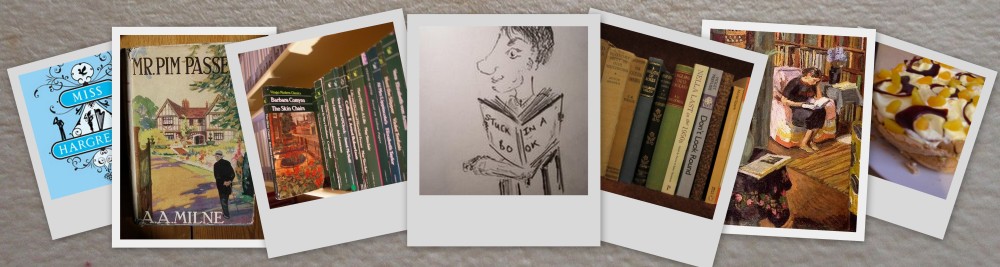
Stuck-in-a-Book’s Weekend Miscellany

I’m off for the weekend, to give a talk on Barbara Comyns to the Bidford History Society (argh! nervous!) and visit my brother in Bristol (not nervous…) so I’m typing out a couple of posts to appear whilst I’m away. First off, the Weekend Miscellany – which has a little bit extra this week. Don’t worry, we’ll still be looking at a book, a blog post, and a link – but before that…

UK Book Bloggers Meet-Up
I wrote about this quite a while ago, when it was in its very early stages of organisation – it’s now a little nearer being organised which, let’s face it, is as near as I’m likely to get, not being one of nature’s organised people. Just ask my family, in whom hope springs eternal.

I don’t want to put all the details up here, Just In Case (we don’t want the wrong sort of internet-lurker turning up!) but I have booked a venue. We’ll be meeting in the function room of a lovely, traditional English pub in London (which comes recommended by Kim) on Saturday May 8th at 5.30pm. To get involved, give me an email at simondavidthomas [at] yahoo.co.uk . I think everyone who got in touch before has had an email from me – let me know if I’ve missed you! The room dooes have a restriction of 35 – I shouldn’t think we’ll have more than that, but just in case, it’s first-come first-served… so get emailing!

1.) The book – Thought I’d mention something which came through the postbox this week – Croc Attack! by Assaf Gavron. Sounds like an edgier David Attenborough, doesn’t it, but no – the novel is about Eitan Enoch, known as Croc, and his survival of various terrorist attacks in Tel Aviv. He inadvertently becomes a national celebrity, but thus also becomes a target… To be honest, it sounds more violent than my usual choice of book, but is also apparently ‘blackly funny’ and might appeal to the more politically minded amongst you? In fact, let me know if you fancy reviewing it for this blog and (if you live in the UK), I’ll pop it in the post to you…

2.) The blog post – it’s always great when bloggers come fresh to my favourite books, so I was delighted to see Thomas at My Porch review EM Delafield’s The Diary of a Provincial Lady; Lisa at BlueStalking Reader write about The Love Child by Edith Olivier, and that Miss Hargreaves has paid a visit to Nicola at Back-to-Books. All are books on my 50 Books list, and though not all the blog posts are from this week, I’ll confess, they’re recent… that’s good enough, isn’t it? OH, and see Jenny’s review of Lucia in London too. So many great posts!

3.) The link – If you’re like me, then the words ‘free’ and ‘book’ in the same sentence won’t go amiss. That’s just what train company First Capital Connect are intending to do, with their own book club – more info here, please excuse the ad agency’s rather bizarre logo.

(by the by, anyone who used to use the ‘Home…’ link in the left-hand column, I’ve now deleted it – but clicking on the picture in the top left-hand corner will take you back to the main page)

Keeping Up Appearances by Rose Macaulay

It’s always nice to feel oneself in like-minded company, so I was pleased (and not entirely surprised) to see that a lot of you felt the same way that I do about Catcher in the Rye. I rather think today’s book will be more up your street…

Although I read Keeping Up Appearances (1928) by Rose Macaulay back in December (around the time I reviewed Crewe Train) I’ve recently been using it as part of an essay, so hopefully it’ll be fresh in my mind… Those of you familiar with a certain BBC sitcom of the same name may recognise the reference in today’s subject title – but while Hyacinth doesn’t make an appearance, Macaulay’s novel has similar ideas of class and how pretending to be above one’s station will only end in complications…

The central characters of the novel are half-sisters Daisy and Daphne, who are worlds apart in character. Daphne is 25, a cultured intellectual who is never put-off by any situations, and moves through high society with ease and grace. Daisy, 30, is plagued by self-doubt and comes from rather commoner stock. Though she tries to engage in the same social circles as Daphne, and is far more snobbish and class-conscious, she has none of Daphne’s confidence, bravery, and charm. She also lives in constant fear that her secret life as popular novelist Marjorie Wynne will be unearthed by the highbrows and intellectuals amongst whom she moves. But she realises that this isn’t likely, as (when she tests the water) they seem completely unaware of Marjorie Wynne’s existence. Macaulay uses these bits to satirise her own position as popular novelist (though one read by middlebrow and highbrow alike, I believe). In fact, throughout Macaulay’s writings (including the novel of hers I’ve recently started, Staying With Relations) she is very teasing of novelists, and quite amusingly so. This, for instance, is in a collection of her essays called A Casual Commentary:

Novels are among the queerest things in a queer world. Chunks out of the imagined life of a set of imagined persons, set down for others to read. For this is what you have to produce if you are a novelist. You will find it quite easy. Anyone can write novels, and most people, at one time or another, do so. One novel is much like another, so you need not worry very much about what kind of novel to write.[…] The great advantage of writing novels is that some people read novels. They are not, on the whole, very clever people, so yours need not be clever novels, and, indeed, had better not be.

I read the Keeping Up Appearances as part of my research about the development of the concept of ‘middlebrow’, and it is a very interesting look at the interaction of different social strata, especially when it comes to literary circles and their inability to understand each other. It’s also a lot about perspective – for example, Daisy considers her role from two different vantages:

Mother’s clever girl, earning her living by writing for the London papers, writing such bright, clever pieces, that people always liked to read. One of those vulgar little journalists who write popular feminine chit-chat in that kind of paper that caters for mob taste. Oh, what matter? She was either, according to her environment. Go to East Sheen, be Mother’s clever girl, petted and admired; go to the newspaper office, be one of the smart young women journalists, writing good live articles; move along Folyots and highbrows, and be as one not realised by nice highbrows, and only recognised by less nice highbrows as a target for unkindly jests.

Though Keeping Up Appearances isn’t as funny as Crewe Train, nor quite as memorable, it does present a clever idea. Because, dear reader, I haven’t told you the central concept which surprises the reader and twists the interpretation completely, which comes about halfway through the novel. And I’m not going to, you’ll have to read it yourself (carefully avoiding reading the blurb on the inside, if you have my edition – which is that pictured above. I don’t know about you, but it reminded me of Picasso’s The Three Dancers).

Without giving that away, I can say little more – except that Rose Macaulay deserves a wider audience. Capuchin Classics have recently republished one of her novels, I believe, and perhaps other publishers will take up the baton. But there are plenty of secondhand copies available of Keeping Up Appearances and Crewe Train, and I daresay that libraries will have them – for a funny, clever, and well-written view of 1920s class issues and literary society, you can do no better.


X is the new Y

My book group has just discussed The Perks of Being a Wallflower by Stephen Chbosky (thanks for lending it to me, Becca) – I don’t have enough to say about it to make a whole blog post. Basically it’s trying to be Catcher in the Rye for the late’90s – and it more or less succeeds, but is rather less annoying than Catcher in the Rye (does ANYBODY here actually like the book, or did you have to be a disaffected youth in the 1950s? Or stoned?). I’d love to hear from anyone who has read The Perks of Being a Wallflower…

Anyway, the point of this post was my strong feeling that TPoBaW was trying to be an updating of CitR. I do think it’s lazy criticism to just compare novels or writers, but I felt that Chbosky was deliberately trying to take on this mantle… do you ever feel like about a book? Other than obvious sequels, of course. Examples, please! Lots to give your feedback to there… c’mon, someone, defend the Great Disaffected American Novel.

No.5

Project 24 – #5

I’m really running through them like wildfire now… halfway through March’s allowance and we’re only just halfway through February. Perhaps the naysayers were right… anyway, enough self-flagellation, you’ll want to know what the book is.

My favourite shop in Oxford, Arcadia, is a lovely little place which is great for gifty things. I always buy my greetings cards and wrapping paper there, and to top it all they sell secondhand books. They specialise in Penguin paperbacks, and when I walked past today, they seemed to have even more than usual. Inside there were rows and rows of them, each individually wrapped in cellophane. But it was outside that I spotted Strange Glory by L H Myers. I can’t remember where I heard of it, but it was in connection with my research, and I wanted to track down a copy… so when I walked past one, I couldn’t leave it there – right?

I should point out how close I came to buying Love by Elizabeth von Arnim yesterday – and I resisted. I’m doing well, honest…

So there it is, no.5. I’ve not read any of the first four yet, I must confess. Maybe I should see how many of the 24 I’ve read by the end of the year… but this week I’m going to immerse myself in Rose Macaulay novels.

Anybody heard of/read any L H Myers? And how are fellow Project 24-ers going? (Project Zero people, keep quiet! You’ll just make me feel worse.)

So Good They Named It Twice


A bit of fun to kick off the week, but something which might also have you banging your head against the wall…

The idea is simple. Think of books with titles which repeat the same word, or set of words, exactly. A made up example – Stuck, Stuck by Ina Book. There can be commas or exclamation marks or dashes, but no other words. No ‘and’, ‘with’, ‘The’ – unless, of course, they’re repeated as well. I had to strike O, These Men, These Men by Angela Thirkell off my list, once I remembered about that ‘O’ at the beginning…

I daresay this would be quite easy to cheat at, but that’s no fun – see which ones you can remember without having recourse to the internet or your bookshelves (checking suspicions is fine). I’ve been pondering it for a couple of days, and have come up with ten… In order to allow you to play along, I’ve put my answers in white text – so you can highlight them and have a look, but only when you’ve put your answers in the comment box…!

Enjoy, and don’t blame me if it drives you a little bit crazy…

Faster! Faster! – EM Delafield
Author, Author – David Lodge
The Sea, The Sea – Iris Murdoch
Lucia, Lucia – Adriana Trigiani
Kiss Kiss – Roald Dahl
Absalom, Absalom! – William Faulkner
Speech! Speech! – Geoffrey Hill
Guards! Guards! – Terry Pratchett
Red Dog, Red Dog – Patrick Lane
Promises Promises – Adam Phillips

Highlight the text above to see which ones I came up with!

Stuck-in-a-Book’s Weekend Miscellany

These weeks do come around quickly, don’t they? Hope you’re all ready for a fun Valentine’s Weekend – that’s right, I’m one of those few single people who finds Valentine’s Day rather sweet. Not the commercial bit of it, no, but the fact that it makes people take time out to celebrate their relationships. Awww…..

But I haven’t availed myself of the opportunity to make this a themed Weekend Miscellany, you’ll be pleased to hear. Instead, we have our usual mixture of interesting link, blog post, and book. Here goes…

1.) The blog post – I have my friend Barbara to thank for bringing this to my attention: anyone interested in old Penguin paperbacks should go and check out this lovely post on a blog called Spitalfields Life.

2.) The book – is, sadly, not one which has landed on my doormat. I spotted it mentioned on Claire’s (aka The Captive Reader) blog, and – unusually? – it’s a great book which is available in the US and not the UK. Well, available in Canada too, presumably, if Claire has a copy – my other deductions come courtesy of Amazon snooping! Enough preamble – the book is A Truth Universally Acknowledged: 33 Great Writers on Why We Read Jane Austen. I confess I was a little dubious – would this be a collection of modern ‘great writers’ of whom I’d never heard? Or, worse, Danielle Steele informing me that Elinor Dashwood is, essentially, the same as the heroine of her latest novel. But no – this appears to be a collection of essays spanning the years, and the writers in question include Virginia Woolf, Eudora Welty, W. Somerset Maugham, Fay Weldon, CS Lewis, David Lodge, Harold Bloom, the director of Clueless… and, yes, quite a few people I wouldn’t know from Adam – but enough there to make me hanker rather a lot for this collection.

3.) The link – if you ignore the unbookish caption to this video, and close your mind to the destruction of a book or two, then this link is rather fun, and very inventive…

No One Now Will Know…

Project 24 – #4

Book no.4 has found its way into my house, helped (as with the Richmal Crompton Roofs Off!, Book no.1) by my abebooks ‘want’ alert. I love EM Delafield (you can read my thoughts about three of her books here) and have amassed quite a collection of her novels – quite a few unread, but nice to know that the store is there for a bit of indulgence now and then, the most recent being Nothing is Safe, which I’ll write about before too long. One I didn’t have is No One Now Will Know – and, consequently, it is one I *do* now have!

I don’t know a lot about the novel, but this wonderful and reliable EMD website says “A decidedly bleak book in which Fred and Lucian (Lucy) both love Rosalie. The title is a quotation from the Irish poem ‘The Glens of Antrim” No one now will know, which of them loved her the most”. He hasn’t actually read this one, if I interpret the asterisk correctly, so perhaps his information comes from Violet Powell’s occasionally underwhelming biography The Life of a Provincial Lady. And I can’t really imagine that EM Delafield could be completely bleak if she tried – even in her bleakest novels, like Consequences, there are flashes of humour.


So, there you have it – book number four, and one of the most melodic titles I’ve ever come across.

Brixton Beach

It’s not been long since our last giveaway, and A Winter Book is still making its way on a slow boat to Texas – but its time for another!

HarperPress sent me two copies of Brixton Beach by Roma Tearne – one for me, and one to give away. Now, I’ve not read it yet, but it will soon be featuring on The TV Book Club, and I thought I should get it out to a reader before the programme is on…

So – this one is for UK readers only, I’m afraid, because that’s where the programme is shown (and I’m counting my pennies…) so, any Brits, please pop your name in the comments to get a copy! I’ll be doing the draw at the weekend, probably. Good luck!

Immortality

A little while ago I mentioned that I was reading Immortality by Milan Kundera for my book group. I can’t remember what stage we were at then, whether the mutiny had taken place… well, tomorrow we’re meeting to discuss Immortality and/or An Equal Music by Vikram Seth, since people were either unable or unwilling to read one or other of these… so, a compromise, we’ve done both and can read either! If you’re not confused by now, then you’re doing better than me. ANYWAY, I have read Immortality – finished this morning – and I hardly know how to respond. It is completely different from anything else I have ever read. That’s a bit of a cliche, I daresay, but for this book it’s true – because Kundera has more or less reinvented the novel. (This is the only Kundera book I’ve read – he might have done this before Immortality, maybe I’ll wait for Claire to pop by, because I know she’s a big Kundera fan.)

It’s very postmodern, that’s the first thing to say. In that, we get bits of narrative from Kundera’s perspective – he mentions his own previous novels, he tells us what he’s going to write in later chapters. The novel (I’m going to use the word, even though it’s not really a novel… or is it?) opens with him seeing a woman making a gesture – he then names her Agnes and invents a story around her, around that gesture. And then weaves it into a literary, historical intertextuality that darts all over the place, including Rubens, Goethe, Hemingway, Beethoven… So many lives intersect and reflect on each other – the real, the fictional, the metafictional. And yet it isn’t formless or baggy – there is a definite feeling of wholeness, a structure – just a very unorthodox one. I haven’t read any reviews of Immortality, but I expect all of them mention this excerpt at some point, from the point of view of Milan Kundera-within-the-novel (who may or may not be the same as Milan Kundera the author, let’s face it): I regret that almost all novels ever written are much too obedient to the rules of unity of action. What I mean to say is that at their core is one single chain of causality related acts and events. These novels are like a narrow street along which someone drives his characters with a whip. Dramatic tension is the real curse of the novel, because it transforms everything, even the most beautiful pages, even the most surprising scenes and observations merely into steps leading to the final resolution, in which the meaning of everything that preceded it is concentrated. The novel is consumed in the fire of its own tension like a bale of straw. I don’t blame you if you’re rolling your eyes, and reaching out for the nearest Agatha Christie novel – but please don’t be put off straight away. I don’t know why postmodern stuff is so often annoying (it’s less the ‘shock of the new’ as the irksome nature of those who want to cause that shock) but, with Kundera, it isn’t annoying at all. He completely disrupts the novel form, and throws the reading experience into a whole new category, but it isn’t self-indulgent. His writing is so good, he is so very, very perceptive, that it works. It’s as I wrote after the first few pages – he notices things about human behaviour, or perceptions of the self, and finds beautiful or unusual images to demonstrate this. Nothing is overwritten, and nothing is carelessly written. There’s nothing worse than an author thinking they’re being profound, when they are actually writing truisms – I believe Kundera doesn’t fall into this trap. (The only trap he does fall into is being rather too obsessed with sex). But, of course, I haven’t read any philosophers, so…

Now I look at it, the excerpt I wanted to quote isn’t the most original thought in the book – that’s because the most original ones are connected to the tiny things individuals do, his perceptions being mostly filmic – like visual leitmotifs running through the book, through different characters and periods. But here’s a bit, to give you a small idea: I think, therefore I am is the statement of an intellectual who underrates toothaches. I feel, therefore I am is a truth much more universally valid, and it applies to everything that’s alive. My self does not differ substantially from yours in terms of its thought. Many people, few ideas: we all think more or less the same, and we exchange, borrow, steal thoughts from one another. However, when someone steps on my foot, only I feel the pain. The basis of the self is not thought but suffering, which is the most fundamental of all feelings. While it suffers, not even a cat can doubt its unique and uninterchangeable self. In intense suffering the world disappears and each of us is alone with his self. Suffering is the university of egocentrism.
This isn’t my normal reading territory at all, and early feedback from my book group suggests some definite disdain for Kundera – but I am fascinated, admiring, and rather captivated… at the same time, it will be a while before I read another book by this author. I’m rather bowled over, and need to keep him to dip into now and then. But Immortality is an amazing achievement – just not one to curl up with in front of the fire.