Third Time Lucky

My recent experiences – as documented this week – with Muriel Spark and Evelyn Waugh have led me to wonder about Third Time Lucky Syndrome. This is, of course, a syndrome I have entirely fabricated… Back in June 2007 (gosh, that makes me feel old) I made up Second Book Syndrome. Not the ‘tricky second novel’ for the author – but the tricky second novel for the reader. I.e., you’ve loved a novel by an author – and then the next one you read doesn’t live up to your expectations. Not necessarily an I-hate-this-book situation, just something of a disappointment. I had it with Frank Baker, which has discouraged me from reading the backlog of Baker novels waiting for me, after Before I Go Hence was so much worse than Miss Hargreaves. I had the same experience with Edith Olivier, and probably other people… let me know if you’ve experienced Second Book Syndrome, with examples please.


But onto the topic for today – which is basically Second Book Syndrome in reverse. The first book you read by the author doesn’t blow you away… but the second does. This was my experience with Penelope Fitzgerald (Human Voices = no; The Bookshop = genius) and Susan Hill (The Battle for Gullywith = did nothing for me; Howards End is on the Landing, The Beacon, In the Springtime of the Year = Hill becomes one of my favourite post-war writers). But – you perspicacious folk will have noticed – it’s Third Time Lucky Syndrome we’re talking about today. How likely is it that we’ll – that you’ll – read one unimpressive book, another unimpressive book, and then persevere onto the third? (By ‘unimpressive’, I of course mean that it failed to impress that individual reader – these things are subjective, of course).

Which gets me thinking. If an author is renowned, then I will probably give them a second chance (unless I really hate the first book I try – I’m looking at you, Lionel Shriver) but I doubt I’d often give them a third, nor would I even bother with a second if the author’s name meant nothing to me. Of course, Spark and Waugh are a bit different because I quite liked the first two I tried – it just wasn’t til the third that I was bowled over.

I’d love to know your thoughts. How many chances are you willing to give an author? Have you found that you loved the third (say) book you read by a previously uninspiring author? Not necessarily their third published novel, of course, but the third one you encounter. Will you persevere with an author you feel a bit ho-hum about, or are the tbr piles so tottering that it’s one-strike-and-you’re-out?

Let me know!

Piece of Waugh

And now for the second novella choice recommended by Simon S… (and various other people, I think, but I can’t remember who) – The Loved One by Evelyn Waugh. I don’t remember buying this, but I’ve had it on my shelves for years, back from the days when I routinely mixed up E.M. Forster and Evelyn Waugh (though two 20th century writers with more variant styles would be hard to imagine) and before I’d read either of ’em.

As with The Driver’s Seat, this is the third novel I’ve read by the author, and easily my favourite of those three. (That gives me an idea for a blog post… come back tomorrow, friends). You can see my thoughts on Put Out More Flags here, and apparently I never got around to writing about Decline and Fall. Whilst I thought both of those novels were very good, and often very funny too, there was a cruel and selfish streak running through them that affected my wee sensitive soul. I couldn’t laugh when I was that appalled and upset for the innocent bystanders being tricked or left devastated. In The Loved One (subtitled An Anglo-American Tragedy) the humour is rather gentler – perhaps because Waugh is laughing at an institution rather than individuals. The lack of cruelty may not satisfy the ardent Waughite, I’d be intrigued to know, but it left me able to love the novella without any reservations.

Which probably isn’t immediately apparent from the novella’s setting – an undertakers/funeral home/cemetery in Los Angeles. Called ‘Whispering Glades’. Oh, and next door (where our English hero Dennis works) is the ‘Happier Hunting Ground’, providing similar services for pets. Now, I haven’t read Jessica Mitford’s The American Way of Death, exposing the American funeral system with all its (at that time, in 1963) over-the-topness, abuses and exploitation – but I can only imagine it makes a great companion read to Waugh’s 1947 novella. (According to LibraryThing, I don’t even own the Mitford book… can this be true?? On my Amazon wishlist it goes…)

So – where Jessica Mitford went, Waugh had gone before. Through the eyes of Dennis, who aspires to raise the standards – and the prices – of the Happier Hunting Ground, we are taken around an overblown and ridiculous funeral home and invited to laugh at all its ludicrousness. You can be buried according to temperament – and pay more for proximity to, say, a statue of Goethe. You can give description of how you want your loved one (for they would never be called ‘the deceased’ or anything like that) to look:
“Have you brought any photographs of your Loved One? They are the greatest help in re-creating personality. Was he a very cheerful old gentleman?”

“No, rather the reverse.”

“Shall I put him down as serene and philosophical or judicial and determined?”

“I think the former.”

“It is the hardest of all expressions to fix, but Mr. Joyboy makes it his speciality – that and the joyful smile for children. Did the Loved One wear his own hair? And the normal complexion? We usually classify them as rural, athletic, and scholarly – that is to say red, brown, or white.”
If that line didn’t make you crack at least a smile, then perhaps you need to book yourself into Whispering Glades. For you can book ahead, as it were, as exemplified by this lovely line (the words Simon S quoted which made me determined to read The Loved One):
“Can I help you in any way?”

“I came to arrange about a funeral.”

“Is it for yourself?” In amongst all this there is, of course, romance. Dennis catches the eye of a corpse beautician – and has competition from the aforementioned Mr. Joyboy. That all adds a fun subplot – it’s fairly astonishing, the amount Waugh manages to pack into a slim book. Nothing is wasted, there is no extraneous matter – and it’s rather a lesson to those novels which ramble on for chapters and chapters unnecessarily. Oh, just one more line I wanted to share, which demonstrates Waugh’s delicious humour: “Here is the strangulated Loved One for the Orchid Room.”Of course, beneath the layers of humour there is a far more serious heart to the novel – the concerns Jessica Mitford raised, which Waugh leaves the reader to recognise unaided. Which is sensible – his is a work of fiction; Mitford’s was non-fiction. I have no problem with a bit of didacticism in literature – it is a very modern bewailing, and seems to me to betray some insecurity – but Waugh lets comedy do the job, and thus gets through to an audience which might never pick up a copy of The American Way of Death. Not, of course, that this was an option when The Loved One was published.

Do go and see Simon S’s review of The Loved One, which persuaded me to (eventually!) pick up my own copy.

The Driver’s Seat

I’ll kick off with the first novella I read at the weekend… although, first, a detour via the word ‘novella’. Peter questioned the criteria for a novella – and he has a point. In the research I did once about short stories, the general consensus seemed to be that there was no strict definition for the novella. It’s basically just a short novel, without necessarily any structural differences from a novel proper – and who can determine what qualifies as ‘short’? Rather arbitrarily, I said 200 pages – but font and margin sizes can mean that 150 pages of one book would be 300 pages of another, and I didn’t have time or energy to make word count estimates… so 200 pages was the number I chose to signify novella! As it turned out, of the seven I read The Driver’s Seat (1970) by Muriel Spark was the thickest, at 160 or so pages – although I suspect it had fewer words than some of the others.

The Driver’s Seat came with recommendation from Simon S, as did one of the other titles this week – so thanks Simon! It was also, apparently, recently in contention for the ‘lost Booker’ of 1970. I have read some Muriel Spark before (The Prime of Miss Jean Brodie and The Girls of Slender Means) and, while I certainly enjoyed them, they didn’t quite click. The Driver’s Seat definitely did.

It tells the story of Lise, a woman who leaves work to fly south on holiday… but Lise is an oddball of the oddest variety. She is looking for her ‘type’ and isn’t afraid to accost strangers to tell them so – but, when pressed, isn’t sure what her ‘type’ is – just that she’ll know when she finds him. We first meet Lise whilst she is buying clothes for her holiday – settling on a dress: ‘a lemon-yellow top with a skirt patterned in bright Vs of orange, mauve and blue’ along with a red/white striped coat. “Of course, the two don’t go well together” says the salesgirl – but Lise thinks otherwise, and welcomes the attention such a brash outfit gives her.

About thirty pages in, the reader gets a bit of a shock. Although it comes quite early on, I won’t mention it here – suffice to say, it throws the rest of the novel into some sort of waiting game, the reader never being quite sure where they stand. Spark’s prose is deliberately – and deliciously – disorientating. We move in and out of Lise’s thoughts, never quite grasping hold of her perspective, nor yet letting it slip entirely out of reach. Eventually Lise takes a ball-point pen from her bag and marks a spot in a large patch of green, the main parkland of the city. She puts a little cross beside one of the small pictures which is described on the map as ‘The Pavilion’. She then folds up the map and replaces it in the pamphlet which she then edges in her hand-bag. The pen lies, apparently forgotten, on the bed. She looks at herself in the glass, touches her hair, then locks her suitcase. She finds the car-keys that she had failed to leave behind this morning and attaches them once more to her key-ring. She puts the bunch of keys in her hand-bag, picks up her paperback book and goes out, locking the door behind her. Who knows her thoughts? Who can tell? The ending didn’t come as a huge surprise to me – Spark leaves an enormous clue – but, as with Lise’s travel throughout the mysterious city, the journey is easily as important as the destination. I finally see what is so special about Muriel Spark, and will definitely be on the hunt for more of her work now. Suggestions welcome…

Weekend over!


A quick note, to say that my weekend of novella reading has been great fun, although my eyes are aching quite a lot at the moment… I managed to read seven novellas, which isn’t bad going since I didn’t read in the mornings on either day (church today; accidental lie-in on Saturday) and didn’t speed read any of them, or anything horrible like that. Lots of variety, and I loved most of them – except the most famous. But more on that throughout the next week or so, as I have plenty of fodder for reviews!

Whilst I’m making quick notes, I will mention that I’ve retrospectively added a couple of books to my 50 Books You Must Read But May Not Have Heard About list – it’s been nearly a year since any were added, and the two non-fiction titles which have joined the ranks have been bubbling away in my mind since I read them – definitely worthy additions.

Stuck-in-a-Book’s Weekend Miscellany

Why, hello there. I’m all geared up for my weekend of novellas – in fact, I’ve snuck another one in by Violet Trefusis, just in case my whim takes me in that direction – but I thought I wouldn’t leave you adrift… before I tuck myself up in my room with the world of short novels, here’s a link, a book, and a blog post.

1.) The blog post – Peter mentioned Moominpappa at Sea by Tove Jansson when I was asking for suggestions for books about moving house, and my curiosity was definitely sparked – now Jodie’s blog post has sealed the deal. Rarely has a review made me so very keen to read a book, and it’s absurd that I haven’t any Moomin books, given how much I love Jansson’s novels and short stories for adults. Is it going to be next on Project 24? Maybe maybe maybe…

2.) The link – thanks to all those people who spotted The Great British Bake Off and told me it would be right up my street. Of course it was! If you’re familiar with Masterchef, basically it’s that format but with baking. The first episode (which was on last Tuesday, but which I’ve only just seen) specialised in cakes – the contestants had to make their own speciality cake, then a basic Victoria sponge, and finally a chocolate celebration cake. The judges then sent two bakers home… I was surprised that I found the programme quite genuinely moving! I started off laughing a bit at the idea of competitive cake baking, and the serious tones everyone had, but I felt all anxious and sad when people had to go home… But anything presented by the fab Mel and Sue can’t be *too* serious…

Oh, and thrown into the mix is a bit of cake history – including some quite astonishing pictures of the wedding cakes Queen Victoria ordered for her children’s weddings! Of course, this is all leading up to a link – until the 14th September you’ll be able to watch the first episode here. Episodes continue on Tuesdays… as usual, I don’t know whether or not it’s available outside of the UK. Hope so!

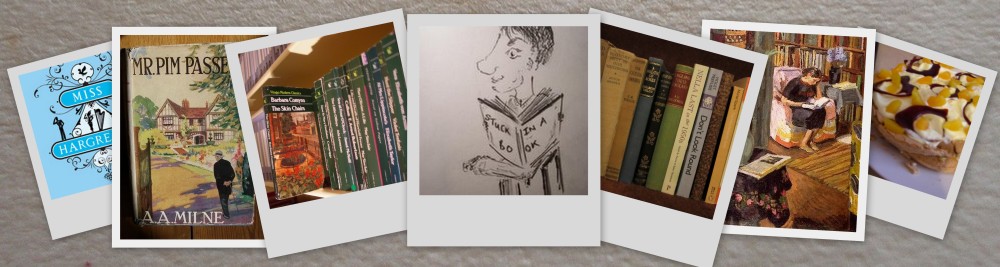
Appropriately enough, I watched The Great British Bake Off whilst baking a cake. It’s a coconut and lime sponge – a combination I haven’t tried before, so the proof is in the, er, pudding. Chocolate/lime sponge and coconut sponge with raspberry jam are my favourite types, so I thought combining bits of both might work… it’s out the oven and cooling, so I can’t show you a pic yet.

BUT (gosh, this is getting more loquacious than most Weekend Miscellanies) this is a good opportunity to show you a piccie or two of a 1950s cakestand I bought last weekend… so I have. I would have loved a three-tier cakestand, but the one I got is pretty darn beautiful…

3.) The book – is getting a bit ahead of myself, but Lyn (of I Prefer Reading) mentioned in our online book group that Capuchin Classics are reprinting Stephen Benatar’s When I Was Otherwise next March. His novel Wish Her Safe at Home rather charmed me recently, and with great titles including A.A. Milne’s Two People on their backlist, Capuchin may well have scored another triumph..

To be Frank(enstein)

As promised, today I’ll be talking about Frankenstein – and bonus marks to those of you know knew that the narrator is in fact Walton, a sailor who takes Frankenstein on board at the beginning of the novel. He relates the story Frankenstein tells him, who in turn breaks off to relay the Monster’s tale in the middle – so layers upon layers, wheels within wheels, and whatnot.

This was my first reading of Frankenstein, and was for a book group – which new Oxfordian Naomi (of Bloomsbury Bell) attended, by the by, and it was lovely to have her there. I was a bit worried, before I started the novel, that we wouldn’t have much to say about it. How very wrong I was – it was one of the best and most animated discussions that we’ve had, as we fiercely and (in my case) almost hysterically took sides. But more on that later…

Obviously, like more or less everyone, I was familiar with the image of Frankenstein’s Monster which has entered popular consciousness. I was even canny enough to know it was Frankenstein’s Monster, rather than Frankenstein, who was the… er, monster. (I’m going to refer to him as Monster throughout, which raises all kinds of issues I’m sure… but I’m going to do it anyway). Probably everyone here knows that much, regardless of whether or not they’ve read the book. And so I thought I knew what to expect when I got it out of the library. To an extent I was right… but for the most part I was not.

Firstly, who’s this Walton bloke? Like so many eighteenth century books – striving after ‘authenticity’ for their narrative, even when obviously fictitious? – there are layers surrounding the narrative, and to be honest I could have done without them. Walton is writing to his sister about his voyage to the Arctic, and in the third letter or so becomes embroiled with a mysterious man they’ve taken on board, one Frankenstein, who has a strange tale to relate… which Walton then writes out wholesale. I like to imagine Walton’s sister getting this letter, utterly nonplussed: “Er, Wally, I just wanted to know how you were getting on… not the ramblings of a madman.” I’d have been more than happy had all this been dispensed with, including the section documenting Frankenstein’s childhood, and instead we’d have started at the words which Mary Shelley claims came to her in a dream at a houseparty held by Byron. That’s how all my best anecdotes have started. It was on a dreary night of November The creation of Frankenstein was much what I expected, and of course it came as no surprise when the Monster came to life – but, even with foreknowledge, I still found this quite chilling: It was already one in the morning; the rain pattered dismally against the panes, and my candle was nearly burnt out, when, by the glimmer of the half-extinguished light, I saw the dull yellow eye of the creature open; it breathed hard, and a convulsive motion agitated its limbs.

How can I describe my emotions at this catastrophe, or how delineate the wretch whom with such infinite pains and care I had endeavoured to form? His limbs were in proportion, and I had selected his features as beautiful. Beautiful! – Great God! His yellow skin scarcely covered the work of muscles and arteries beneath; his hair was of a lustrous black, and flowing; his teeth of a pearly whiteness; but these luxuriances only formed a more horrid contrast with his watery eyes, that seemed almost of the same colour as the dun white sockets in which they were set, his shriveled complexion and straight black lips.

[…]

Oh! no mortal could support the horror of that countenance. A mummy again endued with animation could not be so hideous as that wretch. I had gazed on him while unfinished; he was ugly then; but when those muscles and joints were rendered capable of motion, it became a thing such as even Dante could not have conceived.As you see, Frankenstein himself was similarly disconcerted, and off he went in a fever for a while. It’s extraordinary the number of times this man swoons or has a fever – spending quite alarming quantities of time in bed. (Yes, Dad, I know). Off the Monster runs, and Frankenstein tries to think about other things… until he founds out his brother has died. Which is very sad, although perhaps would have been sadder had Frankenstein been much in touch with said brother for the past few years.

But what of the Monster? He eventually re-encounters his creator, and has his own tale to tell. Luckily Frankenstein and Walton both have extraordinarily good memories, and are able to quote the Monster verbatim… we hear how, confused and infantile, the Monster had taken to watching a family who lived in a cottage, all bursting at the seams with virtue and valour despite their poverty (and, what luck!, they’re actually exiled noblemen and noblewomen, so their poverty comes with none of that nasty taint of the lower classes.) The Monster learns French more or less by eavesdropping – he learns the words “son” and “daughter” and then, more or less instantaneously, the entire French language. In fact, this was what most surprised me about Frankenstein – how eloquent the Monster is. In my mind, he just bumbled around with his arms stretched out and knocked over shelves of potion bottles. Turns out, he’s quite the rhetorician. And I do love to read early nineteenth century novels for that beautiful rhythm they always seem to have – a perfect balance to each sentence. Jane Austen, of course, is the past-mistress of this, but Mary does a great job too.

Much of our discussion centred around the sympathies (or otherwise) we had for the characters… and I had very few for the Monster. Lots of interesting parallels drawn in the novel with Paradise Lost – one of the texts the Monster reads. And all sorts of God/creation ideas… how much responsibility does the Creator have for his Creation, and so forth. Nobody would have Frankenstein as their role model, and certainly wouldn’t choose him as their God, but I think the position he finds himself in is insurmountable, and thus I feel sorry for him… Naomi will doubtless come by and fight the other corner! Of course, I’d love to know anyone’s thoughts if they’ve read Frankenstein…

One final point – despite being penned by a woman, the women in this novel are ghastly! There’s only really two – Frankenstein’s cousin/betrothed, and the woman in the cottage which the Monster spies on. Both are hideously virtuous, with nary another characteristic. Par for the course, I suppose, but one might have hoped for a little more from the daughter of Mary Wollstonecraft…

Still – I’m very glad that I’ve finally read the novel, and haven’t just got hearsay to go on. I recommend it to anyone who likes to see these things first hand, and if you can wade through the first thirty or forty pages, the rest brings up all sorts of fascinating questions and arguments. Not bad, considering it was dreamt up by a 19 year old…

Books to get Stuck into:

I think these have turned up on the Stuck into selection before, but I don’t think you can do better for two 20th century novels about creating a human, and the intricate struggles between creator and created:

Miss Hargreaves – Frank Baker

The Love Child – Edith Olivier

Probably on his landing too


I’ve been rereading Howards End is on the Landing by Susan Hill, and thought it was amusing that the author of Howards End himself had this to say about his personal library (from Two Cheers For Democracy by E.M. Forster):

I have never been a collector, and as for the first edition craze, I place it next door to stamp collecting – I can say no less. It is non-adult and exposes the book-lover to all sorts of nonsense at the hands of the book-dealer. One should never tempt book-dealers. I am myself a lover of the interiors of books, of the words in them – an uncut book is about as inspiriting as a corked up bottle of wine – and much as I enjoy good print and good binding and old volumes they remain subsidiary to the words: words, the wine of life. This view of mine is, I am convinced, the correct one, but even correctness has had its disadvantages and I am bound to admit that my library, so far as I have created it, is rather a muddle. Here’s one sort of book, there’s another, and there is not enough of any sort of book to strike a dominant note. Books about India and by Indians, modern poetry, ancient history, American novels, travel books, books on the state of the world, and on the world-state, books on individual liberty, art-albums, Dante and book about him – they tend to swamp each other, not to mention the usual pond of pamphlets which has to be drained off periodically. The absence of the collector’s instinct in me, the absence of deliberate choice, have combined with a commendable variety of interests to evolve a library which will not make any definite impression upon visitors. (1949)

I’ve got an idea…

…but, thankfully for three men called Mike, Steve, and Dan, it is not the same idea as the title of Rohan O’Grady’s novel republished in the latest batch from the unutterably wonderful Bloomsbury Group. I can’t believe how little I’ve been heralding the return of this series, and I promise to Do Better. First stop, Let’s Kill Uncle.

On the face of it, this is an unusual choice for inclusion. The rest of the books have been in the first half of the twentieth century, more or less, and funny in an insouciant and harmless way. Let’s Kill Uncle was published in 1963, and is rather more sinister than anything else Bloomsbury have published in this series. There are large dollops of humour too, but you’re unlikely to find the following sentence in Miss Hargreaves or Henrietta’s War: “Maudie and I never had a family,” said Uncle sadly, “although we wanted one. So you see, Barnaby is doubly precious to me. I adore children.”

He did indeed. Several little girls to whom he had taken a fancy had vanished into thin air.But I’m getting ahead of myself. O’Grady’s novel is about an orphan called Barnaby Gaunt (wouldn’t Dickens be proud of that name?) who is sent for a holiday to a beautiful Canadian island. He’s renowned as a bit of a trouble-maker, and the gentle couple who take him in don’t quite know how to respond. They lost their son in the war, and Barnaby is a supposed substitute – but doesn’t live up to this image. He is disobedient and mischievous, although not a mean-spirited child… there are reasons for his behaviour, which will become apparent.

And there is Christie. She is the only other child on the island, and equally wild in spirits, though rather more inclined to obedience in front of adults. Their escapades together could have been the stuff of Enid Blyton (with perhaps a little edge) – except the fable-esque anxieties about smugglers become a much more real, and thus more chilling, threat from a murderous uncle. For Barnaby is due to inherit ten million dollars, and Uncle doesn’t want that happen. Uncle is a seriously twisted character – very psychologically manipulative (he beats Barnaby for being good, for instance, or tells him he may go to bed, but continually calls him back with idle comments) and with a history of many murders – but the exterior of a placid, harmless man. So, when Uncle turns up on the island, Barnaby and Christie resolve to take the only logical path: kill Uncle first.

The plan goes into action – whether they succeed or not I won’t tell you, but suffice to say there are all manner of adventures along the way. This is such a difficult novel to categorise. It’s not really like the other Bloomsbury Group novels I’ve read – it’s not cosy, it’s not really a novel to be loved and cherished; it’s too chilling for that. Uncle is simply too evil. But neither is it a ‘scary book’ – there are flashes of humour (‘The children loved the little church; it was such a pleasant, peaceful spot in which to plan a murder’) and a light-heartedness to the children’s activities which was at odds with their murderous plans. When I read in the blurb that Donna Tartt had called Let’s Kill Uncle a ‘dark, whimsical, startling book’, I was a little confused. Surely those words clash a bit when placed together? And I’m still not sure that there is much whimsy in the novel, unless you describe any scene without blood as whimsical – but it’s certainly the lightest dark book I’ve ever read. Or possibly the darkest light book.

So, there you go! Perhaps not what I expected from the Bloomsbury Group series, but certainly a good read – both dark and light, a strange and clever mixture. And not a little unnerving…

I haven’t seen the 1966 film, but found the trailer on YouTube – it seems to be quite a loose adaptation. For those who share my fear of s***ers, don’t watch the last ten seconds of the clip:

Books to get Stuck into:

The Vet’s Daughter by Barbara Comyns – I chose this one because it’s got another depiction of an evil parent-figure. Alice’s dad is like Uncle, in that they are all the more chilling for not being exaggerated. The portrait in The Vet’s Daughter is far more unsettling and brilliantly drawn, but the similarities are there…

Miss Ranskill Comes Home by Barbara Euphan Todd – not really much of a link, but I struggling to find similar books – the link here is an island!!

A Weekend of Novellas


The novella is probably my favourite literary form – you know how I love short books, and I really admire an author who can pack a lot into not many pages. Favourites from recent years of reading include The Heir by Vita Sackville-West and The Beacon by Susan Hill. Of course, ‘novella’ is a pretty imprecise term, but I would include more or less anything under 200pp.

Inspired by my love of all things short (including my housemate Mel :p ) and by Simon S’s recent discussions of the novella over at Savidge Reads, I’ve decided to have a little readathon at the weekend, and blitz my way through as many novellas as I can manage. It’s been ages since I had a whole day to myself, without other activities going on, so I shall enjoy a whole weekend with nothing (except church on Sunday) interrupting my reading…

And what have I got lined up? I don’t imagine I’ll manage all of these by any means, but waiting to be devoured are…


The Driver’s Seat – Muriel Spark (160 pages, but ENORMOUS font)
The Turn of the Screw – Henry James (118pp.)
A Kid For Two Farthings – Wolf Mankowitz (128pp.)
Portrait of the Mother as a Young Woman – FC Delius (125pp.)
Stevenson under the Palm Trees – Alberto Manguel (103pp.)
The Hours (screenplay) – David Hare (122pp.)
The Loved One – Evelyn Waugh (127pp.)

And, why not, let’s throw in Quilt – Nicholas Royle, mentioned yesterday (159pp.)

Give me a moment to do some quick mental arithmetic… ok, some pretty slow arithmetic… If I manage all eight books, that’s 1052 pages, I think. Hmm. Ok, I might not manage all of them, but I certainly intend to read as many as I can manage!


I can’t wait, I think it’s going to be a fun weekend. And, of course, it’s open to anyone who fancies joining me. I doubt many of you have the luxury of a weekend to indulge in just reading – but why not grab something under 200 pages that you’ve been meaning to read, and call next weekend your Novella Weekend?