TV Book Club Outing!

A little while ago I was asked, along with four other bloggers, to see the TV Book Club being recorded in London – and to meet the presenters. Naturally I was beside myself with excitement, and sent off a ‘yes’ to charming Richard who invited me. Before long I was meeting Claire (aka Paperback Reader) at Paddington for sushi, and then heading out to Cactus Studios. We didn’t even get lost, so that’s something to celebrate.The other bloggers there were David of Follow the Thread (whom I had met a couple of times before), Keith from Books and Writers , and Cherry of Cherry Mischevious. Clicking on those three links will take you to their thoughts about the day – because they’ve been a bit more organised than me. I’ll pop in a link to Claire’s post later today. EDIT: here it is!


I have seen a few programmes being recorded before, including My Life in Books earlier in February, but this one doesn’t actually have a studio audience. We felt very privileged – sitting on chairs, leaning against the counter of Saturday Kitchen (which, in turns out, is filmed in the same studio), and watching the presenters discussing Bleed For Me by Michael Robotham. It’s a gory thriller set in a small Somerset village. A bit close to home. I’ve got to say, despite the presenters and VT book group raving about it, nothing about the novel appeals to this squeamish reader. Although, having said that, Jo Brand assured me afterwards that she loved it despite being squeamish.

That’s right – Jo Brand spoke to me! We were invited to the Green Room for tea and cake aftewards (it was Charlotte’s birthday and she kindly shared her delicious birthday cake – I was pleased to see that the stick-thin, uber-glamorous TV types still ate cake. I was worried it would just be me cramming it into my mouth in the corner.) Jo Brand, Meera Syal, and Dave Spikey came and had a nice, friendly chat with us. Jo Brand is my favourite comedienne, and I was *so* excited to meet her – I tried to keep my cool and be nonchalant, but I don’t think I’ve ever really successfully grasped nonchalance… at least I didn’t break down in tears, sobbing about how much I love her.

As for the show – I love that the presenters (who also include Ade Edmondson and Laila Rouass) are passionate about books, and that this programme is shown. TV Channels seem to be waking up to the fact that a lot of people love books. I just wish the TV Book Club, in many ways admirable, would have the courage to avoid dumbing down at all. Not in their choice of books – they seem great in general – but in the format of the programme. Nigel Havers was great on the episode I saw, and the pre-recordered VTs etc. are usually fun and interesting, but please let’s cut some of the celebrities coming on to shift their biographies. Case in point – Ken Barlow from Coronation Street flogging his book; the first thing he said was “I’ve never been much of a reader.” BUT this is a small niggle with the show, which overall I think is great.

Oh, and then we were given a bunch of books to take home, and a goody bag from Specsavers (who sponsor the show, and were responsible for us being there – so I’m going to shamefully advertise them. I wear Specsavers’ glasses myself, and they’re pretty fab.) Thanks Richard and Candace who arranged it; Amanda Ross (most powerful person in the book industry!) for showing us around the technical bits; Charlotte for giving us cake, and Jo Brand for making a little dream of mine come true.

3 Quarks Daily – Vote!

I meant to tell you about nominations for the Best Arts and Literature Blog Post thingummy over at 3 Quarks Daily, but kept forgetting… and now the deadline has passed for nominations. Sorry! But do head over and vote, please!

Click here to vote. I nominated Rachel (Book Snob) for her post on Gilead, and then threw my own review of Gilead into the hat – so a vote for either of those would be very welcome!

There is a monetary prize of no little significance… once someone official gets to see the shortlist. So it would be wonderful if me and Rachel could make the shortlist :D

Song for a Sunday

I couldn’t find a non-live version of this song on YouTube, so I went and made my first ever Movie Maker video. And when I say ‘made’, I mean I typed a few words onto a picture I took on holiday in 2009, and then put the song on it. I had no idea it was that easy. They might have just unleased a monster…

The song is ‘Seafarer’ by Kate Walsh (not the American actress, btw), from the beautiful album Light & Dark. Enjoy!

Referrals and Deferrals

I was going to write a long, musing post about classics and non-classics, and how reading obscure novels does and does not help one become ‘well-read’ – but I’m sleepy and haven’t watched Emmerdale yet, so I’m putting that post on hold… and will instead quickly mention a book I now want. Sister Wendy Beckett – the nun and art historian – was on My Life in Books this week, and was absolutely wonderful. Such a lovely, engaging, inspirational woman – and she left me very much wanting The Duty of Delight: the Diaries of Dorothy Day – even though I still have very little idea who Dorothy Day was. All I know is that she was a co-founder of the Catholic Worker movement (about which I know almost nothing) – but Sister Wendy was persuasive enough to convince me I’d find this book hugley insightful and, again, inspirational.

Drawback being, of course, that it’s over £30. I’ll have to wait until the paperback comes out in October, for under £10 – rather more affordable. But I thought I’d mention it first, in case any of you have read it – and maybe to inspire you to find it in your library. Or perhaps you have £30 you’re keen to spend on books?

Which reminds me – on Monday I finally finished unpacking (we moved last July) and found £10 of book tokens! Actually book-token-cards… which might have expired. Hmm… Usually book tokens last approximately ten seconds in my hands, but Project 24 meant they lingered a bit. I’ll have to pop into Waterstone’s and see if they’re still valid. And then – guilt-free book buying! (Another reminder – I *still* haven’t revealed my haul from a trip to London a few weeks ago. So many things to write about…)

To See Ourselves

Burns’ (anglicised) line ‘Oh would some Power the gift to give us / To see ourselves as others see us’ was one which Delafield played with on a couple occasions (the brilliant collection of sketches As Others Hear Us, and the play To See Ourselves which later proved inspiration for VMC The Way Things Are). More broadly, I think it can be seen as the cornerstone of her writing – whether witty or sad or biting (and Delafield excels at all of these, in different works) her primary technique is demonstrating people’s lack of self-awareness.

Danielle and I have both been reading Gay Life (1933) and both our reviews will appear today – if I’ve understood time differences properly, then Danielle’s will come along later. It is another example of characters who have built up false images of themselves – but rather than having a single focus, Gay Life is filled with a cast of many. We see through nearly all of their eyes at different points, and thus Delafield builds up many perspectives on the same few days and group of people. They’re all on a long holiday in the South of France, staying at a hotel, mostly having stayed to the point where they know each other reasonably well and have separated wheat from chaff – usually getting stuck with the chaff. Delafield’s title, of course, uses ‘gay’ in its original sense – but also ironically. Despite the supposedly delights of the resort, few of the characters are enjoying themselves; even fewer have happy or uncomplicated relationships with those around them.

There are so many people – I ought to start introducing them. Hilary and Angie Moon are recently, and dejectedly, married (‘The little that they had ever had to say to one another had been said in the course of an electrically-charged fortnight, two years earlier, when they had fallen desperately in love.’) She’s already on the look-out for a new beau, but isn’t likely to find it in grumpy Mr. Bolham, still less his hapless secretary Denis. Angie’s not the only woman willing to welcome love – Coral Romayne is besotted with Buckland, the beefy holiday tutor hired ostensibly to teach her neglected son Patrick. There are a few more, but I don’t want to dizzy you.

EMD is mistress of the brief description which utterly reveals a character and their flaws. This, for instance, is Denis: ‘Morally – in the common acceptance of the term – he had remained impeccable, for he was both undersexed and inclined to a physical fastidiousness that he mistook for spirituality.’ And Dulcie, one of the most amusing characters in the novel, who is the daughter of a hotel entertainer, and thus treading an awkward line between guest and servant: ‘Dulcie continued to prattle. It was evidently her idea of good manners, to permit no interval of silence.’

One character I haven’t mentioned, who is awfully significant, is the novelist Chrissie Challoner. She is staying in a house near the cottage, and one of the central threads of this multi-faceted novel is her encounter with Denis. He’s had a rather pathetic life, but she immediately sees through his facade of worldliness – and rather falls in love with his true self. Which leads to all manner of moonlight proclamations and furtive assignations. Being honest, I was a bit worried at this point. A lot of interwar novelists try their hand at romance and flail a bit madly. It’s all much more comfortable for the reader when they’re being arch and detached – and there is nothing detached about Chrissie’s pondering on his inner being, declaring she has never felt this before, etc. etc. I daresay such things are enjoyable to the people experiencing them, but not really to the reader…

But, of course, I ought to have trusted Delafield not to err. After a few pages where it seems Denis may have finally met a woman who will understand and appreciate him… but no, I shan’t spoil the plot for you.

Besides, Delafield is never too earnest. The humour of The Provincial Lady is toned down, but makes it appearances, especially when Dulcie is on the scene.
“Mr. Bolham, is your bedroom door locked?”

“Why should my bedroom door be locked?” said Mr. Bolham. “I’ve nothing to hide.”

Dulcie gave a thin shriek of nervous laughter.

“You are funny, Mr. Bolham. I shall die. I suppose it did sound funny, me putting it like that. What I meant was, really, could I possibly pop in there, just for one second, to get something – well, it’s a bathing-cloak really – that’s fallen on to your balcony.”

“Again?”

Dulcie giggled uncertainly.

“It’s not my fault, Mr. Bolham,” she said at last, putting her head on one side.

“I know. It’s the Duvals.”

“It just dropped off their window-ledge, you know.”

“Did madame Duval send you to get it?”

Dulcie nodded.

“I expect she thought you might be a tiny bit cross, as it’s happened so often,” she suggested.

Mr. Bolham felt her eyeing him anxiously, to see if this would get a laugh. He maintained, without any difficulty, a brassy irresponsiveness, and Dulcie immediately changed her methods.

“I like to do anything I’m asked, always – my Pops says that’s one of the ways a little girl makes nice friends,” she observed in a sudden falsetto. “And Marcelle – she lets me call her Marcelle, you know – she’s always terribly sweet to me. So naturally, I like to run about and do errands for her, Mr. Bolham.”

“Well, I hope you’ve enjoyed doing this one,” said Mr. Bolham sceptically. “I’ll send the towel, or whatever it is, up by the chambermaid.”
Although there are some central players in Gay Life, the cast is so wide that things don’t get dull or stilted. Delafield takes it in turns to focalise goings-on through the eyes of each character, so that we are still learning back-story well on into the last quarter of the novel – so it feels more like meeting every guest at a hotel than it does like a linear novel. Presumably that is the effect EMD wanted – and it certainly works. Plot isn’t entirely unimportant, though – and a Big Event rears its head towards the end.

Danielle asked me, in an email, what else I’d read by Delafield. I did a quick count on the back of a piece of scrap paper, and realised that I’ve read 19 books by EMD – mostly in pre-blog days, and a fair few in pre-uni days, when I could afford to indulge in one author for a month or two. (Favourites include: As Others Hear Us, Mrs. Harter, The War Workers, Faster! Faster!, Consequences…) Of that 19, I have read no duds. Gay Life isn’t the best of those reads – in fact, it probably lags somewhere towards the end – and yet it is really very good indeed. EMD deservedly has most of her fame from the Provincial Lady books, which are sublime and which I can well imagine reading every year for the rest of my life – but her other works shouldn’t be neglected. She seems incapable of writing a bad novel, and if most play towards sombreness and melancholy, she can never quite avoid the comic touch.

Gay Life is incredibly scarce, but you might be able to find it in a library. But you can’t go wrong with a Delafield – and I encourage you to look beyond the Provincial Lady books (and, of course, to read those IMMEDIATELY if you have yet to do so). It is wonderful that she is remembered at all, but she leaves a legacy of works which have been sadly neglected – have a hunt in your library archives and see what you can find! Go on, have a search now – and let me know what’s available in your area.

I’m looking forward to hearing Danielle’s response to this novel, and will put in a link here once her review appears. EDIT: here it is!

A Book By Any Other Name…

Having recently chatted about William by E.H. Young, and Howards End by E.M. Forster, I’ve been thinking a bit about the naming of books. In both cases the focus laid at the feet of the man and the house (respectively) comes about mostly through the authors’ decisions about titles. How easily could Young’s novel have been called Lydia or The Nesbitts? Or something hazy like Decisions Once Made or Marry in Haste. You know the sort of thing. (Incidentally, the Oxford University library catalogue has eight books called Marry in Haste, dating from 1935 to 2000. What fun it would be to read them all, one after the other… Although four of them are Mills & Boon.)

As for Howards End – so many other titles would spring to mind first, if one were somehow to read an untitled edition. Helen and Margaret. The Lure of the Wilcoxes. Even, one might say, Sense and Sensibility. If any of these had been chosen, the significance of Howards End itself would have faded into the background.

This might seem a really facile point, but I find it fascinating how much these titles influence the way in which we read these novels – and how differently we would read them, had they more obvious titles. Why does Emma get her own title, where Mansfield Park claims the coveted spot there, and Persuasion’s title is handed over to a noun? Would we read these differently as Delusion, Fanny Price, and, erm, whatever Anne Elliot’s house is called. (Although apparently there is no evidence that Jane Austen chose the title Persuasion.)

Just something to think about when reading a novel – it isn’t something that usually crosses my mind, until titles are as directed as those which inspired today’s post. I know it’s a horrible cliche to end a blog entry with ‘question time’, but… Can you think of any book with a title which pointed your view in one direction, or which would read very differently under another title?

Howards End by E.M. Forster

I wrote quite a lot last year about being Third Time Lucky with Muriel Spark and Evelyn Waugh – after not loving a couple of their novels, I was bowled over by the third I read. Well, ladies and gents, it’s happened again! This time, courtesy of Mr. E.M. Forster. I admired, but didn’t particularly relish reading, A Room With A View and A Passage to India. Both were obviously well written books, but neither quite worked for me, and I found them more of a chore than a pleasure. A reliable friend told me that she’d felt the same way about those novels, but loved Howards End – I couldn’t make myself read it unaided, so persuaded my book group to read alongside me. Plus, having loudly proclaimed my love for Susan Hill’s Howards End is on the Landing, it seemed only right that I read the novel which inspired the title.


Well, thank you Sarah for telling me to persevere – I loved Howards End. In outline (and not giving away the huge plot points that my blurb does – BAD Penguin Classics) the novel is about the interaction of the Schlegel and Wilcox families. Impetuous Helen Schlegel and her more cautious, sophisticated (but often equally romantic – in the original sense of the word) sister Margaret first encounter the Wilcoxes on holiday somewhere, I think, but the action of the novel starts as Helen is staying with the Wilcoxes at Howards End. Within a few pages she has written to Margaret to announce herself engaged to Paul Wilcox – by the time their aunt has arrived on the scene, the engagement has been called off, but not before all manner of amusing confusion has taken place – and enough happened to make the families wish to avoid each other in perpetuity.

Naturally, this is not to be. The Schlegels and the Wilcoxes find themselves living opposite one another, and engaging in the same society. The romance between Helen and Paul is quickly put in the background, and their paths cross in all manner of other ways – during which we learn more about all the characters, including Paul’s father Henry Wilcox. Although at one point he is described as having ‘imperishable charm’, in general he is one of the more loathsome characters I’ve ever found within the pages of literature. The sort of man who favours logic over people, and is always able to argue himself rationally out of the most uncaring or selfish actions. Such a frustrating figure – and drawn so well by Forster – since it is almost impossible to fault his arguments, even while everything in you knows they are wrong. Eugh, he is truly horrible.

Woven throughout the novel are Leonard Bast and his, ahem, fiance Jacky. Leonard is a lowly clerk with cultured aspirations; Jacky is somewhat lowlier, and utterly without aspirations of the cultural variety. His life crosses with the Schelegels when Helen accidentally swipes his umbrella at a concert (‘”I do nothing but steal umbrellas! […] What about this umbrella?” She opened it. “No, it’s all gone along the seams. It’s an appalling umbrella. It must be mine.” But it was not.’) Forster is not so crude as to have stock figures, but it can still be said that Bast represents the lower-middle-classes. He is intelligent, and yearns after the outward signs of it; the Schlegels, on the other hand, see his natural affinity for beauty – and hate any affected attempt he makes to cloak himself in learning. The clash of these sensibilities leads to some wonderful exchanges, including (overblown analysis alert) two of the best pages of writing I can remember reading. Jacky – only a rung or two above the oldest profession in the world – gets it into her jealous head that Leonard is with the Schlegels and turns up on their doorstep. At this point they have forgotten who he is, and Helen reports back her conversation with Jacky. That is the genius of the section – which the (otherwise admirable) film misses. What makes it brilliant is that we don’t see Jacky’s explosive accusations – only Helen’s account of them, which reveal both her snobbery and her self-awareness;

“Annie opens the door like a fool, and shows a female straight in on me, with my mouth open. Then we began – very civilly. ‘I want my husband, what I have reason to believe is here.’ No – how unjust one is. She said ‘whom’, not ‘what’. She got it perfectly. So I said, ‘Name, please?’ and she said, ‘Lan, Miss,’ and there we were.”
and
“We chatted pleasantly a little about husbands, and I wondered where hers was too, and advised her to go to the police. She thanked me. We agreed that Mr. Lanoline’s a notty, notty man, and hasn’t no business to go on the lardy-da.”

There’s something about indirect, reported speech that always has the potential to be hilarious…

To reveal the further entanglements of these characters and families would be to reveal too much. They do not – can never – escape one another, though, and their idealistic differences become increasingly difficult to overcome. Characters are rarely in opposition to each other – Forster’s brushstrokes are not that broad. Rather, he creates realistic characters whose opinions sometimes change; whose values are not always sturdy or practicable, and who do not always say exactly what they mean, or what they wish to say.
Lest this all sounds terribly worthy, I should reiterate that Howards End is also really funny – mostly humour derived from the foibles of class and the society. To pick one amusing sentence: ‘He did not kiss her, for the hour was half past twelve, and the car was passing by the stables of Buckingham Palace.’

What makes Howards End so good, in my opinion, is the melee of the characters – and the directions in which their conversations go. So often exchanges take unexpected turns – steering away from novelistic cliche. In doing so, Forster is endlessly perceptive about how people do interact. If, occasionally, he gets a little bogged down in political or societal arguments (‘Only connect’, and suchlike) it must be conceded that these suit his characters, and (unlike some of them) he always puts people ahead of these ideas and ideals. There is much beauty in the way he writes, and endless attention to detail. This is picked more or less at random, but I thought it a lovely paragraph – adding nothing to the plot, but everything to the pleasure of reading the novel:

They drew up opposite a draper’s. Without replying, he turned round in his seat, and contemplated the cloud of dust that they had raised in their passage through the village. It was settling again, but not all into the road from which he had taken it. Some of it had percolated through the open windows, some had whitened the roses and gooseberries of the wayside gardens, while a certain proportion had entered the lungs of the villagers. “I wonder when they’ll learn wisdom and tar the roads,” was his comment. Then a man ran out of the draper’s with a roll of oilcloth, and off they went again.

Throughout most of the novel, Howards End itself remains elusive. We see it at the beginning; we are teased with another visit, where Margaret makes it only as far as the railway station. Like the lighthouse in Woolf’s To The Lighthouse, Howards End represents something to be reached and attained, rather than a constant physical presence in the novel. It flits in and out of the novel’s pages, offering something which it eventually completely subverts.

Perhaps I loved it because Forster had his characters on home turf, rather than acting as tourists? I find novels set abroad (unless they’re written by someone from that country) tend to become travel guides, and those are very much not my cup of tea. Or perhaps Howards End is simply more astute and, well, better? I don’t know. I’m just glad that I continued to try Forster – and grateful that he wrote a novel so beautifully and perceptively.

I’d love to hear from any of you who’ve read this, and how you think it compares to other Forster novels. I’d especially like to hear from you if you’ve read Zadie Smith’s On Beauty – a reworking of Howards End, I believe – to know whether or not it’s worth bothering with?

My Life in Books

I was intending to finish another Persephone book today, but that was wildly ambitious, since I have over 200pp left to read of it still… so another Persephone review will be turning up at some point, and for now I’ll just thank Claire and Verity for their stirling work. (Thanks, ladies!) Persephone Reading Week[end] seems to get bigger every year, even if the number of days have shrunk – and I’m sure lots of us have added potential reads to our real or imaginary tbrs. I realised I still ahve 26 unread Persephones on my shelf, so I shan’t be buying any more for a while (though have my fingers crossed for winning one of the competitions I entered.)

So, instead of a review, I’ll mention My Life in Books. Has anyone been watching this? Anne Robinson almost succeeds in putting away her steely glare, and asks authors and other famous people to talk about the books they have loved throughout their lives, and a bit of biographical info thrown in. I think it’s a great idea, and has led to some interesting programmes. There’s one on every night for two weeks, and we’re in the middle of ’em now – all so far available to watch here, if you like in the UK (and maybe if you don’t – I’m never sure about these things.)


So far, I think I most enjoyed the programme with Sue Perkins and Giles Coren – both pretty funny people, with interesting choices. Perkins’ mention of The Queen of Whale Cay by Kate Summerscale, about a rich, eccentric playgirl Joe Carstairs, was especially intriguing. Also one of the few surprising choices – my only criticism is that most of the guests seem to have loved a diet only of classics. Truly fanatical readers have to find their own niches in the libraries of the world, surely, rather than simply love received wisdom. But perhaps the BBC persuaded them to pick books they had video clips of?

Some great pairings so far – I wouldn’t have expected PD James and ‘disgraced ex-Blue Peter presenter’ Richard Bacon to have much in common, but they actually had a lovely conversation. I can’t wait for Debo Devonshire’s episode, coming up this week. Jeanette Winterson and smarmy-spin-doctor Alastair Campbell could be interesting… What is wonderful, though, is how enthusiastic the guests are about books – they really do love reading. They discuss re-reading, or the merits/demerits of adaptations, to the manner born; they chat about Austen, Dickens, Melville, Dostoevsky with affection and knowledge. I can’t believe a programme this bookish and, yes, intelligent is being shown on a terrestrial TV channel – this NEVER happens. Much as I genuinely enjoy the TV Book Club and their presenters (more on’t next week), the content – outside of the author interview and the actual book discussion amongst the delightfully literature-lovin’ presenters – often dumbs down a little. I saw an episode the other day in which the first thing the guest said was “I’ve never been much of a reader.” Indeed.

So, head over and have a watch, if you can. You (like me) will doubtless come away wishing that you and other bloggers could be taking the place of the guests… well, if so, watch this space…

From Tiny Acorns


I’ve been looking forward to Persephone Reading Weekend for ages, so apologies that I’m joining in quite late in the day – yesterday I was so tired that I went to bed at 8.30pm. The fact that I was still awake at 2am was not fun… nor did I read much of this book during those hours (my eyes always give up before the rest of my mind/body does) but it was a quiet day today, so read the rest of it – ‘it’ being Saplings by Noel Streatfeild. (And aren’t the endpapers beautiful?)

I bought Saplings (1947) in 2004, I think, and somehow it has languished on my shelves since then. It even came on holiday with me once, but didn’t get as far as being read – no real reason for this neglect. Perhaps because I haven’t read any of Streatfeild’s books for children? Perhaps simply because it came in over my 300pp bench-mark for ideal reads. But it finally came down from my bookcase, and I can report back.

I’ve got to confess – the first few pages didn’t win me over. It would be nice to be completely positive during an Appreciation Weekend, but I’m afraid I’m going to pick a few holes in Streatfeild’s work – although overall I was very impressed. Let’s get that out there now, so that this doesn’t feel too complainy a review. But those first few pages – we’re on a beach with the Wiltshire family. Laurel, Tony, Kim, and Tuesday (yes, Tuesday – has this ever been a name?) are messing about, playing, and doing things like this:
Kim was singing to a tune of his own, ‘The sea, the sea, the lovely sea.’ His happiness was given a sharp edge by fright. The day was going to be very scrumptious. Dad and Mum were here, and there was going to be a picnic and prawning; but first there’d be the bathe and Dad would make him swim to the raft.Oh. This felt very much like Streatfeild hadn’t taken off her children’s-writer hat, and was merely giving adult novel writing a go. My heart sank a little.

When the focus switches around to their parents Alex and Lena, however, things started to improve. Alex is a hands-on father, always conscious of what his children might be feeling, and doing his best to help them grow up properly and well-disciplined without being thwarted or unhappy. He is one of the best fathers I’ve come across in literature – rather better than E.H. Young’s William, I’d say – and still fairly convincing. His major fault, in my eyes, is sending the children to boarding school. Lena, on the other hand, is not of a maternal disposition, and misses being her husband’s sole object of affection. Through the eyes of the holiday governess Ruth, this is how Lena comes across:
On other counts Lena was not so good. She never even pretended the children came first. But did that matter? Was that not out-balanced by the perfect love always before the children’s eyes? Ruth, helping herself to peas, knew one of her more noticeably amused flicks was crossing her eyes. Was it perfect love the children saw? Certainly Lena loved Alex, but perfect love in her philosophy was an ill-balanced affair, almost all body, the merest whiff of soul.It is in her allusions to Lena’s various, ahem, appetites that Streatfeild most prominently demonstrates that this is not a children’s book. (P.134 made me gasp a little…) But alongside this we do get the bread and butter of children’s lives – the four children are well-drawn, and certainly have formed and individual characters. Kim the show-off, who craves attention but can’t control the way in which he seeks it; Laurel the dependable eldest sibling, but fraught on her own; Tuesday who wishes only to have her family around her; Tony who asks such pertinent questions, and worries too much. All painted convincingly with Streatfeild’s brush – but still it feels a little like one is reading a children’s book with longer words… There’s even a Nanny of the indomitable variety.


But things are about to change. I shan’t spoil the big event which changes the course of the novel, but suffice to say that a tragedy occurs to alter the lives of all concerned. And it’s from here that Streatfeild comes into her own – we follow the children to their various schools as they cope with this tragedy in their various ways. They come home for holidays, and we see the reunions then. In the background is always the war – rarely creeping nearer than the background, but certainly getting no further away.

Somewhere towards the last third of the novel Laurel, Tony, Kim, and Tuesday are split up for the holiday and must each spend time with a different Aunt. There were definite overtones of Richmal Crompton’s Matty and the Dearingroydes here – snapshots of various intriguing or eccentric family units. It should have been a different novel, really – they just came flitting past, and were gone before you could grasp hold of them. I’d happily read many more chapters, for instance, about the vicarage family where loving vicar’s wife Sylvia lovingly makes up holy reasons to excuse her children doing things their father might find worrying. Since Streatfeild is, like me, a vicarage child, it would be fascinating. Structure isn’t Streatfeild’s strong suit – Saplings seems to explode somewhat, proliferating with characters and going off at tangents, right until the final pages.

Structure may not be her trump card, but there is still a lot to love in the novel. Chief amongst these is the way in which she demonstrates the damage done to families and children by war. A lot of this damage would have been done by separating them from each other and their parents in their schooling, but war still has its undeniable effects. There is a rather silly Afterword from Dr. Jeremy Holmes, a Psychiatrist who reads Saplings through the lens of child psychology. In doing so, he completely ignores the fun that Streatfeild pokes at this field – it is no coincidence that the Aunt who makes generalisations about child psychology is the only one who has no children of her own. Despite this misreading, it is true that Streatfeild is insightful into the child’s mindset – although she would never, I am sure, have labelled this insight psychology.

Perhaps it is unfortunate for Saplings’ sake that I have read so many good books this year. One can’t help think how much better E.H. Young creates family dynamics; how much more insightfully Barbara Comyns gives the voice and mind of children; how much more poignant Marilynne Robinson can be. Comparisons, as Mrs. Malaprop intended to say, are odious – and on its own merits, Saplings is a fantastic read. It’s engaging, occasionally moving, and certainly enjoyable. Maybe seven years on my shelf had built up its potential too greatly for me? I shall learn not to lament the novel Saplings was not, and heartily enjoy the novel that it is.

More William

Do keep popping over to Darlene’s review and the discussion of William – it’s here, and kicked off a bit early to compensate for all our differing timezones.


And over here, it’s time for a giveaway: I picked up a copy of William while in Edinburgh, and thought I’d pop it in the post to someone who hadn’t had luck in tracking it down. If you’ve been intrigued by the various reviews popping up, then just put your name in the comments (open worldwide). Actually, that’s too easy – I want to know your favourite book with a person’s name for its title! Let me know that, and a random entrant will be picked sometime next week.

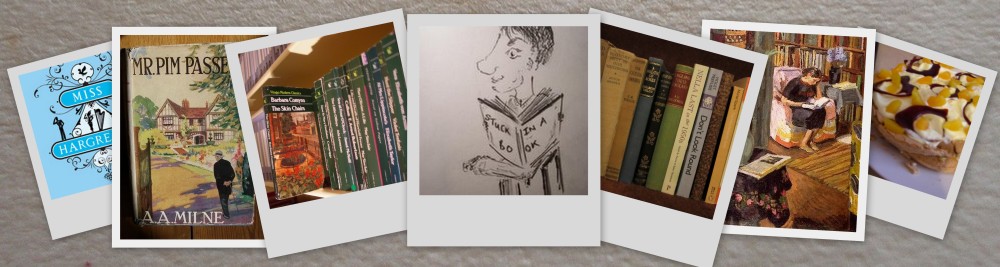
Mine – don’t know if you’ve heard it mentioned – is Miss Hargreaves…