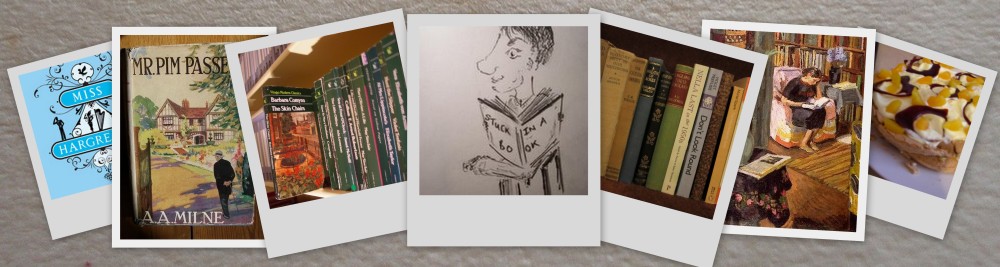
Song for a Sunday

I re-watched the film Nine a couple of days ago.  It got middling-to-poor reviews, and it’s true that the storytelling isn’t great, but the cast certainly is.  Unbelievably, in a film starring two of my favourites – Dame Judi Dench (showing how great she looks with a flapper bob) and Nicole Kidman – it was Marion Cotillard who stole the show.  That woman is simply brilliant.  And she sings what is easily my favourite song from the film: My Husband Makes Movies.  I love it so much that I can cope with the word ‘movie’ for once.  Here she is:

Two competitions…

I’ve turned over the Weekend Miscellany to competitions – one of which could win you all sorts of bookish goodies from Glasses Direct, and the other of which could see you choosing Hesperus Press‘s next reprint.  On with the show…

I’m copying and pasting the Glasses Direct competition:

1.) To celebrate Glasses Direct’s new blog, the online prescription glasses retailer has launched the GD Book Worm Club, an online competition that encourages book readers, whether avid or occasional, to post their reviews so that others can read up on their recommendations on a plethora of reads. Whether it be a good old paperback, a Kindle or Kobo, Glasses Direct want glasses wearers to join the GD Book Worm Club.
Each month, GD Book Worms can submit their reviews on a book they’ve read, which will then be posted onto the Glasses Direct blog. Whichever review gets the most happy comments wins that months star review.

Each monthly winner will receive a star prize, as well as a pair of glasses. For April, the winner will receive a Kindle Touch, a pair of Element or London Retro frames with their prescription and one of the Spring Summer 2012 goody bags* from the glasses e-tailer’s press event, held at The Soho Hotel this April.
Email your entries to: gdwin(at)glassesdirect(dot)com
And don’t forget to include a picture of yourself with the book! (If you’re camera shy, just the book will do but we’d rather see your lovely faces)

*Goody Bag Contents:
1 pair of designer sunglasses (Chloe, Serengeti, Marc Jacobs, Armani etc)
Handmade speccy cookie from Love Birds
A gift voucher for a pair of Element or London Retro specs.
Spectacle necklace
Retro sweets (no reason, but who doesn’t love sweets?)
Eco-concious cotton lunch bag
London Retro/Element USB stick.

2.) I spotted a great post on Lyn’s blog, giving the opportunity for readers to choose the next Hesperus Press classic title.  I hadn’t seen or heard anything from Hesperus for years, and was rather worried that they’d disappeared, but I’m delighted that that isn’t the case.  Before themed blog weeks really existed, I ran an I Love Hesperus week – gosh, years and years ago – what fun it was!

To celebrate their 10th anniversary, they’re looking for 500 word submissions suggesting out of print classics (usually pretty short – 100-200 pages) that they could reprint, and why.  The deadline is 1st June, and the book would come out in September – more info here.  The 500 words will form the introduction for the winning book.

Their books are always so beautifully produced, as well as having great contents.  You can read all my Hesperus reviews here, and start wracking your brains!

Books I Borrowed…

There are a few books I’ve borrowed from friends and libraries which have now been returned, and so I’m going to give each one a paragraph or two, instead of a proper review.  Partly so I can include them on my Century of Books list, but partly because it’s fun to do things differently sometimes.  Of course, it’s entirely possible that I’ll get carried away, and write far too much… well, here are the four books, in date order.  Apologies for the accidental misquotation in the sketch today… I only noticed afterwards!

Canon in Residence – V.L. Whitechurch (1904)
This was surprisingly brilliant. Rev. John Smith on a continental holiday encounters a stranger who tells him that he’d see more of human life if he adopted layman’s clothes.  Smith thinks the advice somewhat silly, but has no choice – as, during the night, the stranger swaps their outfits.  Smith goes through the rest of his holiday in somewhat garish clothing, meeting one of those ebullient, witty girls with which Edwardian novels abound.  A letter arrives telling him that he has been made canon of a cathedral town – where this girl also lives (of course!)  He makes good his escape, and hopes she won’t recognise him…

Once in his position as canon, Smith’s new outlook on life leads to a somewhat socialist theology – improving housing for the poor, and other similar principles which are definitely Biblical, but not approved of by the gossiping, snobbish inhabitants of the Cathedral Close.  As a Christian and the son of a vicar, I found this novel fascinating (you can tell that Whitechurch was himself a vicar) but I don’t think one would need to have faith to love this.  It’s very funny as well as sensitive and thoughtful; John Smith is a very endearing hero.  It all felt very relevant for 2012.  And there’s even a bit of a criminal court case towards the end.

Three Marriages – E.M. Delafield (1939)
Delafield collects together three novellas, each telling the tale of a courtship and marriage, showing how things change across years: they are set in 1857, 1897, and 1937.  Each deals with people who fall in love too late, once they (or their loved one) has already got married to somebody else.  The surrounding issues are all pertinent to their respective periods.  In 1897, and ‘Girl-of-the-Period’, Violet Cumberledge believes herself to be a New Woman who is entirely above anything so sentimental as emotional attachments – and, of course, realises too late that she is wrnog.  In 1937 (‘We Meant To Be Happy’) Cathleen Christmas marries the first man who asks, because she fears becoming one of so many ‘surplus women’ – only later she falls in love with the doctor.  But the most interesting story is the first – ‘The Marriage of Rose Barlow’.  It’s rather brilliant, and completely unexpected from the pen of Delafield.  Rose Barlow is very young when she is betrothed to her much older cousin – the opening line of the novel is, to paraphrase without a copy to hand, ‘The night before her wedding, Rose Barlow put her dolls to bed as she always had done.’  Once married, they go off to India together.   If you know a lot more about the history of India than I do, then the date 1857 might have alerted you to the main event of the novella – the Sepoy Rebellion.  A fairly calm tale of unequal marriage becomes a very dramatic, even gory, narrative about trying to escape a massacre.  A million miles from what I’d expect from Delafield – but incredibly well written and compelling.

Miss Plum and Miss Penny – Dorothy Evelyn Smith (1959)
Miss Penny, a genteel spinster living with her cook/companion Ada, encounters Miss Plum in the act of (supposedly) attempting suicide in a duckpond.  Miss Penny ‘rescues’ Miss Plum and invites her into her home. (Pronouns are tricky; I assume you can work out what I mean.)  It looks rather as though Miss Plum might have her own devious motives for these actions… but I found the characters very inconsistent, and the plot rather scattergun.  There are three men circling these women, whose intentions and affections vary a fair bit; there are some terribly cringe-worthy, unrealistic scenes of a vicar trying to get closer to his teenage son. It was a fun read, and not badly written, but Dorothy Evelyn Smith doesn’t seem to have put much effort into organising narrative arcs or creating any sort of continuity.  But diverting enough, and certainly worth an uncritical read.

The Shooting Party – Isabel Colegate (1980)
Oh dear.  Like a lot of people, I suspect, I rushed out to borrow a copy of The Shooting Party after reading Rachel’s incredibly enthusiastic review.  Go and check it out for details of the premise and plot.  I shall just say that, sadly, I found it rather ho-hum… perhaps even a little boring.  The characters all seemed too similar to me, and I didn’t much care what happened.  Even though it’s a short novel, it dragged for me, and the climax was, erm, anti-climactic.  Perhaps my expectations were too high, or perhaps my tolerance for historical novels (albeit looking back only sixty or seventy years) is too low.  Sorry, Rachel!

Somerset: The Books

Whilst down here in Somerset, I have been mostly adoring the cat, but also jaunting off to various places – including, yesterday, sunny Lyme Regis…

…and whilst out and about I have, of course, been buying some books.  Being the gent that I am, I thought I’d share my spoils with you – asking the usual questions: have you read them, and what do you think?

Letters – Sylvia Townsend Warner
I had a copy out of the library, but I was pleased to find one myself, for the chapter of my thesis I’m currently writing.

Look Back With Gratitude – Dodie Smith
You might remember that I loved Dodie Smith’s first volume of autobiography, so I was excited to see another volume – and risked life and limb to rescue it from a teetering pile on top of a bookcase.

The White/Garnett Letters – David Garnett and T.H. White
And this will be useful for my final chapter, which includes sections on David Garnett’s Lady into Fox!  Our Vicar was pleased that some of my purchases could be considered work-related.

Love in the Sun – Leo Walmsley
Ever since Jane/Fleur Fisher raved about this, I’ve been hoping to stumble across a copy.  Thanks, Lyme Regis!

Journey to Paradise – Dorothy Richardson
I’m rather too scared to try Richardon’s endless Pilgrimage series, but I thought this collection of short stories and autobiographical pieces might be a good way in.

Gone To Earth – Mary Webb
I read somewhere that this helped inspire Lady into Fox, and have been hoping to find a copy.  This trip has unearthed (ahem) a lot of titles I’ve had on my mental wishlist!

Injury Time – Beryl Bainbridge
An Awfully Big Adventure – Beryl Bainbridge
I’m all ready for Beryl Bainbridge Reading Week, now!  Are you?

The Hand of Mary Constable  – Paul Gallico
This looks like Gallico in surreal/psychological mode, which is how I like him…

Somewhere Towards The End – Diana Athill
This brings my Athill autobiographical volumes to three, without having read any of them… but this is the one which appeals most.

Woman in a Lampshade – Elizabeth Jolley
Short stories by another author I’m stockpiling without yet reading!

Non-Combatants and Others -Rose Macaulay
Love me some Dame Rose, and didn’t have this title yet.

To Margaret, From Pat

This is something a bit different – probably valueless, but once I’d seen it, I couldn’t leave it behind.  It’s a handwritten collection of excerpts and poems, clearly given as a romantic gift from Pat to Margaret.  It’s not dated, but based on the poems included, it’s post-1940; based on the handwriting, I don’t think it’s much after.  How lovely!

More Women Than Men – Ivy Compton-Burnett

When I wrote about Pamela Hansford Johnson’s pamphlet on Ivy Compton-Burnett, I mentioned that it had made me keen to read more of my beloved Dame Ivy’s work soon.  It didn’t take me long – at Easter I delved through my collection of Ivy Compton-Burnett novels to find one to fill a gap in A Century of Books, and opted (because I love its dryly prosaic title) for More Women Than Men (1933).

If I dared, I would try an Ivy Compton-Burnett Reading Week, but I don’t think it work – partly because people often seem intimidated by her, but also because it’s no secret that Ivy Compton-Burnett’s novels are all similar in tone and title.  It’s difficult to differentiate Mother and Son from Daughters and Sons; Parents and Children from Elders and BettersA Family and a Fortune from A Father and his Fate, etc. etc.  The previous owner of my copy of More Women Than Men obviously had the same issues, for she has noted down a little list on the first page:

1933
Girls’ school
Mrs Napier
Felix Bacon.

Well, anonymous (and probably deceased) owner of my book, you have organised my thoughts for me.  More Women Than Men does, indeed, take place in a girls’ school – which is unusual for Ivy Compton-Burnett, who usually sets her novels in sprawling families with nine or so children.  I initially thought that she would just transfer this dynamic to the hierarchies and alliances of pupils and teachers, but in actual fact none of the girls say anything at all in the novel.  Rather, we watch the headmistress, Josephine Napier, rule over family and staff with a firmness which doesn’t repress the verbal dalliances of those around her, but which does render them powerless in the face of her unflappable logic.  People love to chop logic in Ivy Compton-Burnett’s novels – and I love reading them do it.  Truisms are interrogated; the polite shorthand tricks of conversation are exposed as evasions, and analysed to death.  None of it is very natural, it is definitely stylised – but deliciously so.

“I feel a little conscious of my appearance,” said Felix, coming up to the group.  “Perhaps it is being one of the few people who can wear formal clothes.”

His speech was met by incredulous mirth, his hearers keeping their eyes on his face, in case of further entertainment.

“Well, I hope that no one will be conscious of mine,” said Josephine.  “It is not my habit to be aware of it; but when I am oblivious, it may be hitting other people in the eye.  I got into the garment in time, but I admit it does not add to the occasion.”

“People always seem to think admission alter things,” said Helen, “when it really rather helps to establish them.”I’m running ahead of myself, as usual, since I haven’t explained who these people are.  

Apologies if the following run-through is confusing – there are always a lot of characters in Ivy Compton-Burnett’s novels, often with complex interrelations.  More Women Than Men starts with Josephine greeting her all-female staff back after the school holidays.  Helen is a new staff member, and the others are returning – none of these are pivotal to the plot, for the majority of the novel, but each is rather wonderful to read about.  Miss Munday is large, vapid, and doleful; Miss Luke is grateful and ignored; Mrs. Chattaway is one of the few who has been married (now widowed):

Mrs. Chattaway seldom referred to her wedded life, and her companions, in spite of their sincere deprecation of the married state, assigned her reticence to her sense of loss; whereas the truth was, as they might consistently have guessed, that the memory was uncongenial.

Josephine herself is married to Simon, who fades into the background – not so much browbeaten as so wholly in her shadow as to be rendered free of personality.  They have an adopted son, Gabriel, who is in fact Josephine’s nephew – he is in his early twenties, but still living at home, rather uselessly.  Josephine’s brother Jonathan (Gabriel’s father) taught pupils independently, until the last one stayed with him for 22 years.  This last one is Felix Bacon, who (joining together disparate groups) becomes the drawing master at Josephine’s school.  There are plenty of amusing conversations where Felix defends the idea of a man teaching girls to pupils’ fathers who think the job beneath him.  (I should add that More Women Than Men, like maybe of Dame Ivy’s novels, is set in a vaguely Edwardian period.)  And then there is the change of dynamic when a man is introduced to the all-female staff…

“You will find that not much gossip is done here,” said Josephine, smiling as if in spite of herself.

“I suppose it hardly could be in a common room.”

“Either there or elsewhere.”

“And in a community of women!  I am glad I am seeing life for myself, as all the theories about it are untrue.  Now I see that you are dismissing me with a look.  Of course you are one of those people whose glance is obeyed.”

Josephine initially appears to be the paragon of diligence and kindness – a rather dominant and detached paragon, one whose glance is indeed obeyed, but a paragon nonetheless.  It becomes apparent, however, that she is ruthlessly manipulative – and yet she is far more complex than those words suggest.  Her love for husband and adopted son is deeply genuine, but it is coupled with her immovable sense of justice, and the love she demands in return.  She puts up a great deal of resistance when Gabriel becomes engaged to Ruth, the daughter of Elizabeth, an old acquaintance of Josephine and Simon Napier whose reappearance causes quite a stir earlier in the novel.

“In that case you will be grateful to Ruth, Josephine,” said Gabriel, coming nearer with a stumble, to avoid lifting his head.  “She is giving me a happiness greater than I had conceived.”

“Then it must be on a generous scale indeed, indulged boy,” said Josephine, her tone out of accordance with the change in her eyes.  “Let us hear about it before I resume my labours.  Come to the point, and enunciate some demand of youth.”

“It is the demand that I was bound to make one day.  It is naturally often a demand of youth.  This breaking up of our life seemed to the best time to make it.  The lesser change must count less at the time of the greater.  I make the demand with confidence, having been taught, as you will say, to make demands.  I have said enough for you to understand me?”

“No,” said Josephine, in a quiet, conversational tone; “I don’t think so.  You have not said anything definite, have you?”

There are almost never histrionics in an Ivy Compton-Burnett novel.  Whatever their emotions may be, characters are far more likely to react by calmly picking apart their antagonist’s sentence than hysterically screaming in their face.  These verbal gymnastics are not true to life, but they raise tension far more effectively (and originally) than a few outbursts could achieve.
did you really think that Sherpa wouldn’t find her way into this post?


The interconnections, misalliances, grievances, dependencies and loyalties between characters in More Women Than Men would be impossible to explain in a mere blog post.  Although the dialogue is undeniably stylised, there are complex and believable relationships throughout the novel – an aspect of Ivy Compton-Burnett’s writing which is seldom applauded.  A discussion of whether or not her novels are realistic would be fascinating – because ‘realistic’ has so many facets and definitions.  Would people talk like this?  No, definitely not.  Would people act like this?  Probably no.   But would people feel like these characters feel?  Yes – absolutely – and it is Ivy Compton-Burnett’s genius that she can interweave the genuine and the bizarre.
It is not true, either, that nothing happens in Ivy Compton-Burnett novels.  In fact, More Women Than Men contains one of the most ingenious murders ever – done by exposing a ill person to a draught.  A spoiler, yes, but the reason that Compton-Burnett’s novels have the reputation of nothing happening is that the plot, as such, doesn’t really matter.  It’s the way things happen, and the way she writes.  Oh! the way she writes!  I adore it.  Settling down to her aphorisms and linguistic somersaults is a joy – because they are not simply clever, but hilarious.


Of the six Ivy Compton-Burnett novels I’ve now read, this is perhaps my favourite.  Others have had sections where they dragged, but this one never did.  It’s not the easiest of her novels to find, but definitely worth hunting down – I’m hoping that my enthusiasm will lead to one or two Ivy Compton-Burnett converts, or at least encourage some more readers to give her a go.  You’ll love or loathe – and, if you love, you’ll never look back.

Happy Birthday Sherpa!

Continuing a theme of my time at home, somewhat, you can wish Sherpa a very Happy 2nd Birthday!  She’s marginally less silly than when she as a little kitten, and falls off things less, but it would still be a stretch to call her intelligent.  She is, however, very active – being athletic and stupid, she doesn’t fit in particularly with the family Thomas… but we love her to bits.  I can’t find her at the mo (she loves hiding) so here’s an old picture.

To drag this back to books, here’s a little game.  Can you subtly alter (with puns, please) book titles to make them feline friendly?  I’m thinking A Tail of Two Kitties, but wittier…  The best one gets Sherpa’s purr of approval.

Stuck-in-a-Book’s Weekend Miscellany

Happy weekend, one and all.  I’m enjoying being down in Somerset, with beautiful Sherpa (oh, and Mum and Dad, of course) – and sometimes the internet stretches its reach as far as my bedroom.  Fingers crossed that I can get through writing this post without it crashing.

1.) The book – doesn’t appear to be out yet (although they’re saying early May on the website): it’s a reprint of Richmal Crompton’s wonderful novel Matty and the Dearingroydes, being brought out by Greyladies Books (who reprinted Leadon Hill a while ago.)  No cover image yet, but this is a wonderful novel with one of those eccentric, joyful, outgoing heroines whom I cherish.  I wrote a review of it in 2010, which you can read here – I’m glad there will soon be copies available easily!

2.) The blog – is a new one, called A Musical Feast.  Samantha emailed me and mentioned that she’d started up a blog, and I’m always delighted to see new faces in the blogosphere.  Go along and say hello!  Yes, the blog title sounds musical, and that is one of Samantha’s interests – but the literary side is there, in the pun on Hemingway’s A Moveable Feast.  Incidentally, Chris told me I must read Hemingway’s novel a while ago.  I hadn’t even heard of it, although I knew the quotation from the Book of Common Prayer.  I digress…

3.) The link – isn’t remotely highbrow, but it’ll give you a laugh, especially if you like puns… and American celebrities… but mostly puns.  Enjoy.

Searching for Sylvia

It’s a bit of Sylvia Townsend Warner themed week this week (I’ll save writing about her diary for another day, I think) because today I drove off to Dorchester, to look at the Sylvia Townsend Warner archives.  I’d emailed the woman in charge beforehand, and she had warned me that there wouldn’t be a huge amount for my area of interest – being Lolly Willowes.  Annoyingly for me, Warner only started her diary a year or two after Lolly Willowes was published, and there’s not much in the letters either – but they did manage to provide some interesting items and I spent a happy 2.5 hours poring over various clippings, letters, and notes.  I haven’t done a lot of archival work, because there isn’t a lot out there for my authors, but it is easily the most absorbing part of my DPhil.

Anyway – as I was bidding farewell to the two women who’d shown me the materials, one mentioned that Chaldon Herring wasn’t too far away, and that Sylvia Townsend Warner and her partner Valentine Ackland were buried there.  Their cottage had been bombed during the war, but at least I could still see the memorial.

Well, it turned out not to be quite as close as I’d hoped – especially given the lengthy single-lane tracks that sat-nav decided to take me down.  (That was rather a feature of the day, actually – I don’t know the area to the south-east of our village at all well, and sat-nav took me on a lot of tiny roads, coming back.  Not fun.)  However, having been through several other Chaldons, all of which seemed to amount to a farmhouse each, I came upon the relative metropolis of Chaldon Herring.  There must have been at least ten houses… Actually, looking at the village website, there are apparently 170 people, and there seems to be rather a lot going on – including cream teas and a writers’ walk, ‘learn about Chaldon’s extraordinary literary past’, later this week.  I assume that would be about Sylvia Townsend Warner and David Garnett (who named his novel The Sailor’s Return after the village’s pub), and T.F. Powys, who lived there – and it sounds as though I should have waited a few days to go!  

My solitary, uninformed search was aided by a plan of graveyards in the church, and I managed to locate the place where Sylvia Townsend Warner and Valentine Ackland were buried.  Warner was herself rather anti-Christian, in quite a viciously closed-minded way which sadly colours a lot of her writing for me, but she would no doubt be delighted to have these views from her resting place (apologies for the poor weather – these must be stunning when it’s sunny.)

It seems appropriate for an author who wrote so engagingly about nature, but without the townsman’s fey illusions about the countryside.  Warner knew what village life was like – rarely pure and never simple, as my Mum says – but spent most of her life in rural areas, avoiding literary London.

Although the journey there was a little nerve-wracking, I’m delighted that Chaldon Herring was mentioned to me, and valued my little pilgrimage.

And, just because I’m at home, here’s a new picture of gorgeous Sherpa… she’s still tiny!

Summer Will Show – Sylvia Townsend Warner

Yes, the excerpt yesterday was from Sylvia Townsend Warner’s 1936 novel Summer Will Show.  STW has had quite a few mentions at Stuck-in-a-Book this year, since I’ve been researching a chapter of my thesis on her novel Lolly Willowes, and I read Summer Will Show for the same reason.  Well, it’s very different.  Warner is renowned, in fact, for the disparity of her topics – which include a missionary on a desert island, a medieval convent, a woman becoming a witch, and, in this instance, the French Revolution.  The only tie between her novels is her striking prose and observational eye.

Our heroine is Sophia Willoughby, who begins Summer Will Show as a rich, aristocratic wife and mother in 1840s Dorset.  Her marriage is not an especially companionable one, but she doesn’t seem particularly upset about it.  Indeed, it seems to be par for the course.  Warner expertly encapsulates the change in temperament between an engaged woman and a married woman of the period:

Sophia might refuse her food, pine, burst into unexpected tears, copy poetry into albums and keep pet doves, while her marriage was being arranged and her trousseau ordered; but once married it was understood that she would put away these extravagancies and settle down into the realities of life once more.
Sophia seems rather unfeeling at the outset – strict, rather than motherly, and without any noticeably emotional attachments.  Warner often summarises people’s essential characters through seemingly incidental – and here is Sophia’s sentence: ‘She disliked sitting down in the middle of a walk, she disliked any kind of dawdling.  A slow and rigid thinker, to sit still and contemplate was an anguish to her.’

She is contented, if anything, when her husband absconds to Paris – but even her delight in the freedom afforded by her unassailable singleness is tainted when she learns about her husband’s Parisian mistress, Minna Lemuel:

For even to Dorset the name of Minna Lemuel had made its way.  Had the husband of Mrs. Willoughby chosen with no other end than to be scandalous, he could not have chosen better.  A byword, half actress, half strumpet; a Jewess; a nonsensical creature bedizened with airs of prophecy, who trailed across Europe with a tag-rag of poets, revolutionaries, musicians and circus-riders snuffing at her heels, like an escaped bitch with a procession of mongrels after her; and ugly; and old; as old as Frederick or older – this was the woman who Frederick had elected to fall in love with, joining in the tag-rag procession, and not even king in that outrageous court, not even able to dismiss the mongrels, and take the creature into keeping.

Ouch.  But doesn’t Warner arrange an image well?

Something tragic happens, which sets Sophia off to find her husband – even with the obstacle of Minna.  She arrives in Paris, and first encounters Minna while the latter is telling a story about her past to an assembled group of eager listeners.  The difficulty about having a great raconteur as a character is that the novelist must be one themselves (it’s one of the things which makes Angela Young’s accounts of storytellers so wonderful in Speaking of Love, incidentally) – Warner is pretty impressive, but her strength lies in unusual metaphors and striking images (which only occasionally go too far and become too self-conscious), rather than compelling anecdotes, per se.  Here’s another of those curious little verbal pictures I love so much:

And with dusters tied on her feet she [Minna] made another glide across the polished floor, moving with the rounded nonchalant swoop of some heavy water bird.  Her sleeves were rolled up, she wore a large check apron, she had all the majestic convincingness of a gifted tragedy actress playing the part of a servant – a part which would flare into splendour in the last act.
Indeed, Minna’s personality is captured most effectively when we are told that ‘she was always pitching herself to an imaginary gallery’.  Her dramatic nature captures Sophia’s interest, and the burning resentment with which she arrives turns into affection, and then devotion…  The excerpt I posted yesterday comes into play here.

I enjoyed the first half of Summer Will Show.  Warner’s prose is certainly dense here, not to be read speedily, but the dignity and spark of Sophia still came through strongly.  Her concerns about reputation in a judgemental aristocratic world were interesting and subtle; her relationship and re-encounter with her husband were vibrant and never slipped into the sort of unrealistic emotionalism seen in a lot of novels from the 1930s.  But… the second half dragged and dragged.

First edition (can be bought here)

Perhaps my main problem was that I’m not especially interested in the French Revolution – and I’m certainly not coming from the impassioned left-wing perspective with which Warner wrote this novel (although she later grew rather less zealous in later life.)  Understandably a lot of the action of revolutionary France takes centre stage later in the novel, and as the narrative wandered a little away from relationships, hurt, and pride – themes Warner explores rather masterfully – I lost interest.  And yet even in the first part of the novel, I admired more than I loved.  It was enjoyable, but I couldn’t respond with the fervour with which I greeted Lolly Willowes.  The writing was so thick, so relentlessly beautiful, even, that I felt exhausted reading it.  That can hardly be labelled a criticism of Warner, but it prevented me loving the novel deeply.

I have heard Summer Will Show praised to the heights, and thus part of me thinks a re-read in a decade or so would be a good idea.  I don’t thrill to the thought.  Harriet Devine has also recently struggled to love this novel, so at least I’m not aloe in my assessment.  For those more interested in historical fiction than I am (and it would hard to be less) maybe you’d get more from this than I did.  For the reader new to Warner, I would certainly suggest Lolly Willowes as the first novel – but I have grown increasingly to think that her greatest triumph is her letters.  I’ve heard people say the same thing of Virginia Woolf, about her letters and diaries, and thought the assessment rather silly – but, for Warner, the chief qualities of her fiction-writing (adeptness at unusual imagery; an eye for original perspectives) appear in her correspondences, without the flaws which creep into her novels.  The Element of Lavishness is still the best thing I’ve read by Warner, and Summer Will Show didn’t come close to challenging the throne.