X is the new Y

My book group has just discussed The Perks of Being a Wallflower by Stephen Chbosky (thanks for lending it to me, Becca) – I don’t have enough to say about it to make a whole blog post. Basically it’s trying to be Catcher in the Rye for the late’90s – and it more or less succeeds, but is rather less annoying than Catcher in the Rye (does ANYBODY here actually like the book, or did you have to be a disaffected youth in the 1950s? Or stoned?). I’d love to hear from anyone who has read The Perks of Being a Wallflower…

Anyway, the point of this post was my strong feeling that TPoBaW was trying to be an updating of CitR. I do think it’s lazy criticism to just compare novels or writers, but I felt that Chbosky was deliberately trying to take on this mantle… do you ever feel like about a book? Other than obvious sequels, of course. Examples, please! Lots to give your feedback to there… c’mon, someone, defend the Great Disaffected American Novel.

No.5

Project 24 – #5

I’m really running through them like wildfire now… halfway through March’s allowance and we’re only just halfway through February. Perhaps the naysayers were right… anyway, enough self-flagellation, you’ll want to know what the book is.

My favourite shop in Oxford, Arcadia, is a lovely little place which is great for gifty things. I always buy my greetings cards and wrapping paper there, and to top it all they sell secondhand books. They specialise in Penguin paperbacks, and when I walked past today, they seemed to have even more than usual. Inside there were rows and rows of them, each individually wrapped in cellophane. But it was outside that I spotted Strange Glory by L H Myers. I can’t remember where I heard of it, but it was in connection with my research, and I wanted to track down a copy… so when I walked past one, I couldn’t leave it there – right?

I should point out how close I came to buying Love by Elizabeth von Arnim yesterday – and I resisted. I’m doing well, honest…

So there it is, no.5. I’ve not read any of the first four yet, I must confess. Maybe I should see how many of the 24 I’ve read by the end of the year… but this week I’m going to immerse myself in Rose Macaulay novels.

Anybody heard of/read any L H Myers? And how are fellow Project 24-ers going? (Project Zero people, keep quiet! You’ll just make me feel worse.)

So Good They Named It Twice


A bit of fun to kick off the week, but something which might also have you banging your head against the wall…

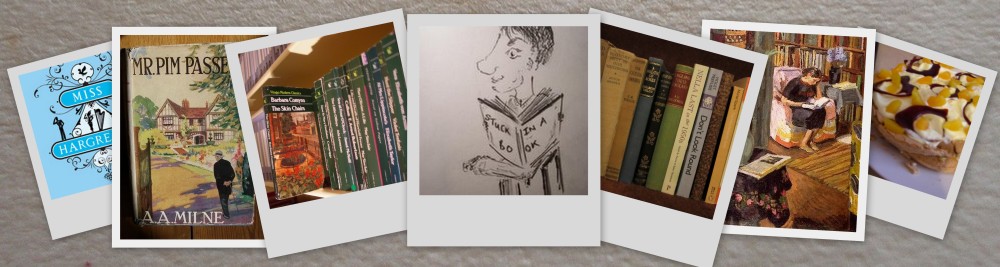
The idea is simple. Think of books with titles which repeat the same word, or set of words, exactly. A made up example – Stuck, Stuck by Ina Book. There can be commas or exclamation marks or dashes, but no other words. No ‘and’, ‘with’, ‘The’ – unless, of course, they’re repeated as well. I had to strike O, These Men, These Men by Angela Thirkell off my list, once I remembered about that ‘O’ at the beginning…

I daresay this would be quite easy to cheat at, but that’s no fun – see which ones you can remember without having recourse to the internet or your bookshelves (checking suspicions is fine). I’ve been pondering it for a couple of days, and have come up with ten… In order to allow you to play along, I’ve put my answers in white text – so you can highlight them and have a look, but only when you’ve put your answers in the comment box…!

Enjoy, and don’t blame me if it drives you a little bit crazy…

Faster! Faster! – EM Delafield
Author, Author – David Lodge
The Sea, The Sea – Iris Murdoch
Lucia, Lucia – Adriana Trigiani
Kiss Kiss – Roald Dahl
Absalom, Absalom! – William Faulkner
Speech! Speech! – Geoffrey Hill
Guards! Guards! – Terry Pratchett
Red Dog, Red Dog – Patrick Lane
Promises Promises – Adam Phillips

Highlight the text above to see which ones I came up with!

Stuck-in-a-Book’s Weekend Miscellany

These weeks do come around quickly, don’t they? Hope you’re all ready for a fun Valentine’s Weekend – that’s right, I’m one of those few single people who finds Valentine’s Day rather sweet. Not the commercial bit of it, no, but the fact that it makes people take time out to celebrate their relationships. Awww…..

But I haven’t availed myself of the opportunity to make this a themed Weekend Miscellany, you’ll be pleased to hear. Instead, we have our usual mixture of interesting link, blog post, and book. Here goes…

1.) The blog post – I have my friend Barbara to thank for bringing this to my attention: anyone interested in old Penguin paperbacks should go and check out this lovely post on a blog called Spitalfields Life.

2.) The book – is, sadly, not one which has landed on my doormat. I spotted it mentioned on Claire’s (aka The Captive Reader) blog, and – unusually? – it’s a great book which is available in the US and not the UK. Well, available in Canada too, presumably, if Claire has a copy – my other deductions come courtesy of Amazon snooping! Enough preamble – the book is A Truth Universally Acknowledged: 33 Great Writers on Why We Read Jane Austen. I confess I was a little dubious – would this be a collection of modern ‘great writers’ of whom I’d never heard? Or, worse, Danielle Steele informing me that Elinor Dashwood is, essentially, the same as the heroine of her latest novel. But no – this appears to be a collection of essays spanning the years, and the writers in question include Virginia Woolf, Eudora Welty, W. Somerset Maugham, Fay Weldon, CS Lewis, David Lodge, Harold Bloom, the director of Clueless… and, yes, quite a few people I wouldn’t know from Adam – but enough there to make me hanker rather a lot for this collection.

3.) The link – if you ignore the unbookish caption to this video, and close your mind to the destruction of a book or two, then this link is rather fun, and very inventive…

No One Now Will Know…

Project 24 – #4

Book no.4 has found its way into my house, helped (as with the Richmal Crompton Roofs Off!, Book no.1) by my abebooks ‘want’ alert. I love EM Delafield (you can read my thoughts about three of her books here) and have amassed quite a collection of her novels – quite a few unread, but nice to know that the store is there for a bit of indulgence now and then, the most recent being Nothing is Safe, which I’ll write about before too long. One I didn’t have is No One Now Will Know – and, consequently, it is one I *do* now have!

I don’t know a lot about the novel, but this wonderful and reliable EMD website says “A decidedly bleak book in which Fred and Lucian (Lucy) both love Rosalie. The title is a quotation from the Irish poem ‘The Glens of Antrim” No one now will know, which of them loved her the most”. He hasn’t actually read this one, if I interpret the asterisk correctly, so perhaps his information comes from Violet Powell’s occasionally underwhelming biography The Life of a Provincial Lady. And I can’t really imagine that EM Delafield could be completely bleak if she tried – even in her bleakest novels, like Consequences, there are flashes of humour.


So, there you have it – book number four, and one of the most melodic titles I’ve ever come across.

Brixton Beach

It’s not been long since our last giveaway, and A Winter Book is still making its way on a slow boat to Texas – but its time for another!

HarperPress sent me two copies of Brixton Beach by Roma Tearne – one for me, and one to give away. Now, I’ve not read it yet, but it will soon be featuring on The TV Book Club, and I thought I should get it out to a reader before the programme is on…

So – this one is for UK readers only, I’m afraid, because that’s where the programme is shown (and I’m counting my pennies…) so, any Brits, please pop your name in the comments to get a copy! I’ll be doing the draw at the weekend, probably. Good luck!

Immortality

A little while ago I mentioned that I was reading Immortality by Milan Kundera for my book group. I can’t remember what stage we were at then, whether the mutiny had taken place… well, tomorrow we’re meeting to discuss Immortality and/or An Equal Music by Vikram Seth, since people were either unable or unwilling to read one or other of these… so, a compromise, we’ve done both and can read either! If you’re not confused by now, then you’re doing better than me. ANYWAY, I have read Immortality – finished this morning – and I hardly know how to respond. It is completely different from anything else I have ever read. That’s a bit of a cliche, I daresay, but for this book it’s true – because Kundera has more or less reinvented the novel. (This is the only Kundera book I’ve read – he might have done this before Immortality, maybe I’ll wait for Claire to pop by, because I know she’s a big Kundera fan.)

It’s very postmodern, that’s the first thing to say. In that, we get bits of narrative from Kundera’s perspective – he mentions his own previous novels, he tells us what he’s going to write in later chapters. The novel (I’m going to use the word, even though it’s not really a novel… or is it?) opens with him seeing a woman making a gesture – he then names her Agnes and invents a story around her, around that gesture. And then weaves it into a literary, historical intertextuality that darts all over the place, including Rubens, Goethe, Hemingway, Beethoven… So many lives intersect and reflect on each other – the real, the fictional, the metafictional. And yet it isn’t formless or baggy – there is a definite feeling of wholeness, a structure – just a very unorthodox one. I haven’t read any reviews of Immortality, but I expect all of them mention this excerpt at some point, from the point of view of Milan Kundera-within-the-novel (who may or may not be the same as Milan Kundera the author, let’s face it): I regret that almost all novels ever written are much too obedient to the rules of unity of action. What I mean to say is that at their core is one single chain of causality related acts and events. These novels are like a narrow street along which someone drives his characters with a whip. Dramatic tension is the real curse of the novel, because it transforms everything, even the most beautiful pages, even the most surprising scenes and observations merely into steps leading to the final resolution, in which the meaning of everything that preceded it is concentrated. The novel is consumed in the fire of its own tension like a bale of straw. I don’t blame you if you’re rolling your eyes, and reaching out for the nearest Agatha Christie novel – but please don’t be put off straight away. I don’t know why postmodern stuff is so often annoying (it’s less the ‘shock of the new’ as the irksome nature of those who want to cause that shock) but, with Kundera, it isn’t annoying at all. He completely disrupts the novel form, and throws the reading experience into a whole new category, but it isn’t self-indulgent. His writing is so good, he is so very, very perceptive, that it works. It’s as I wrote after the first few pages – he notices things about human behaviour, or perceptions of the self, and finds beautiful or unusual images to demonstrate this. Nothing is overwritten, and nothing is carelessly written. There’s nothing worse than an author thinking they’re being profound, when they are actually writing truisms – I believe Kundera doesn’t fall into this trap. (The only trap he does fall into is being rather too obsessed with sex). But, of course, I haven’t read any philosophers, so…

Now I look at it, the excerpt I wanted to quote isn’t the most original thought in the book – that’s because the most original ones are connected to the tiny things individuals do, his perceptions being mostly filmic – like visual leitmotifs running through the book, through different characters and periods. But here’s a bit, to give you a small idea: I think, therefore I am is the statement of an intellectual who underrates toothaches. I feel, therefore I am is a truth much more universally valid, and it applies to everything that’s alive. My self does not differ substantially from yours in terms of its thought. Many people, few ideas: we all think more or less the same, and we exchange, borrow, steal thoughts from one another. However, when someone steps on my foot, only I feel the pain. The basis of the self is not thought but suffering, which is the most fundamental of all feelings. While it suffers, not even a cat can doubt its unique and uninterchangeable self. In intense suffering the world disappears and each of us is alone with his self. Suffering is the university of egocentrism.
This isn’t my normal reading territory at all, and early feedback from my book group suggests some definite disdain for Kundera – but I am fascinated, admiring, and rather captivated… at the same time, it will be a while before I read another book by this author. I’m rather bowled over, and need to keep him to dip into now and then. But Immortality is an amazing achievement – just not one to curl up with in front of the fire.

LibraryThing

I set up a LibraryThing account back in September 2005, added ninety or so books to it, and promptly abandoned the whole thing… For some reason, a couple of weeks ago I decided to give it another go. In the interrim I have made card catalogue lists of all my books (very handy for taking to Hay-on-Wye and preventing me buying books I already own) which made putting them on LibraryThing a HECK of a lot easier.


And so here I am. If you’ve ever wanted to scout through my library, now you have the opportunity – and I even have a sassy widget in the left-hand column which will show you some of the books every four seconds. It’s a bit weighted to authors beginning G-Z, because for the A-F authors I was scrupulously choosing the editions I owned, and after that I just chose the ones which had cover pictures included.

To be honest, I’m not sure what else to do with it now – I know that FleurFisher is the person who has the highest percentage of her books in common with me, and it’s fun to see how many books I own that nobody else on LibraryThing does, but I don’t really see myself having the time to enter into the (doubtless bustling) community. My bookish online community time is already taken up twofold!


But there you are, thought you might be interested. How’s about you – are you a LibraryThing user? Or any other online library service?

Nella Last

30. Nella Last’s War

I’ve mentioned a couple of times on here about Nella Last’s War, which I’ve been reading gradually for a few months. I knew that I was one of the last (no pun intended) to pick this up, but hadn’t realised that it was first published back in 1981 – before I was born! So it’s taken me my whole life so far, but I’m delighted to have finally come upon this – I’ll be very surprised if it doesn’t feature in my favourite books of 2010.

For those not in the know (or thought it was Nella’s Last War – or, like me, confused Nella Last with Nella Larsen) this diary is taken from a Mass Observation diary compiled by ‘Housewife, 49’ Nella Last during World War Two. She documents the war from the perspective of a mother in Northern England, with solider-age sons (Cliff and Arthur), living a fairly ordinary life with an ordinary husband in an ordinary neighbourhood.

But this diary is anything but ordinary. Though Nella did not think herself a clever woman, nor believe that she had fulfilled her half-held ambition to be a writer, she has a quite astonishing gift. I’ve read quite a few diaries and letters and similar, but only Virginia Woolf compares – they both have an intelligent voice, a way of describing everyday events with unusual images or perceptive insights which reveal so much about them. Unlike most people’s diaries (certainly unlike mine) there is little repetition, no undue introspection, no references to unknown people who appear and disappear. True, these may have been edited (I don’t know how substantially) but had Nella Last intended to write a novel, the structure, and precision in her language, couldn’t be bettered.

And of course, the period was not uneventful. I find reading about major events from an individual’s perspective so illuminating.

Wednesday night, 5 June, 1940
This morning I lingered over my breakfast, reading and re-reading the accounts of the Dunkirk evacuation. I felt as if deep inside me was a harp that vibrated and sang – like the feeling on a hillside of gorse in the hot bright sun, or seeing suddenly, as you walked through a park, a big bed of clear, thin red poppies in all their brave splendour. I forgot I was a middle-aged woman who often got up tired and who had backache. The story made me feel part of something that was undying and never old – like a flame to light or warm, but strong enough to burn and destroy trash and rubbish. It was a very hot morning and work was slowed a little, but somehow I felt everything to be worthwhile, and I felt glad I was of the same race as the rescuers and rescued.I could quote so much from this book, but I’m just going to give you another – one of my favourite excerpts, a beautiful passage, all the more beautiful because it is from true experience, and not a honed image from a novel.
Saturday, 6th November, 1943
How swiftly time has flown since the first Armistice. I stood talking to my next-door neighbour, in a garden in the Hampshire cottage where I lived for two years during the last war. I felt so dreadfully weary and ill, for it was only a month before Cliff was born. I admired a lovely bush of yellow roses, which my old neighbour covered each night with an old lace curtain, to try and keep them nice so that I could have them when I was ill. Suddenly, across Southampton water, every ship’s siren hooted and bells sounded, and we knew the rumours that had been going round were true – the war was over. I stood before that lovely bush of yellow roses, and a feeling of dread I could not explain shook me. I felt the tears roll down my cheeks, no wild joy, little thankfulness. Oddly enough, Cliff has never liked yellow roses. When he was small, he once said they made him feel funny, and his remark recalled my little Hampshire garden and the first Armistice. Now Cliff is in another war – and we called it the ‘war to end all war.’
A year or so ago Nella Last’s Peace was published, which carries on her diaries until 1965 – Our Vicar’s Wife has a copy, so I’ll borrow it from her at some point. I didn’t see the TV programme Housewife, 49, based on Nella Last’s War, with the rather wonderful Victoria Wood – but apparently it was rather good. Which is only fitting for a book, and a woman, so exceptional as Nella Last. As a diary, it can scarcely be bettered – and as a perspective on the Second World War from the home front, this book is invaluable and should be read for many years to come.