
I meant to mention this earlier, but better late than never – lovely Kim has very kindly invited me to take part in Triple Choice Tuesday – click here for more info, and my choices. Not a huge surprise to anyone familiar with my favourite books, but good fun nonetheless – while you’re there, check out previous Triple Choice Tuesdays – they include Stuck-in-a-Book favourites such as Danielle, Sakura, Annabel, Jackie, Lizzy, Kirsty, Claire, Simon S, Teresa, Stu, Kim herself, and loads of others too.
All
Patricia Takes a Bus Ride
As I predicted, I dove straight into the books by Kitty Vincent – I’ll write about them properly soon, maybe tomorrow, but I don’t think I can really do so without giving you a taste of her writing. So I thought I’d copy out the piece I love most so far – ‘Patricia Takes a Bus Ride’ from Gin & Ginger.

Patricia’s companion said something to the lady seated next him in the bus, but she regarded him with an icy stare. When they reached Patricia’s flat, and she was pouring out tea, she remonstrated with him.
“I shan’t take you out again,” she said, “if you don’t observe the proper etiquette. It has taken me years to learn it, but I am absolutely infallible now. I believe I could write a book on how to be a perfect lady in a bus.
“If you are travelling on top it is quite in order, I might almost say desirable, to enter into conversation with your neighbour. If it should happen to be raining a little light badinage is allowable as you snuggle beneath the cover, so thoughtfully provided by the company.
“If you are a woman you begin (I beg your pardon, you commence) the conversation by hoping that your umbrella is not objectionable, and the correct retort is, ‘Some weather for the ducks, what!’ Then you discuss the latest murder, or some interesting trifle of the description, being careful to keep the conversation within strictly suitable limits. It is advisable to preface your remarks with, ‘Well, what I always say is —‘ and you finish up by observing that ‘Murder is always a mistake; it comes out in the end.’
“You must never be original, because it may lead you into being daring, and to be daring on a bus is not good form.
“When you or he come to the parting of the ways, I advise you to murmur, ‘So long,’ or ‘Well, ta, awfully.’ I know that the latter remark is frightfully ‘bon ton’ because the most immaculate young man bade farewell to me in these terms, and he was so marvellously dressed that I am sure he was a dancing, partner or something really smart of that description.
* * *
“You should never speak to anyone inside a bus, as it violates every canon of deportment. If you should be forced to speak – if, for instance, you want to leap across the body of the person next you – you merely ejaculate ‘Pardon!’ This will have the desired effect.
 “When the conductor asks for your fare, do, please, not enter into a long description of where you are going, it sounds excessively vulgar, and shows that you are not conversant with your world. If, for instance, you desire to alight at South Kensington, merely hold up one finger, and mutter, ‘South Ken.’ This places you, at once, as being ‘all right,’ while if you explain that you want to get to a square somewhere near the Underground, you are making yourself conspicuous.
“Many contretemps may occur in buses, and the way in which you meet them places you at once. If you are seated opposite a child who appears to be rapidly growing more and more ashen, you may assume that it is suffering from mal de bus. You must either pretend that, although you took a ticket to Piccadilly Circus, you recollect that you have pressing business at Hyde Park, and leap from the bus, or you must accept the consequences with sang-froid.
* * *
“Bus laws lay down that a child who is violently sick is ‘a poor little dear,’ and you are expected to behave accordingly, although in your heart of hearts you know that it is a gluttonous little pig. But if you so much as lift an eyebrow, child-lovers glare at you with muttered expressions of, ‘Well, I suppose she as a child once.’ It is useless and exhausting to explain that, although you were once a child, you were not a sick-in-a-bus one, and you merely become an object of universal execration.
“As one spends so many hours in buses, it is so important to learn how to behave,” Patricia said a little plaintively.
Numbers, Numbers
I occasionally have idle thoughts. And today’s idle thought was ‘I wonder if I can think of an author’s name of every length from 1 to 20 letters.’ Using the names under which they published, this is what I’ve come up with… fancy having a go? Can you fill in my gaps?
1. Q
2.
3.
4. Saki
5. Ouida
6. Sapper
7. A. A. Milne
8. E. F. Benson
9. Roald Dahl
10. Enid Blyton
11. E. M. Delafield
12. Lewis Carroll
13. Frances Burney
14. Charles Dickens
15. Richmal Crompton
16. Arthur Conan Doyle
17. Ivy Compton-Burnett
18. William Shakespeare
19.
20. Sylvia Townsend Warner
Well, that was worthwhile, wasn’t? Happy Monday!
The Sack of Hay
I’ve spent the past couple of days visiting Ludlow and Hay-on-Wye (the latter with my friend from Ludlow). The visit was a little spoilt by a (non-dangerous) car-related thing which was my fault, and very annoying. I tried not to let me stupidity cast a cloud over a day of book-filled fun, and it certainly didn’t diminish my book-buying capabilities: I came back 19 books the richer, and it includes some choices which are endearing eccentric, even for me. (Yes, I tend to be called eccentric on this blog, but I thought I’d throw in ‘endearing’ too… let’s run with it.) This photo is in Richard Booth Books – I want to move into their shop, please.

Jenny Wren – E.H. Young
The Vicar’s Daughter – E.H. Young
I’ve been very fortunate with stumbling across Young novels, and must have nearly all of them by now… I even aided and abetted Young novel buying – my friend bought William and The Misses Mallett.
Through a Glass Darkly: the life of Patrick Hamilton – Nigel Jones
A biography of my favourite author du jour, for when I finally get around reading the other Hamilton novels I’ve been hoarding.
The Letters of Evelyn Waugh – ed. Mark Amory
Had my eye of this book for a while, and it was less than a third of the cover price – hurrah!
The Corner That Held Them – Sylvia Townsend Warner
I was hoping to find some STW short stories in Hay, and although I didn’t manage to, I did manage to get another of her novels.
Jill – Philip Larkin
My friend Clare loves this, so I’ve kept an eye out for a while. Plus it has a nice cover of someone on a bicycle.

The Second Mrs. Tanqueray – Arthur Wing Pinero
Pinero’s plays are bizarrely difficult to find in bookshops, given how influential he was, so I snapped up this one.
The Victorian Chaise-Longue – Marghanita Laski
Not the Persephone edition (which I read from the library a while ago) but an old Penguin – fancied having this on the shelf.
The Swan in the Evening – Rosamond Lehmann
Autobiographical fragment of an author I really *will* read one day…
Safety Pins – Christopher Morley
A hopefully amusing collection of essays by the author of Parnassus on Wheels – my housemate Debs has already stolen it from me, and read out excerpts which made me guffaw.
Shaving Through The Blitz – G.W. Stonier
Great title! This looks like it might be akin to ‘Mr. Miniver’, had that book existed.
The Ballad of Peckham Rye – Muriel Spark
I just keep buying those Spark books… this one has the advantage that my supervisor told me to read it, and fools me into thinking that the trip to Hay was essentially study.
A Reckoning – May Sarton
Blame Thomas.
Messages from My Father – Calvin Trillin
See above.
A Baker’s Dozen – Llewelyn Powys
I have read around the Powys family, and thought I’d read a little more – Llewelyn Powys’ father (and thus presumably Littelton’s, T.F.’s and John Cowper’s) was a vicar in Montacute – a beautiful village near our home in Somerset – and this little book is a collection of essay memories about his childhood.
The Shakespeare Wallah – Geoffrey Kendal
I didn’t realise Felicity Kendal’s father had written this book – I loved her autobiography/biography of him White Cargo, and this book will be a fantastic complementary read.
The Island of the Colorblind – Oliver Sacks
The other day I asked people on Facebook to recommend Oliver Sacks titles, since I found The Man Who Mistook His Wife For A Hat fascinating. I don’t think anyone mentioned this, but it looks really interesting… does what it says on the tin.
…and now for my favourite two finds of the day…

Gin & Ginger – Lady Kitty Vincent
Lipstick – Lady Kitty Vincent
These books, from 1927 and 1925, are silly, comic sketches in the vein of Joyce Dennys’ lighter books – illustrated with fun pictures by ‘Fish’. I’d never heard of them before, but they’re irresistible. Exactly the sort of thing I lap up. Lipstick starts “No, my dear, I cannot say that I really know the Bishop of Runnymede”. I think these will go straight to the top of my pile… can’t wait.

Blooming Smith
Following your recent advice and comments, tonight I’m going to blog about a novel which is very difficult to find at an affordable price, or indeed to find at all. Having re-read I Capture the Castle a while ago, I was intrigued to see what else Dodie Smith had to offer. I asked around, and general consensus was to look out for The New Moon with the Old or, failing that, The Town in Bloom. I can’t afford £20-£30 for novels I know nothing about, and Oxfordshire libraries didn’t have The New Moon with the Old, so I went for The Town in Bloom (1965).

The novel kicks off with a reunion between friends known as the Mouse, Moll Byblow, Madam Lily de Luxe and Zelle, reminiscing about their days living in a ‘club’ together in the 1920s, going through turbulent youthful events and trying to find work in the theatre. It’s now over four decades later. But… Zelle is absent, as she has been at all their five-yearly reunions. But is the shabby old woman across the road, who reminds ‘Mouse’ (the otherwise unnamed narrator) ‘of the crones said to have sat knitting round the guillotine during the Reign of Terror’, actually Zelle? And, if so, has she donned a disguise, or have 45 years apart led her to destitution?
And suddenly the novel flings us back those 45 years, to Mouse leaving her aunt’s house and arriving in London, at that club. We see her first experiences through the lens of her journal, which feels like we’re in familiar I Capture the Castle territory…
I am here at last! I arrived this afternoon, at Marylebone Station so I only had a short taxi drive – I wished it could have been longer as it was thrilling to be driving through London on my own. And it was such a lovely day. The trees here are further out than they are at home. Home! I haven’t one any more. That thought doesn’t make me feel sad. It makes me feel wonderfully free.Mouse, despite her nickname, isn’t particularly timid, and isn’t all that different from Cassandra of Smith’s more famous novel. Both are young and inexperienced, but oddly confident and more worldly than they seem. Both are incredibly introspective, yet manage not to be annoyingly so – although Mouse gets rather closer to ‘annoying’ than Cassandra does. But while Cassandra is isolated in a highly romanticised setting in rural Suffolk, Mouse is flung into the maelstrom of the theatre. Oh, and the journal fades away after a few pages – being replaced with first-person narrative (so she is hardly ever called ‘Mouse’ in the book) but from the distance of 45 years.
I love books about the theatre, fact or fiction, especially if it’s about theatre of the 1920s or 1930s. So I lapped up the first half of The Town in Bloom – which is set in a theatre run by actor-manager Rex Crossway, last in a line of theatrical Crossways. Dodie Smith was herself both an actress and playwright (it was as pseudonymous playwright C. L. Anthony that she first found fame) so she writes this section in an informed and entertaining manner. Mouse launches herself into his world through an impromptu audition for The School for Scandal, playing both Sir Peter and Lady Teazle.
I played both of them. First, as Sir Peter, I looked to my right and used a deep, rich voice. Then, looking left, I became Lazy Teazle and used a lighter voice than was natural to me. Backwards and forwards from right to left I went, speaking fast because I feared Mr. Crossway would stop me. I particularly wanted to reach what was, for me, the high moment of the scene, when Sir Peter tells Lady Teazle she had no taste when she married him. Lady T. then goes into fits of laughter – that is, she did in my interpretation. And never had I laughed better, louder or longer than I did for Mr. Crossway. I checked my laughter with some very amusing gasps and continued the scene. Still Mr. Crossway did not interrupt me. So I went on until Lady Teazle’s exit when I sketched a pert curtsy to Sir Peter – and then made a very deep one to Mr. Crossway.It was a brave, and a delicious, decision on Dodie Smith’s part to make Mouse no prodigy – she is an appalling actress, and no amount of advice from Crossway can make her anything else. So, instead, she starts working in one of the theatre offices with Eve Lester, a kind, sensible, and wise woman in an environment of those who are often kind, but rarely the rest.
The backstage goings-on of a theatre fascinate me, and I loved all the minutiae of rehearsals, editing, understudies etc. – and a very amusing scene where Mouse takes it upon herself to replace the ill leading lady halfway through a play, completely changing the interpretation, and rather ruining the whole affair. All written rather cleverly, and Mouse’s combination of naivety and knowingness make for a fun read.
But then…
Yes, Mouse falls in love with Mr. Crossway. Of course she does. At which point The Town in Bloom becomes significantly less interesting, while she repeatedly tries to seduce Mr. Crossway into an affair. I know there are plenty of real life relationships with big age gaps which work well, but I find them almost universally disturbing in novels – even up to and including Emma and Mr. Knightley. This is the sort of affair where Mr. Crossway laughingly calls her ‘my dear’ a lot, and she pontificates on how she will never love anybody else, not as long as she lives. And so on and so forth.
There are a few more twists to the tale, and her flatmates do play more significant roles than this review suggests, but I’m afraid The Town in Bloom turned into a rather tedious novel. There is enough momentum from the first half – and the lingering question from the prologue of what happened to Zelle – but the re-focus upon a rather tawdry romantic storyline is significantly duller than the theatrical focus of the earlier section to the novel.
In this respect, as in several others, The Town in Bloom is something of a pale shadow of I Capture the Castle, and I can quite see why nobody has bothered to reprint it for a while. I wish Smith had had the courage to leave out the romance/affair/adultery storyline altogether – this would have been an infinitely better novel without it, and would also have been rather further away from I Capture the Castle territory, and thus easier to appraise on its merits, not judged on its comparative demerits.

And not a dalmatian in sight.
Footnotes
I’m currently reading two different volumes of letters, and have recently finished another – Sylvia & David: The Townsend Warner/Garnett Letters edited by Richard Garnett; Dearest Jean: Rose Macaulay’s Letters to a Cousin edited by Martin Ferguson Smith; The Element of Lavishness: The Letters of William Maxwell and Sylvia Townsend Warner edited by Michael Steinman. Gosh, writing out titles, subtitles, authors, and editors is quite a lengthy process.
Anyway, it got me thinking about footnotes. Never let be said that I avoid the high-octane topics here at Stuck-in-a-Book. I have a love/hate relationship with footnotes and endnotes. If they’re not there – as they weren’t in the otherwise wonderful A Truth Universally Acknowledged collection of essays about Jane Austen – then I get frustrated. If they are there, I get easily annoyed. Something like Hermione Lee’s biography Virginia Woolf went so hugely over the top with footnotes that reading it was exhausting. For scholarly works, they are essential. But often biographies or collections of letters have both scholarly potential and the possibility of being read for pleasure – so, what to do with the paraphenalia of academia?
 (you might have to click on the sketch and enlarge it, to read it all!)
(and spot the deliberate mistake… oops.)
I’ll write proper reviews of all those letter collections at some point, probably after I’ve actually read them, but I’ve been intrigued by the way they’ve approached footnotes. The Garnett/Warner letters have very few, and those only when significant reference is made to someone so vaguely that a footnote is absolutely necessary to make sense of an anecdote or opinion. The Maxwell/Warner letters had scarcely more, although they did often fill in the gap when a story was being discussed. Martin Ferguson Smith, on the other hand, has so many footnotes – and such thorough footnotes – in his collection of Rose Macaulay’s letters that he actually has written more than Macaulay has in the book.
I suppose they’re not actually footnotes – not sure what the correct terminology is, but his notes come after each individual letter. Macaulay will write 1.5 pages to Ferguson Smith’s 2, perhaps. Which I thoguht would irritate me, but actually – and unusually for me – I love it! I am not reading them all; I just read the letters as though there were no footnotes – and if I’m interested or intrigued or confused by one of Macaulay’s comments, then I’ll look at the footnote. Which is a much more liberating reading experience than feeling obliged to read each note laboriously – I think I’ve found the perfect reading compromise.
 Perhaps notes feel more helpful here because only one half of the correspondence is present? Or perhaps Macaulay is just more off-at-tangents than Maxwell, Warner, or Garnett in her writing, and needs Ferguson Smith’s guiding hand. Either way, he has done an astonishing amount of research. Every reference is tracked down; often he doesn’t merely give the details of a mentioned book, but an outline of the plot – or, rather than just fill in the name of a figure alluded to, he will pop in an anecdote or two. It’s a truly humbling amount of research – and I love it when Ferguson Smith’s personality sneaks into the footnotes, usually in the form of an exclamation mark in brackets; which is one of my own favourite modes of punctuation(!)
Over to you. Do you like editorial notes to abound or, erm, not abound? Footnotes, endnotes, or end-of-section notes? I know it’s a small thing, but I bet quite a few of you have opinions on the topic. In fact, I know Lyn does, for a start…
Whether a dove or a seagull
I thought I’d pop out a quick post, to test your knowledge (/actually I have no idea, and hoped someone else would.) I’ve been reading a bit about Sylvia Townsend Warner of late, mostly letters, and footnotes in a couple of different volumes have mentioned Whether a Dove or a Seagull. It’s a poetry collection she published in 1934 with her partner Valentine Ackland – a joint-collection, but none of the poems were signed, so the authorship of each was left unknown. Which is an intriguing thought – and a brilliant title.
But in the footnotes it has simply said ‘This experiment was not a success’. And no more info. Does anybody know any more about the collection, and in what manner it failed to succeed? Simply in terms of sales? Or was it critically panned? Or was one poet so evidently inferior to the other that anonymity was pointless? Anybody in the know, do shout!
Journey through a book

I’ve just finished reading Edith Olivier’s The Triumphant Footman and was pondering whether or not to write a review of it here. I love Edith Olivier’s novel The Love-Child, as you might know, and thanks to various reprints (including one by Virago in the 1980s) it’s quite easy to find at an affordable price. So I don’t feel bad telling everyone that they really should read it, cos it’s brilliant. The Triumphant Footman, on the other hand, isn’t as good – but it is worth reading – more importantly, it is impossible to find in England. In the US there are a handful of copies available surprisingly cheaply (my edition was printed in the US, actually) but it’s still fairly scarce.
So, instead of telling you much about The Triumphant Footman (although do ask if you’d like to know!) I shall merely tell you that it includes the wonderful character description of someone being “invincibly vague”. And instead this will be a meandery post on obscure books, and such-like. I love these sorts of posts on other people’s blogs (Rachel and Simon are especially good at them), so I hope you’ll indulge me. Whenever I go off the book-review beaten-track, you lovely folk never fail to provide with great comments, so… now you’re under some pressure!

Having a look through the books I’ve read in the past couple of years, there are quite a few which I deliberately decided not to write about on S-i-a-B because of their scarcity. There are also quite a few I simply forgot to write about, but that’s a different matter. I’m never one to shy away from a list, so here they are:
Nothing is Safe by E.M. Delafield
Flower Phantoms by Ronald Fraser
A Harp in Lowndes Square by Rachel Ferguson
The Seraphim Room by Edith Olivier
Dwarf’s Blood by Edith Olivier
Economy Must Be Our Watchword by Joyce Dennys
Birds in Tiny Cages by Barbara Comyns
The House in the Country by Bernadette Murphy
An Unexpected Guest by Bernadette Murphy
Which Way? by Theodora Benson.
Some were brilliant (Dennys); some were pretty poor (Fraser); some were disappointing (Comyns) and some were so-so (most of the rest) but nearly all of them are more interesting to me than the latest hardback or shortlisted issue-novel. But I don’t see the point in telling you about a book that you then won’t be able to find for less than £50… hmm. (If you do want to know about any of them, just let me know in the comments!)
Every now and then I get the urge to sideline all the esoteric, slightly eccentric reading choices I make, and settle down with the classics. While I find I have read a surprisingly high number of classic authors, I certainly read more non-classic authors. Of course, we could get tied in knots trying to work out the difference between ‘classic’ and ‘non-classic’, but even by the most generous criteria, only about twenty of the 115 books I read last year could be considered classics. Nobody is ever going to come up to me and say “Oh, just wondering, have you read An Unexpected Guest?” nor would I really have felt the lack from my reading life had I never done so. The opposite is true of, say, Middlemarch.

And yet… how unpersonal it would be to read only Austen, Eliot, Joyce, Lawrence… how uninteresting it would be to have a conversation with (or read a blog by) someone who never veered from the paths of canonical literature! I think most blog-readers agree that it’s far more enticing to find a little-known gem uncovered, or even less popular Virago Modern Classics etc. Which can work alongside reviews of classics too, of course – as bloggers we tend not to discriminate that much in how a review is written, do we? My review of Howards End by E.M. Forster, for instance, appeared in between posts on Gay Life by E.M. Delafield and Saplings by Noel Streatfeild. As with most things, a mixture is the most interesting – but I’d always rather a blog leaned to the eccentric…
When I asked people on Twitter (I know, I know…) whether they’d ever chosen not to post about a book because it was scarce, all the respondents said no – because they might be able to revive interest, which in turn might help encourage publishers to reprint. I can see the logic of that for fantastic scarce novels – which is why, in retrospect, I really should have written about Joyce Dennys’ Economy Must Be Our Watchword – but I probably wouldn’t think it worthwhile to write about a book which nobody would be able to find if it was only mediocre, or even just ‘quite good’.

This post has got even more meandering than I intended, since I’ve written it in instalments on different days. And the heat has addled my brain, so I’m not entirely sure what it was I wanted to say when I started this post. But do enjoy pictures of the lovely edition I have of The Triumphant Footman – and I thought it might be fun to include a sample of what happens when I read books. I tend to just write page numbers, in miniscule pencil writing, on the reverse of the title page – and then indicate the bit I’m interesting in on the page in question. If the book is too lovely to desecrate too many pages, I’ll just make notes on that one page. Usually it’s for review purposes, but these are actually in case the novel can be useful for my thesis. Make of them what you will….

Right. I’m off to write some of that thesis… or collapse in a melting heap on the floor. Undecided.
Song for a Sunday
First things first, I’ve only gone and added a ‘follow me on Twitter’ thing over on the left. To be honest, I haven’t quite got to grips with Twitter, but I seem to be using it a bit more than before, so it would lovely to see you there. And I end up following more or less everyone who follows me, just out of interest (that makes me think about Pooh and Piglet tracking the Heffalump, round and round in a circle…)
This Sunday’s song is ‘I Didn’t Know I Was Looking For Love’ by Everything but The Girl – UK readers about my age might remember Karen Ramirez’s remixed version from 1998, which is more popular than the 1993 original but not, in my opinion, as good…
For all previous Sunday Songs, click here.
The Two Towers
I stole the idea for this title from Elaine who was one of the bloggers who joined me at two venues two days ago, courtesy of the lovely people at Harper Collins. Or possibly HarperCollins, I’m not sure which is de rigueur. Nor am I entirely sure what de rigueur means. Let’s move on swiftly.
 The two towers in question were the Oxo Tower and the Tower of London – neither of which had I been to before. I met Elaine and Claire outside the lifts to the Oxo Tower, and we went up to the top floor and the brasserie, to be greeted by some friendly folk from Harper (let’s settle on that for now – sorry Mr. Collins, I do appreciate your work) and introduced to the authors whom we were meeting. Step forward Fanny Blake and David Nobbs, both of whom were funny, charming, and great fun to chat with. Fanny Blake’s first novel What Women Want is out soon (or possibly out now) more info here – and I was fascinated by her previous career as a literary editor. I think the editor’s job is remarkable – I could read a novel and say which bits I did or didn’t like, but the ability to suggest how to reshape a novel or a character is far beyond me.
David Nobbs (famous for TV writing, as well as novels – he wrote for The Two Ronnies, Reginald Perrin, etc.) has a book out now called It Had To Be You – more info here – spot their deliberate mistake; they refer to the novel by its working title Life After Deborah(!) David is a great conversationalist, and I was mostly delighted to meet someone else who loves Stephen Leacock and Saki. In fact, both of us find that we never meet others who love Leacock (although I think he is still ‘known’ in Canada?) so we raised a glass to him.
Oh, yes, the food and drink! Cocktails were cunningly matched to trays of delicious individual desserts – photos on Talli’s blog here, Talli being another author/blogger whom I met for the first time. I also met Amanda (we discovered we knew lots of people in common, since we’d both been library trainees at the Bodleian) and Mel, and saw Jackie again, which was lovely.
And then on to the Tower of London! Sarah Gristwood was talking about her latest book, The Girl in the Mirror – a telling of Elizabeth I and Essex. I would have been tempted to call it The Only Way of Essex, but that’s probably why I’m not a publisher. I almost never read historical fiction, but Gristwood’s talk (which was more of general historical interest than specific to her novel) was entertaining and might lead me to try it out… The canapes served afterwards included quails’ eggs, so that was another first for me. As was travelling solo in a taxi! Take this boy out of the provinces, and everything changes.
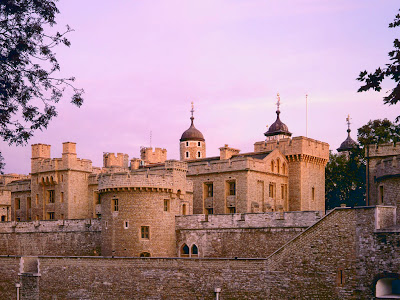
It was a great day out – always a joy and a surprise that publishers know about bloggers, and want to get us involved. Lovely to meet the authors, publishers, and other bloggers, and to do more than Essex managed: go to the Tower of London, and leave it alive.