Song for a Sunday

Despite being twins, my brother and I don’t share our taste for books, music, films… we used to like more or less the same TV shows, but even that seems to have diverged (how can anyone not love Samantha Who?? – first question mark in the title; second question mark in my question, y’all…)  However, when he likes female singers or I like male singers, we tend to agree.  And he introduced me to Amos Lee’s beautiful song ‘Colours’.  A quick peak at Wikipedia suggests Mr. Lee is now doing rather well for himself, so you might have heard of him, but this song has been on my iTunes for years now…

Have a good day :)

Londoning (and, er, books)

As I mentioned, I spent a couple of days gallivanting around London – and I thought I’d share my experiences with you, since most of them were of a bookish nature.

It all started on Wednesday morning when I took the Oxford Tube bus into London for the first time in quite a while, which was rather more miserable than I remembered – no leg-room, lots of delays etc. – but did manage to read quantities of Simon Stephenson’s excellent book Let Not The Waves of the Sea on the way (a sort of memoir/travel-log/philosophy about his brother who died in the 2004 tsunami, which I mentioned a while ago) – I’ve finished it now, and will report back on it soon.

My first stop was the Notting Hill Book & Comic Exchange, since the bus happens to stop mere metres away from it.  This time I didn’t bother with the everything-50p-each basement, since I was short on time, and there were plenty of wonderful things upstairs.  I came away with:

The Wedding Group by Elizabeth Taylor
The Solitary Summer by Elizabeth von Arnim – two reliable authors
The Friendly Young Ladies by Mary Renault – I know nothing about this, but it’s not historical – the reason I’ve previously stayed away from Mary Renault.  About a 17 yr old girl who runs away from Cornwall to bohemian London, which apparently turns disturbing – love this premise!
It Falls Into Place: the stories of Phyllis Shand Allfrey – Allfrey wrote The Orchid House, one of the first Viragos I bought, and one I still haven’t read.
Little Boy Lost by Marghanita Laski – I already have the Persephone Original, but not the Classic!
A Letter to Madan Blanchard by E.M. Forster – The Hogarth Letters No.1, which was rather a lovely find.  There’s a tiny pencilled ‘2’ on the first page, which I like (fancifully) to imagine was inscribed by Virginia Woolf herself…

I also bought Lolly Willowes as a gift for the next person I saw…

…a lady called Marie, who had contacted me after seeing Richmal Crompton’s novels mentioned here on my blog, or on LibraryThing, or somewhere.  One email led to another, and we exchanged rare RCs via post (I read the wonderfully histrionic The House). I arranged to give them back in person, so I trotted off to her beautiful house.  We had a lovely chat, and she took down lots of my recommendations (hurrah!) and I went away with another four books borrowed!  Two rare Richmals, and two by EM Delafield (in her email she wrote “Have you heard of an author called E.M. Delafield?”  Er – yes!!)  The internet is wonderful for encountering bookish types, isn’t it?  Thank you, Marie, for your delightful generosity.  The books are The Thorn Bush and Portrait of a Family by RC; Three Marriages and Zella Sees Herself by EMD.

My next stop was delicious Thai dinner with a couple of bloggers – Claire from Paperback Reader and Rachel from Book Snob – before we went to a screening of Descendants at Twentieth Century Fox, courtesy of Vintage press.  More on that soon – as a spoiler, it was very good!  Rachel very sweetly offered me a place to stay for the night (and gave me Mr. Skeffington by Elizabeth von Arnim, which was so nice of her!)  I gave her a Rachel Ferguson book called Passionate Kensington – about a year in Kensington, but with all sorts of detours and tangents.  I’ll quote a bit of that soon, too (this post is turning into dozens of others!)  I totally threatened Rachel with a no-holds-barred expose on what she’s really like, but… I’ll save that for another day ;)  (Rachel: is that why you bribed me with a book?)

My token I-came-to-London-for-study moment happened at the British Library, and you’ve already seen some of the fruits of that.  It was very productive, turning up reviews for Miss Hargreaves, Provincial Lady in Wartime, and more.  And it made me a bit late for meeting up with the lovely ladies of dovegreybooks, an online book discussion group of which I’ve been a member for nearly eight years.  Nine of us met up at the Geffrye museum, including Elaine and Barbara, both of whom have written their own reports on the day.  We had our Christmas lunch and, as always, chatted away nineteen-to-the-dozen.  Despite my plans to make my book bag lighter, I ended the trip as heavy-laden as I started – thanks to the dovegreybooks Secret Santa, and a general book swap.  So that added these four titles to my winnings:

Trains and Buttered Toast by John Betjeman
Elizabeth Jenkins’ biog of Caroline Lamb
A London Girl of the 1880s by M.V. Hughes
Christmas at Cold Comfort Farm by Stella Gibbons (super-excited about this!)

Not to mention a lovely literary calendar (from Barbara) and some beautiful bookmarks (from Sherry, who wasn’t there and lives in America – I still haven’t worked out how these arrived!)

So, all in all, a productive London trip!  Quite tiring, what with all that dashing about, but great fun – and all of it the result of online literary friends!  Lovely.

Books Will Go On

Sorry, I meant to review that other book… but… I didn’t.  Next week, promise!  Instead, I was off having fun in London for a couple of days, including several bloggers along the way – I’ll tell you all about that (and the books I got!) soon.  Tonight I thought I’d share an article I read in the Book Society News.  Part of my time in London was spent in the British Library, reading old copies of this newsletter for the biggest book-of-the-month style club in the UK.  The copies I read were from 1939 and 1940, and this piece by ‘A.B.’ (Arnold Bennett?) came from October 1939 – the first issue after the Second World War had been declared.  I know I am in a privileged position, having access to these sorts of gems, so I wanted to share it with you all:

Books will go on. They are needed more than ever in wartime; and they are not rationed.  Thus far, all the news has been most of the reading, but before long people will turn to books as the best comfort, the greatest recreation in an anxious, darkened world.  In the last war it happened during 1915, and by the middle of 1916 more books were being bought than in any summer of Edward peace.

This time the urge to read often will come earlier.  The present war is a grim, not to say drab affair.  We have no false exaltation; the prevailing mood is that of 1917 rather than 1914; and much beyond our evenings has been blacked out.  The one always reliable refuge comes from access to what the Poet Laureate writing to The Times calls “the treasury of the universe of the mind.”  Books may become more necessary than gas-masks.

If history is a guide, the supply of good literature will keep pace with the demand.  It was in the worst years of the war with Napoleon that Jane Austen, a quiet spinster in Bath, wrote Pride and Prejudice, and that Walter Scott, bearing a load of debt, wrote Rob Roy.  Flaubert, Maupassant and others were in full creation while the Prussians were battering at France’s Second Empire.  And in 1914-18 some of the best work by Kipling, Conrad, Galsworthy, Wells, Maugham and Walpole arrived.

So the Book Society, also, will go on.  Already we have in view two exceptional new books for the months ahead, and there are plenty of alternatives if you prefer them.  We shall vary our recommended lists between books that reveal the strange times we live in and literature that bridges the gulf between to-day’s madness and the sanity that lives in fine imagination.

Consider, meanwhile, what one copy of a good new book can achieve in wartime, even though restrictions multiply and we are taxed beyond a millionaire’s worst fears.  The book costs less than a few sandbags at the profiteers’ price, or a bottle of evaporating scent, or a stall in the peace-time theatre.  Yet it can keep boredom at bay for days and fill inactive evenings with pleasure, stimulation, forgetfulness of the present.  In any house it can do this for several readers in succession; and thereafter, it can be kept for an encore while serving as a decoration.  Or it can be sent or lent to do as much for those on national service, among whom the need for books is even more urgent.

A Fairy Leapt Upon My Knee by Bea Howe

Most of you, my lovely readers, chose the obscure novel yesterday – which goes to show how lucky I am to have you lot reading my blog!  I’ll probably end up writing about both – perhaps the well-known author will even pop up tomorrow in my absence, whilst I’m gallivanting in London.  Dark Puss suggested I wrote about the one I enjoyed more… well, I enjoyed this one more, but the other one was probably better.  (Other people used to that feeling?)

As you might have spotted from the post title, this is an obscure book, but I have mentioned it before.  A Fairy Leapt Upon My Knee (1927) by Bloomsbury Group hanger-on Bea Howe lent its paper to my new blog background – I thought it was time I told you what was on the pages (other than David Garnett’s signature!)  (Some of you may even have spotted a very brief section of this review in your blog readers yesterday… oops!)

The outline of the novel is pretty simple – William and Evelina have fallen in love, and deal with the difficulties of not being able entirely to understand one another.  Much of the narrative flicks back and forth between their minds, as they grapple with starting a new stage of their life together – melding two rather different personalities into one prospective marriage.  Oh, and along the way a fairy turns up.

Evelina is not unlike a fairy herself – she is fanciful, thoughtful – bright, light, and sparkling:

She was dressed in a silver frock with a deep jewelled belt that gripped her waist.  Her light brown hair was cut quite short like a boy’s and brushed softly over her ears; it was shot with gold at its curling tips.  But it was her eyes, of an odd green colour, that William first noticed.  They regarded him so intently; like a child’s.  They were also very bright.  Eyebrows thin, dark, arched, gave a flying look to her face.  Her face which was painted and pale.

William, on the other hand, is a little more staid and grounded.  Where Evelina is concerned with her ‘secret self’, and often wanders off into realms of imagination (although not in an annoying way, for the reader at least) William is an etymologist – the fluttering world of moths is his chief concern, and he approaches it with the eyes of a scientist.  (Scientists will doubtless tell us – indeed, my brother does tell me – that there is a greater beauty in the structure and order of numbers/nature etc. than in its aesthetics.  Well, horses for courses.)  William’s captivation by lepidoptera is all-consuming, and colours even his attempted romantic overtures:

“One day I will tell you all about my moths.  In some odd way you remind me of them.”  His voice was low and gentle.  Evelina did not know that this was the first compliment he had paid a woman.

Yet it is he, the scientist, rather than she, the wistful romantic, who stumbles upon the fairy.  I once attended a nighttime moth hunt, and sadly no fairies turned up.  The one William finds has not quite the daintiness of Tinkerbell et al:

A pale, extremely ugly, wizened-looking little face, about the size of a hazel-nut, stared up at him.  And this face did not belong to a giant moth or beetle!  The filmy stuff, the cobwebby matter which had first stuck between his fingers and given such a peculiar sensation to his skin, was evidently part of this creature’s clothing.  Underneath its thin protection, William could see the vague outline of a tiny body.  It was a woman’s body, shaped quite perfectly, like a minikin statuette.  With a vague feeling of embarrassment he knelt down and rolled his prisoner gently off his palm on to the ground.  The fairy did not move.  She only remained looking in a dazed way at him.  William gazed back.  He still felt completely bewildered.  

A Fairy Leapt Upon My Knee is a strange little book, not least because the fairy doesn’t do very much, except sit listlessly in William’s house.  She emphasises, however, the disparity between William and Evelina.  He has no personal curiosity in the fairy, except as a scientific specimen – ‘It had not even occurred to him to think of her as another living being.’  Evelina, on the other hand, is jealous that she did not make the discovery – and the existence of the fairy propels her even further into realms of the fanciful and fey.

A Fairy Leapt Upon My Knee is a simple story which I found charming and enchanting – but which really could have done with a better structure.  It feels a little as though Howe started writing on page one, and put down anything that crossed her mind – which does give the novel a feeling of freedom and flow, but it ultimately lacks the impression of unity and progression which a properly planned novel has.  Evelina and William fall out and make up and fall out and make up – often without even seeing each other in between – which is possibly more life-like, but a little dizzying to read.

This was Bea Howe’s only novel (although she wrote a few biographies) so it’s impossible to tell how her style might have progressed.  For a first novel, A Fairy Leapt Upon My Knee is rather delightful, and I’d definitely recommend it to anyone with a taste for a touch of whimsy – as an only novel, it does lead one to speculate what Bea Howe could possibly have followed it with, and gives me an altogether bemused impression of Howe as an authoress.  That creative inspiration should hit only once in this manner, and in such a manner, is curious and amusing.  Perhaps, just once, a fairy leapt upon her knee?

Tomorrow… another strange book, but one from almost eighty years earlier and a different language altogether.  Ten points to anybody who can guess…

The Readers

I’m going to be community minded again tonight (for which read: it’s too late for me to write a proper book review) and point you in the direction of the latest episode of The Readers (click zee link).  For those not in the know, it’s a podcast run by Simon S and Gav, covering all manner of bookish topics – always including plenty of recommendations for reading.

This week’s podcast features lovely Kim as a guest, and equally lovely Polly also pops up with her five favourite books (and a mention of me!)  The chief topic of discussion is book blogging – a subject dear to all our hearts, of course.  I am in love with their discussion!  It covers so many areas – why they started; how long they take to write reviews; positive vs. negative posts, and so on.  All stuff I find fascinating – some people don’t care much for blogging-about-blogging, but I’m all about the meta-conversations.  And all the way through I wished I were there to join with the chatter…   (They also talk about book-culling, and it’s lovely to hear a tbr pile of 450 considered ‘not bad’ – my real-life-in-the-flesh friends consider half a dozen unread books as somewhat pressing.)

So, pop over and have a listen to the whole thing, but especially the first half.  And I’ll be back tomorrow with another strange little book… (which is my vague way of saying that I haven’t decided between two strange little books waiting for review.  Would you rather hear about the well-known author or the utterly obscure author?)

Henry Green Week with Stu

Thank you so much for all your lovely comments – they do mean the world to me.  I get very nervous about changing how my blog appears (goodness knows why I would get nervous about it, but… I do!) so I’m chuffed to bits.

A quick post today – something I missed out of my last Weekend Miscellany, because I hadn’t spotted it – Stu (from the blog Winston’s Dad) is planning Henry Green Week January 23-29 next year.  I announced all the way back in May that I intended to read some of my newly-acquired Henry Green novels soon.  And, of course, I still haven’t – but I’m more than keen to join in with Stu’s planned week.  Basically, pick one or more Green novels and join in!  These are the ones I have at my disposal:

Doting, Back, Party Going, Blindness, and Concluding.

I can’t decide between starting with Blindness, because it was his first – or with Party Going, because it’s the one I’ve heard great things about.  Or maybe even both!

Let me know – and let Stu know – if you’re thinking about joining in… c’mon, if you all did it for Anita Brookner, you can definitely do it for Henry Green.

Playing – and Song for a Sunday

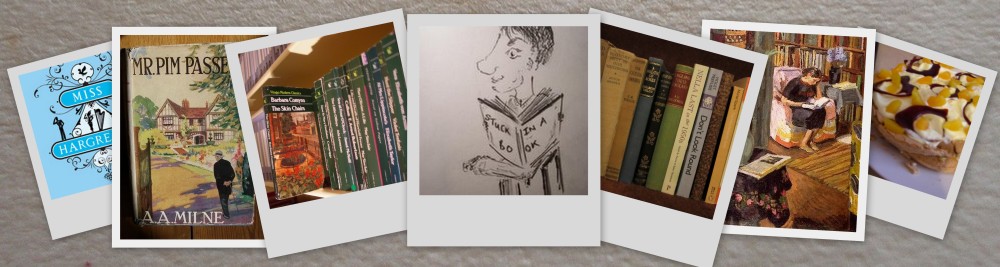
After four and a half years, it felt like time for a little face-lift.   I have made myself a Blog Header for the first time! I hope you like it – the pictures I chose felt appropriate, and the paper-background is actually from a page of A Fairy Leapt Upon My Knee – the copy I own signed by David Garnett!   That’s the same paper that forms my new background.  I have waved goodbye to my dots… for now, at least.

(Comment facilities back to normal, after all that kerfuffle, so I hope it works.  Or works as well as anyone else suffering the vagaries of Blogger, that is!  As always, if you have problems, let me know…)

Enough of that – let’s have a song, shall we?  To be honest, I’m running out of unusual artists to feature… so you might well have come across Aimee Mann before, but ‘Wise Up’ is too beautiful a song to ignore.  Over to you, Aimee:

All previous Sunday Songs here.

Stuck-in-a-Book’s Weekend Miscellany

I am not best pleased, as the post I spent 45 minutes writing just disappeared. Darn it darn it darn it. Well, I’ll try again, but I might be a little less insouciant than usual…

Firstly, I have yet to reach the end of the tunnel when it comes to comments. Apparently some of you can’t see other people’s comments – curiouser and curiouser! I think this might be people using Internet Explorer – can I recommend the all-round-nicer Firefox! I’m going to keep the new comment format for the next few days, and if the problems don’t clear up then I’ll probably change back…

EDIT: well, it wasn’t working, so we’re back to the old way of commenting for now… well, it’s teething at the mo, but we’ll be back to normal by tonight. I will keep trying!

But enough of these shenanigans! It’s the weekend, it’s already been miscellaneous, that can only mean that it’s Stuck-in-a-Book’s Weekend Miscellany!

1.) The blog post – is over at Tales From the Reading Room, and a fascinating discussion about Why Write Reviews? This isn’t quite the same as Why Blog? A few bloggers noticed that full-length reviews tended to get fewer comments than other posts, and also themselves were often more reluctant to read full-length reviews than bookish-chatter type posts. Which led Litlove to write an interesting analysis of why she writes reviews – and, of course, the comments box is filled with conversation on the topic, including my tuppenyworth.

2.) The question – (for there is no link this week!) is on similar territory. I was wondering what you thought of the post Claire and I co-created on One Day? A few of you commented – most of you (of course!) did not. What did you think of the conversation format? Do you think it worked? Those bloggers amongst you – would you like to have a go yourself? I’d love to know your thoughts. (If the comments box doesn’t work, email them to me!)

3.) The book – is The Outward Room (1937) by Millen Brand, which New York Review of Books Classics gave to me a while ago. I forget quite why I asked for it, or where I heard about, but I’m even more excited about it since I spotted in an old interview with Persephone Books that they had it forthcoming. Those plans must have been shelved, perhaps because of the NYRB edition, but a Persephone stamp of approval doesn’t go amiss. Since I’ve yet to read it, I thought I should at least give it a mention. It’s about a woman, Harriet Demuth, who escapes from a mental hospital and goes on a journey both of New York and of self-discovery. That synopsis puts me in mind of Margaret Laurence’s The Stone Angel, which is no bad thing – and it sounds as though it might have been rather revolutionary for 1937.

Ok, that’s it for this miscellany – have a good weekend, everyone.

November

So far in November I have…

Tried and failed to take a photo of Sherpa.

Tried and succeeded to take a photo of Sherpa.  (Doesn’t she look daft?)

Taken a photo of my Mum playing Scrabble.  (She was less likely to scamper away.)

Made a road-trip-themed-collage-covered notebook for my housemate Mel.

Taken icing sugar from a box of kitchen stuff left on the street.

Appreciated autumn.

Attended a proper village Christmas fayre.

Gone jumping in the street.

I’ve also done a fair amount of reading, but people tend not to take photos whilst I’m doing it.  For which I am quite grateful…

Update on Comments… or what to do in the Face of Peril and Troubles

[this page has been edited to be used as a comments-help…]
I’ve changed the way comments work – they are now on the main screen, rather than a separate window.  You are able to reply to individual comments (this will bring up a new window – simply add your comment after the HTML string.)

People have reported problems, of not being able to see other people’s comments.  This mostly seems to be the case with Internet Explorer – I recommend downloading the all-round-nicer Firefox or Google Chrome!

If this isn’t working please do email me (simondavidthomas[at]yahoo.co.uk) or tell me on the Stuck-in-a-Book Facebook page.

If people are still having problems, I will have a rethink…