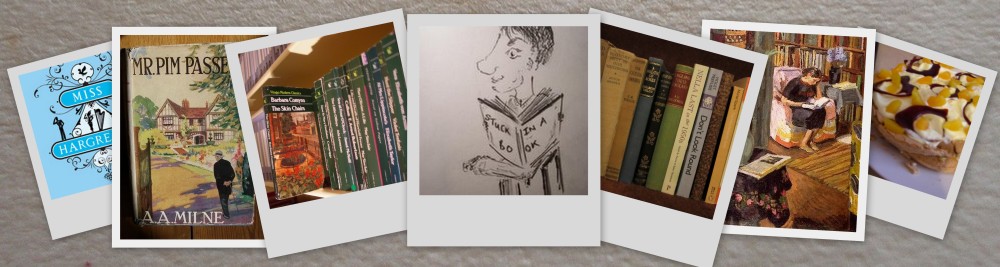
What makes a literary idol?

Another short post, but one which I’ve been mulling over while reading Barchester Towers – since, as any followers of @stuck_inabook on Twitter might have noticed, I flipping love Septimus Harding. He is the hero of The Warden and, to a lesser extent, Barchester Towers – and he is about the most moral, kind, and self-sacrificing gentleman imaginable.

He thus joins what has become a trio of literary men whom I admire wholeheartedly. Alongside Septimus H are Atticus Finch in To Kill a Mockingbird and lovely Joe Gargery in Great Expectations. What all three have in common are absolute goodness. They are basically my fictional moral compasses.

But… what’s also struck me, subsequently, is that (much as I continue to admire these men) I’m not sure how much I would like to know them in real life. Because none of them (correct me if I’m wrong) are especially funny, and a sense of humour is pretty much the thing I value most in a friend or acquaintance. Yes, Joe is fond of larks, but I’m not sure I would find many of the same things larkworthy.

Would knowing Septimus or Atticus in real life just make me feel unworthy all of the time? Would they be able to have a giggle over a cup of tea? I’m not sure.

Plenty of the characters I love reading about (Miss Hargreaves, Lady Catherine de Bourgh, Mapp & Lucia) would be nightmares in reality, but I’ve come to realise that it’s not just the appalling ones who wouldn’t work out well on a day to day basis, it’s the good’uns too.

Or are there characters who are very funny but also very good? By which I mean moral-mentor-good, not Elizabeth-Bennett-sort-of-good. Or is a sense of humour always a slight moral flaw (or at least a moral diminishment) in a novel?

Here endeth the stream of consciousness…

Crying, apples, and Jingle Bells (…things I do at work)

Irrelevant cute photo of Sherpa.
I know what people on the internet want.

Sometimes I think my job is some Truman Showesque experiment in giving me my dream role and seeing whether or not I believe it is happening. I get to write about language for a living. It’s insane.

I was on a copywriting course today, with a bunch of other people from marketing divisions across OUP (who were all, incidentally, really nice and fun – I must try to meet more people in the building) and it struck me how lucky I am to write about words and whatnot. All their jobs are doubtless awesome in many ways, but when we were sharing examples of our copywriting, other people had edited descriptions of law books, or written email campaigns, and I… had written about apples.

Recently, I have been done the following…

a post about names in expressions
the language of crying
putting Jingle Bells through a historical thesaurus
scripting a video about the Oxford comma

Please go and check out the last of those… because there is a priceless moment in it that I don’t want to spoil. It’ll be worth it; promise.
Lest this post sound braggy or anything, I hope it’s obvious that I’m just very grateful that I get to do such fun things for work. There are less fun bits too, of course, but they aren’t really worth blogging about.
In other news… one day I will review the books piling up in my room, promise. And I may even finish Barchester Towers. (I never did finish Vanity Fair, it turns out… perhaps I will, 18 months after starting?)

How many others have read it?

I was musing, while reading Barchester Towers by Anthony Trollope, how curious it is to think of all the other people who have read whatever book I happen to be reading at any one time… and how widely that varies.

This probably wouldn’t strike the sort of person who picks up their books from the bestselling table, or who subsists on a diet of accepted classics. But most of us go back and forth, between Jane Austen and the latest literary author and an out of print author from the 1930s. We mix and match. And it definitely changes the way that I think about a book – or, more particularly, the way I think about my blog posts.

While reading Barchester Towers, I’ve occasionally thought “Oh, this section is wonderful, I must jot it down.” And I have, and I will tell you about it when I’ve finished reading it – but I certainly shan’t be surprising anybody. Nobody is going to think “Thank goodness old Anthony is finally getting a bit of a leg-up”, or “What is this Barchester Towers, then?” Everybody’s heard of it. Many of us haven’t read it yet, but it is hardly going to be a revelation to praise it. When I’m writing about (say) Miss Hargreaves, Patricia Brent: Spinster, or Guard Your Daughters (all wonderful books that others recommended to me before I started spreading the word) I can be confident that most of my blog readers won’t have heard of them, and that my praise might send people off in pursuit.

It isn’t necessarily more worthwhile to advocate those novels, but I feel on firmer ground when starting a review. Perhaps because I don’t feel the weight of a hundred thousand readers on my back? Whatever else my thoughts will be, they won’t be controversial or flying in the face of public opinion.  They also won’t be unoriginal! What can I say about Barchester Towers that hasn’t been said before? What can I say about Guard Your Daughters that has been said before?

And, more abstractly, it feels very different to join the legions of people who have read and loved Trollope than joining the hundred or so who have really loved Patricia Brent: Spinster, or the half-dozen alive today who think Economy Must Be Our Watchword by Joyce Denys is a rare gem.

Just some musings while I put off writing you another book review (teehee!)

Top Ten Books of 2014

Every year when I put my top ten reads together, I start by thinking that the year hasn’t been all that brilliant for reading, and then discover it’s been amazing. Seriously, it’s pretty great that I’m lucky enough to read such fab books every year. This year I had a 24 book shortlist, but have whittled it down to ten (and, as always, no re-reads and only one per author). And… here they are! In reverse order, for funsies. Also fun is that half of them were read for Shiny New Books (in those cases, the title links straight to SNB; the others link to SIAB reviews).

I think my main surprise is how few of them come from the first half of the 20th century… two are even from 2014; imagine!

Do let me know your end of year lists in the comments, please!

10. The Listener (1971) by Tove Jansson
Her first collection of short stories shows how great she would become – and she was great straight from the off. Some very deft and poignant tales here.

9. Marrying Out (2001) by Harold Carlton
Another wonderful memoir from Slightly Foxed, this one is about a young boy’s Jewish family disintegrating when one of his uncles wants to marry a girl who isn’t Jewish.

8. Mr Fox (1987) by Barbara Comyns
One of my favourite authors doesn’t disappoint with this quirky novel about a naive woman and the spiv whose life she is tangled up in.

7. The Optimist’s Daughter (1972) by Eudora Welty
A really stunning novella about how a daughter copes with her stepmother and neighbours after her father’s death.

6. Charlotte Mew and Her Friends (1984) by Penelope Fitzgerald
I loved Fitzgerald as a novelist; I vaguely knew of Mew – I couldn’t have known how gripping and involving this exceptional biography would be.

5. My Salinger Year (2014) by Joanna Rakoff
A wonderful memoir of working at the literary agency that represented J.D. Salinger – utterly involving.

4. Home (2008) by Marilynne Robinson
I read Home and Lila this year, but it was the former that won out for my end-of-year-list. The middle book of a truly exceptional, beautiful trilogy by (for my money) the world’s greatest living writer.

3. Boy, Snow, Bird (2014) by Helen Oyeyemi
Oyeyemi goes from strength to strength (as well as being sickeningly young) and her fifth novel is a sophisticated exploration of the relationship between three related women.

2. Patricia Brent, Spinster (1918) by Herbert Jenkins
Entirely improbable and silly, but an unadulterated delight – Patricia persuades a young man to pretend to be her fiancée. Guess what happens next?

1. The Sundial (1958) by Shirley Jackson
An extremely funny and surreal novel about an extended family who will survive the apocalypse by staying in the family home together. Brilliantly, they are all rather unconcerned about the impending fire-and-brimstone, and Jackson gives us their squabbles and passive aggression instead. A superlatively inventive, amusing, and bizarre book.

My Husband Simon by Mollie Panter-Downes

I was very excited to get an abebooks alert about an affordable copy of My Husband Simon (1931) by Mollie Panter-Downes (which is usually either unavailable or extortionately expensive). Her novel One Fine Day is (bold claim) one of the best I’ve ever read, and her war diaries are exceptionally good, and naturally I wanted to read more. After I posted about buying it, I was inundated with (ahem) two requests that I read and review it quickly. So, dear readers, I have.

I’ll start by managing expectations – it’s not as good as One Fine Day, London War Notes, or her volumes of short stories published by Persephone. But I still rather loved reading it. The heroine (with the extraordinary name Nevis – is this a name?) is a young wife and novelist, and the novel does, indeed, largely concern her relationship with ‘my husband Simon’. Nevis is literary, intelligent, cultured, and quite the intellectual snob; Simon is none of these things, but is charismatic and jovial (as well as fond of horse-racing). They are not temperamentally suited, but they do have rather a physical attraction – more than I would have expected to find in a 1931 novel, until I remembered The Sheik – and the novel negotiates Nevis’ attempts to write her third novel and manage her marriage. Oh, and she’s 24.

From what I can gather on her Wikipedia page (which isn’t a lot), My Husband Simon is intensely autobiographical. Both Nevis and Mollie had had runaway bestsellers while still teenagers (Mollie was only 17 when The Shoreless Sea became a huge success); both married at 21; Mollie was 24 when writing My Husband Simon – which was her third novel. As far as I can tell, it was all very much drawn from life – and it is nice to know that her real-life marriage lasted for many decades beyond the three-year-anxieties.

As far as plot goes, it is all fairly simplistic. It’s not really the love triangle that the ‘about this novel’ section promises; it’s more introspective and undecided than that. While Nevis’s problems are fairly self-indulgent, and perhaps look a bit ridiculous to anybody older than 24 (which she obviously considers a couple of steps from the grave), the novel is still engaging and enjoyable.

Mollie P-D’s greatest quality – in her finest work – is that of a stylist, I would argue. Particularly in One Fine Day, where the prose is like the most unassuming poetry. There was a 16 year gap between My Husband Simon and One Fine Day (in terms of novels); her attention was transferred to short stories. And so there is only a hint of what her writing could become. It is certainly never bad, but there are only glimpses of beauty. I did like this moment of looking out from a tram, that has the same observational stance as much of One Fine Day:

We climbed on top of the tram and away it snorted. A queer constraint was on us. We hardly said a word, but in some way all my perceptions were tremendously acute so that I took in everything that was going on in the streets. A shopping crowd surged over the pavements. In the windows were gaping carcases of meat, books, piles of vegetable marrows, terrible straw hats marked 6/11d. I though vaguely: “Who buys all the terrible things in the world? Artificial flowers and nasty little brooches of Sealyhams in bad paste, and clothes-brushes, shaped like Micky the Mouse and scarves worked in raffia?” A lovely, anaemic-looking girl stood on the kerb, anxiously tapping an envelope against her front teeth. Should she? Shouldn’t she? And suddenly, having made her decision, all the interest went out of her face and she was just one of the cow-like millions who were trying to look like Greta Garbo.
So, be comforted to know that the best of Panter-Downes’ work is easily available – but this is a novel that certainly wouldn’t disgrace Persephone covers, if they ever decided to publish more by Mollie, and a really interesting example of how she developed into the writer she eventually became.

Happy Christmas (and some goodies)

I hope you have all had, or will have, a very wonderful Christmas. We’ve had a lovely day here – mostly playing games, eating, and opening presents (once we’d been to church, of course, some of us several times). And I did rather well for books this year… these photos were mostly taken as the day wended its way to a close, so apologies for the poor light quality. But, wow, lucky me with these books!

The Unexpected Professor by John Carey is a book I’ve had my eye on for a while – it’s about Oxford, after all – and was given to me by my dear friends Lorna and Will.
The next two came from Our Vicar and Our Vicar’s Wife, and were (I believe) both recommended by bloggers. Closely Observed Trains by Bohumil Hrabal is a fascinating-looking novella, and The Great Indoors by Ben Highmore is an equally fascinating-looking history of the home.
I am also in a LibraryThing Virago Secret Santa, which has thoroughly spoilt me this year (my Santa being the lovely Christina):

Look at these beauties! Such lovely wrapping, and those are all Christmas decorations on top (now gracing our tree). And, when unwrapped…
From left to right…
Peking Picnic by Ann Bridge (a novelist I like a lot); God on the Rocks by Jane Gardam (an author I’ve been meaning to try), and a really, really beautiful edition of The True Heart by Sylvia Townsend Warner.
This one deserves its own line: Out of the Red, Into the Blue by Barbara Comyns. My family had to cope with my squeals and excitement. I can’t believe Christina managed to find this. I’ve been on the hunt for years, and thought it would be forever hopeless. 
And, finally, from Colin – this beauty:

I spent an extremely happy day visiting Monk’s House once, and this book is a gorgeous history of the garden, from 1919 (when the Woolfs bought it) until the present day. The photography is absolutely stunning.

So, lucky me! What did Santa and/or your friends and family bring you, in the book world?

Out and about, bits and bobs, and suchlike

I’m enjoying a lazy time down in Somerset, now that work has finished for Christmas, and was supposed to be getting down to lots of reading. But somehow I am a bit bored with everything I’m reading, so have reverted to an old reliable (which just happens to fill in one of the few gaps in my Century of Books from the first half of the year – 1932): The Provincial Lady Goes Further. It is my favourite of the Provincial Lady series (as well as being the first one I read), and I laugh aloud to myself despite having read it about a dozen times… particularly, for some reason, at this paragraph:

Door flies open and Pamela Pringle, of whom I have now given up all hope, rushes in, kisses everybody, falls over little dog – which has mysteriously appeared out of the blue and vanishes again after being fallen over – and says Oh do we all know on another, and isn’t she a frightfully bad hostess but she simply could not get away from Amédé, who really is a Pet. (Just as I have decided that Amédé is another little dog, it turns out that he is a Hairdresser.)
Yesterday some of my extended family came over to go to a football match. Well, obviously I didn’t go (I mean, come on) and Our Vicar’s Wife also didn’t fancy it, so we took a trip to see the new Paddington film instead. There were quite a few other mother-and-child(ren) groups there, but I think we were conclusively the oldest. And it was good fun! A little different from the books, but Sally Hawkins and Hugh Bonneville are dependably great, and CGI Paddington was a wonder.

We got to Yeovil very early, so we did a bit of last-min Christmas shopping, and (since we were there) popped into Oxfam to have a look at the books. And – lo and behold – I managed to snare a copy of E. Nesbit’s The Lark! I went on an online hunt for it after reading Scott’s enthusiastic review, because I am always drawn to any novel with spinsters or boarding houses, and this one has both, but the only available copies were prohibitively expensive. Obviously buying books online is great, and it would be a foolish lie to claim I don’t do it, but there’s nothing quite like a serendipitous find in person, is there? (I’ve borrowed the photo from Scott’s blog, as it’s the same edition I bought and I can’t remember where my camera is…)

Also, have you seen that Mystery in White by J. Jefferson Farjeon has become a Christmas bestseller? It’s a British Library Crime Classics reprint of a 1930s murder mystery, and it sounds glorious (Harriet reviewed it for Shiny New Books, fyi). I haven’t actually read any of the BL reprints yet, but it’s exciting that they’re doing so well – and I think the cover designer has to be thanked in a large part (as well, of course, as the people selecting the books).

Christmas is always a time when I watch a lot more TV than usual. Partly because my parents tend to have it on in the evening, partly because of Christmas specials and the like, and perhaps mostly because it’s the only time I really see a TV guide. I’m excited about The Day We Sang (by Victoria Wood, with Imelda Staunton – what a wonderful combination!) and Esio Trot (Roald Dahl; Judi Dench!) not to mention the Christmas special (and final) of delightfully-silly-but-touching Miranda. And let’s not forget the final episode of Radio 4 comedy Cabin Pressure, that my friend Malie successfully got me into this year.

Speaking of Imelda, I’m going to go and see her in Gypsy next April, which is exciting. My other booked tickets for theatre next year include the musical Once and the play Peter Pan Goes Wrong, a Christmas version of the incredibly funny The Play That Goes Wrong, which I saw in Malvern and has now transferred to London.

A review round-up

I’ve made my peace with not getting to the end of my Century of Books by the end of 2014 – that’s fine; the rules are very flexible – but I will bolster out the list with some of the others I have read which don’t quite warrant a post to themselves, for one reason or another…

A Painted Veil (1925) by W. Somerset Maugham
I read this in the Lake District, and found it rather enthralling if a little overdramatic and a touch sententious. But it was borrowed from a friend, and I didn’t blog about it before sending it back…

The Listerdale Mystery (1934) by Agatha Christie
This was part of my Christie binge earlier in the year, but slipped in just after my other Christie round-up. This is a collection of short stories, some of which were better than others. It also has one with a novelist who complains that adapted books are given terrible names like ‘Murder Most Horrid’ – which later happened to Christie herself, with Mrs McGinty’s Dead.

It’s Too Late Now (1939) by A.A. Milne
One day I’ll write a proper review of this glorious book, one of my all-time favourites. It’s AAM’s autobiography and I’ve read it four or five times, but have left it too late this time to write a review that would do it justice. But I’m bound to re-read it, so we’ll just wait til then, eh?

Summer in February (1995) by Jonathan Smith
This novel is an all-time favourite of my friend Carol’s, and for that reason I feel like I should give it a proper review, but… well, it’s already seeped out of my head, I think. It was a good and interesting account of the Newlyn painters. I didn’t love it as much as Carol, but it was certainly well written and enjoyable.

The Blue Room (1999) by Hanne Ørstavik
I was going to review this Peirene translation for Shiny New Books, but I have to confess that I didn’t like it at all. But was I ever going to like an X-rated novel about submission? Reader, I brought this upon myself.

Making It Up (2005) by Penelope Lively
I wasn’t super impressed by my first Lively, I have to confess. I heard her speak about this book in 2005, so it was about time I read it – but it’s a fairly disparate selection of short stories, tied together with the disingenuous notion that all of them have some vague resemblance to sections of Lively’s life or people she saw once on the train. Having said that, some of the stories were very good – it just felt like the structure was rather weak. Still, I’m sure there are better Lively novels out there?

The Man Who Unleashed the Birds (2010) by Paul Newman
This biography of Frank Baker (author of Miss Hargreaves) has been on my on-the-go shelf for about four years, and I finally finished it! The awkward shape of the book was the main reason it stayed on the shelf, I should add; it wouldn’t fit in my bag! It was a brilliantly researched biography, with all sorts of info I’d never have been able to find elsewhere – most particularly a fascinating section on his relationship (er, not that sort of relationship) with Daphne du Maurier after he’d accused her of plagiarising ‘The Birds’.