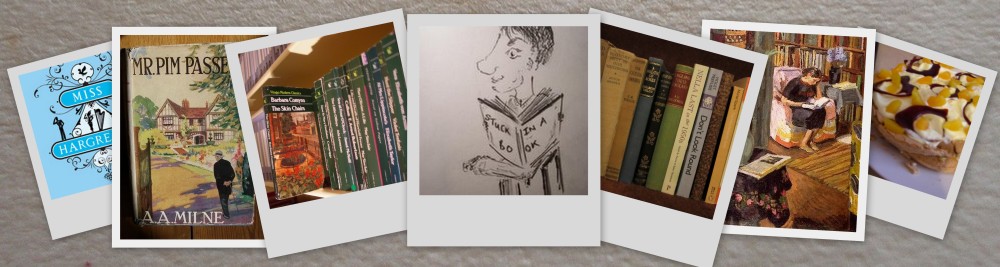
A.A. Milne’s first book

I seem to be having a little spate of reading author’s first books (look out for Agatha Christie’s coming up soon!) and I decided a good way to tackle one of the remaining years of A Century of Books would be a re-read of A.A. Milne’s first – Lovers in London (1905).  I wrote a little about it back here, in January 2010, but that was mostly about the topic of print-on-demand books.  Lovers in London is one of the very few POD books I own, and it isn’t very attractive – but it’s impossible to find a non-POD edition anywhere, mostly because Milne disowned the book and bought back the copyright to prevent anyone reprinting it. 

That will probably make you assume that it is appalling, and it isn’t at all.  It might only be for Milne completists, but it is nonetheless interesting to see where and how he started.  As you might expect, it is about young lovers – only at the beginning they haven’t met.  Edward (or Teddy) is the narrator in the mould Milne wrote so well at the beginning of his career – the jovial, cricket-loving, occasionally-writing-for-Punch sort of upper-middle-class man; Amelia is his godfather’s daughter, travelling to England from her native America.  We’re early let into the obvious secret – that by chp.24 (and there are only 125 pages; these are not long chapters) Amelia and Edward will be betrothed.

It’s all very cheery and insouciant and very AAM in his sketch-writing days.  If you’ve had the pleasure and privilege of reading The Day’s Play, The Sunny Side, The Holiday Round or things like that (and if you haven’t, you should) then you’ll recognise the sort of fun they have:

As we went under the bridge to get to the elephant-house Amelia insisted on buying buns for the rhinoceros.
 
“But they don’t eat buns,” I objected.
 
“He will if I offer it to him,” said Amelia confidently.
 
“My dear Amelia,” I said, “it is a matter of common knowledge that the rhinoceros, belonging as it does to the odd-toed set of ungulates, has a gnarled skin, thickened so as to form massive plates, which are united by thinner portions forming flexible joints.  Further, the animal in question, though fierce and savage when roused, is a vegetable feeder.  In fact, he may be said to be herbivorous.”
 
“I don’t care,” said Amelia defiantly; “all animals in the Zoo eat buns.”
 
“I can tell you three that don’t.”
 
“I bet a shilling you can’t – not straight off.”

 I instanced the electric eel, the ceciopian silk moth, and the coconut crab.  So Amelia paid for our teas.  But in the elephant-house the rhinoceros took his bun with verve – not to say aplomb.
The most successful sections are such as these – when Amelia and Teddy wander around and indulge in frivolous conversation.  It’s witty – not the structured, repeatable sort of wit we meet in Wilde, but the variety that puts a happy smile on one’s face.

Some chapters were less well done, to my mind, and these tended to be where Milne’s imagination got the better of him – particularly one where action wandered (in Teddy’s mind) to a desert island.  A little too fanciful, and a little too silly.  But for the most part, it is all very entertaining and jolly.  What Teddy writes about himself could equally be said of Milne:

I am a harmless, mild-mannered person.  There is nothing “strong” about my work; nothing that calls for any violent display of emotion on the part of my puppets.  I doubt if there could be an illegitimate canary (even) in my stories…
I can’t see quite why Milne took so against Lovers in London.  If it is not up to the standard of his next few books, it isn’t so far behind them as to make it embarrassing.  If it were available in bookshops across the land, I wouldn’t hesitate in telling you to get a copy to enjoy on a rainy Sunday afternoon – as it is, in pricey POD editions, you’d be much better off hunting for the much cheaper, much more attractive editions of slightly later books by AAM.

Reading Presently

An update on my reading project for next year – the one where I read 25 (or maybe 50, depending on how it goes) books that I’ve received as gifts – I was throwing around some names on Twitter and decided upon Reading Presently.

I was wondering if there were any people who enjoyed making badges for projects?  If so, and you fancy making one for me and anyone else who wants to do this, let me know in the comments!  In fact, let’s make it a competition!  (If more than one person wants to, that is…)

Comment, and then email me your Reading Presently badge – it just has to feature those words, the rest is up to you – and in a week or two I’ll declare a winner – with some sort of bookish prize!  (Clue: it’ll probably be a book.)

My Life in Books (all of ’em)

As promised, here is the updated hub of My Life in Books, with links to all three series (as well as links to the bloggers in question.)  Enjoy!

Series One

Karen and Susan’s Life in Books
Lyn and Our Vicar’s Wife/Anne’s Life in Books
Lisa and Victoria’s Life in Books
Darlene and Our Vicar/Peter’s Life in Books
Annabel  and Thomas’s Life in Books
David and Elaine’s Life in Books
Harriet and Nancy’s  Life in Books

Series Two

Rachel and Teresa’s Life in Books
Claire and Colin’s Life in Books
Hayley and Karyn’s Life in Books
Jenny and Kim’s Life in Books 
Danielle and Sakura’s Life in Books
Claire B and Nymeth/Ana’s Life in Books
Gav and Polly’s Life in Books
Eva and Simon S’s Life in Books

Series Three

Jackie and John’s Life in Books
Iris and Verity’s Life in Books
Tanya and Margaret’s Life in Books
Stu and Florence’s Life in Books
Lisa and Jane’s Life in Books
Laura and Jodie’s Life in Books
Frances and David’s Life in Books

In a German Pension – Katherine Mansfield

One of the first times that I thought (forgive me) that I might actually have some sort of literary astuteness was in relation to Katherine Mansfield.  Our Vicar’s Wife and I were off to a lecture day at Oxford on Modernism – this was two or three years before I started studying university – and I’d been reading a Collected Short Stories of Katherine Mansfield that my friend Barbara had given me.  I’d never heard of Katherine Mansfield before, and I immersed myself in the book.  Most I loved, some I didn’t so much, but there was one I definitely liked best – and I read it out loud to Mum as we drove from Worcestershire to Oxford.  It was ‘The Garden Party’.  Little did I know that it was her most famous and acclaimed short story; I didn’t even know it was the title story for one of her collections.  When I found out, I thought – huh, maybe I can tell when something is good and when it isn’t.

Excuse that slightly trumpet-blowing story (it doesn’t feel trumpet-blowing, since it’s about me-a-decade-ago, a very different person to me-now) because it does have some relevance to my post.  When reading that Collected Short Stories, the stories which didn’t particularly grab me were those from In A German Pension (1911) – Mansfield’s first book.  A few years ago I bought a beautiful Hesperus edition (tautology, of course – all of their books are beautiful) and I decided that it was about time that I gave In A German Pension another go.  I was actually a little pleased to see that my opinion hasn’t really changed.  It doesn’t prove that I was right a decade ago, but at least it means I’ve stayed fairly consistent in my tastes.

In A German Pension is chiefly interesting as a suggestion of what Mansfield would become – the markings of her extraordinary talent are there, but she is not yet a writer confident of her own particular abilities.

The stories were inspired by Mansfield’s time spent in Europe, and are mostly from the perspective of a wry English woman, crowded with absurd characters and baffled by their foibles and anxieties.  Foolish people lecture one another, a dressmaker is mistaken for a baroness, young women flirt and retreat.  It all feels very Edwardian.  What strikes oddest is the way in which Mansfield tries to be funny.

At that moment the postman, looking like a German army officer, came in with the mail.  He threw my letters into my milk pudding, and then turned to a waitress and whispered.  She retired hastily.  The manager of the pension came in with a little tray.  A picture postcard was deposited on it, and reverently bowing his head, the manager of the pension carried it to the Baron.

Myself, I felt disappointed that there was not a salute of twenty-five guns.
This is all well and good – but it is not where Mansfield excels.  The dry, sardonic quip, the understatement, is a far cry from the subtle, clever examination of sorrow or guilt or self-awareness that Mansfield paints in delicate shades in her finest work.  Instead there are caricature women criticising one another – the sort of ribaldry and comedy-writ-large which one would expect from Jerome K. Jerome, perhaps:

“Of course it is difficult for you English to understand when you are always exposing your legs on cricket fields, and breeding dogs in your back gardens.  The pity of it!  Youth should be like a wild rose.  For myself I do not understand how your women ever get married at all.”
As a brand of humour, it can be very successful – but it feels awkward from a pen that is already learning some sensitivities.  It’s certainly not bad at all – it is even good.  It’s just the wrong fit for Mansfield.

Only one story of the thirteen approaches her later triumphs, to my mind: ‘The Swing of the Pendulum’.  It’s about a woman who is about to be thrown out of her flat, since she can’t afford the rent.  A young man knocks at the door, looking for someone she’s never heard of – he seems to leave but, bored, she hopes he is waiting outside the door – and, a little later, he unsuccessfully tries to rape her.  More dramatic than some of her best stories, which focus on the minutiae of experience, but it does demonstrate the subtlety and perception that would later become the cornerstones of Mansfield’s writing.

She heard him walk down the passage and then pause – lighting a cigarette.  Yes – a faint scent of delicious cigarette smoke penetrated her room.  She sniffed at it, smiling again.  Well, that had been a fascinating interlude!  He looked so amazingly happy: his heavy clothes and big buttoned gloves; his beautifully brushed hair… and that smile… ‘Jolly’ was the word – just a well-fed boy with the world for his playground.  People like that did one good – one felt ‘made over’ at the sight of them. Sane they were – so sane and solid.  You could depend on them never having one mad impulse from the day they were born until the day they died.  And Life was in league with them – jumped them on her knee – quite rightly, too.  At that moment she noticed Casimir’s letter, crumpled up on the floor – the smile faded.  Staring at the letter she began braiding her hair – a dull feeling of rage crept through her – she seemed to be braiding it into her brain, and binding it, tightly, above her head…
Of all the writers taken too early, I think Katherine Mansfield’s death at 34 is the most tragic, and the most frustrating.  Her talents were not in decline – indeed, in the two years before she died of tuberculosis she wrote not only her best stories, but the best short stories I have ever read.  Who knows what she could have written had she lived another 30, 40, 50 years?  Still – in those 34 years she achieved quite astonishing brilliance and beauty with her writing.  If In A German Pension isn’t quite up to the level of her best work, then at least it serves to show us, a little, how she got there.

Five From the Archive (no.11)

It’s been a few weeks since I last did a Five From the Archive, and perhaps My Life in Books has brought a few new readers (hello!), so I’ll quickly explain what it is.  Once I’d been blogging for five years, I had a glance back at the hundreds of books I’d written about, and thought that it was a shame that wonderful titles would be lost in the annals of my archive.  So every week now and then, I’ll pick a theme and choose five great books from my review archive to fit it – it’s fun finding unexpected connections between much-loved books.  An index of all previous Five From the Archive posts can be found here.  This week, inspired by the wonderful school scene in Blue Remembered Hills, I have picked an apposite theme:

Five… Books About School

1.) St. Clare’s series (1941-5) by Enid Blyton

In short: I could fill this list with children’s school stories, but I’ll stick with this series which I loved as a child – mischievous (but, of course, good-hearted) twins Pat and Isabel get up to schoolgirl antics.

From my review: “Blyton appears to have had a pathological hatred of ‘tell-tales’ (which always seems to me to be invented as an excuse for teachers to ignore the majority of children’s squabbles) and a fervour for sport, and Janet (in the ‘good egg’ category) is so bluntly rude that I wanted to push her down a well – despite all these things, I’ve been joyously reliving my youth through these books.”

2.) More Women Than Men (1933) by Ivy Compton-Burnett

In short: My favourite ICB novel so far, the politics and in-fighting of a girls’ school provide a perfect setting for Compton-Burnett’s characteristic wit and discord.  There is only one line of dialogue from a pupil…

From my review: “Would people talk like this?  No, definitely not.  Would people act like this?  Probably no.   But would people feel like these characters feel?  Yes – absolutely – and it is Ivy Compton-Burnett’s genius that she can interweave the genuine and the bizarre.”

3.) Curriculum Vitae (1992) by Muriel Spark

In short: I would pick The Prime of Miss Jean Brodie if I’d ever reviewed it here – so this is the next best thing.  Spark’s brilliant autobiography includes wonderful sections on Miss Christina Kay, Spark’s teacher and the inspiration for Miss Jean Brodie.

From my review: “There are definitely signs of Spark-the-novelist in the structuring of
the autobiography.  Her usual trick of playing around with time makes an
appearance, but it’s the enticingly disjointed beginning which made me
realise Spark-the-autobiographer was no real distance from
Spark-the-novelist.”

4.) Dusty Answer (1927) by Rosamond Lehmann

In short: We follow only-child Judith Earle through childhood and emotional student days (I’m stretching a point), as she is forever tethered to the family that lived next door.

From my review: “It takes a talented writer to write about childhood without the novel feeling like a children’s book, and Lehmann achieves this wonderfully.”

5.) The Well-Tempered Clavier (2008) by William Coles

In short: A cross between Othello and Notes on a Scandal, an affair between pupil and piano teacher at Eton becomes a study in jealousy.

From my review: “The Well-Tempered Clavier is a beautiful book, managing to use a simple narrative voice without a consequently bland style – honesty, beauty, and passion pervade the novel, but so do humour, youthfulness and energy.”

As always – your suggestions, please!

Blue Remembered Hills – Rosemary Sutcliff

There must have been a time – a dark, bleak time – before I was introduced to the Slightly Foxed Editions.  I love the Slightly Foxed journal when I get my hands on a copy, but that doesn’t compare to the bottomless affection I have for all the memoirs I’ve read in their Slightly Foxed Editions series.  Which is, I realise, only five or six – I still have a long way to go.  But the one I finished recently is battling it out with Dodie Smith’s Look Back With Love not only for my favourite SF, but for my second favourite book read this year (Guard Your Daughters has secured first place.)

I need to start condensing my preambles, don’t I?  The book is Blue Remembered Hills (1983) by Rosemary Sutcliff, and it is heartwarmingly wonderful.  The original run of 2000 hardback copies has sold out and, due to its popularity, Slightly Foxed have produced this paperback edition.  Unlike most of the people I’ve spoken to about this book, I’ve never read anything by Rosemary Sutcliff.  My allergy to historical fiction has been lifelong, and her Eagle of the Ninth series has never got nearer than the peripheries of my awareness.  That doesn’t matter in the slightest, in terms of enjoying this book, believe me.

Born in 1920, Sutcliff was quite isolated in her childhood – she was an only child, and (after suffering Still’s Disease when very young) had varying levels of disability, and spent a great deal of time in and out of hospitals and nursing homes.  Yet this couldn’t be further from a misery memoir.  Everything is coated with a fascination for life, and a joy for the possibilities of observing and experiencing.

Like Smith’s childhood memoir, Sutcliff has great fun describing all her relatives – how blessed these memoirists seem to have been with comic uncles and aunts! – and especially her parents.  Her mother seems to have had undiagnosed bipolar disorder – Sutcliff describes times when her mood would change for days without warning – and this understandably made her unpredictable to live with.  This was coupled with a difficult personality, and Sutcliff (though generous to her) clearly didn’t have an entirely easy mother/daughter relationship.  Her father (a sailor) spent long periods away from home – all in all, not a simple childhood for young Rosemary.

But, as I say, she finds the beauty and joy in this all – not by ignoring her difficulties, but by maintaining an optimistic attitude.  Indeed, it wasn’t until I sat back and put together the information Sutcliff gives about her parents that I realised the difficulties she faced.  In Blue Remembered Hills this sort of excerpt represents the tone with which Sutcliff recalls them:

He was a lieutenant when he and my mother were married.  The had first met when they were both fourteen, at a mixed hockey match, and he always claimed that the first word he ever heard her say was ‘Damn’, which I suppose, to judge from her vehemence in protesting that it was the first time she had ever said it, was quite a word in those days.  My father’s invariable retort – oh, the lovely ritual changlessness of family hokes and traditions! – was that for a first time, she said it with remarkable fluency.
I think my favourite thing about childhood memoirs is the revelation of family jokes.  It makes the reader feel, at least for a page or two, that they’ve been inducted into the family.  We all have these, don’t we?  And they’re usually senseless and silly, and oh so precious!

Among Sutcliff’s many memories, the ones which most warmed my heart were about Miss Beck’s school.  Education reform has doubtless done much for children’s welfare, but as a side-effect it was removed the possibility of anything as joyful as this:

In a small back room with peeling wallpaper, under the eye of a gaunt elderly maid, I was stripped of my coat, leggings and tam-o’-shanter, in company with twelve or fourteen others of my kind.  And with them, all on my own, so grown up, I filed through into the schoolroom, to be receive, as Royalty receives, by Miss Beck herself, who sat, upright as Royalty sits, in a heavily carved Victorian armchair.

My schooldays proper had begun.

Looking back with warm affection at that first school of mine, I can hardly believe that it was real, and not something dreamed up out of the pages of Cranford or Quality Street.  I suppose nowadays it would not be allowed to exist at all.  Miss Amelia Beck had no teaching qualifications whatsoever, save the qualifications of long experience and love.  She was the daughter of a colonel of Marines, in her eighty-sixth year when I became one of her pupils; and for more than sixty years, in her narrow house overlooking the Lines at Chatham, she had taught the children of the dockyard and the barracks.  She accepted only the children of service families.  Oh, the gentle snobbery of a bygone age; bygone even then, and having less to do with class than totem.  It was her frequent boast that she had smacked, in their early days, most of the senior officers of both services.  Both, not all three, for the RAF was too young as yet to count for much in Miss Beck’s scheme of things.  But I do not think that it can have been true, unless she had gentled greatly with the passing of her years.  For I never knew her to smack anybody during the year that I sat at her feet.
Isn’t that blissful?  There is quite a bit about this school and Miss Beck, who stayed in touch with every pupil she taught (or so Sutcliff claims!) – it is all fairly ordinary, but made extraordinary through Sutcliff’s lovely writing and engaging personality.

In fact, it is the ordinariness of Sutcliff’s life that makes Blue Remembered Hills so difficult to write about.  It is oddly similar to The Outward Room, reviewed yesterday, in being significant not for its incidents, but for the beautiful way in which they are related.  After relaying the activities, thoughts, people and pets of her childhood, Sutcliff relays her early career as a miniaturist (not, she notes sadly, a form likely to win any major notice in the art world) and her first infatuation.  Those are the two important strands in the second half of the book, I suppose, and it continues up to her first literary commissions.  But the events are so much less vital than the tone.

So, yes, it’s another book you have to read to appreciate… but, oh, what a warm, engaging, beautiful book it is.  One of the very few where I cannot bear the lessening pages as I read on – and which I am certain I shall return to time and again.  Slightly Foxed – I don’t know how you do it.  You are my new addiction.  Long may you continue to find memoirs as spectacularly lovely as this!

Others who got Stuck into this:

“Perfect. My only complaint is that it is too short.” – Leaves and Pages

“The tone of the book is one of gratitude for life’s blessings & joy at the natural world, her friends, her dogs & her love for her parents.” – Lyn, I Prefer Reading

The Outward Room – Millen Brand

photo source

A long, long time ago (I can still remember) I was sent Millen Brand’s The Outward Room (1937) to review – in fact, I had asked for it – and it has taken me absurdly long to read it, and a couple months longer to get around to reviewing it.  But it is really very good indeed, and worth the wait.

The reason I asked for this NYRB edition was (apart from the fact that all NYRB editions are beautiful and belong on my bookshelf) that I remembered The Outward Room being mentioned once in a Persephone Quarterly – and it fixed in my mind.

The Outward Room starts with Harriet Demuth’s life in some sort of mental hospital, having suffered a nervous breakdown as a result of a family tragedy.  Estranged from her parents and frustrated by her doctor’s blinkered obsession with Freudian analysis, Harriet’s life has been sucked dry of anything but routine and confusion.  Her ability to articulate her personality and self have been stifled by illness and by the unsympathetic institution which came as a consequence to it.  Brand writes this section very well, but it is necessarily claustrophobic and begins to stifle the reader.

But Harriet escapes.

She makes her way to New York, pawns her brother’s ring, and lives hand-to-mouth for some time.  The Great Depression has given the city a desperate air, and she struggles to find the means of supporting herself – her first ‘job interview’ is for a single day’s work, and consists of standing in a long row with many other women, and not being pointed at.  There are some poignant scenes where Harriet first rents, and then must leave, a tiny apartment.

After about 100 pages, Harriet is sitting in a late-night cafe, unable to afford a cup of coffee, when a stranger approaches and offers to buy her the drink.  John (for this is his name) invites her back to his house for food and shelter and – desperate, and a little naive perhaps – she goes.  At this point I expected awful things to happen to her, or for John’s apparent kindness to (at least) be revealed as covering ulterior motives.  What I wasn’t prepared for was a gentle, gradual, and quite beautiful love story.  Through simple, ordinary scenes of everyday life and undramatic conversations, Harriet and John fall in love and become necessary to one another.  We see some of Harriet at work, and the friend she makes Anna; we see a neighbour or two – but the beauty of The Outward Room is the quiet unfolding of a believable, unassuming relationship.

I don’t normally just give all the plot in a series of paragraphs like that – I usually try to break it up with some of my thoughts about the author’s approach, etc. – but it seemed important to lay out the  structure of The Outward Room and the direction the novel takes before addressing the issue of style.  They are so interrelated.  At the beginning, Brand opts for quite a lot of the disjointed and fragmentary prose that is often used to represent mental disharmony or any kind of mental illness.  Personally, I find it very easy to overuse this style.  Stream of consciousness has of course often been used to portray thoughts, especially of a disturbed mind – but I think it has to be done exceptionally well (we’re talking Woolf-standards well) to work, otherwise it can simply seem sloppy.  These were the sections of The Outward Room which I found least convincing.

However, when Brand didn’t concentrate this effect into single chapters, he used a more successful variant on it – by simply omitting verbs and pronouns.  It’s a bold way to start a paragraph, giving a sense of both immediacy and uncertainty, and it think it works well within a sparser descriptive mode:

Dark, the smell of stairs.  She began to notice the stairs as she had not the day before.  She leaned and looked down the dark stairwell.  These stairs were not solid; their treads sagged, the staircase was pegged to the walls with iron rods at each landing.  The house was old.  She went down and when she came into the light of the lower open house door, she looked around her.  She saw only a bare hallway; on one side was a large metal barrel with a warped cover, on the other a table on which were several letters – evidently this was where mail was left for those in the house.  Except for this, the hall was vacant; scribbled on the plaster were a few names – “DIDOMENICO 2nd” “LICORA” —
Brand moves between this fairly straightforward narrative and a fluid, more consciously beautiful prose.  And that is the result (and the cause) of the relationship between John and Harriet.  Which comes first?  I don’t know – the gentle unfolding of their love is both mirrored and created by the gentle unfolding of touching imagery and emotional explorations.  This paragraph was picked more or less at random, but hopefully it gives you a sense of what I mean:

Breathing the air deeply, she looked down at the courtyard.  Hardly changed, a little dirtier from melted snow, the tinge of winter.  Frost had made new cracks in the cement, in the so-called paving.  Yet the evidences of winter were small only to be seen, like the signs of spring, by the heart that feels small changes.  The room too had its changes from winter, but because of her need of its permanence they too were small, only what had been absolutely necessary.

It is incredibly difficult to write about this sort of novel, because it is of the variety which can only be appreciated once one is reading them.  Perhaps that is true of any book, but it seems especially so of The Outward Room.  And that being said, it is especially impressive that Peter Cameron writes such a good afterword in the NYRB edition.  Good afterwords and introductions are hard to find, aren’t they?  One thing Cameron writes will strike home with many of us:

It’s somewhat frightening to learn that good books – even books heralded in their time – can disappear so quickly and completely.  We like to think that things of enduring quality and worth are separated from the dross and permanently enshrined, but we know that this is not true.  Beautiful things are more likely to disappear than to endure.  The Outward Room is such a beautiful thing.  
None of us are surprised when we find that wonderful, beautiful books have fallen by the wayside – we all know too many examples.  Despite having an initial print run of 140,000 copies (wow!), The Outward Room has fallen victim to this disappearing act – its peculiar qualities are those which can so easily be overlooked.  Thank you NYRB for bringing it back – the novel definitely deserves it, and I hope you give it a chance too.

Reading Plans?

Thank you so much for all your lovely birthday wishes!

I’m off to a conference tomorrow – gosh, my third this year! – and will be speaking on David Garnett’s Lady Into Fox.  I have barely thought about it, to be honest, which is good as it has meant that I’m not nervous yet.  Whether my paper is up to much is an entirely different matter… but I rather doubt anyone there will have read Lady Into Fox anyway!

So, I’ll be back late on Friday night, so I’ll leave you with a question.  It’s getting to that time of year when people start to mull over next year’s book projects.  I’ve really enjoyed doing A Century of Books this year – it has joined my love of reading to my love of lists – and it’s made me vary my reading a lot.  But while I think I’ll revisit it one day, I don’t want to do the same project two years on the trot.  (And who knows if I’ll even finish this one on target!)

Instead, I’ve picked a project that is shamefully unblogworthy.  A lot of lovely people have given me books over the years, and I am rather awful at getting around to reading them.  Bloggers and other bibliophiles tend to understand – but I still feel a bit guilty, as well as missing out on all the potential gems on my bookshelves.  So, I’ve decided that in 2013 I’m going to read at least 25 books that other people have given me.  I haven’t even checked that I have 25 such books – but I rather expect that it’s nearer double that.  Just looking at my shelves in Oxford, not counting review books or books I got for my birthday yesterday… oh, there are 34.  Well, that answers that question!  I think it’ll be a nicely varied pile – as well as enabling me finally to thank folk properly for my presents.

Howsabout you?  (If you wavered on A Century of Books this year, I can definitely recommend it as a really fun and fruitful project – which, of course, can be spread over two years or more, if need be.)  Any reading plans, or are you just going to go with the flow?  Or is it still too early to think about it?

See you at the weekend!  Wish me luck with my paper…

It’s My Birthday and I’ll Post Photos of the Lake District if I Want To.

Happy Birthday Me!  Today I turn 27 – the age at which Anne Elliot was washed up in Persuasion.  Don’t worry, I don’t actually have a neurosis about 27 – even though I spend a lot of my time amongst undergraduates, so I feel ancient – but when 30 rolls around, things might feel rather different.  My goal is to have finished accruing degrees by then… (!)

I thought I’d indulge on my birthday by sharing with you photographs from my recent trip to the Lake District.  I’ve been there many times throughout my life, often with family, and this time I visited my friend Phoebe (who works at Wordsworth’s house) and was joined by Colin.  Autumn in the Lake District is pretty stunning, I have to stay.  Well, enough with words – shall we let some pictures do the talking?

This is the view from my friend’s house – amazing, no?

Getting ready to go on a ferry… and it’s sunny! (but freezing)

The original purpose for visiting for a birthday visit to beautiful Blackwell –
an Arts & Crafts house; one of my favourite places in the world.
Sadly no photos allowed inside, but more on their website.
Not a bad view to have from the house, is it?

And here we are, outside it!

My friend and her boyfriend, on Wansfell.

I’ve never carved a pumpkin before – so I was pleased by my first effort
(inspired by the peacock frieze at Blackwell)

And we make a delicious cat carrot cake!

I co-ordinate with the autumn, by Lake Windermere

Sepia makes EVERYTHING like classy, doesn’t it?

The sun didn’t last long – Colin and I take a walk over to Ambleside,
and it was cloudy and rainy – but still beautiful.
I don’t think the Lake District could be unbeautiful if it tried.